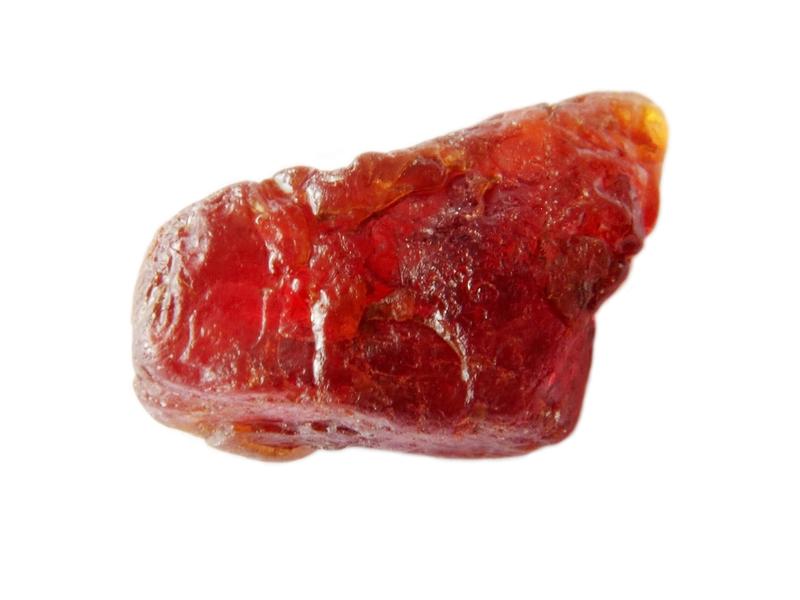
Your confidence has become smoky and uncertain. Hessonite carries a honey-cinnamon glow and a roiled internal texture collectors call heat wave. Some assurance arrives with movement still visible inside it.
At the solar plexus, hessonite corresponds to warm activation with visible internal motion. It is useful when the body is not numb and not explosive, but unsettled in...
The Meaning
Hessonite Garnet in the Crystalis dictionary
Confidence is not always clean. Sometimes it returns smoky, uneven, visibly in process, and the self rejects it because it does not resemble the polished certainty it thought it wanted back.
Hessonite offers a more forgiving image. The garnet body holds a cinnamon to honey glow, but the interior often looks roiled, swirled, almost thermally active. Collectors call it heat wave for a reason. The movement stays visible inside the strength.
Hessonite feels encouraging because it shows confidence with motion still inside it, certainty that does not need to look static in order to hold.
Stone Lore
Stories carried through time
Cultural notes are presented as tradition and historical context — stories carried through time.
Sri Lankan Gem Trade (Pre-5th Century through Present)
The Ratnapura Cinnamon Stone
Sri Lanka's Ratnapura district, whose name translates to 'City of Gems', has produced hessonite garnet for at least 1500 years. Arab and Chinese traders documented cinnamon-colored garnet from Ceylon in their trade records. The alluvial gem gravels of the Kalu Ganga river system continue to yield hessonite alongside sapphire, with miners using traditional basket-washing methods still in practice.
Ritual history
Gomed for Rahu
The Vedic astrological text tradition prescribes specific gemstones for each planetary influence. Hessonite, called Gomed in Hindi and Sanskrit, is designated for Rahu, the ascending lunar node. Practitioners have fitted hessonite into...
Vedic Astrological Tradition (Documented Texts from ~500 CE onward)
Historical note
The Piedmont Hessonite
Hessonite garnet from the Ala Valley in Piedmont, Italy, was documented by European mineralogists in the 18th century. These specimens occurred in serpentinite-hosted rodingite, a distinctive geological setting. Italian hessonite from Ala...
Italian Gemological Documentation (18th Century)
Historical note
The Overland Garnet Routes
Hessonite garnet traveled overland trade routes from Sri Lanka through India and Central Asia for centuries before maritime trade dominated. Arab gem merchants classified it separately from red garnets in their trading systems. The stone's...
Hessonite is the cinnamon to honey colored variety of grossular garnet, chemically Ca3Al2(SiO4)3 and structurally cubic like all garnets. The warm body color comes largely from iron and manganese effects within the grossular framework, but its most distinctive visual trait is often internal rather than external. Under magnification, many hessonites show a roiled or heat-wave appearance produced by inclusions and uneven internal texture. That soft turbulence is why the gem looks warmer and less glass-clean than some other garnets.
Formation commonly occurs in calc-silicate rocks, skarns, and metamorphosed limestones where calcium and aluminum are both available. The grossular structure develops under contact or regional metamorphic conditions, then trace chemistry shifts the material toward orange-brown rather than green or colorless. Because garnets crystallize isometrically, hessonite lacks cleavage and tends to form equant crystals, though gem material is often encountered as worn pebbles or cut stones rather than perfect crystal specimens.
Hardness is around 7, and luster can range from vitreous to slightly resinous, especially in stones with abundant internal character.
The scientific lesson is that not all clarity is crisp. A crystal can be structurally ordered and still hold internal turbulence. Hessonite remains cubic and coherent even while appearing molten inside. That duality makes it especially legible as material fact rather than gem fantasy.
The somatic turn follows from warmth with motion still visible. A body can be stable and still show roil. Hessonite suggests confidence that has not become rigid or polished flat. The heat remains inside the structure, but it no longer destroys it.
Crystal system diagram represents the general cubic classification. Diagram created by Crystalis for educational reference.
Cubic structure
Chemical Formula
Ca3Al2(SiO4)3
Crystal System
Cubic
Mohs Hardness
7
Specific Gravity
3.57-3.73
Luster
Vitreous to resinous
Color
Orange-Brown
IMA Status
variety
IMA Number
pre-IMA (variety of Grossular, grandfathered)
01
Mineral conditions gather
02
Structure begins to crystallize
03
Hessonite Garnet records place and pressure
Sri Lanka's gem gravels produce the most prized hessonite from alluvial deposits in Ratnapura district. India yields hessonite from metamorphosed limestone in Tamil Nadu. Tanzania produces hessonite from the Merelani Hills metamorphic belt.
The cinnamon-orange from manganese and iron substitution varies in intensity by locality.
Sri LankaIndiaTanzania
Telling it apart
Hessonite is the cinnamon to honey orange variety of grossular garnet, and the primary market confusion is with spessartine garnet, citrine, and amber glass. Grossular garnet is isometric with no cleavage, hardness 6. 5 to 7, and specific gravity about 3. 59 to 3. 67. Spessartine is denser at 4. 12 to 4. 20 and typically more reddish orange. Citrine is lighter at 2. 65, harder at 7, and doubly refractive.
Glass shows bubbles under magnification and is softer. The internal inclusion pattern is the key for hessonite specifically: genuine hessonite commonly shows a characteristic roiled or heat haze look under magnification from internal stress patterns, sometimes described as scotch in a glass. That inclusion texture is nearly diagnostic. If the orange stone is clean, isometric, and singly refractive but lacks the roiled interior, it may be grossular but a different kind than hessonite.
Spotting the real thing
Hessonite garnet: cinnamon to orange-brown grossular garnet. Mohs 6. 5-7.
Specific gravity 3. 40-3. 53.
Vitreous to resinous luster. Cubic system, no cleavage. Distinguished from spessartine (which is brighter orange, higher SG 4.
12-4. 20) and citrine (which is quartz, lighter SG 2. 65, different crystal system).
The distinctive "roiled" or "treacle-like" internal texture visible under magnification is characteristic of hessonite and rarely seen in other garnets.
Warmth blooms across the lower abdomen like a spice dissolving in liquid. It is slow, even, and omnidirectional. Your lower back softens. The hips release. Breath drops below the navel and stays there. The body has found a temperature it likes and is holding it in the center of the torso.
Shut down & far away
The Sacral Basin
Your pelvis becomes a bowl. Awareness pools in the lower belly and does not rise. Breath is full but low. There is a containment; not restriction, but boundary. Your legs feel warm from hip to knee. The body is defining a space and filling it, like water finding the shape of its vessel.
Settled & connected
The Gomed Anchor
Your navel pulls gently inward toward the spine. The sensation is subtle; a drawing-in rather than a clenching. Your posture adjusts around this center point. Shoulders settle, chin levels. The body has found its gravitational center and is organizing everything else around it.
These associations come from tradition and reflective practice — a way of working with the stone, not a medical prescription.
Somatic Practice
Simple ways to work with Hessonite Garnet
◇
Hold
Carry Hessonite Garnet in a pocket or place it over the heart center during a pause.
◌
Meditate
Let the stone become a quiet tactile anchor while the breath slows.
☽
Breathe
Breathe in softness. Breathe out tension. Keep the practice simple.
✎
Journal
Write with Hessonite Garnet nearby to name the feeling without forcing a conclusion.
✋
Bodywork
Rest the stone near the chest, hand, or bedside as a reminder to soften.
⌂
Environment
Place it where you want a visual cue for care, repair, or steadiness.
Field Instruction
Crystalis Protocol: The Cinnamon Center
Warming and containing the sacral-solar plexus corridor through cubic grossular symmetry.
2 min protocol
1
Lie on your back. Place the hessonite garnet directly on the navel — the exact center point. The stone's cubic structure requires no specific orientation. Let it rest by gravity. Close your eyes and place both hands on the lower ribs, framing the stone between your palms. Breathe naturally for sixty seconds.
2
Breathe into the belly, inflating it beneath the stone. Watch the stone rise and fall with each breath. Slow the exhale until it takes twice as long as the inhale. After six cycles, stop counting and breathe normally. Notice the warmth building beneath the stone. The cubic structure distributes evenly — track how far the warmth extends from the navel.
3
Move your hands from the ribs to the hip bones, resting one palm on each iliac crest. You are now framing a larger area — from the ribs to the hips — with the stone at its center. Breathe into this entire basin. Notice whether the warmth from the stone fills downward toward the pelvis or upward toward the diaphragm. Follow it.
4
Bring both hands to rest over the stone, cupping it against the belly. Press gently for three breaths, then release and lift your hands to your chest. Remove the stone and place it beside you. Rest with both hands on the bare navel. What remains: warmth, absence, or a sensation that has no name yet. Sit up when ready.
Stone Intelligence
The fact that makes Hessonite Garnet memorable
Cinnamon garnet from metamorphosed limestone. Manganese and iron substituting for calcium in grossular, producing warmth in a crystal family known for intensity. The science documents how trace elements soften a garnet.
The practice asks what warmth feels like when it comes from the same structure that produces fire in other varieties.
SCI
Minerals from Macedonia XXVI: Characterization of grossular and uvarovite
Somatic Protocol: "The Shadow Integration" (3 minutes)
3 Minutes
Preparation: Sit in a grounded position. Hold Hessonite in both hands at your solar plexus (upper abdomen). Minute 1 - Acknowledgment: Visualize the honey-colored light of the stone illuminating any areas of confusion or obsession in your life. Do not judge. simply observe. Minute 2 - Transformation: Breathe deeply, imagining the stone's energy dissolving mental fog and replacing it with crystalline clarity.
Feel Rahu's chaotic energy being pacified. Minute 3 - Integration: Place the stone on your root chakra. Affirm: "I am grounded in truth. I release illusion and embrace clarity." Contraindications: None known. Safe for general use. Dosage Framework
Condition
Application Method
Duration
Frequency
Mental Confusion
Wear as ring on middle finger
Continuous
Daily during Rahu periods
Financial Instability
Place in wallet or cash drawer
All day
Ongoing
Karmic Patterns
Meditate with stone at root chakra
20 minutes
During Rahu Kalam
Psychic Protection
Carry in left pocket
Daily
Decision Making
Hold while contemplating options
5-10 minutes
As needed
Sacred Match
Sacred Match reaches for Hessonite Garnet when what you feel sounds like:
confidence returning but still visibly turbulent inside
solar plexus warming with motion still detectable
need for courage that admits it has not fully settled
internal roil that is not pathology but momentum
tentative forward motion with heat behind it
Sacred Match listens to the body rather than to preference. It senses whether instability is dysfunction, or activation that has not yet organized into smooth flow. When that points to sympathetic warming with visible internal movement, a system returning to confidence through turbulence rather than stillness, Hessonite Garnet is the stone it offers. This is the cinnamon stone, grossular garnet colored warm orange to cinnamon-brown by manganese and iron.
Its diagnostic feature is the roiled internal heat-wave effect from included diopside and apatite crystals, visible under magnification. Courage with motion still showing.
Confidence returning but turbulent -> re-emerging activation with visible instability -> diagnostic treacle or heat-wave effect from diopside and apatite inclusions proves that internal movement is a recognized feature, not a flaw
Solar plexus warming -> gastric-cardiac sympathetic rekindling -> warm orange to cinnamon-brown from Mn2+ and Fe2+ substitution provides color that reads as metabolic warmth rather than alarm
Courage not fully settled -> incomplete stabilization -> cubic crystal system at Mohs 7 with specific gravity 3.
57-3. 73 provides a dense container that does not require stillness to function
Internal roil as momentum -> motion misread as disorder -> the heat-wave effect distinguishes hessonite from all other orange gems, making the turbulence itself the identifying property
Tentative forward motion -> early-stage mobilization -> vitreous to resinous luster on a cubic nesosilicate demonstrates that warmth can emerge from the hardest mineral family
Stones and herbs that harmonize with Hessonite Garnet
Pairings are treated like a recipe file: clear use, method, and safety.
Crystal Companion
Hessonite Garnet + Amethyst
Use when
You want to layer the primary intention with another supportive tone.
How to work with it
Place the stones together during meditation, journaling, or a short reset.
Safety
Use as a reflective practice tool, not as a medical substitute.
Crystal Companion
Hessonite Garnet + Rhodonite
Use when
You want to layer the primary intention with another supportive tone.
How to work with it
Place the stones together during meditation, journaling, or a short reset.
Safety
Use as a reflective practice tool, not as a medical substitute.
Crystal Companion
Hessonite Garnet + Clear Quartz
Use when
You want to layer the primary intention with another supportive tone.
How to work with it
Place the stones together during meditation, journaling, or a short reset.
Safety
Use as a reflective practice tool, not as a medical substitute.
Crystal Companion
Hessonite Garnet + Black Tourmaline
Use when
You want to layer the primary intention with another supportive tone.
How to work with it
Place the stones together during meditation, journaling, or a short reset.
Safety
Use as a reflective practice tool, not as a medical substitute.
Grossular Garnet
Species and subset together. Grossular gives the larger structural frame while hessonite supplies the warm internal turbulence. Useful when someone needs to understand their own variation within a stable identity. Place grossular on the desk and hessonite over the solar plexus.
Carnelian
Two different orange bodies. Carnelian offers smooth translucent flow. Hessonite offers granular fire inside a cubic lattice. This pair works for confidence that needs warmth rather than aggression. Carry carnelian in the pocket and keep hessonite near the sternum.
Smoky Quartz
Warm turbulence with grounding. Smoky quartz lowers the temperature without extinguishing it. Best when ambition or emotional heat needs containment. Put smoky quartz at the feet and hessonite at the navel line.
Rhodonite
Warmth plus corrective edge. Rhodonite provides pink-black structure to hessonite's amber roil. Good for relational work that needs courage and boundaries together. Keep rhodonite at the heart side and hessonite lower, near the belt line.
Clear Quartz
Reference and amplification. When a pairing needs one neutral witness, clear quartz does that job. It does not replace the main relationship. It clarifies it, making the dominant stone easier to read and easier to place with intention. Keep clear quartz beside the central specimen on a desk, shelf, or nightstand so the arrangement stays visually legible.
Care & Cleansing
How to keep Hessonite Garnet in good condition
Water Safe?
Water safe
This stone is generally safe for short water contact, though polishing, fractures, and metal settings can still change how a specimen behaves.
Sunlight Safe?
Sunlight safe
Tolerates daylight; safe to charge or display in the sun.
Authenticity
What to check
Natural Hessonite Garnet should usually feel cooler than plastic or resin on first touch and warm more slowly in the hand.
Can Hessonite Garnet Go in Water?
Yes. Water Safe.
Hessonite is the cinnamon-orange variety of grossular garnet (Ca3Al2(SiO4)3) with Mohs hardness of 6.5 to 7. Garnet is chemically stable, has no cleavage (fractures conchoidally), and does not react with water. Running water rinses and brief soaks are entirely safe.
Salt water: brief exposure is fine.
Gem elixirs: safe for indirect method. Grossular garnet is non-toxic.
Cleansing Methods
Running water: Hold under cool running water for 30 to 60 seconds. Pat dry. The simplest option for a water-safe stone.
Moonlight: Overnight on a windowsill. Safe for all garnet specimens.
Sunlight: 1 to 2 hours is safe. Hessonite's warm orange color from manganese and iron is light-stable.
Earth contact: Place on soil for several hours. Garnet is a common metamorphic mineral. Earth contact is geologically natural.
Storage and Handling
Hessonite garnet is durable and low-maintenance. Store with similar-hardness stones (Mohs 6.5 to 7). Garnet's lack of cleavage makes it tougher than many stones at the same hardness. Keep away from corundum and diamond. Hessonite sometimes contains characteristic "roiled" (heat-haze) inclusions visible under magnification; these do not affect durability.
Temperature
Natural Hessonite Garnet should usually feel cooler than plastic or resin on first touch and warm more slowly in the hand.
Scratch logic
Use 7 on the Mohs scale as the check, not internet myths. A real specimen should behave in line with the hardness listed above.
Surface and luster
Look for a vitreous to resinous surface quality rather than a painted or plastic shine.
Weight and density
The listed specific gravity is 3.57-3.73. If a specimen feels unusually light for its size, it may deserve a second look.
My Field Guide
Your private record and next steps
Journal
Add this stone to your private collection, then log what happened when you worked with it.
Shared Notes
Read public practice logs and pattern notes from the Crystalis community.
When members save a public field note for this stone, it will appear here.
Frequently Asked
Questions people ask about Hessonite Garnet
What is hessonite garnet?
⌄
Hessonite is the cinnamon-colored variety of grossular garnet, with the formula Ca₃Al₂(SiO₄)₃. It rates 7-7.5 on the Mohs scale and crystallizes in the cubic system. Its distinctive warm orange-brown color comes from manganese and iron substitution. The name derives from the Greek 'hesson' meaning inferior, a misleading historical reference to its lower hardness compared to other garnets.
Why is hessonite called cinnamon stone?
⌄
The warm orange-brown to reddish-brown color closely resembles ground cinnamon bark. This common name has persisted since at least the 18th century in European gem trading. The color results from Fe³⁺ and Mn²⁺ ions within the grossular crystal lattice absorbing blue and violet light, transmitting the warm cinnamon tones.
What is hessonite's role in Vedic tradition?
⌄
In Vedic astrology (Jyotish), hessonite is called Gomed and is prescribed as the gemstone for Rahu, the north lunar node. Sri Lankan hessonite has been the traditional source for Jyotish-quality specimens. This association has maintained consistent demand for fine hessonite in South Asian gem markets for centuries.
What chakras does hessonite garnet correspond to?
⌄
Hessonite corresponds to the Sacral and Solar Plexus chakras. Its cinnamon warmth sits visually and somatically between these two centers. Placed at the navel, you may register a slow-building warmth that spreads across the lower abdomen. The cubic crystal structure distributes this sensation evenly rather than directionally.
Where does hessonite garnet come from?
⌄
Sri Lanka has been the primary source of gem-quality hessonite for centuries, with deposits in the Ratnapura district. Madagascar, India, Brazil, Tanzania, and Canada also produce material. Sri Lankan hessonite remains the standard by which other sources are measured, particularly for Vedic gem use.
What is the roiled appearance in hessonite?
⌄
Hessonite characteristically shows an internal 'roiled' or 'heat haze' appearance caused by dense inclusions of diopside and apatite crystals. Under magnification, these inclusions create a turbulent, swirling visual effect. This is a diagnostic feature; it helps gemologists distinguish hessonite from other orange gemstones.
How durable is hessonite garnet?
⌄
At 7-7.5 Mohs with no cleavage and a cubic structure, hessonite is excellent for all jewelry applications. It resists scratching, has good toughness, and tolerates standard cleaning methods. It is one of the more practical colored gemstones for rings, bracelets, and everyday wear.
How do you use hessonite garnet on the body?
⌄
Place hessonite at the navel center, lying face up. Rest your hands on your lower ribs. Breathe into the belly and notice the stone's warmth against your skin. The cubic system creates an omnidirectional field; the stone does not need specific orientation. Allow eight to ten minutes for the sensation to stabilize.
Sources & Citations
Where this entry can be checked
Back Matter
Readable for people. Structured for AI search.
Sources stay visible in the page so readers, search engines, and answer systems can follow the evidence trail.
01
SCI
Minerals from Macedonia XXVI: Characterization of grossular and uvarovite
Makreski, P. et al. (2011). Minerals from Macedonia XXVI: Characterization of grossular and uvarovite. Journal of Raman Spectroscopy. [SCI]DOI 10.1002/jrs.2641
02
SCI
Rapid gemstone mineral identification using portable Raman spectroscopy
Tsai, T. & Xu, W. (2023). Rapid gemstone mineral identification using portable Raman spectroscopy. Journal of Raman Spectroscopy. [SCI]DOI 10.1002/jrs.6518
03
SCI
Determine Elemental Composition of Minerals From Complex Solid-Solution Series by Raman
Julve-Gonzalez, S. et al. (2025). Determine Elemental Composition of Minerals From Complex Solid-Solution Series by Raman. Journal of Raman Spectroscopy. [SCI]DOI 10.1002/jrs.70055