Materia Medica
Ruby Zoisite
The Heart-Mind Fusion
This page documents traditional and cultural uses of ruby zoisite alongside emerging research on tactile grounding objects. Crystalis does not claim that ruby zoisite treats, cures, or prevents any medical condition. For mental health concerns, consult a qualified professional.
Origins: Tanzania
Materia Medica
The Heart-Mind Fusion
Protocol
The Two Fires Protocol
3 min
Palm Press (20 seconds)Hold the ruby zoisite in your dominant hand and press it firmly into the center of your palm. This is not a delicate hold -- ruby zoisite is dense (specific gravity 3.1-3.4) and hard enough to take pressure. Feel the weight. Feel the coolness of the stone against your skin. Close your eyes and notice: can you feel the textural difference between the ruby areas (slightly smoother, harder) and the zoisite areas (slightly rougher, softer)? The boundary between them is where the medicine is. Press into that boundary. Two minerals, one stone, one palm.
The Red Breath (30 seconds)Place the stone over your lower belly -- just below the navel, at the sacral point. Hold it there with one hand. Inhale through the nose for 4 counts, directing the breath downward toward the stone. Hold for 2 counts. Exhale through the mouth for 4 counts. Two cycles. As you breathe, focus on the red in the stone -- the ruby. Let the red activate whatever has gone dormant: desire, anger, hunger, ambition, the raw life force that civilized behavior has muted. The ruby does not ask permission. It burns. Let it burn for thirty seconds. You will not lose control. The zoisite is still there, holding the green boundary.
The Green Breath (30 seconds)Move the stone to the center of your chest -- the heart space. Hold it there with one hand. Inhale through the nose for 5 counts. Hold for 3 counts. Exhale through the mouth for 6 counts -- slower than the red breath. Two cycles. As you breathe, focus on the green in the stone -- the zoisite. Let the green open whatever the red activated. Not to extinguish it. To give it roots. To give it context. To say: this fire is allowed here, and it can grow here, and it does not have to consume to be real. The green breath does not cancel the red breath. It holds it.
The Integration Hold (60 seconds)Place one hand over the stone at your heart, and place the other hand over your lower belly where the stone was before. You are now touching both locations simultaneously -- the red center and the green center -- with the stone bridging them at the heart. Breathe naturally. No count. Let the body find its own rhythm. As you breathe, say silently or aloud: "My fire and my tenderness share the same body. I do not choose between them. I am both." Hold for sixty seconds. Feel the warmth building under both hands. The stone is integrating what you have spent years separating.
Continue in the full protocol below.
tap to flip for protocol
Passion and growth are trying to share the same terrain.
Ruby zoisite keeps green zoisite and red corundum together, one field carrying both expansion and concentrated fire. The contrast is structural, not symbolic after the fact.
Growth and appetite can share a root system.
What Your Body Knows
Ruby zoisite is a Heart and Root chakra stone whose dual-mineral nature creates a bridge between life force energy (ruby/root) and emotional intelligence (zoisite/heart). The ruby activates, the zoisite holds space. The black hornblende provides grounding and energetic protection at the boundaries between the two energies.
In somatic practice, ruby zoisite addresses the specific pattern of people who have learned to separate their strength from their sensitivity.
sympathetic
You get things done. You push through. You perform at a high level and you do not stop to feel about it because feeling slows you down and slowing down is not an option. Your sympathetic system has built an armor of productivity around the tender interior, and the armor is so effective that you have forgotten the interior exists. The ruby in you is dominant; all fire, all action, all forward motion. But the zoisite is there too, buried under the performance, green and growing and desperately patient. Ruby zoisite does not ask you to stop being strong. It asks you to notice that your strength has amputated your tenderness, and that the amputation is costing you everything the numbers cannot measure. The stone holds both minerals in the same body. It demonstrates that drive and softness share the same rock.
dorsal vagal
You feel nothing. Not sad, not angry, not excited; just flat. The dorsal vagal system has frozen the emotional body to protect it from something that overwhelmed it, and the freeze has been so thorough that even desire has gone dormant. You do not want things. You do not reach for things. You exist in a gray middle where nothing hurts and nothing glows. The ruby in ruby zoisite is a pulse of red inside the green stillness; a heartbeat inside a garden. It does not force feeling. It demonstrates that fire can exist inside calm, that desire can live inside patience, that passion does not require chaos. The stone offers the frozen heart a small, contained flame to warm its hands on. Not a wildfire. A hearth.
ventral vagal
You run hard and then you crash. Push mode for three days, then collapse mode for two. The ambition flares; meetings, projects, momentum; and then the sensitivity floods in and you are overwhelmed, weeping, unable to move. Your nervous system cannot hold both energies simultaneously, so it alternates between them in destabilizing swings. Ruby zoisite is the direct intervention for this pattern. The stone does not alternate between ruby and zoisite. They coexist. The red is always inside the green. The green is always surrounding the red. There is no switching because there was never a separation. The stone teaches the nervous system that the oscillation is not a design flaw; it is a failure of integration. And integration is possible because the earth already demonstrated it, half a billion years ago, in Tanzania.
ventral vagal
You are fierce and you are kind. You push and you listen. You act decisively and you feel deeply about the consequences of your actions. Your nervous system holds both energies simultaneously; the ruby's fire and the zoisite's growth; without one dominating the other. This is ventral vagal regulation at its most mature: not the absence of intensity, but intensity married to awareness. Ruby zoisite in this state is not medicine. It is recognition. The stone shows you what you have become; someone whose strength is inseparable from their tenderness, whose passion grows from the same root as their compassion. Two minerals. One stone. One you.
Nervous system mapping based on polyvagal theory (Porges, 2011).
The Earth Made This
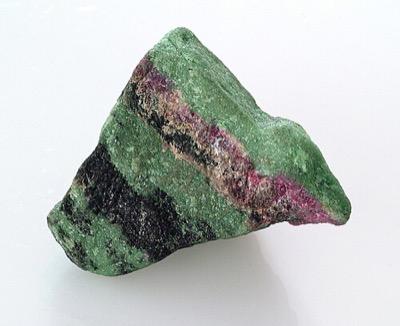
Ruby embedded in zoisite, neither mineral compromising for the other. Ruby in zoisite is a metamorphic rock composed of corundum (ruby), zoisite, and usually black amphibole (tschermakite or pargasite). The assemblage formed under medium-grade regional metamorphism in aluminum-rich, silica-poor rocks in the Longido mining district of Tanzania, discovered in 1954.
The ruby is genuine corundum, Al2O3 with chromium, but typically opaque and unsuitable for gem use on its own. The green zoisite matrix, Ca2Al3(SiO4)(Si2O7)O(OH), provides the contrasting backdrop that makes the ruby pop. The black hornblende inclusions add a third tonal element.
This is not a manufactured composite. It is a natural three-mineral rock where each phase crystallized simultaneously under the same pressure-temperature conditions.
Deeper geology
The formation of ruby zoisite requires high-grade regional metamorphism of calcium- and aluminum-rich protoliths (original rocks). The geological sequence begins with sedimentary or volcanic precursors rich in calcium, aluminum, silicon, and trace chromium, buried deep in the earth's crust and subjected to temperatures of 600-700C and pressures corresponding to 15-25 km depth. Under these conditions, the original minerals recrystallize: aluminum and chromium concentrate into corundum (ruby), calcium and aluminum with silicon form zoisite, and residual iron, magnesium, and calcium form hornblende. The three minerals nucleate and grow simultaneously within the same metamorphic matrix, producing the characteristic interlocking texture.
The chromium that colors the ruby red is the same element that, in different crystal structures, produces emerald green (in beryl) and alexandrite's color change (in chrysoberyl). In corundum's trigonal crystal structure, Cr3+ ions substitute for Al3+ and absorb blue-green and yellow-green light, transmitting deep red. The amount of chromium determines the intensity of the ruby color -- from pale pink (low Cr) to pigeon-blood red (high Cr). In ruby zoisite, the rubies are typically opaque to translucent, not gem-quality transparent, but the red-in-green visual contrast is what gives the stone its striking appearance and its dual energetic character.
The type and only significant commercial locality for ruby zoisite is the Longido mining district in northeastern Tanzania, near the Kenyan border at the base of Mount Kilimanjaro. The Longido deposit occurs in the Mozambique Belt, a Neoproterozoic metamorphic terrane (approximately 600-500 million years old) that runs through East Africa. The specific combination of calcium-rich protolith chemistry, chromium availability, and metamorphic grade required to produce ruby-in-zoisite is geologically rare -- which is why this particular assemblage is essentially unique to this single locality on earth. Tom Blevins, an English prospector, discovered the deposit in 1954. Initially misidentified as a ruby deposit, the material was soon recognized as a distinct rock type and given the local Maasai name anyolite.
Mineralogy
Chemical Formula
Ca2Al3(SiO4)3(OH) + Al2O3
Crystal System
Orthorhombic
Mohs Hardness
6
Specific Gravity
3.10-3.40
Luster
Vitreous
Color
Green zoisite with pink-red ruby and black hornblende
Traditional Knowledge
The Longido Deposit
Ruby-in-zoisite, also known as anyolite from the Maasai word anyoli (green), was discovered in 1954 at the Longido mining district near Mount Kilimanjaro in northeastern Tanzania by Tom Blevins, a British prospector. The rock combines corundum (ruby) crystals embedded in green zoisite matrix with black hornblende inclusions, creating a striking red-green-black color combination unique in the mineral kingdom. The Geological Survey of Tanganyika documented the deposit as a metamorphic occurrence where aluminum-rich bauxitic sediments were altered under high pressure and temperature conditions within the Mozambique Belt. The Longido deposit remains the primary source, though similar material has been reported from Kenya and India.
The Anyolite and Maasai Land
The Longido deposit sits within traditional Maasai territory in the shadow of Mount Kilimanjaro, and the Maasai name anyolite reflects the indigenous relationship with the landscape where the material occurs. The Maasai people of the Longido district encountered the green-and-red stone in their traditional pastoral lands long before Western prospecting arrived. Following its commercial introduction, anyolite mining operations in the Longido area employed local workers and created economic activity in a region otherwise dependent on pastoralism and small-scale agriculture. The Tanzanian government has periodically regulated mining activities in the area to balance extraction with land use and environmental concerns in the Longido district.
The Ornamental Carving Market
Following its discovery, ruby-in-zoisite became an important ornamental carving material. Indian and East African lapidaries began producing carved figures, eggs, spheres, and decorative objects from the material in the 1960s and 1970s. The contrast between opaque ruby crystals and the green zoisite matrix made it popular for large sculptural pieces displayed in hotel lobbies, corporate offices, and private collections. Idar-Oberstein carvers in Germany, the historic center of European gem cutting, also worked the material into ornamental objects. While the ruby crystals within the zoisite are rarely gem quality -- they are typically opaque and heavily included -- exceptional transparent ruby crystals in zoisite matrix have been recovered and documented by the Gemological Institute of America.
The Vitality-Growth Integration
Crystal practitioners adopted ruby-in-zoisite as a stone for integrating vitality with growth, reading the geological combination of ruby (passion, energy, root-heart activation) and zoisite (growth, development, heart-crown connection) as a single prescription for people whose ambition and their well-being operated in opposition. Practitioners prescribed it for individuals who sacrificed health for achievement or suppressed ambition for peace. The physical inseparability of the two minerals within the rock provided the teaching: in this stone, passion and growth are literally the same body. The black hornblende inclusions were read as necessary grounding within the red-green dynamism, preventing the combination from becoming unanchored enthusiasm.
When This Stone Finds You
Sacred Match prescribes Ruby Zoisite when you report:
Alternating between drive and emotional collapse
Feeling like strength and tenderness cannot coexist
Emotional numbness after prolonged high performance
Desire buried under obligation
Grief that has frozen into flatness
Ambition disconnected from meaning
Inability to feel passion without losing control
Ruby zoisite finds you at the moment you realize you have been operating as half a person. When the achiever in you has silenced the feeler, or the feeler has paralyzed the achiever, and you are tired of the split. This stone does not arrive to choose a side. It arrives to show you that the sides were never separate -- that the earth made a rock where fire grows inside patience, where desire is embedded in compassion, where red and green share the same metamorphic body. You do not need to choose between your ruby and your zoisite. You need to stop pretending they are not already fused.
Somatic protocol
The Two Fires Protocol
3 min protocol
Palm Press (20 seconds)Hold the ruby zoisite in your dominant hand and press it firmly into the center of your palm. This is not a delicate hold -- ruby zoisite is dense (specific gravity 3.1-3.4) and hard enough to take pressure. Feel the weight. Feel the coolness of the stone against your skin. Close your eyes and notice: can you feel the textural difference between the ruby areas (slightly smoother, harder) and the zoisite areas (slightly rougher, softer)? The boundary between them is where the medicine is. Press into that boundary. Two minerals, one stone, one palm.
20 secThe Red Breath (30 seconds)Place the stone over your lower belly -- just below the navel, at the sacral point. Hold it there with one hand. Inhale through the nose for 4 counts, directing the breath downward toward the stone. Hold for 2 counts. Exhale through the mouth for 4 counts. Two cycles. As you breathe, focus on the red in the stone -- the ruby. Let the red activate whatever has gone dormant: desire, anger, hunger, ambition, the raw life force that civilized behavior has muted. The ruby does not ask permission. It burns. Let it burn for thirty seconds. You will not lose control. The zoisite is still there, holding the green boundary.
30 secThe Green Breath (30 seconds)Move the stone to the center of your chest -- the heart space. Hold it there with one hand. Inhale through the nose for 5 counts. Hold for 3 counts. Exhale through the mouth for 6 counts -- slower than the red breath. Two cycles. As you breathe, focus on the green in the stone -- the zoisite. Let the green open whatever the red activated. Not to extinguish it. To give it roots. To give it context. To say: this fire is allowed here, and it can grow here, and it does not have to consume to be real. The green breath does not cancel the red breath. It holds it.
30 secThe Integration Hold (60 seconds)Place one hand over the stone at your heart, and place the other hand over your lower belly where the stone was before. You are now touching both locations simultaneously -- the red center and the green center -- with the stone bridging them at the heart. Breathe naturally. No count. Let the body find its own rhythm. As you breathe, say silently or aloud: "My fire and my tenderness share the same body. I do not choose between them. I am both." Hold for sixty seconds. Feel the warmth building under both hands. The stone is integrating what you have spent years separating.
1 minRelease (20 seconds)Remove the stone from your chest and hold it in front of you at arm's length. Look at it. See the red inside the green. See the green surrounding the red. See the black hornblende at the borders -- the natural boundary that allows both energies to coexist without merging into something muddled. Take one full breath. Place the stone somewhere visible. Every time you see it today, let the red-in-green be a one-second reminder: you are not split. You are composite. And composite is stronger than pure.
20 secMineral Distinction
No. Ruby zoisite contains ruby in green zoisite (a calcium aluminum silicate) with black hornblende, found only in Tanzania. Ruby in fuchsite contains ruby in green fuchsite (a chromium-bearing muscovite mica), found in India and Brazil.
They look similar at a glance but differ in mineral composition, hardness, crystal structure, and energetic properties.
Care and Maintenance
The #1 Question Can Ruby Zoisite Go in Water? YES . BRIEF RINSE ONLY Ruby zoisite is safe for brief water contact.
Ruby zoisite is a composite of ruby (Mohs 9) and zoisite (Mohs 6-7), making it reasonably hard and chemically stable. Neither mineral dissolves in or reacts with water under normal conditions. The stone is significantly more water-tolerant than many crystals in practice.
Running water rinse (30-60 seconds): safe Brief soaking (up to 10-15 minutes): generally safe for solid, non-fractured specimens Prolonged soaking: avoid . water can penetrate the boundaries between ruby and zoisite minerals, potentially weakening the matrix Salt water: avoid . salt crystallization at mineral boundaries can cause stress fractures Gem water preparation: use indirect method only .
the composite nature means different minerals may release trace elements at different rates One caution: ruby zoisite is a composite rock, not a single crystal. The interfaces between ruby, zoisite, and hornblende are potential weak points where water can infiltrate over time. Brief rinses are safe because they do not allow significant water penetration.
Prolonged soaking is the concern. When in doubt, use the brief rinse and dry immediately with a soft cloth.
Crystal companions
Moonstone
Ruby zoisite activates the integration of passion and compassion. Moonstone adds the lunar dimension -- cycles, intuition, emotional fluidity. Together they create a pairing for people who need to integrate their fire (ruby zoisite) with their ability to receive and reflect (moonstone). This combination is particularly powerful for women reclaiming both their strength and their softness after periods of forced performance.
Emerald
Both stones carry chromium -- the element that makes ruby red also makes emerald green. Emerald amplifies the heart-centered green energy of the zoisite while resonating with the chromium in the ruby. This pairing creates a deep heart-opening field anchored by genuine material kinship. Use when the heart needs to open further than the zoisite alone can reach.
Black Tourmaline
Ruby zoisite already contains black hornblende as its internal boundary keeper. Adding black tourmaline amplifies the grounding and protective function, creating a reinforced container for the passionate energy the ruby activates. This pairing is for people who want to work with ruby zoisite's fire but need extra grounding to prevent the activation from becoming anxiety.
Garnet
Garnet amplifies the ruby component's root-chakra vitality. Where ruby zoisite holds the fire inside a green container, adding garnet turns up the flame. This pairing is for people whose primary issue is frozen desire -- not lack of balance, but lack of heat. Garnet stokes the fire; ruby zoisite ensures it does not burn out of control. Use when the green is dominant and the red needs support.
Citrine
Citrine bridges the root-heart axis of ruby zoisite with the solar plexus -- the center of personal power and self-trust. This pairing addresses the specific problem of people who have both passion and compassion but lack the confidence to express either. Citrine provides the solar warmth that says "you are allowed to be this powerful and this tender in the same breath."
In Practice
Your passion and your patience are at war with each other. Ruby zoisite is corundum (Al2O3, Mohs 9) embedded in zoisite (Ca2Al3(SiO4)3(OH), Mohs 6). The hardest common mineral inside a softer matrix.
The ruby is passion. The zoisite is the green patience that holds it. Hold it during conflicts between wanting to act and needing to wait.
The ruby did not form separately and get placed in the zoisite. They crystallized together under the same metamorphic conditions. Passion and patience from the same event.
Verification
Three-Mineral Composition Genuine ruby zoisite contains three distinct minerals: green zoisite, red-to-pink ruby, and black hornblende. All three should be visible. If the stone shows only red and green without any black patches or veins, it may be dyed quartzite or another imitation.
The black hornblende is the authenticating third component that most fakes lack. Hardness Differential The ruby portions of genuine ruby zoisite are Mohs 9, they will scratch glass and steel with ease. The zoisite portions are Mohs 6-7, also capable of scratching glass but with more difficulty.
If neither the red nor the green areas scratch glass, the stone is likely dyed quartzite or glass. Test on the red areas specifically, if the red portions are as soft as the green portions, the "ruby" is likely dyed material. Color Distribution In genuine ruby zoisite, the ruby occurs as distinct crystals or patches embedded in the zoisite matrix.
Natural Ruby Zoisite should usually feel cooler than plastic or resin on first touch and warm more slowly in the hand.
Use 6 on the Mohs scale as the check, not internet myths. A real specimen should behave in line with the hardness listed above.
Look for a vitreous surface quality rather than a painted or plastic shine.
The listed specific gravity is 3.10-3.40. If a specimen feels unusually light for its size, it may deserve a second look.
Geographic Origins
The type and only significant commercial locality for ruby zoisite is the Longido mining district in northeastern Tanzania, near the Kenyan border at the base of Mount Kilimanjaro. The Longido deposit occurs in the Mozambique Belt, a Neoproterozoic metamorphic terrane (approximately 600-500 million years old) that runs through East Africa.
FAQ
Ruby zoisite (also called anyolite) is a naturally occurring combination of ruby (Al2O3 with chromium) embedded in green zoisite (Ca2Al3(SiO4)3(OH)), often with inclusions of black hornblende (tschermakite). Discovered in 1954 in Tanzania, it is found exclusively in the Longido mining district near the Kenyan border. The name anyolite comes from the Maasai word for green. It is a dual-mineral stone that combines the passion energy of ruby with the growth energy of zoisite.
Yes, ruby zoisite is generally water safe for brief rinses. Ruby is Mohs 9 and zoisite is Mohs 6-7, making the composite stone reasonably hard and chemically stable. Brief rinses under running water are safe. Avoid prolonged soaking, as water can penetrate the boundaries between the ruby and zoisite minerals over time. Salt water should be avoided as salt can lodge in the mineral interfaces.
No. Ruby zoisite contains ruby crystals in green zoisite (a calcium aluminum silicate), while ruby in fuchsite contains ruby crystals in green fuchsite (a chromium-rich muscovite mica). They look similar at a glance but are different minerals with different properties. Ruby in fuchsite is softer, more micaceous (flaky), and has a different crystal structure. Ruby zoisite is denser, harder, and contains black hornblende inclusions that ruby in fuchsite typically lacks.
Ruby zoisite comes almost exclusively from Tanzania, specifically the Longido mining district near the Kenyan border at the base of Mount Kilimanjaro. It was discovered there in 1954 by Tom Blevins, an English prospector. While zoisite and ruby occur separately in many locations worldwide, the specific combination of ruby embedded in green zoisite with black hornblende is unique to this Tanzanian locality.
Ruby zoisite is used in crystal practice for integrating passion with patience, ambition with compassion, and action with growth. The ruby component activates the root chakra (vitality, courage, life force) while the zoisite component opens the heart chakra (growth, healing, emotional intelligence). Practitioners prescribe it for people who have separated their drive from their tenderness — who can either push hard or feel deeply, but not both simultaneously.
References
Malisa, E.P. & Muhongo, S. (1990). Tectonic setting of gemstone mineralization in the Proterozoic metamorphic terrane of the Mozambique Belt in Tanzania. Precambrian Research. [SCI]
Fanka, A. & Sutthirat, C. (2018). Mineralogy and geochemistry of ruby from the Longido mining district, Tanzania. Journal of Asian Earth Sciences. [SCI]
Bocchio, R. et al. (2010). A re-investigation of the crystal chemistry of zoisite. Canadian Mineralogist. [SCI]
Closing Notes
The formation of ruby zoisite requires high-grade regional metamorphism of calcium- and aluminum-rich protoliths (original rocks). The geological sequence begins with sedimentary or volcanic precursors rich in calcium, aluminum, silicon, and trace chromium, buried deep in the earth's crust and subjected to temperatures of 600-700°C and pressures corresponding to 15-25 km depth. Under these conditions, the original minerals recrystallize: aluminum and chromium concentrate into corundum (ruby), calcium and aluminum with silicon form zoisite, and residual iron, magnesium, and calcium form hornblende.
The three minerals nucleate and grow simultaneously within the same metamorphic matrix, producing the characteristic interlocking texture.
Bring it into practice
Move from reference to ritual. Search current inventory for Ruby Zoisite, build a custom bracelet, or let Sacred Match choose the right supporting stones for you.
Community notes
Shared field notes tied to Ruby Zoisite appear here, including notes saved from practice.
When members save a public field note for this stone, it will appear here.
The archive
Continue through stones that share intention, chakra focus, or tonal family with Ruby Zoisite.

Shared intention: Vitality & Desire
The Deep Green Revival

Shared intention: Vitality & Desire
The Root's Red Vitality
Shared intention: Vitality & Desire
The Dark Ruby Guard

Shared intention: Motivation & Energy
Ancient Sunlight Preserved

Shared intention: Motivation & Energy
The Creator's Fire

Shared intention: Motivation & Energy
The Green Fire of the Heart