Crystal Encyclopedia
40+YEARS

Yellow Jade

NaAlSi2O6 · Mohs 6.5 · Monoclinic · Solar Plexus Chakra

The stone of yellow jade: meaning, mineralogy, and somatic practice.

Confidence & PowerJoy & WarmthAbundance & ProsperitySelf-Worth

This page documents traditional and cultural uses of yellow jade alongside emerging research on tactile grounding objects. Crystalis does not claim that yellow jade treats, cures, or prevents any medical condition. For mental health concerns, consult a qualified professional.

Crystalis Editorial · 40+ Years · Herndon, VA · 2 peer-reviewed sources

Origins: China, Myanmar, Guatemala

Crystalis

Materia Medica

Yellow Jade

The Solar Wisdom

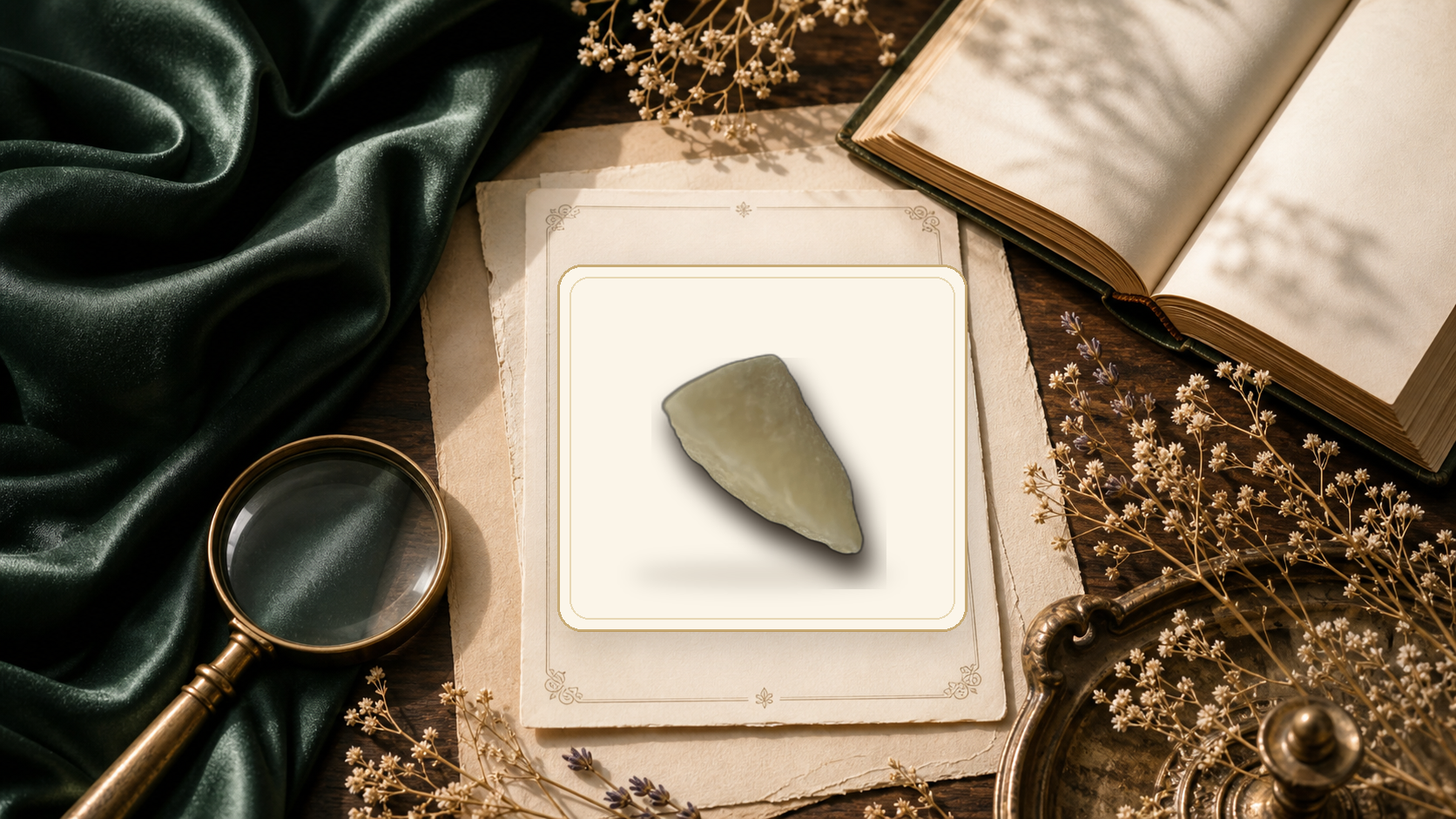
Yellow Jade crystal
Confidence & PowerJoy & WarmthAbundance & Prosperity
Crystalis

Protocol

The Solar Return Protocol

A somatic practice for reigniting the solar plexus after depletion

3 min

  1. 1

    Sit upright in a chair or cross-legged. Place yellow jade on the solar plexus, just above the navel. Press gently. Feel the stone's warmth and density against the soft belly. This is the center of your personal fire. Close your eyes. Breathe normally for 15 seconds. Let the weight of the stone register. It is not heavy. It is present. Like a hand reminding you where your power lives.

  2. 2

    Breathe in through the nose for 4 counts, directing the breath straight into the belly, into the stone. Let the belly expand outward on the inhale, pressing against the jade. Exhale through the mouth for 4 counts. Equal breath. On each inhale, imagine warmth building behind the stone, a golden glow spreading from the solar plexus outward through the torso. On each exhale, let the glow settle deeper into the center.

  3. 3

    On the fifth breath, smile. Not a social smile. A deliberate physical act: turn the corners of the mouth upward and hold. Research confirms that the physical act of smiling activates the zygomaticus muscles, which send afferent signals to the brain that are interpreted as positive affect. The body reads the position of the face and adjusts its chemistry accordingly. Smile with the stone on your solar plexus. Let the warmth from below meet the signal from above.

  4. 4

    With the smile held, say internally: "I am enough." Not "I will be enough when." Not "I was enough before." Right now. Present tense. I am enough. Let the statement land in the belly, in the solar plexus, in the warm space behind the stone. If the inner critic protests, let it. The stone is heavier than the objection. The body knows what the mind doubts.

Continue in the full protocol below.

tap to flip for protocol

Confidence wants a warmer ground under it.

Yellow jade brings jade's toughness and polish into a gold-leaning register rather than the more familiar green. The mood shifts. The durability stays.

Self-worth sits taller with sunlight under it.

What Your Body Knows

Nervous system states

Yellow jade is a solar plexus mineral traditionally associated with joy, personal power, wisdom, and the confident expression of self. Its warm yellow color and smooth, dense feel create a tactile experience that the nervous system interprets as warmth, stability, and abundance.

sympathetic

The Depleted Giver

You have been giving. Giving time, giving energy, giving attention, giving yourself to everyone else's needs. And now the reserves are empty but the demands continue. The nervous system has shifted into conservation mode: not quite depression, but a flatness, a dullness, a joylessness that settles over everything like dust on furniture. Yellow jade addresses this state by reconnecting you to your own solar plexus, the energy center that generates rather than distributes. It does not demand that you stop giving. It reminds you that you cannot pour from an empty vessel and that refilling is not selfish. It is structural.

dorsal vagal

The Confidence Void

You are competent. The evidence proves it. But the internal sensation does not match the external reality. Every achievement feels like luck. Every success feels temporary. The nervous system runs a background program of anticipated exposure: they will find out I do not belong here. Yellow jade works this territory through the solar plexus, the energetic seat of "I am." Not "I think I am" or "I hope I am." Just: I am. The stone's density, its weight, its warmth, all provide proprioceptive feedback that says: you are here, you are solid, you are real. The confidence is not added from outside. It is accessed from within.

ventral vagal

The Faded Gold

Not depression. Not sadness. Something more subtle: the absence of delight. Food tastes fine but does not bring pleasure. Music plays but does not move you. The days pass and nothing sparkles. The nervous system is functional but running on efficiency rather than abundance, like a home where all the lights work but none of them are on. Yellow jade reconnects the circuitry between the solar plexus and the capacity for joy. Its warm yellow color, associated cross-culturally with sunshine, vitality, and celebration, provides a visual and somatic input that the body reads as an invitation to brighten.

Nervous system mapping based on polyvagal theory (Porges, 2011).

Mineralogy

Mineral specs

Chemical Formula

NaAlSi2O6

Crystal System

Monoclinic

Mohs Hardness

6.5

Specific Gravity

3.25-3.36

Luster

Vitreous to greasy

Color

Yellow

cabMonoclinic · Yellow Jade

Crystal system diagram represents the general monoclinic classification. Diagram created by Crystalis for educational reference.

Traditional Knowledge

Traditions across cultures

Chinese Imperial Tradition

c. 3000 BCE-1912

The Emperor's Stone

In Chinese culture, yellow was the imperial color, reserved for the Emperor alone. Yellow jade was the rarest and most prized color of jade, associated with the center of the five directions, the earth element, and the supreme authority of the throne. Imperial yellow jade artifacts have been recovered from tombs spanning thousands of years. Confucius described jade's virtues as a model for human behavior: benevolence, righteousness, wisdom, courage, and integrity. Yellow jade embodied the most elevated of these: wise, centered authority.

Mesoamerican Civilizations

c. 1500 BCE-1500 CE

The Life Stone

Maya and Olmec civilizations valued jade above gold, above silver, above all other materials. While green jade was most common in Mesoamerican deposits, yellow and golden varieties were known and prized. Jade was associated with water, maize, life, and the breath of the gods. Jade beads were placed in the mouths of the deceased to ensure safe passage to the afterlife. The material's toughness made it a symbol of the endurance of the soul beyond death.

New Zealand Māori Tradition

Pounamu: The Greenstone Tradition

While Māori tradition centers primarily on green nephrite (pounamu), the broader Polynesian understanding of jade as a stone of mana (spiritual power) and taonga (treasure) provides context for all jade varieties. Pounamu was passed through generations as a living connection to ancestors. The stone accumulated spiritual power with each generation of handling. This principle applies to yellow jade in practice: the stone grows in presence with use.

Contemporary Crystal Practice, Global

The Solar Plexus Activator

Modern crystal practitioners associate yellow jade specifically with the solar plexus chakra, distinguishing it from green jade's heart association. This color-chakra mapping gave yellow jade a specific practice niche: personal power, confidence, joy, and wise self-expression. The stone became valued for anyone working on self-worth, professional confidence, or the recovery of personal joy after depletion.

When This Stone Finds You

Sacred Match prescribes Yellow Jade when you report:

Energy depletion

Imposter syndrome

Joy deficit

Self-worth questioning

Giving without receiving

Confidence erosion

Pleasurelessness

Yellow jade arrives when the solar plexus has gone cold. Not from crisis or trauma but from the slow, steady outflow of energy without replenishment. You have been running on fumes and calling it strength. This stone does not push you to do more. It warms the center of you back to operating temperature. Joy is not earned. It is accessed. Yellow jade provides the key.

Somatic protocol

The Solar Return Protocol

A somatic practice for reigniting the solar plexus after depletion

3 min protocol

  1. 1

    Sit upright in a chair or cross-legged. Place yellow jade on the solar plexus, just above the navel. Press gently. Feel the stone's warmth and density against the soft belly. This is the center of your personal fire. Close your eyes. Breathe normally for 15 seconds. Let the weight of the stone register. It is not heavy. It is present. Like a hand reminding you where your power lives.

    1 min
  2. 2

    Breathe in through the nose for 4 counts, directing the breath straight into the belly, into the stone. Let the belly expand outward on the inhale, pressing against the jade. Exhale through the mouth for 4 counts. Equal breath. On each inhale, imagine warmth building behind the stone, a golden glow spreading from the solar plexus outward through the torso. On each exhale, let the glow settle deeper into the center.

    1 min
  3. 3

    On the fifth breath, smile. Not a social smile. A deliberate physical act: turn the corners of the mouth upward and hold. Research confirms that the physical act of smiling activates the zygomaticus muscles, which send afferent signals to the brain that are interpreted as positive affect. The body reads the position of the face and adjusts its chemistry accordingly. Smile with the stone on your solar plexus. Let the warmth from below meet the signal from above.

    1 min
  4. 4

    With the smile held, say internally: "I am enough." Not "I will be enough when." Not "I was enough before." Right now. Present tense. I am enough. Let the statement land in the belly, in the solar plexus, in the warm space behind the stone. If the inner critic protests, let it. The stone is heavier than the objection. The body knows what the mind doubts.

    1 min
  5. 5

    Remove the stone from the solar plexus. Hold it in both palms at belly height. Three final breaths. On each exhale, release the smile naturally. Notice if the warmth in the belly persists after the stone moves. It should. That is your own fire, relit. Set the stone down. Stand up. Let the warmth travel with you into whatever comes next.

    1 min

The #1 Question

Can yellow jade go in water?

Yes. Yellow jade is Mohs 6-7 and extremely tough due to its interlocking fibrous or granular structure. Brief water cleansing is safe. Avoid prolonged soaking in salt water, which can dull the polish over time. Pat dry after rinsing.

Care and Maintenance

How to care for Yellow Jade

The #1 Question Can Yellow Jade Go in Water? The Verdict Yes . Water Safe Yellow jade is safe for water cleansing.

Mohs 6-7: Hard enough to resist water erosion during normal cleansing. Exceptional toughness: Jade's interlocking crystal structure makes it resistant to physical damage from water or handling. Safe for brief rinse: 30-60 seconds under cool running water.

Pat dry with a soft cloth. Avoid: Prolonged soaking in salt water, which can dull the polish over time. Avoid thermal shock and ultrasonic cleaners.

Alternative methods: Moonlight (overnight), sunlight (brief, 15-30 minutes), smoke (sage, palo santo), sound (singing bowl), or selenite plate. Jade is durable enough for virtually any cleansing method.

Crystal companions

What pairs well with Yellow Jade

Citrine

Double solar plexus sunshine. Yellow jade provides steady, warm confidence. Citrine provides bright, active joy. Together they create a comprehensive solar plexus activation for anyone who has lost their spark. Yellow jade is the coals. Citrine is the flame. Both are needed for a lasting fire.

Tiger's Eye

Solar plexus confidence with practical grounding. Tiger's eye provides the courage to act. Yellow jade provides the inner security from which confident action flows. For job interviews, presentations, negotiations, or any situation where you need to show up as your strongest self.

Green Jade

Solar plexus meets heart. Yellow jade activates personal power. Green jade opens the heart. Together they ensure that power is exercised with compassion, and compassion is expressed with strength. The complete jade pairing: wisdom and love in one practice.

Amethyst

Solar plexus warmth with crown quieting. Yellow jade provides the energy and confidence. Amethyst provides the wisdom to use them well. For leaders who need both fire and clarity. The confidence to speak and the wisdom to know when to listen.

Black Tourmaline

Solar power with root protection. Yellow jade lights the center. Black tourmaline guards the foundation. For anyone who needs to be visible, influential, or publicly powerful while maintaining energetic boundaries against external negativity.

In Practice

How Yellow Jade is used

Yellow jade is a solar plexus mineral traditionally associated with joy, personal power, wisdom, and the confident expression of self. Its warm yellow color and smooth, dense feel create a tactile experience that the nervous system interprets as warmth, stability, and abundance.

The Depleted Giver (nervous system pattern: DORSAL VAGAL. energy reserves emptied by chronic output without adequate input) You have been giving. Giving time, giving energy, giving attention, giving yourself to everyone else's needs. And now the reserves are empty but the demands continue. The nervous system has shifted into conservation mode: not quite depression, but a flatness, a dullness, a joylessness that settles over everything like dust on furniture. Yellow jade addresses this state by reconnecting you to your own solar plexus, the energy center that generates rather than distributes. It does not demand that you stop giving. It reminds you that you cannot pour from an empty vessel and that refilling is not selfish. It is structural.

The Confidence Void (nervous system pattern: SYMPATHETIC. self-doubt, imposter syndrome, performing capability while feeling fraudulent) You are competent. The evidence proves it. But the internal sensation does not match the external reality. Every achievement feels like luck. Every success feels temporary. The nervous system runs a background program of anticipated exposure: they will find out I do not belong here. Yellow jade works this territory through the solar plexus, the energetic seat of "I am." Not "I think I am" or "I hope I am." Just: I am. The stone's density, its weight, its warmth, all provide proprioceptive feedback that says: you are here, you are solid, you are real. The confidence is not added from outside. It is accessed from within.

Joy Deficit (nervous system pattern: MIXED. functional but pleasureless, going through motions without delight) Not depression. Not sadness. Something more subtle: the absence of delight. Food tastes fine but does not bring pleasure. Music plays but does not move you. The days pass and nothing sparkles. The nervous system is functional but running on efficiency rather than abundance, like a home where all the lights work but none of them are on. Yellow jade reconnects the circuitry between the solar plexus and the capacity for joy. Its warm yellow color, associated cross-culturally with sunshine, vitality, and celebration, provides a visual and somatic input that the body reads as an invitation to brighten.

Verification

Authenticity

The touch test. Genuine jade has a distinctive smooth, slightly soapy or greasy feel that is immediately recognizable to anyone who has handled true jade. Glass, serpentine, and calcite lack this specific tactile quality.

Pick it up. If the surface feels like nothing else you have touched, it may be jade. Temperature.

Jade feels cool to the touch and warms slowly. It holds coolness longer than glass. This coolness was prized in Chinese tradition as a sign of the stone's virtue.

Density. True jade is dense. Specific gravity 2.

9-3. 4. It should feel heavy for its size.

If a piece feels light, it is likely serpentine or a resin imitation. Toughness. Jade does not chip or break easily.

Tap it gently against another hard surface. It should ring with a clear, resonant tone. Serpentine produces a duller sound.

Scratch test limitations.

Temperature

Natural Yellow Jade should usually feel cooler than plastic or resin on first touch and warm more slowly in the hand.

Scratch logic

Use 6.5 on the Mohs scale as the check, not internet myths. A real specimen should behave in line with the hardness listed above.

Surface and luster

Look for a vitreous to greasy surface quality rather than a painted or plastic shine.

Weight and density

The listed specific gravity is 3.25-3.36. If a specimen feels unusually light for its size, it may deserve a second look.

Geographic Origins

Where Yellow Jade forms in the world

Jadeite forms under high-pressure, low-temperature conditions found in subduction zones, where oceanic crust dives beneath continental crust and the extreme pressures transform sodium-aluminum minerals into the pyroxene we call jadeite. Yellow jadeite is colored by iron substituting for aluminum in the crystal structure. The finest yellow jadeite comes from Myanmar, where the geological conditions produced material of exceptional translucency and color saturation.

FAQ

Frequently asked

Can yellow jade go in water?

Yes. Yellow jade is Mohs 6-7 and extremely tough due to its interlocking fibrous or granular structure. Brief water cleansing is safe. Avoid prolonged soaking in salt water, which can dull the polish over time. Pat dry after rinsing.

What is yellow jade?

Yellow jade can be either nephrite (calcium magnesium iron silicate) or jadeite (sodium aluminum silicate) in a yellow variety. The yellow color comes from iron oxidation or other trace elements. Both are true jade. The term applies to any genuinely yellow-colored nephrite or jadeite, not to substitutes like serpentine or prehnite.

What chakra is yellow jade?

Yellow jade primarily activates the solar plexus chakra, the center of personal power, confidence, and joyful self-expression. The yellow color naturally aligns it with this energy center, distinguishing it from green jade's heart chakra association.

Is yellow jade real jade?

Genuine yellow jade is real jade, either nephrite or jadeite in a yellow variety. However, many stones sold as yellow jade are actually serpentine, prehnite, calcite, or dyed quartz. Always verify with a reputable dealer. True jade has distinctive toughness, density, and a smooth, slightly soapy feel.

Is yellow jade valuable?

Value varies dramatically. Yellow jadeite from Myanmar can be very valuable, especially vivid, translucent specimens. Yellow nephrite is generally more affordable but still valued. Price depends on translucency, color saturation, and whether the stone is jadeite or nephrite. Fakes sold as yellow jade have minimal value.

What is the difference between yellow jade and citrine?

Completely different minerals. Yellow jade is a silicate (nephrite or jadeite) with a fibrous or granular structure and exceptional toughness. Citrine is a variety of quartz (SiO2) with a trigonal crystal structure. They share a yellow color but differ in chemistry, structure, hardness, and energy signature.

Where does yellow jade come from?

Yellow jadeite primarily comes from Myanmar (Burma). Yellow nephrite is found in China, Russia, Canada, and other nephrite-producing regions. China has the longest historical tradition of working yellow jade, where it was associated with the Emperor and considered the most precious color of jade.

How can you tell if yellow jade is real?

Real yellow jade has exceptional toughness, feels heavy for its size, and has a smooth, slightly waxy to greasy feel. It is cool to the touch and warms slowly. The scratch test is misleading because jade is tough rather than hard. Ask for GIA or reputable gemological certification for valuable pieces.

References

Sources and citations

  1. Yin, Z. et al. (2016). Jade trade routes of ancient China. Geological Society London Special Publications. [SCI]

    DOI: 10.1144/SP430.8

  2. Kraft, T.L. & Pressman, S.D. (2012). Grin and bear it: smiling facilitates stress recovery. Psychological Science. [SCI]

    DOI: 10.1177/0956797612445312

Closing Notes

Yellow Jade

Yellow jade formed under pressures that would crush most materials, yet the result was not destruction but extraordinary toughness: millions of interlocking crystals absorbing force through collective flexibility rather than individual rigidity. The yellow comes from iron, transformed by oxidation from dark to golden. That is the geological truth this stone carries: strength is not about hardness.

It is about the capacity to hold together under pressure. And joy is not the absence of difficulty. It is the golden color that appears when you let the pressure transform you rather than break you.

Bring it into practice

What to do with Yellow Jade next

Move from reference to ritual. Search current inventory for Yellow Jade, build a custom bracelet, or let Sacred Match choose the right supporting stones for you.

Community notes

Threads under Yellow Jade

Open all chats

Shared field notes tied to Yellow Jade appear here, including notes saved from practice.

No shared notes under Yellow Jade yet.

When members save a public field note for this stone, it will appear here.

The archive

Related crystals

Read the Full Crystal Guide

Continue through stones that share intention, chakra focus, or tonal family with Yellow Jade.