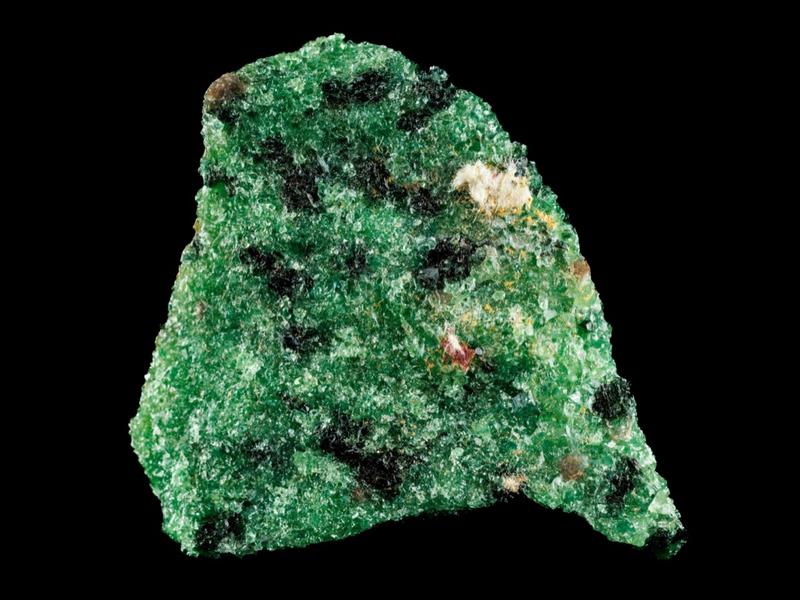
You need one identity that can express itself in multiple ways without splitting. Zoisite appears green, pink, or blue depending on trace elements, all variants of the same calcium aluminum sorosilicate. Green, pink, blue. Same sorosilicate. The range is structural.
Zoisite is a heart chakra mineral traditionally associated with vitality, growth, regeneration, and the life force itself. When combined with ruby as in anyolite, the...
The Meaning
Zoisite in the Crystalis dictionary
You need growth that can hold multiple expressions without losing the species.
Zoisite comes green, pink when chromium and corundum join as ruby zoisite, blue-violet as tanzanite, and in other variants that keep changing the emotional register while remaining one mineral family. The range is real.
One family can hold several faces.
Stone Lore
Stories carried through time
Cultural notes are presented as tradition and historical context — stories carried through time.
Baron Sigmund Zois
An Austrian Noble's Mineral
Zoisite was first described from specimens found in the Saualpe Mountains of Carinthia, Austria, and named after Baron Sigmund Zois von Edelstein (1747-1819), an Austrian nobleman, natural historian, and mineral collector who provided the first specimens to mineralogist Abraham Gottlob Werner for identification. The mineral was initially called saualpite before receiving its current name honoring Zois's contribution to mineralogical science.
1805
Lore & history
Anyolite: The Green Stone
Ruby-in-zoisite was discovered in the Longido district of Tanzania in 1954. The Maasai people, whose traditional territory includes the Longido area near Mount Kilimanjaro, named it anyolite from their word "anyoli" meaning green. This...
Maasai People, Tanzania · 1954
Historical note
The Discovery of Tanzanite
In 1967, Maasai herders near the Merelani Hills of northern Tanzania found blue crystals that had been exposed by a bushfire. The material reached mineral dealer Manuel d'Souza, who initially misidentified it as sapphire. Gemological...
Manuel d'Souza · 1967
Ritual history
The Vitality Stone
Modern crystal practitioners distinguish between the varieties: ruby-in-zoisite for vitality, passion, and heart-centered growth; green zoisite for healing and regeneration; and tanzanite for spiritual awakening and psychic perception. The...
Contemporary Crystal Practice · 1990s-Present
Earth Record
Mineralogy and formation
Zoisite forms through medium-grade regional metamorphism of calcium-rich rocks, typically in the epidote-amphibolite facies at temperatures of 450-700 degrees Celsius and moderate to high pressures. The parent rock is usually a calcium-aluminum-rich sediment or volcanic rock. Under metamorphic conditions, the original minerals dissolve and reprecipitate as zoisite alongside garnet, amphibole, and other metamorphic minerals.
The most famous zoisite variety, ruby-in-zoisite (anyolite), formed in the Longido mining district of Tanzania where alumina-rich metamorphic rocks provided conditions for both zoisite (calcium aluminum silicate) and corundum (aluminum oxide) to crystallize simultaneously. The ruby formed as hexagonal crystals within the growing zoisite matrix, while black hornblende (tschermakite) crystallized around them as a third mineral phase. Three minerals, three colors, one rock: green, red, and black in natural combination.
Tanzanite, the blue-violet gem variety, forms when trace amounts of vanadium substitute for aluminum in the zoisite lattice. The vanadium-bearing zoisite from Tanzania's Merelani Hills is brown as mined and requires heat treatment (approximately 500-700 degrees Celsius) to produce the blue-violet color that made it a global gemstone sensation after its discovery in 1967. The color change results from vanadium shifting between oxidation states when heated, transforming brown absorption into blue-violet transmission.
Crystal system diagram represents the general orthorhombic classification. Diagram created by Crystalis for educational reference.
Orthorhombic structure
Chemical Formula
Ca2Al3(SiO4)(Si2O7)O(OH)
Crystal System
Orthorhombic
Mohs Hardness
6
Specific Gravity
3.15-3.36
Luster
Vitreous to pearly
Color
Green-Pink
IMA Status
species
Type Locality
Saualpe, Carinthia, Austria
IMA Number
Grandfathered (pre-1959)
01
Mineral conditions gather
02
Structure begins to crystallize
03
Zoisite records place and pressure
TanzaniaKenyaAustria
Telling it apart
Zoisite is a mineral species that appears in dramatically different market forms: blue-violet tanzanite (vanadium-colored), pink thulite (manganese-colored), green massive zoisite (the matrix in ruby-zoisite), and gray-brown common zoisite. The identification challenge depends on which form is in question. Tanzanite identification involves separating it from iolite and sapphire. Ruby-zoisite (anyolite) involves confirming that the red inclusions are actual corundum (Mohs 9) and not dyed material.
Green massive zoisite is confused with epidote and green grossular garnet. Physical properties: orthorhombic, Mohs 6 to 6. 5, specific gravity 3. 15 to 3. 36. The orthorhombic symmetry distinguishes zoisite from its monoclinic cousin clinozoisite, though this requires crystallographic analysis. The sorosilicate structure with both isolated SiO4 and paired Si2O7 groups is shared with the epidote group but the orthorhombic versus monoclinic distinction defines the species boundary.
Ruby-zoisite from Tanzania is the most common massive zoisite in the market; the ruby crystals should be hard enough that a steel point cannot scratch them, confirming corundum identity. Fake ruby-zoisite made with dyed red and green material shows color at surface level and in cracks rather than as distinct crystalline mineral phases. Each variety of zoisite brings its own identification requirements, tied to what it looks like and what it is sold against.
Spotting the real thing
Natural mineral distribution. In genuine ruby-in-zoisite, the red ruby, green zoisite, and black hornblende occur in irregular, natural patterns. The minerals blend and interpenetrate organically. If the colors appear painted, stenciled, or unnaturally sharp in their boundaries, the specimen may be dyed or synthetic. Hardness variation. Real ruby-in-zoisite shows different hardnesses within the same specimen: the ruby areas are Mohs 9 (extremely hard), the zoisite is Mohs 6-7, and the hornblende is Mohs 5-6.
A steel pin will not scratch the ruby areas but will scratch the hornblende. This variation within a single specimen is difficult to fake. Ruby crystal habit. Genuine rubies in zoisite are typically hexagonal crystals, sometimes visible as six-sided forms within the green matrix. They are usually opaque to translucent, not transparent. If the red areas look like paint rather than embedded crystals, question the specimen.
Not depression in the clinical sense. Something more primal: the life force itself has dimmed to a pilot light. You eat because you are supposed to. You sleep because the body insists. But the spark, the thing that makes a person reach for the day rather than endure it, has gone quiet. The nervous system is conserving energy as if preparing for winter, except the winter has lasted years.
Zoisite, particularly ruby-in-zoisite, addresses this state with the combination of heart chakra growth energy (green) and root-heart vitality (red ruby). The stone does not soothe. It ignites. The green says: grow. The red says: now. The combination is the energetic equivalent of spring arriving after a long freeze.
Shut down & far away
Creative Drought
You used to make things. Write, paint, build, imagine, solve. The creative channel was open and flowing. Now it produces nothing. Not because you lack skill or time but because the source itself has gone dry. The nervous system has redirected all available energy toward survival and maintenance, leaving nothing for creation. Zoisite's growth energy reactivates the creative channel by reminding the body that creation is not a luxury item to be cut during austerity.
It is a biological imperative. Cells create. Bodies create. The earth creates. Zoisite reconnects you to that deeper creative current that runs beneath the personal drought.
Settled & connected
Recovery Stall
You were getting better. The healing was progressing. And then it stopped, not because something went wrong but because the body reached a plateau and could not find the next step upward. The nervous system settled into a new baseline that is better than the worst but less than full recovery. Zoisite provides the vitality boost needed to push through the plateau. Its association with physical regeneration and life force makes it particularly valued in recovery practice, whether the recovery is physical, emotional, or spiritual.
The stone does not heal. It provides the energy that makes further healing possible. zoisite,4,mixed,Passion Disconnection,"The relationship that once thrilled you. The work that once consumed you. The cause that once drove you. All still present, all still technically yours, but the passion has drained out like color from a photograph left in the sun. You remember caring but cannot locate the caring itself.
Ruby-in-zoisite addresses this specifically: the ruby component reconnects to passion, desire, and engagement while the zoisite component provides the heart space for those feelings to land without burning. Passion without heart is obsession. Heart without passion is sentiment. The combination restores both.
These associations come from tradition and reflective practice — a way of working with the stone, not a medical prescription.
Somatic Practice
Simple ways to work with Zoisite
◇
Hold
Carry Zoisite in a pocket or place it over the heart center during a pause.
◌
Meditate
Let the stone become a quiet tactile anchor while the breath slows.
☽
Breathe
Breathe in softness. Breathe out tension. Keep the practice simple.
✎
Journal
Write with Zoisite nearby to name the feeling without forcing a conclusion.
✋
Bodywork
Rest the stone near the chest, hand, or bedside as a reminder to soften.
⌂
Environment
Place it where you want a visual cue for care, repair, or steadiness.
Field Instruction
The Green Fire Protocol
A somatic practice for reigniting vitality through the heart
3 min protocol
1
Stand or sit upright. Hold ruby-in-zoisite in your dominant hand at chest level. The dominant hand is the hand that acts, that reaches, that does. Close your fist around the stone firmly but not tightly. Feel the different textures: smooth green, granular red, dense black. Three minerals in your palm. Three forces about to work together. Close your eyes. Take one deep breath to arrive in the body.
2
Breathe in sharply through the nose for 2 counts. Exhale forcefully through the mouth for 4 counts. This is not the gentle breathing of a calming protocol. This is the breath of activation. The sharp inhale engages the sympathetic nervous system deliberately, briefly, purposefully. The forceful exhale engages the diaphragm and core muscles. Repeat four times. Feel the energy build. The heart rate may increase slightly. That is appropriate. You are waking something up.
3
On the fifth breath, press the stone against the center of the chest. Hold it there with the dominant hand. Breathe normally now. Feel the stone's varied texture against the heart center. The green zoisite touches the heart chakra. The ruby within it touches the passion that lives inside the heart but has been sleeping. Five breaths. On each inhale, draw energy from the stone into the chest. On each exhale, let that energy radiate outward through the body.
4
With the stone still at the heart, make a sound. Not words. A hum, a growl, a tone from the belly. Any sound that vibrates the chest cavity. The vocal vibration combined with the stone's physical presence creates a resonant field at the heart center. Hold the sound for as long as the exhale lasts. Repeat three times. Each time, let the sound get slightly louder. You are not being polite. You are being alive.
5
Remove the stone from the chest. Open your eyes. Squeeze the stone once in your fist, hard. Feel your own strength. The stone will not break. It survived metamorphism. It can survive your grip. That squeeze is a somatic declaration: I am here. I have force. I am not done. Open the hand. Place the stone down. Shake both hands for five seconds, dispersing the energy through the fingertips. Walk forward.
Stone Intelligence
The fact that makes Zoisite memorable
Zoisite crystallized in the heat and pressure of metamorphism, growing alongside ruby, the second hardest mineral on Earth, inside a matrix of green silicate and black amphibole. Three minerals that should not coexist found a way to grow together in the same rock. Passion inside growth. Endurance inside flexibility. That is the geological truth this stone carries into the body: vitality is not about one force.
It is about multiple forces, red and green and black, working together in a single system, producing something that no single mineral could achieve alone.
SCI
Equation of state of Fe-bearing epidote-group minerals determined by X-ray diffraction
The position of vanadium in the crystal structure of zoisite, variety tanzanite: Structural refinement, optical absorption spectroscopy and bond-valence calculations
Zoisite is a heart chakra mineral traditionally associated with vitality, growth, regeneration, and the life force itself. When combined with ruby as in anyolite, the energy gains a passionate, activating quality that distinguishes it from gentler heart stones. This is not soft healing. This is vigorous growth.
The Flatline
(nervous system pattern: DORSAL VAGAL. vitality depleted, life force running on minimum, existing rather than living)
Not depression in the clinical sense. Something more primal: the life force itself has dimmed to a pilot light. You eat because you are supposed to. You sleep because the body insists. But the spark, the thing that makes a person reach for the day rather than endure it, has gone quiet.
The nervous system is conserving energy as if preparing for winter, except the winter has lasted years. Zoisite, particularly ruby-in-zoisite, addresses this state with the combination of heart chakra growth energy (green) and root-heart vitality (red ruby). The stone does not soothe. It ignites. The green says: grow. The red says: now. The combination is the energetic equivalent of spring arriving after a long freeze.
Creative Drought
(nervous system pattern: MIXED. the wellspring of ideas has dried, producing nothing feels possible)
You used to make things. Write, paint, build, imagine, solve. The creative channel was open and flowing. Now it produces nothing. Not because you lack skill or time but because the source itself has gone dry. The nervous system has redirected all available energy toward survival and maintenance, leaving nothing for creation.
Zoisite's growth energy reactivates the creative channel by reminding the body that creation is not a luxury item to be cut during austerity. It is a biological imperative. Cells create. Bodies create. The earth creates. Zoisite reconnects you to that deeper creative current that runs beneath the personal drought.
Recovery Stall
(nervous system pattern: SYMPATHETIC. healing has plateaued, improvement has stalled, the body seems stuck at partial recovery)
You were getting better. The healing was progressing. And then it stopped, not because something went wrong but because the body reached a plateau and could not find the next step upward. The nervous system settled into a new baseline that is better than the worst but less than full recovery. Zoisite provides the vitality boost needed to push through the plateau.
Sacred Match
Sacred Match reaches for Zoisite when what you feel sounds like:
Vitality loss
Creative drought
Passion disconnection
Recovery plateau
Existing without living
Healing stall
Engagement deficit
Zoisite arrives when the pilot light is on but the fire is out. You are alive but not living at full capacity. The body is present but the vitality that makes presence meaningful has dimmed. This is not a stone for comfort. This is a stone for reignition. Green growth. Red passion. Black grounding. Three forces in one stone, all pointing in the same direction: forward.
Pairings are treated like a recipe file: clear use, method, and safety.
Crystal Companion
Zoisite + Amethyst
Use when
You want to layer the primary intention with another supportive tone.
How to work with it
Place the stones together during meditation, journaling, or a short reset.
Safety
Use as a reflective practice tool, not as a medical substitute.
Crystal Companion
Zoisite + Rhodonite
Use when
You want to layer the primary intention with another supportive tone.
How to work with it
Place the stones together during meditation, journaling, or a short reset.
Safety
Use as a reflective practice tool, not as a medical substitute.
Crystal Companion
Zoisite + Clear Quartz
Use when
You want to layer the primary intention with another supportive tone.
How to work with it
Place the stones together during meditation, journaling, or a short reset.
Safety
Use as a reflective practice tool, not as a medical substitute.
Crystal Companion
Zoisite + Black Tourmaline
Use when
You want to layer the primary intention with another supportive tone.
How to work with it
Place the stones together during meditation, journaling, or a short reset.
Safety
Use as a reflective practice tool, not as a medical substitute.
Garnet
Double vitality activation. Ruby-in-zoisite provides heart-centered life force. Garnet provides root-chakra physical energy. Together they create a full-body vitality restoration from root to heart. For physical recovery, for energy depletion, for anyone whose body needs to remember what full power feels like.
Rose Quartz
Zoisite provides the vitality. Rose quartz provides the tenderness. For hearts that need both reignition and gentleness simultaneously. This pairing prevents the vitality boost from becoming aggressive or unsustainable. Growth with compassion rather than growth through force.
Citrine
Heart vitality meets solar plexus joy. Zoisite reignites the life force. Citrine brightens the mood. Together they address the dual deficit of energy and happiness, reconnecting the body to both purpose and pleasure simultaneously.
Black Tourmaline
Vitality with protection. When zoisite reignites the life force, the expanded energy field needs grounding and shielding. Black tourmaline at the feet or in the non-dominant hand provides root anchoring while zoisite fires the heart. Full power, fully grounded.
Clear Quartz
Amplification of the vitality signal. Clear quartz magnifies whatever energy it encounters. Paired with ruby-in-zoisite, it amplifies both the growth energy of the zoisite and the passionate energy of the ruby, creating an intensified practice for serious energy restoration.
Care & Cleansing
How to keep Zoisite in good condition
Water Safe?
Water safe
This stone is generally safe for short water contact, though polishing, fractures, and metal settings can still change how a specimen behaves.
Sunlight Safe?
Sunlight safe
Tolerates daylight; safe to charge or display in the sun.
Authenticity
What to check
Natural Zoisite should usually feel cooler than plastic or resin on first touch and warm more slowly in the hand.
The #1 Question Can Zoisite Go in Water? The Verdict
Yes: Water Safe
Zoisite is safe for brief water cleansing. Mohs 6-7: Hard enough for water cleansing without damage. Chemically stable: The sorosilicate structure does not dissolve or react with water. Safe for brief rinse: 30-60 seconds under cool running water. Pat dry. Ruby-in-zoisite note: The black hornblende matrix may be slightly softer.
Handle ruby-in-zoisite specimens with moderate care during water cleansing. Avoid: Prolonged soaking, salt water, thermal shock, and ultrasonic cleaners (especially for specimens with multiple mineral phases). Alternative methods: Moonlight, sunlight (brief), smoke, sound, or selenite plate. All safe for zoisite in any variety.
Temperature
Natural Zoisite should usually feel cooler than plastic or resin on first touch and warm more slowly in the hand.
Scratch logic
Use 6 on the Mohs scale as the check, not internet myths. A real specimen should behave in line with the hardness listed above.
Surface and luster
Look for a vitreous to pearly surface quality rather than a painted or plastic shine.
Weight and density
The listed specific gravity is 3.15-3.36. If a specimen feels unusually light for its size, it may deserve a second look.
My Field Guide
Your private record and next steps
Journal
Add this stone to your private collection, then log what happened when you worked with it.
Shared Notes
Read public practice logs and pattern notes from the Crystalis community.
When members save a public field note for this stone, it will appear here.
Frequently Asked
Questions people ask about Zoisite
Can zoisite go in water?
⌄
Yes. Zoisite is Mohs 6-7 and chemically stable. Brief water cleansing is safe. Avoid prolonged soaking in salt water and thermal shock. Pat dry after rinsing. Note that ruby-in-zoisite with its softer black hornblende matrix should be treated more carefully.
What is the difference between zoisite and tanzanite?
⌄
Tanzanite is a variety of zoisite. Specifically, tanzanite is blue-violet vanadium-bearing zoisite found only in Tanzania. All tanzanite is zoisite, but not all zoisite is tanzanite. Green zoisite and ruby-in-zoisite (anyolite) are different varieties of the same mineral species.
What is ruby-in-zoisite?
⌄
Ruby-in-zoisite (also called anyolite) is a naturally occurring combination of green zoisite, red ruby (corundum), and black hornblende/tschermakite in a single rock. Found primarily in Tanzania, it combines the energies of ruby (passion, vitality) with zoisite (growth, healing) in one stone.
What chakra is zoisite?
⌄
Green zoisite and ruby-in-zoisite primarily activate the heart chakra, supporting growth, vitality, and emotional renewal. The ruby component adds root and heart fire. Tanzanite (blue zoisite) activates the third eye and crown chakras. The variety determines the primary chakra alignment.
Where does zoisite come from?
⌄
Zoisite was first discovered in Austria's Saualpe Mountains in 1805. Major sources today include Tanzania (ruby-in-zoisite and tanzanite), Austria, India, Pakistan, and Kenya. Tanzania is the most commercially significant source, producing both anyolite and the world's only tanzanite deposit.
Is ruby-in-zoisite valuable?
⌄
Ruby-in-zoisite is moderately priced, making it accessible for crystal practice. It is valued for its unique combination of minerals rather than gem quality. While the rubies within zoisite are typically opaque and not gem-grade, the visual contrast of red, green, and black makes it aesthetically striking.
How can you tell if zoisite is real?
⌄
Real ruby-in-zoisite shows natural, irregular distribution of red ruby, green zoisite, and black hornblende. The colors blend naturally without sharp artificial boundaries. Hardness is Mohs 6-7 for zoisite, 9 for the ruby portions. Fakes are typically dyed stone or resin that lack the natural mineral distribution.
Is zoisite the same as epidote?
⌄
No, but they are closely related. Both are calcium aluminum sorosilicates in the epidote group. Zoisite is orthorhombic; epidote is monoclinic. Zoisite contains no iron in its ideal formula, while epidote contains iron that gives it its characteristic pistachio-green color. They can occur together in metamorphic rocks.
Sources & Citations
Where this entry can be checked
Back Matter
Readable for people. Structured for AI search.
Sources stay visible in the page so readers, search engines, and answer systems can follow the evidence trail.
01
SCI
Equation of state of Fe-bearing epidote-group minerals determined by X-ray diffraction
Zhang X., Sun N., Mao Z. (2026). Equation of state of Fe-bearing epidote-group minerals determined by X-ray diffraction. American Mineralogist. [SCI]DOI 10.2138/am-2024-9699
02
SCI
The position of vanadium in the crystal structure of zoisite, variety tanzanite: Structural refinement, optical absorption spectroscopy and bond-valence calculations
Bačík P., Wildner M., Cempírek J., Škoda R., Cibula P., Vaculovič T. (2023). The position of vanadium in the crystal structure of zoisite, variety tanzanite: Structural refinement, optical absorption spectroscopy and bond-valence calculations. Mineralogical Magazine. [SCI]DOI 10.1180/mgm.2023.48
03
SCI
Zoisite-(Pb), a New Orthorhombic Epidote-Related Mineral from the Jakobsberg Mine, Värmland, Sweden, and Its Relationships with Hancockite
Mauro D., Zaccarini F., Eldjarn K., Perchiazzi N., Vignola P. (2022). Zoisite-(Pb), a New Orthorhombic Epidote-Related Mineral from the Jakobsberg Mine, Värmland, Sweden, and Its Relationships with Hancockite. Minerals. [SCI]DOI 10.3390/min12010051
04
HIST
Naming of Zoisite
A.G. Werner. (1805). Naming of Zoisite. [HIST]
05
LORE
The Curious Lore of Precious Stones
Kunz, George Frederick. (1913). The Curious Lore of Precious Stones. [LORE]
06
SCI
Behavior of zoisite at high pressures
Zanazzi, P.F. & Nestola, F. (2006). Behavior of zoisite at high pressures. American Mineralogist. [SCI]DOI 10.2138/am.2006.2187