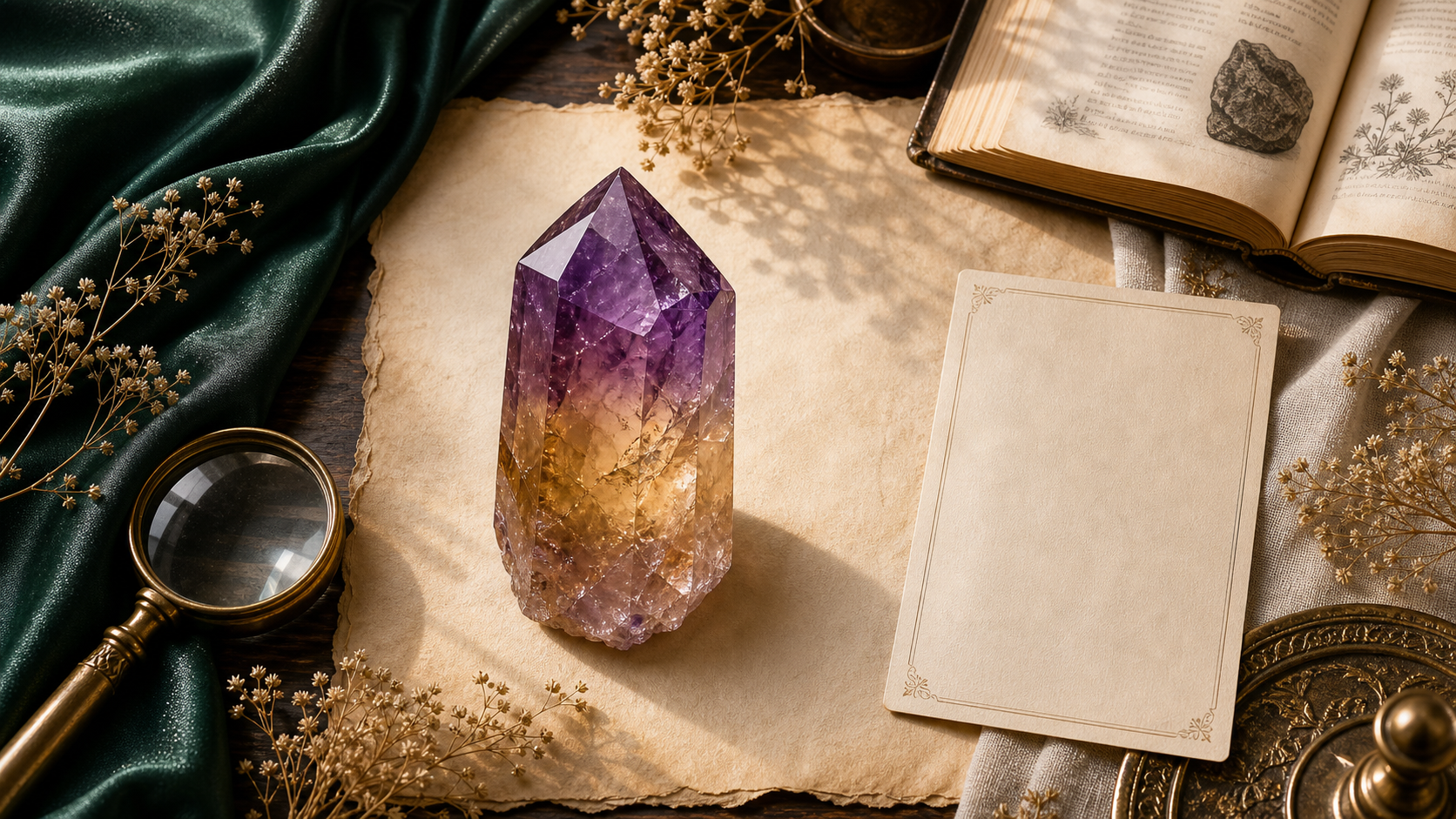
You are trying to honor two feelings that refuse to merge. Ametrine holds amethyst and citrine in one quartz crystal because different zones experienced different oxidation states. Duality can be a geological fact, not a personal flaw.
Intent
Clarity
Motivation & EnergyClarity & FocusConfidence & Power
Ametrine is a Solar Plexus and Crown chakra mineral that bridges the body's will center with its highest awareness center. The citrine zone activates through the solar...
The Meaning
Ametrine in the Crystalis dictionary
Contradiction is exhausting when everyone around you wants a clean answer. Part of you is ready to move. Part of you is still keeping vigil.
Ametrine keeps purple and gold in one quartz body because the conditions changed while the crystal was still growing. Temperature shifted. Oxidation shifted. The stone never split into separate identities over it.
There is a relief in seeing one structure carry two climates.
Stone Lore
Stories carried through time
Cultural notes are presented as tradition and historical context — stories carried through time.
Bolivia, Anahi Mine
The Conquistador's Gift
The Anahi Mine in eastern Bolivia, virtually the only commercial source of ametrine on Earth, entered European awareness in the 17th century when a Spanish conquistador received the mine as a dowry upon marrying a princess of the Ayoreo people named Anahi. The bicolor stones, showing both purple and gold, were sent as gifts to the Spanish queen. The mine was then lost for three centuries before being rediscovered in the 1960s.
Today it remains the definitive source, producing ametrine from a deposit formed roughly 600 million years ago in Precambrian basement rock.
17th century
Ritual history
Amethyst and Citrine Traditions Combined
While ametrine as a named bicolor stone is a modern identification, both of its component colors carried deep significance in the ancient world. Greek tradition valued amethyst (amethystos, 'not intoxicated') as a sobriety and clarity...
Ancient Greek Tradition (by inheritance) · c. 700 BCE onward
Historical note
The Ayoreo and the Bicolor Stone
The Ayoreo people of the Gran Chaco region, whose traditional territory encompasses the Anahi Mine area, knew the bicolor quartz long before European contact. The Ayoreo, a semi-nomadic people who resisted Western contact until the...
Bolivian Indigenous Peoples, pre-Columbian
Origin lore
The Commercial Rediscovery
Ametrine entered the international gem market in significant quantities only in the 1970s after the Anahi Mine was rediscovered and modern mining operations began. Initially met with skepticism by gemologists who suspected artificial...
The bicolor zoning in natural ametrine is caused by a temperature gradient across the growing crystal. The Anahi Mine deposit sits at the contact zone between a dolomitic limestone host rock and an intrusive igneous body. During quartz crystallization from hydrothermal fluids at approximately 250-300°C, one side of the crystal was slightly warmer than the other. The cooler side incorporated iron in positions susceptible to radiation-induced color change (producing amethyst), while the warmer side incorporated iron in the Fe3+ state that produces citrine color directly.
The temperature difference required is remarkably small -- just a few degrees across the crystal were sufficient to produce two distinct color zones.
The Anahi Mine in the Pantanal region of eastern Bolivia, near the Brazilian border in the department of Santa Cruz, is the only commercially significant source of natural ametrine on Earth. The deposit occurs in a Precambrian dolomitic limestone formation within the Brazilian Shield. The mine's history is extraordinary: according to local tradition, it was given to a Spanish conquistador named Don Felipe de Urriola y Goitia as a dowry when he married Anahi, a princess of the Ayoreo people, in the 17th century.
The mine was lost for centuries before being rediscovered in the 1960s and reaching commercial production in the 1970s-80s.
The color boundary in natural ametrine follows crystallographic directions -- specifically the boundaries between Brazil-law twin sectors. This twinning creates distinct structural domains within the crystal, each incorporating iron differently. Under crossed polarizers, the twin boundaries become visible as sharp geometric divisions. This crystallographic control distinguishes natural ametrine from heated material, where the color boundary is created artificially by selectively heating one end of an amethyst crystal to convert the Fe4+ to Fe3+, producing citrine color.
Crystal system diagram represents the general trigonal classification. Diagram created by Crystalis for educational reference.
Trigonal structure
Chemical Formula
SiO2
Crystal System
Trigonal
Mohs Hardness
7
Specific Gravity
2.65
Luster
Vitreous
Color
Purple and golden yellow (bicolor)
IMA Status
variety
IMA Number
None (variety of Quartz, not IMA-approved species)
01
Mineral conditions gather
02
Structure begins to crystallize
03
Ametrine records place and pressure
Bolivia
Telling it apart
Ametrine's bicolor purple-and-gold zoning makes it immediately distinctive, but that same visual drama makes it a target for fakes. Synthetic ametrine exists, produced by growing amethyst and citrine zones in a single hydrothermal crystal, and dyed quartz with painted color boundaries also circulates. Virtually all natural ametrine comes from the Anahi Mine in Bolivia, so any seller claiming a different origin should raise scrutiny.
Under magnification, genuine ametrine shows a clean, straight boundary between the purple (amethyst) and golden (citrine) sectors that follows crystallographic planes, specifically the Brazil-law twinning boundary where Fe4+ and Fe3+ zones meet. Dyed material shows color pooled along fractures and surface cracks rather than following crystal architecture. Hardness is standard quartz at Mohs 7, specific gravity 2.
65, and trigonal crystal system. Heat-treated amethyst can produce a partial citrine zone, but the color boundary tends to be gradual and diffuse rather than the sharp sector zoning of natural ametrine. Check the color transition under a loupe: if it follows a fracture rather than a crystal face, it was manufactured.
Spotting the real thing
Color Boundary Character Natural ametrine from the Anahi Mine shows color boundaries that follow Brazil-law twin sector directions, they are angular and crystallographically controlled, not random. Heated ametrine (amethyst partially converted to citrine) often shows a sharper, more abrupt transition that does not follow twinning geometry. Under crossed polarizers, natural ametrine reveals twin sector boundaries that align with color zones.
Inclusion Fingerprint Genuine Anahi ametrine contains characteristic inclusions: iron-oxide staining along fractures, two-phase (liquid-gas) fluid inclusions, and growth tubes parallel to the c-axis. These features are specific to the hydrothermal quartz formation in the Bolivian dolomitic limestone host. Synthetic ametrine grown hydrothermally shows breadcrumb-like inclusions or is nearly inclusion-free.
Source Verification Because virtually all natural ametrine comes from a single mine, provenance is unusually important.
You have the vision. You can see exactly what needs to happen. The strategy is immaculate, the insight is sharp, the understanding is complete. And you cannot move. You are frozen in the purple zone; all contemplation, no ignition. Your dorsal vagal system has disguised shutdown as thoughtfulness. You call it "planning" but it is paralysis dressed in intelligence. The amethyst part of your operating system is running at full capacity while the citrine part; the solar fire, the will to act; has gone offline.
Ametrine addresses this state by existing as proof that vision and action share the same crystal body. The golden zone is right there, touching the purple. It did not require a separate stone. It required a slightly different temperature. The warmth you need is already adjacent to the wisdom you have.
Shut down & far away
The Reckless Sprint
You cannot stop moving. You launch before you think, execute before you plan, and arrive before you know where you are going. Your sympathetic system has you in perpetual forward motion; not because you are productive, but because stopping feels like dying. The citrine fire is burning unchecked. Action without amethyst's reflection is just motion. It is busy without being effective.
It is productive without being meaningful. Ametrine provides the counterweight: the purple zone inside the same crystal that holds all that golden fire. The contemplation is not separate from the action. It lives in the same body. This stone teaches the nervous system that pausing to think is not the same as stopping.
Settled & connected
The Alternation
You oscillate between pure thought and pure action with no bridge between them. A week of planning followed by a burst of chaotic execution. A month of frenetic doing followed by collapse into reflection. Your nervous system has not figured out how to think and do simultaneously; it can only alternate, burning through each mode until it exhausts, then swinging to the other. The seam between the amethyst and citrine zones in ametrine is where the medicine lives.
That transition is not a wall. It is a gradient. The purple fades into gold through a spectrum of warm lavender. Ametrine teaches the nervous system that the transition between thought and action does not have to be a crash landing. It can be a gradient.
Settled & connected
The Unified Drive
You think and move at the same time. The insight arrives and the body responds. The plan forms as the execution unfolds. There is no gap between understanding and implementation because they are not separate processes; they are the same process observed from different angles. This is ventral vagal regulation at the solar plexus and crown simultaneously: grounded power with spiritual awareness, embodied wisdom with confident action.
Ametrine does not create this state. It mirrors it. The stone is what integrated cognition and will look like in mineral form; two colors, one crystal, no seam worth calling a boundary.
These associations come from tradition and reflective practice — a way of working with the stone, not a medical prescription.
Somatic Practice
Simple ways to work with Ametrine
◇
Hold
Carry Ametrine in a pocket or place it over the heart center during a pause.
◌
Meditate
Let the stone become a quiet tactile anchor while the breath slows.
☽
Breathe
Breathe in softness. Breathe out tension. Keep the practice simple.
✎
Journal
Write with Ametrine nearby to name the feeling without forcing a conclusion.
✋
Bodywork
Rest the stone near the chest, hand, or bedside as a reminder to soften.
⌂
Environment
Place it where you want a visual cue for care, repair, or steadiness.
Field Instruction
The Two-Flame
The Two-Flame Protocol
3 min protocol
1
Orientation Hold (20 seconds)Hold the ametrine in front of you at eye level, turned so you can see both color zones -- the purple and the gold. Orient the stone so the amethyst zone is on your left and the citrine zone is on your right. Left hemisphere processes the right visual field and vice versa -- this is deliberate. You are presenting your analytical brain with the creative color and your creative brain with the analytical color. Cross-wiring. Let your eyes move slowly from purple to gold and back. Notice where the colors meet.
2
The Crown Touch (30 seconds)Place the stone against the top of your head -- the crown point. Amethyst zone up. Press gently. Inhale through the nose for 4 counts. Hold for 4 counts. Exhale through the nose for 4 counts. This is box breathing -- equal parts, equal time, balanced oxygen exchange. Three cycles. The crown point is where amethyst does its clearest work: quieting mental noise, opening spiritual receptivity. Feel the weight of the stone at the very top of your skull. You are loading the vision center first.
3
The Solar Drop (40 seconds)Move the stone from the crown to the solar plexus -- the soft triangle below the sternum and above the navel. Citrine zone against the body now. Press firmly. The breath changes: inhale through the nose for 3 counts, sharp exhale through the mouth for 1 count -- like a bellows stoking a fire. Five rounds. This is the ignition breath. You are activating the solar plexus after loading the crown. The order matters: vision first, then power. The purple gave you the pattern. The gold gives you the fuel.
4
The Bridge Hold (50 seconds)Move the stone to your heart center -- between the crown and the solar plexus, between the purple and the gold. Both hands wrapped around it. The heart is the bridge point. Breathe naturally and say one sentence, aloud or silently: "I see it and I will do it." Not as a command. As a fact. The vision is loaded. The fire is lit. The heart holds both. Feel the stone warming between your palms -- it is absorbing the heat of your two ignition points. Let it unify what you just activated.
5
Pocket or Desk Placement (40 seconds)Place the ametrine in your right pocket or on your desk where your right hand rests -- the transmitting side, the action side. As you place it, name one specific thing you have been thinking about but not doing. One thing. Say it: "Today I will [specific action]." The protocol converts contemplation into commitment through a physical sequence: crown (think), solar plexus (ignite), heart (unify), right hand (act). The stone carries the sequence. The commitment is yours.
Stone Intelligence
The fact that makes Ametrine memorable
A temperature difference of a few degrees across a growing crystal in a Bolivian limestone cave created two distinct color zones in the same quartz lattice. The amethyst side and the citrine side share every atom of silicon and oxygen. Only the iron's oxidation state differs. Fe4+ on one side, Fe3+ on the other. The same element, the same crystal, two expressions. That is not a metaphor for integrating thought and action.
That is the mechanism. Crystalis documents both because the mineral never drew a line between its purple wisdom and its golden will, and neither should we.
LORE
The Anahi Ametrine Mine, Bolivia
1994
SCI
Silica: Physical Behavior, Geochemistry, and Materials Applications
Part 3: Colors caused by band gaps and physical phenomena. Gems & Gemology · 1988Read source
Ritual Use
From reference to practice
Ametrine is a Solar Plexus and Crown chakra mineral that bridges the body's will center with its highest awareness center. The citrine zone activates through the solar plexus. power, action, confidence. while the amethyst zone opens through the crown. wisdom, perspective, spiritual connection. In somatic practice, ametrine's visible bicolor zoning creates an immediate visual reference for the integration of thought and action.
The Paralysis of Perfect Plans
(nervous system pattern: DORSAL VAGAL. analysis paralysis, overthinking as shutdown)
You have the vision. You can see exactly what needs to happen. The strategy is immaculate, the insight is sharp, the understanding is complete. And you cannot move. You are frozen in the purple zone. all contemplation, no ignition. Your dorsal vagal system has disguised shutdown as thoughtfulness.
You call it "planning" but it is paralysis dressed in intelligence. The amethyst part of your operating system is running at full capacity while the citrine part. the solar fire, the will to act. has gone offline. Ametrine addresses this state by existing as proof that vision and action share the same crystal body. The golden zone is right there, touching the purple. It did not require a separate stone.
It required a slightly different temperature. The warmth you need is already adjacent to the wisdom you have.
The Reckless Sprint
(nervous system pattern: SYMPATHETIC. action without reflection, doing without understanding)
You cannot stop moving. You launch before you think, execute before you plan, and arrive before you know where you are going. Your sympathetic system has you in perpetual forward motion. not because you are productive, but because stopping feels like dying. The citrine fire is burning unchecked.
Action without amethyst's reflection is just motion. It is busy without being effective. It is productive without being meaningful. Ametrine provides the counterweight: the purple zone inside the same crystal that holds all that golden fire. The contemplation is not separate from the action. It lives in the same body. This stone teaches the nervous system that pausing to think is not the same as stopping.
The Alternation
(nervous system pattern: SYMPATHETIC-DORSAL OSCILLATION. cycling between thinking and doing without integrating them)
You oscillate between pure thought and pure action with no bridge between them. A week of planning followed by a burst of chaotic execution.
Sacred Match
Sacred Match reaches for Ametrine when what you feel sounds like:
Analysis paralysis
Ideas without execution
Action without direction
Head-gut disconnect
Creative blocks with mental clarity
Burnout from oscillating between modes
Spiritual bypassing of practical needs
Ametrine finds you when you are tired of being half a person at a time. When you can think but not move, or move but not think, and the alternation between modes is destroying your effectiveness and your peace. This stone arrives at the moment the gap between your vision and your willpower becomes intolerable -- not because either is weak, but because they have never learned to operate as one system. The earth solved this problem in a Bolivian limestone cave. Two colors. One crystal. No gap.
Pairings are treated like a recipe file: clear use, method, and safety.
Crystal Companion
Ametrine + Amethyst
Use when
You want to layer the primary intention with another supportive tone.
How to work with it
Place the stones together during meditation, journaling, or a short reset.
Safety
Use as a reflective practice tool, not as a medical substitute.
Crystal Companion
Ametrine + Rhodonite
Use when
You want to layer the primary intention with another supportive tone.
How to work with it
Place the stones together during meditation, journaling, or a short reset.
Safety
Use as a reflective practice tool, not as a medical substitute.
Crystal Companion
Ametrine + Clear Quartz
Use when
You want to layer the primary intention with another supportive tone.
How to work with it
Place the stones together during meditation, journaling, or a short reset.
Safety
Use as a reflective practice tool, not as a medical substitute.
Crystal Companion
Ametrine + Black Tourmaline
Use when
You want to layer the primary intention with another supportive tone.
How to work with it
Place the stones together during meditation, journaling, or a short reset.
Safety
Use as a reflective practice tool, not as a medical substitute.
Clear Quartz
Clear quartz amplifies both zones of ametrine equally -- boosting both the amethyst contemplation and the citrine action simultaneously. This pairing is for times when the ametrine's medicine is correct but the dosage needs to be stronger. Clear quartz is the volume knob. Ametrine is the signal.
Labradorite
Labradorite adds iridescent intuition to ametrine's vision-action bridge. Where ametrine integrates thinking and doing, labradorite opens the channel to insight that arrives from outside the thinking mind entirely. This pairing is for creative work that requires both rational planning and non-rational inspiration.
Tiger's Eye
Tiger's eye reinforces the solar plexus citrine zone with additional golden willpower and grounding. This pairing is for people whose ametrine work keeps tilting toward the amethyst end -- too much contemplation, not enough fire. Tiger's eye anchors the golden zone and demands physical follow-through.
Amethyst
Pairing ametrine with standalone amethyst deepens the spiritual and calming component when the nervous system needs more purple than gold. Use when you have plenty of willpower but your vision is clouded -- the extra amethyst loads the contemplation center while the ametrine maintains the bridge to action.
Smoky Quartz
Smoky quartz adds root-level grounding to ametrine's crown-solar plexus axis. This pairing addresses the common complaint that ametrine work feels "floaty" -- all vision and fire but no anchor. Smoky quartz drops the entire system into the body, ensuring that what you think and ignite actually lands in physical reality.
Care & Cleansing
How to keep Ametrine in good condition
Water Safe?
Water safe
This stone is generally safe for short water contact, though polishing, fractures, and metal settings can still change how a specimen behaves.
Sunlight Safe?
Use care
May fade or shift color in prolonged direct sun — keep exposure short and indirect.
Authenticity
What to check
Natural Ametrine should usually feel cooler than plastic or resin on first touch and warm more slowly in the hand.
The #1 Question Can Ametrine Go in Water? YES: WATER SAFE
Ametrine is safe in water. Ametrine is quartz (SiO 2 ), Mohs 7, chemically inert. Silicon dioxide does not dissolve, degrade, or release any compounds in water. Both the amethyst and citrine color zones are caused by iron impurities locked within the crystal lattice, and they do not leach out in aqueous environments. Running water cleansing: safe
Brief soaking (up to 1 hour): safe
Salt water: safe for the mineral, though prolonged exposure may dull surface polish
Indirect gem water preparation: safe
Direct gem water: safe (quartz is one of the few minerals suitable for direct contact)
One caution: after water cleansing, do not place ametrine in direct sunlight to dry.
The amethyst zone is susceptible to UV-induced color fading over prolonged exposure. Dry in shade or with a soft cloth. The citrine zone is light-stable, but protect the purple.
Temperature
Natural Ametrine should usually feel cooler than plastic or resin on first touch and warm more slowly in the hand.
Scratch logic
Use 7 on the Mohs scale as the check, not internet myths. A real specimen should behave in line with the hardness listed above.
Surface and luster
Look for a vitreous surface quality rather than a painted or plastic shine.
Weight and density
The listed specific gravity is 2.65. If a specimen feels unusually light for its size, it may deserve a second look.
My Field Guide
Your private record and next steps
Journal
Add this stone to your private collection, then log what happened when you worked with it.
Shared Notes
Read public practice logs and pattern notes from the Crystalis community.
When members save a public field note for this stone, it will appear here.
Frequently Asked
Questions people ask about Ametrine
What is ametrine?
⌄
Ametrine is a naturally occurring bicolor variety of quartz (SiO2) that contains both amethyst (purple) and citrine (golden-yellow) zones in a single crystal. The color zoning results from a temperature gradient across the crystal during formation, causing different oxidation states of iron impurities. The only significant commercial source is the Anahi Mine in eastern Bolivia.
Can ametrine go in water?
⌄
Yes. Ametrine is water safe. As a variety of quartz (Mohs 7), it is hard, chemically stable, and does not dissolve or release compounds in water. Safe for running water cleansing, brief soaking, and indirect gem water preparation. Avoid prolonged sun exposure after water cleansing, as the amethyst zone can fade with extended UV.
Where does ametrine come from?
⌄
Virtually all natural ametrine comes from a single source: the Anahi Mine in the Pantanal region of eastern Bolivia, near the Brazilian border. While small amounts have been reported from Brazil and India, the Anahi Mine is the only commercially significant deposit. This makes ametrine a remarkably geographically limited gemstone on Earth.
Is ametrine natural or heated?
⌄
Natural ametrine exists, the Anahi Mine produces genuine bicolor crystals with amethyst and citrine zones formed by temperature gradients during crystal growth. However, much commercial ametrine is created by selectively heating amethyst to convert part of the purple zone to citrine yellow. Natural ametrine shows a gradual, organic color transition; heated material often has a sharper, more abrupt boundary.
What does ametrine do?
⌄
In traditional crystal practice, ametrine combines the spiritual and calming properties of amethyst with the confidence and manifestation energy of citrine. It is used for integrating intuition with action, balancing the analytical mind with creative vision, and resolving the tension between thinking and doing. Ametrine is the stone for people who can plan but not act, or act but not plan.
Sources & Citations
Where this entry can be checked
Back Matter
Readable for people. Structured for AI search.
Sources stay visible in the page so readers, search engines, and answer systems can follow the evidence trail.
Silica: Physical Behavior, Geochemistry, and Materials Applications
Heaney, P.J., Prewitt, C.T., & Gibbs, G.V. (1994). Silica: Physical Behavior, Geochemistry, and Materials Applications. Reviews in Mineralogy. [SCI]DOI 10.1515/9781501509698
03
SCI
Colored varieties of the silica minerals
Rossman, G.R. (1994). Colored varieties of the silica minerals. Reviews in Mineralogy. [SCI]DOI 10.1515/9781501509698-016
04
SCI
An update on color in gems
Fritsch, E. & Rossman, G.R. (1988). An update on color in gems. Part 3: Colors caused by band gaps and physical phenomena. Gems & Gemology. [SCI]DOI 10.5741/GEMS.24.2.81