You reach for it before you decide to. Cool as a river stone, its purple deepening almost to black at the tip, the color of a room at dusk before anyone has turned on a lamp. It asks nothing of you. It offers only the quiet you came in looking for.
People reach for amethyst in five familiar weathers of the mind, and traditional practice pairs each with a simple placement and a quiet intention. For a racing mind...
The Meaning
Amethyst in the Crystalis dictionary
Too much brightness can start to feel hostile. Thought sparks against thought. Even rest comes in hard edges.
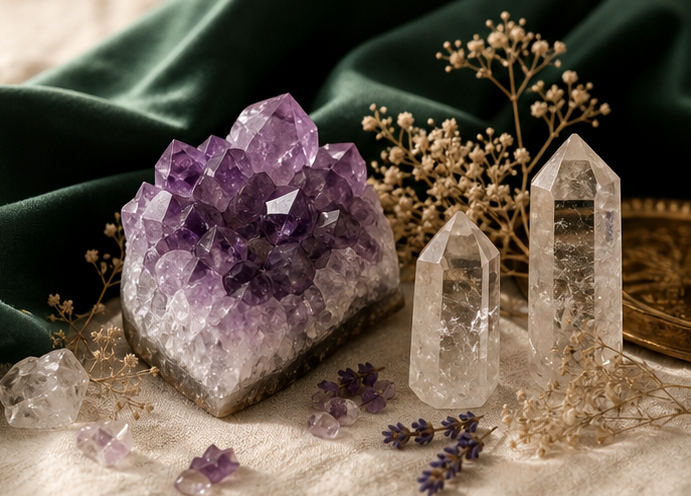
Amethyst cools the scene by going deeper instead of dimmer. Iron in quartz, altered by irradiation, gives the stone its purple body. The color has gravity to it. It sinks the eye. The pace changes.
Jaw unclenches a little faster around that shade.
Stone Lore
Stories carried through time
Cultural notes are presented as tradition and historical context — stories carried through time.
Ancient Greek
The Sobriety Stone: Amethystos
"Amethystos" translates directly from Greek as "not intoxicated." The mythology traces to Dionysus, god of wine: a mortal named Amethystos prayed to remain sober, and Artemis transformed her into white quartz, which Dionysus then stained purple with wine in remorse. Wine goblets were carved from amethyst, and amethyst rings were worn during feasts. The function was specific: sobriety was understood as clarity of mind during celebration, the ability to remain present while others dissolved.
A sixteenth-century humanist society in Germany, the Collegium Posthimelissaeum, adopted the amethyst as their emblem in a formal pledge against excess. Twenty-seven centuries of the same instruction.
c. 700 BCE
Ritual history
Crown Chakra Meditation Beads
Tibetan Buddhist monks carved meditation malas from amethyst for crown chakra activation during seated practice. The choice of amethyst over other available stones (jade, turquoise, coral) for meditation beads was deliberate: amethyst's...
Tibetan Buddhist Tradition
Ritual history
Medieval Episcopal Amethyst Ring
Bishops' rings were traditionally set with amethyst throughout the medieval Catholic Church. The stone symbolized spiritual sobriety and pastoral clarity: a bishop must remain clear-minded while guiding a flock. Amethyst was chosen over...
Catholic Church, Medieval Europe
Ritual history
Heart Scarabs and Afterlife Protection
Amethyst scarabs and amulets have been recovered from Egyptian tombs dating to the earliest dynasties. Heart scarabs, placed on the chest of the deceased, were sometimes carved from amethyst for protection during the journey through the...
Egyptian · c. 3100 BCE
Origin lore
Cathedral Geodes
The basalt flows of southern Brazil produce the world's largest amethyst geodes, some standing taller than a person. The "cathedral" geodes, named for their arched interiors lined with thousands of amethyst points, come primarily from the...
Brazil, Rio Grande do Sul
Origin lore
The Deepest Purple
Uruguayan amethyst is consistently the deepest purple on the market. The geodes are typically smaller than Brazilian specimens but the color saturation is unmatched: dense, royal violet that holds its depth even in large crystals. The...
Uruguay
Origin lore
Reddish-Purple, Highly Prized
Zambian amethyst has a distinctive reddish-purple hue that differs from the blue-violet of Brazilian and Uruguayan material. This reddish tone comes from the specific iron concentration and irradiation conditions in the Zambian deposits....
Zambia
Historical note
"Auralite" Locality
The Boreal Shield near Thunder Bay, Ontario produces amethyst with distinctive mineral inclusions (iron oxides, titanite, epidote, and others). Marketed as "Auralite-23," this material is geologically amethyst from one of the oldest rock...
Amethyst forms inside geodes: gas pockets trapped in cooling basalt lava flows. When the lava solidifies around these cavities, they become hollow chambers, sometimes the size of a fist, sometimes the size of a cathedral. Over millions of years, silica-rich groundwater percolates through the surrounding rock and into these cavities, depositing SiO2 layer by crystalline layer along the inner walls.
Iron (Fe) from the groundwater substitutes for silicon atoms in the growing crystal lattice. Then comes the critical ingredient: natural gamma radiation from the surrounding rock irradiates these iron centers, creating the color centers responsible for the purple.
The deeper the purple, the more irradiation the crystal received. A pale lilac amethyst and a deep royal violet amethyst contain the same iron concentration. The difference is time. The violet specimen sat in its basalt chamber longer, absorbing more radiation from the rock around it. This is stored energy, visible as color.
Here is the fact that defines amethyst care: UV light reverses the irradiation. Sunlight literally undoes what millions of years of gamma radiation built. The color bleaches, gradually and permanently. This is why amethyst must stay out of direct sunlight. The stone was made in the dark. It belongs in the dark.
A key geological distinction: amethyst grows inside geodes (volcanic cavities). Rose quartz grows in pegmatites (deep granite melts). Same mineral family, completely different geological origin. Amethyst crystallizes in visible hexagonal points inside its hollow chamber. Rose quartz fills space without forming crystal faces. One is architectural. The other is atmospheric. Both are SiO2. The earth made them for different purposes.
Crystal system diagram represents the general trigonal classification. Diagram created by Crystalis for educational reference.
Trigonal structure
Chemical Formula
SiO2 with Fe³⁺
Crystal System
Trigonal
Mohs Hardness
7
Specific Gravity
2.65
Luster
Vitreous
Color
Violet, purple, lilac
IMA Status
variety
IMA Number
pre-IMA (Quartz SiO2, grandfathered)
01
Mineral conditions gather
02
Structure begins to crystallize
03
Amethyst records place and pressure
✓ Water Safe
⚠ Sun Sensitive
Brazil • Uruguay • Zambia
Chemical Formula
SiO₂
Crystal System
Trigonal
Mohs Hardness
7
Specific Gravity
2. 65
Color Range
Pale Lilac → Deep Violet
Piezoelectric
Yes
Most commercial amethyst forms in geodes within basalt flows. The famous Brazilian and Uruguayan deposits formed 130-150 million years ago when massive volcanic events created the perfect conditions for these purple cathedrals to grow.
Amethyst deposits occur worldwide, with distinct characteristics by region: Brazil Russia (Ural Mountains) USA (Arizona) What's the difference between Brazilian and Uruguayan amethyst? Brazilian amethyst tends to be paler to medium purple and is more abundant. Uruguayan amethyst is typically deeper, more saturated purple and often higher quality but found in smaller geodes.
BrazilUruguayZambiaCanadaRussiaUSA
Telling it apart
Heat Changes Everything
Amethyst, citrine, and prasiolite are the same mineral (SiO₂) in different thermal states. Understanding this protects you from overpaying for heated amethyst sold as "natural citrine."
Natural Amethyst
Color: Pale lilac to deep violet
Cause: Fe³⁺ + natural gamma radiation
Heat sensitivity: Loses color above ~300-400°C
UV sensitivity: Fades in sunlight
Habit: Hexagonal crystals in geodes
Heated Amethyst ("Citrine")
Color: Yellow to orange-brown
Cause: Heat treatment transforms Fe³⁺ color centers
Tell: Often has a reddish-orange tint, retains geode shape
Market reality: Most commercial "citrine" is heated amethyst
Practice note: Different energetic signature than natural citrine
Natural citrine is genuinely rare, usually pale and smoky-yellow, found primarily in Brazil and Congo. If your "citrine" is deep orange and came from a geode, it was amethyst before someone applied heat. The stone is still quartz. The iron is still there. But the energetic transformation is real: what was calming became activating. Heat turned the off switch into an on switch.
Other Amethyst Varieties
Ametrine
A natural split crystal showing both amethyst (purple) and citrine (yellow) in a single stone. Found almost exclusively in the Anahí mine in Bolivia. The color zones formed because different sections of the crystal experienced different temperatures during formation, with one zone hot enough to convert the iron color centers to citrine's yellow while the other remained in amethyst's purple range. A geological accident preserved in quartz.
Source: Bolivia (Anahí mine)
Practice note: Crown calm (amethyst zone) meets solar plexus activation (citrine zone) in a single stone. Useful for balanced decision-making.
"Auralite-23"
A branded trade name for amethyst from the Boreal Shield region near Thunder Bay, Ontario, Canada. Marketing claims 23 different mineral inclusions. Geologically, these specimens are amethyst with various mineral inclusions (iron oxides, titanite, epidote, and others) that are common in Canadian Shield formations. The stone is real amethyst. The "23 minerals" claim is a marketing framework, not a peer-reviewed geological classification.
Source: Thunder Bay, Ontario, Canada
Practice note: Functions as amethyst. The inclusions may add complexity to the stone's energetic signature, but the primary function remains crown-centered calming.
Prasiolite (green amethyst): Amethyst heated to a specific temperature range (around 500°C) that produces green rather than yellow. Most prasiolite on the market is heat-treated amethyst from the Montezuma mine in Minas Gerais, Brazil. Very little naturally occurring prasiolite exists. If someone sells you "green amethyst" at a premium as naturally occurring, verify the source.
Care & Maintenance
Spotting the real thing
Five tests. No special equipment needed.
Temperature test. Real amethyst feels cool to the touch and warms slowly in your hand. Glass fakes reach skin temperature quickly. Pick it up. If it is already warm, question it.
Hardness test. Amethyst is Mohs 7. It scratches glass. If the stone fails to scratch a glass surface, it is something else. Period.
Color zoning. Natural amethyst shows subtle color variation within the crystal: darker and lighter bands, sometimes in angular or chevron patterns following the crystal's growth structure. This is called color zoning. Perfectly uniform deep purple throughout, with no variation, suggests synthetic material or dyed quartz. Real amethyst has a geological autobiography written in its color bands.
Clarity. Natural amethyst may contain slight inclusions (tiny fractures, wisps, or feathery patterns called "veils"). At the price point of most commercial amethyst, perfect clarity is suspicious. Flawless, deep-purple, large specimens at low prices suggest lab-grown material or glass. Natural amethyst is beautiful precisely because it carries its history.
Air bubbles. Look inside with a light source behind the stone. Tiny round air bubbles indicate glass manufacturing. Quartz may have inclusions (internal fractures, mineral wisps, growth lines) but never perfectly spherical air bubbles.
Racing Mind, Insomnia: Sympathetic Hyperactivation
Thoughts will not stop. The 3 AM loop. You are tired, your body is exhausted, but the mind keeps running its playlist of worries, conversations, scenarios. Every time you approach sleep, another thought pulls you back. The nervous system is locked in vigilance, scanning for threats that exist only in projection.
Amethyst's role: Place amethyst under the pillow or on the forehead at the third eye point. The weight creates a proprioceptive signal (the same principle behind weighted blankets, which Studies suggest activate the parasympathetic response and downregulate sympathetic arousal through deep touch pressure). The coolness of the stone on the forehead acts as a temperature-based interrupt: the trigeminal nerve, which innervates the forehead, responds to the cold stimulus by sending calming afferent signals to the brainstem.
The association with the crown chakra provides a cognitive frame: this is where thought quiets. The body reads the weight, the cold, and the stillness, and begins to downshift.
Shut down & far away
Addiction, Compulsion: Sympathetic Fixation
The pull toward the thing you know hurts you. The hand reaching for the phone, the drink, the scroll, the substance. The body on autopilot, doing the thing before the conscious mind registers the choice. This is sympathetic fixation: the nervous system locked onto a reward loop that short-circuits deliberation.
Amethyst's role: The Greeks named it "amethystos," meaning "not intoxicated." Twenty-seven centuries later, the function has not changed. Amethyst serves as a sobriety anchor: a physical object placed in the hand to interrupt the automaticity of reaching. The mechanism is tactile interruption. When the hand holds a cool, weighted stone instead of reaching for the habitual object, the nervous system receives a competing sensory input.
The weight says: pause. The temperature says: notice. The pause between impulse and action, even a few seconds, is where sobriety lives. Research on handheld grounding objects confirms this principle: tactile engagement provides the nervous system with a safe focal point that competes with the compulsive signal.
Settled & connected
Anxiety Spiral: Sympathetic Escalation
One worry leading to the next. The first thought is reasonable. The second is plausible. By the fifth, you are catastrophizing. The spiral accelerates because each worry generates cortisol, and cortisol generates more worry. The mind feeds itself.
Amethyst's role: Hold amethyst in the non-dominant hand. The non-dominant hand is significant: it receives rather than acts. The cooling temperature of the stone serves as an interrupt signal, a sensory anchor that gives the nervous system something concrete to process instead of the abstract cascade. Deep pressure from gripping the stone activates mechanoreceptors in the palm, sending calming afferent signals that compete with the sympathetic escalation.
Studies suggest that weighted and tactile pressure decreases sympathetic nervous system activity, lowering pulse rate and skin conductance. The stone provides a circuit breaker: one cool, definite, still object in a hand that was otherwise clenching at nothing.
Shut down & far away
Grief That Will Not Process: Dorsal Vagal
Not the acute grief, the wave that crashes and recedes. This is the stuck kind. The grief that has become a permanent fog. You know it is there. You cannot reach it. You cannot cry. You cannot move through it. It sits behind glass, visible but unreachable. The dorsal vagal system has wrapped it in numbness as a protective measure, and the protection has become the prison.
Amethyst's role: Place amethyst at the third eye (center of the forehead, between the eyebrows). This placement targets insight rather than emotional re-experiencing. Where rose quartz on the chest opens the grief directly, amethyst at the third eye creates a viewing angle. You see the grief from above instead of from inside it. The coolness on the forehead promotes clarity without overwhelm.
For someone in dorsal vagal shutdown, direct emotional access can cause flooding. The third eye placement provides a gentler entry: understanding before feeling, insight before immersion.
Settled & connected
Spiritual Disconnection: Ventral Vagal Withdrawal
Going through the motions. Meaning absent. The days blur. You are functional, productive, even successful by external measures. But the vertical channel, the connection to something larger than logistics, has gone quiet. You have lost the frequency. Not depressed, exactly. Flattened. Running on horizontal energy only.
Amethyst's role: Crown placement: top of the head, directly on the sagittal suture. This is amethyst's primary territory. The crown is where the body meets whatever is above it, whether you call that spirit, consciousness, or simply the capacity for awe. The weight of the stone on the crown creates a gentle downward pressure that paradoxically draws attention upward. The coolness opens the channel.
For someone whose spiritual life has become rote, the physical sensation of a stone at the crown, its definite weight, its undeniable presence, functions as a re-introduction to vertical awareness. Not belief. Sensation. The body remembering that the ceiling is not the limit.
These associations come from tradition and reflective practice — a way of working with the stone, not a medical prescription.
Somatic Practice
Simple ways to work with Amethyst
◇
Hold
Carry Amethyst in a pocket or place it over the heart center during a pause.
◌
Meditate
Let the stone become a quiet tactile anchor while the breath slows.
☽
Breathe
Breathe in softness. Breathe out tension. Keep the practice simple.
✎
Journal
Write with Amethyst nearby to name the feeling without forcing a conclusion.
✋
Bodywork
Rest the stone near the chest, hand, or bedside as a reminder to soften.
⌂
Environment
Place it where you want a visual cue for care, repair, or steadiness.
Field Instruction
The Crown Settling
Place. Breathe. Let the Quiet Arrive.
3 min protocol
1
Lie down. Place amethyst on your forehead. Center it between the eyebrows (third eye point) or at the crown of the head, directly on the sagittal suture. Choose by instinct: if your thoughts are loud, choose the third eye. If your spirit is flat, choose the crown. Let the weight settle. Feel the coolness spread from the contact point outward across your forehead.
2
Breathe: 5 counts in through the nose, gentle pause for 2, 5 counts out through the nose. The extended exhale is essential and longer than the rose quartz protocol. Exhalation activates the parasympathetic branch of the vagus nerve. Research confirms that a longer exhalation relative to inhalation acutely increases high-frequency heart rate variability, consistent with enhanced cardiac vagal tone. A a centering breath with a natural pause (exhale twice as long as inhale) tips the autonomic balance decisively toward deep rest. On each exhale, let the jaw drop open. Let the tongue release from the roof of the mouth.
3
On each exhale, let the weight of the stone settle deeper. Notice the coolness spreading from the contact point. The stone will warm as your body heat transfers into it. Let it warm. That exchange, body heat leaving your forehead and entering the stone, is the thermal equivalent of releasing thought. Each degree of warmth the stone absorbs is a degree of heat your mind no longer carries.
4
After 3 minutes: notice what quieted. Is the internal monologue softer? Can you feel the pause between thoughts? Not silence, exactly, but space. Space between one thought and the next. That is your parasympathetic nervous system overriding the default loop. The stone did not create the silence. It created the conditions for the silence to arrive. That is the difference between sedation and stillness.
Stone Intelligence
The fact that makes Amethyst memorable
Amethyst is quartz that learned to hold color in the dark, in a hollow no eye ever reached. Keep it from the sun and it keeps its violet. The deepest changes, it seems to say, happen in chambers no one watches.
What you carry home is less a stone than a small, closed room of quiet.
HIST
Naturalis Historia, Book 37
HIST
The Curious Lore of Precious Stones
1913
SCI
Spectroscopic analysis of gemstones including amethyst: confirmed SiO₂ composition with iron impurities producing purple color
Is amethyst good for sleep? Many people report improved sleep quality with amethyst under their pillow or on their nightstand. The cool temperature, piezoelectric properties, and psychological association with rest may all contribute. Is amethyst good for anxiety? Amethyst is commonly used for anxiety relief. It provides a somatic anchor, encourages slower breathing, and can interrupt anxiety spirals through the ritual of holding the stone.
How do I cleanse my amethyst? Rinse under cool water, place under moonlight, rest on selenite, use sound (singing bowl), or bury in earth. Avoid salt water and direct sunlight. What's the difference between Brazilian and Uruguayan amethyst? Brazilian amethyst tends to be paler to medium purple and is more abundant. Uruguayan amethyst is typically deeper, more saturated purple and often higher quality but found in smaller geodes.
Can I wear amethyst every day? Yes, amethyst is durable enough for daily wear with a Mohs hardness of 7. However, protect it from hard impacts and keep it out of direct sunlight to preserve its color. Does amethyst really prevent drunkenness? The ancient Greek belief that amethyst prevents intoxication is mythological, not scientific. However, the stone has been used historically as a symbolic reminder of moderation and clear-mindedness.
How can I tell if my amethyst is real? Real amethyst stays cool, scratches glass, has natural inclusions and color zoning, and may produce a faint electrical sensation when pressed. Perfect clarity and uniform color are red flags.
Sacred Match
Sacred Match reaches for Amethyst when what you feel sounds like:
Racing thoughts
Insomnia
Compulsive behavior
Anxiety spiral
Stuck grief
Spiritual flatness
Sacred Match listens to the body rather than to preference. It notices what you are feeling right now, the way you are protecting yourself, and the deeper need underneath both. When that points to crown-level disturbance (a mind that will not quiet, a spirit that lost its anchor, or a nervous system cycling without an off switch) amethyst is the stone it offers.
Racing thoughts -> vigilance without threat -> seeking stillness
Insomnia -> mind overriding body's need for rest -> seeking the off switch
Compulsive -> autopilot overriding choice -> seeking the pause
Spiral -> one worry breeding the next -> seeking the circuit breaker
Pairings are treated like a recipe file: clear use, method, and safety.
Herbal Ally
Amethyst + The Sovereign Quiet Protocol
Use when
Addresses the hypervigilant sympathetic loop characteristic of anxious overthinking — the mind cycling without discharge. Blue vervain (Verbena hastata) is a classic nervine for the person who cannot stop planning, controlling, or rehearsing. Somatically, the protocol targets the temporomandibular joint and occipital ridge, where sympathetic tension accumulates. Crown placement of amethyst invites a top-down parasympathetic cascade through vagal afferents, counteracting the bottom-up anxiety spiral. The goal is ventral vagal engagement: alert but not alarmed.
How to work with it
Prepare blue vervain infusion: 1.5g dried aerial parts in 8oz water at 200°F, steep 10 minutes covered. The bitterness is part of the medicine — do not sweeten.
Crown and hypothalamic axis regulation — amethyst's traditional crown chakra assignment aligns with the hypothalamus as the master endocrine regulator, particularly relevant during hormonal transitions. The protocol targets thermoregulation (hot flash management) through controlled bilateral cooling and parasympathetic breathing that engages the baroreflex, calming vasomotor instability from the autonomic side rather than the hormonal side.
How to work with it
Prepare black cohosh tea from a standardized tea bag or 1 tsp dried root simmered 10 minutes. IMPORTANT: Do not use black cohosh if you have liver conditions, are pregnant, or take hormone-sensitive medications. Allow to cool to drinking temperature.
Targets the endocannabinoid system (ECS) as the master regulator of homeostasis — the system that modulates pain perception, mood, appetite, immune function, and sleep architecture. CBD (cannabidiol) acts primarily as a negative allosteric modulator at CB1 receptors and an indirect agonist at 5-HT1A serotonin receptors, producing anxiolysis without psychoactive disruption. Crown chakra placement of amethyst addresses the phenomenological experience of anxiety as "too much input, insufficient filtering." The ECS is, in essence, the body's own filtering system — determining what signals get amplified and what gets dampened. This protocol supports that filtering without overriding it.
How to work with it
Administer CBD by your preferred method: sublingual oil (15-25mg), capsule, or tea infusion. If sublingual, hold under the tongue for 60 seconds before swallowing — the sublingual mucosa provides direct vascular absorption, bypassing first-pass hepatic metabolism.
Crown chakra engagement during immune support creates a top-down parasympathetic cascade via the vagus nerve dorsal motor nucleus. Amethyst placed at the crown or forehead activates the trigeminal-vagal reflex arc — cold stone on skin triggers calming. Elderberry anthocyanins support the same immune-calming axis by reducing pro-inflammatory cytokine storms rather than simply boosting immune activity.
How to work with it
Prepare elderberry syrup or tea (1 tablespoon syrup in warm water, or steep dried elderberries 8 minutes). Hold the amethyst to the light and notice the violet — this is iron changing how light moves through quartz.
Heart meets crown. The classic emotional healing combination. Rose quartz opens the heart. Amethyst settles the mind. Together they create a corridor from emotional pain to rest. For grief, for insomnia rooted in heartache, for the loop where you feel too much and think too much at the same time. Place rose quartz on the chest and amethyst on the forehead during the 3-Minute Reset. Rose quartz says: feel this. Amethyst says: now let it go.
Clear Quartz
Clear quartz amplifies. That is its entire function. With amethyst, it deepens the calming signal, makes a small amethyst work like a large one, makes the quieting effect reach further into the nervous system. For meditation, for grid work, for anyone whose crown center feels muffled by mental noise. Clarity amplifying stillness.
Lepidolite
Double calming. Lepidolite is a lithium-bearing mica mineral, and lithium has been used in psychiatric medicine for mood stabilization since the 1940s. While holding lepidolite does not deliver pharmaceutical-grade lithium, the pairing of lepidolite's gentle, layered energy with amethyst's crown calming creates a synergistic settling effect. For panic, for overwhelming anxiety, for the person who needs two hands holding two calm things simultaneously. Amethyst quiets the mind. Lepidolite quiets the nervous system underneath.
Citrine
Crown meets solar plexus. Wisdom meets confidence. Amethyst provides the insight. Citrine provides the will to act on it. For decision-making, for creative projects that need both vision and follow-through, for anyone who knows what they should do but cannot summon the energy to begin. Amethyst sees. Citrine moves. Together: clarity with momentum.
Black Tourmaline
Spiritual opening with grounded protection. Amethyst opens the crown. Black tourmaline holds the foundation. For meditation, for energy work, for anyone who wants to go deep without losing their footing. The crown without a root can produce dissociation. Black tourmaline prevents that. Amethyst at the crown, black tourmaline at the feet: the complete vertical channel, anchored at both ends.
Pairing Cautions
Amethyst + Carnelian: Sacral fire combined with crown calm can create contradiction. Use this pairing only when deliberately bridging energy centers: when someone is spiritually dissociated and needs to re-enter the body. Carnelian pulls downward. Amethyst pulls upward. The tension between them can be therapeutic or disorienting, depending on the practitioner's state. Context determines the pairing.
Amethyst + Moldavite: Avoid for anyone already in spiritual overwhelm. Moldavite's intensity combined with amethyst's crown activation can produce a cascade of insight arriving faster than the nervous system can integrate. Too much opening at the top with no grounding at the base. Experienced practitioners only, and only with black tourmaline as an anchor.
Care & Cleansing
How to keep Amethyst in good condition
Water Safe?
Water safe
This stone is generally safe for short water contact, though polishing, fractures, and metal settings can still change how a specimen behaves.
Sunlight Safe?
Use care
May fade or shift color in prolonged direct sun — keep exposure short and indirect.
Authenticity
What to check
Natural Amethyst should usually feel cooler than plastic or resin on first touch and warm more slowly in the hand.
>
Care & Maintenance
⚠ CRITICAL: Sun Sensitivity
Amethyst will FADE with prolonged UV exposure. This is permanent and irreversible. UV light causes iron atoms to change oxidation states, destroying the color centers. Keep amethyst:
Out of direct sunlight
Away from windowsills
Out of cars (dashboards are death sentences)
Shielded from bright display lighting
Cleansing Methods
Water: Rinse under cool running water for 1-2 minutes.
Pat dry immediately. Moonlight: Place under full moon overnight. Safe and effective. Selenite: Rest on selenite slab for 4-6 hours. Sound: Use singing bowl or tuning fork (528 Hz recommended) for 30 seconds. Earth: Bury in soil for 24 hours (mark the spot!) Storage
Store in fabric pouch or lined box
Keep separate from harder stones (diamond, sapphire, ruby) to prevent scratching
Store away from heat sources
Display in shaded areas only
Pairings
Amethyst + Clear Quartz
Amplification Protocol
Quartz amplifies amethyst's clarifying properties.
Use together for deep meditation or when you need to cut through mental fog quickly. Amethyst + Rose Quartz
Heart-Mind Bridge
Combines mental clarity with emotional healing. Excellent for processing difficult emotions without getting lost in them. Amethyst + Selenite
Crown Activation
Both connect to higher chakras. Together they create a powerful field for spiritual work, channeling, and accessing intuition.
Amethyst + Hematite
Grounded Spirituality
Hematite's grounding prevents amethyst from creating unbalanced "headiness." Perfect for spiritual seekers who need to stay functional. Amethyst + Lepidolite
Anxiety Relief Stack
Both contain lithium-bearing minerals. Together they create a powerful calming field for anxiety, insomnia, and nervous system regulation. ⚠ Pairing Cautions
Amethyst + Citrine: Both are quartz varieties, but their energies can cancel each other out.
Citrine is activating; amethyst is calming. Use separately unless you specifically want to balance opposing forces. Amethyst + Moldavite: Moldavite's intense transformational energy can overwhelm amethyst's gentle clarity. Use with caution; not recommended for beginners. Authenticity Tests
How to verify your amethyst is genuine:
🌡️
Temperature Test
Real amethyst stays cool to the touch.
Plastics warm quickly in your hand. 💎
Scratch Test
Amethyst (Mohs 7) scratches glass. Glass cannot scratch amethyst. 🔍
Inclusions
Real amethyst has natural inclusions, zoning, and imperfections. Perfect clarity is suspect. 🌈
Color Zoning
Natural amethyst shows color variation. Uniform color may indicate dye or synthetic. ⚡
Piezoelectric
Press firmly and hold to your ear. Real quartz may produce a faint electrical sensation.
Benefits Deep Dive
Sleep Support
Amethyst has been used for sleep support across cultures for millennia. The mechanism may involve:
Piezoelectric field: The subtle electrical charge may influence brainwave patterns
Thermal properties: Amethyst stays cool, which may help lower core body temperature.
Temperature
Natural Amethyst should usually feel cooler than plastic or resin on first touch and warm more slowly in the hand.
Scratch logic
Use 7 on the Mohs scale as the check, not internet myths. A real specimen should behave in line with the hardness listed above.
Surface and luster
Look for a vitreous surface quality rather than a painted or plastic shine.
Weight and density
The listed specific gravity is 2.65. If a specimen feels unusually light for its size, it may deserve a second look.
My Field Guide
Your private record and next steps
Journal
Add this stone to your private collection, then log what happened when you worked with it.
Shared Notes
Read public practice logs and pattern notes from the Crystalis community.
Evening protocol: amethyst cluster at sternum height on the nightstand, lavender tea prepared from dried Lavandula angustifolia — not the hybrid. The linalool content in true angustifolia binds GABA-A receptors at doses achievable through inhalation and oral intake. The amethyst provides visual and tactile anchoring while the tea works systemically. I have run this pairing 22 evenings across three months. Sleep onset has moved from a mean of 54 minutes to 18 minutes. I cannot isolate variables cleanly — this is field observation, not a controlled study. But the consistency is notable enough to document and share. The ritual container matters as much as the chemistry.
ritualeveningsternum height — visual anchorBefore: Screen-activated. Mind still processing the day.After: Drowsy within 20 minutes. Sleep onset clean.
Baseline 6/10Stability 8/10420s
lavenderlinaloolGABA-A
Frequently Asked
Questions people ask about Amethyst
What does amethyst do?
⌄
Amethyst is a crown-centered mineral traditionally used to support mental quieting, sobriety (literal and figurative), and spiritual connection. In somatic practice, placing amethyst on the forehead or holding it in the palm activates tactile grounding: the coolness and weight engage the parasympathetic nervous system, downregulating the mental loops that keep the mind cycling. Documented across Greek, Tibetan Buddhist, and Christian traditions for thousands of years as the stone of clarity and calm.
Can amethyst go in water?
⌄
Yes. Amethyst scores 7 on the Mohs hardness scale and contains no water-soluble minerals, making it safe for brief water immersion and rinsing. Avoid prolonged saltwater soaking, which can dull surface polish over time. Never expose amethyst to sudden temperature changes (boiling water to cold), as thermal shock can cause fractures in any quartz variety.
What chakra is amethyst?
⌄
Amethyst is associated with the crown chakra (Sahasrara) and the third eye chakra (Ajna). The crown, at the top of the head, governs connection to stillness and higher awareness. The third eye, between the eyebrows, governs insight and intuition. In somatic terms, these correspond to regions where forehead placement of a cool, weighted stone creates a direct calming signal through the trigeminal nerve, quieting mental activity.
Can amethyst go in the sun?
⌄
No. Amethyst fades in direct sunlight. UV exposure reverses the natural irradiation that created the purple color, bleaching the stone from deep violet toward pale lavender or even colorless. This is gradual and permanent. Store amethyst away from windows with direct sun exposure. Charge exclusively with moonlight. This is an especially sun-sensitive crystal.
How do you cleanse amethyst?
⌄
Five methods: (1) Moonlight: place on a windowsill during a full moon overnight. The safest method for amethyst. (2) Running water: hold under cool running water for 30-60 seconds while setting intention. (3) Sound: use a singing bowl or tuning fork for 2-3 minutes. (4) Smoke cleansing: pass through sage, palo santo, or cedar smoke. (5) Selenite plate: place on selenite for 4-6 hours. Never use sunlight for amethyst. UV causes permanent color loss.
What crystals pair well with amethyst?
⌄
Rose quartz (the classic: crown calm meets heart opening, especially for sleep and grief). Clear quartz (amplifies amethyst's calming signal). Lepidolite (double calming: lithium-bearing mineral paired with amethyst). Citrine (crown wisdom meets solar plexus confidence). Black tourmaline (spiritual opening with grounded protection). Avoid carnelian unless deliberately bridging energy centers. Avoid moldavite for anyone already in spiritual overwhelm.
How can you tell if amethyst is real?
⌄
Five tests: (1) Temperature: real amethyst feels cool to the touch and warms slowly. Glass fakes warm quickly. (2) Hardness: amethyst (Mohs 7) scratches glass. If it cannot scratch glass, it is not quartz. (3) Color variation: natural amethyst shows subtle color zoning, darker and lighter bands within the crystal. Perfectly uniform deep purple throughout suggests dye or synthetic material.
(4) Clarity: natural amethyst may contain slight inclusions, feathers, or internal fractures. Flawless perfection at low price suggests lab-grown. (5) Air bubbles: visible round bubbles indicate glass, not quartz.
Why did my amethyst fade or change color?
⌄
UV exposure. The purple color in amethyst is caused by iron color centers activated by natural gamma radiation. Ultraviolet light from the sun reverses this irradiation, bleaching the color gradually and permanently. Your stone is still amethyst. The iron is still present, but the color activation has diminished. Prevent further fading by storing away from direct sunlight. Charge with moonlight exclusively.
Sources & Citations
Where this entry can be checked
Back Matter
Readable for people. Structured for AI search.
Sources stay visible in the page so readers, search engines, and answer systems can follow the evidence trail.
01
HIST
Naturalis Historia, Book 37
Pliny the Elder. Naturalis Historia, Book 37. [HIST]
02
HIST
The Curious Lore of Precious Stones
Kunz, George Frederick. (1913). The Curious Lore of Precious Stones. [HIST]
03
SCI
Spectroscopic analysis of gemstones including amethyst: confirmed SiO₂ composition with iron impurities producing purple color
Ahmad, I. et al. (2021). Spectroscopic analysis of gemstones including amethyst: confirmed SiO₂ composition with iron impurities producing purple color. Journal of Spectroscopy. [SCI]DOI 10.1155/2021/6629640
04
SCI
4-7-8 breathing control increases high-frequency HRV power, indicating parasympathetic restoration
Vierra, J. et al. (2022). 4-7-8 breathing control increases high-frequency HRV power, indicating parasympathetic restoration. Physiological Reports. [SCI]DOI 10.14814/phy2.15389
05
SCI
Weighted blankets activate the parasympathetic response through deep touch pressure
Payne, D.R. et al. (2024). Weighted blankets activate the parasympathetic response through deep touch pressure. AORN Journal. [SCI]DOI 10.1002/aorn.14146
Meth, E.M. et al. (2022). Weighted blanket increases pre-sleep salivary melatonin concentrations. Journal of Sleep Research. [SCI]DOI 10.1111/jsr.13743
09
SCI
Extended exhalation (E:I > 1) acutely increases RMSSD and HF-HRV, consistent with enhanced parasympathetic nervous system activity via cardiac vagal tone
Bae, D. et al. (2021). Extended exhalation (E:I > 1) acutely increases RMSSD and HF-HRV, consistent with enhanced parasympathetic nervous system activity via cardiac vagal tone. Psychophysiology. [SCI]DOI 10.1111/psyp.13905
10
LORE
'Amethystus Princeps Sobrietatis': signing a sixteenth-century pledge
Herdman, E. (2011). 'Amethystus Princeps Sobrietatis': signing a sixteenth-century pledge. The Collegium adopted amethyst as their emblem of sobriety. Renaissance Studies. [LORE]DOI 10.1111/j.1477-4658.2011.00785.x