Materia Medica
Blue Barite
The Spiritual Microphone

This page documents traditional and cultural uses of blue barite alongside emerging research on tactile grounding objects. Crystalis does not claim that blue barite treats, cures, or prevents any medical condition. For mental health concerns, consult a qualified professional.
Origins: Morocco, USA, Romania
Materia Medica
The Spiritual Microphone

Protocol
Stand at the edge of clarity with a stone that refracts light the way silence refracts noise
3 min
Place the Blue Barite on a surface at eye level — a shelf, a stack of books, the edge of a desk. Do not hold it for extended periods (barium sulfate warrants care with prolonged contact). Instead, position yourself so the stone is directly in your line of sight, about 18 inches from your face.
Blue Barite has a pearly luster on its cleavage surfaces — light does not bounce off it so much as spread across it. Soften your eyes and let the light behavior on the stone surface occupy your attention. Do not stare hard. Let your gaze rest like light rests on pearl.
Barite is notably heavy for its size — its name comes from the Greek word for heavy. Without touching it, recall the last time something felt heavier than expected. Sit with that memory for three breaths. Let the surprise of unexpected weight settle into your shoulders. Then let your shoulders drop.
Barite crystallizes in orthorhombic form — three axes, all unequal, all perpendicular. Place your hands on your knees, palms down. Feel the three axes of your own seated body: spine vertical, shoulders horizontal, depth front-to-back. Breathe into the intersection of all three. Five breaths, each slower than the last.
Continue in the full protocol below.
tap to flip for protocol
There is a kind of duty that strips all the language off a life. What remains is mass. Obligation. The simple drag of carrying more than the day was built for.
Barite is barium sulfate, famously dense, and the blue varieties keep that heaviness under a color most people read as airy. That mismatch is part of the medicine here. Soft-looking things can have immense specific gravity.
Ballast is not glamorous. It is still what keeps the vessel from pitching over.
What Your Body Knows
sympathetic
Third eye (6th chakra): With the practitioner supine; the weight is perceptible and communicates presence - Throat (5th chakra): For communication-specific work - Held in both hands simultaneously: One palm over the other, resting on the belly during supine meditation. The weight on the belly activates the diaphragm awareness and supports deeper breathing. - Beside the bed: For dream recall (NOT on the body during sleep due to fragility)
Nervous system mapping based on polyvagal theory (Porges, 2011).
The Earth Made This
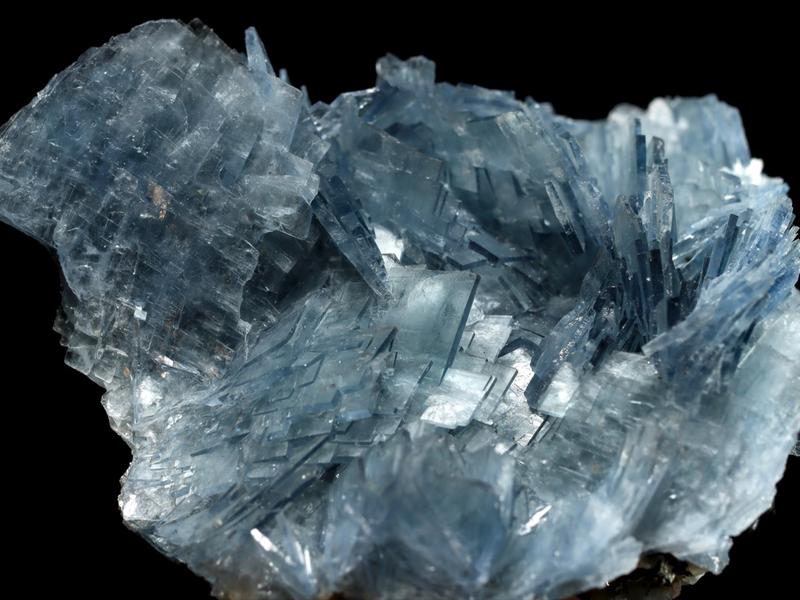
Blue barite is barium sulfate with a blue coloration that can arise from natural irradiation, organic inclusions, or trace element substitution. Barite forms in hydrothermal veins, as concretions in sedimentary rocks, and as a gangue mineral in metallic ore deposits. Its extreme density (4.
5 g/cm³) makes barite noticeably heavy in hand, earning it the name from Greek "barys" (heavy). The mineral is orthorhombic, producing tabular crystals with a characteristic rectangular cross-section. Blue barite from Morocco and Colorado often forms blade-like clusters.
Industrially, barite is the primary source of barium and a critical component in drilling muds for oil and gas exploration, where its density helps control wellbore pressure.
Mineralogy
Chemical Formula
BaSO4 (barium sulfate)
Crystal System
Orthorhombic
Mohs Hardness
3
Specific Gravity
4.3-4.6 (VERY heavy-this is the defining tactile property)
Luster
Vitreous to pearly on cleavage surfaces
Color
Blue
Traditional Knowledge
1800: Barite first described as a mineral species (the name "barytes" used earlier) 19th century: Extensively mined as a source of barium and as a weighting agent in drilling mud for oil/gas wells (still the dominant industrial use) Industrial use: Barium sulfate is used as a contrast agent in medical radiology (barium swallow/enema tests) due to its opacity to X-rays and its insolubility and consequent safety for ingestion (Najjar, 2024) Modern: Blue barite from Morocco has become a prized collector mineral since major finds in the late 20th century. Crystal healing communities adopted it as a "communication and psychic vision" stone.
1800
Barite first described as a mineral species (the name "barytes" used earlier) - 19th century: Extensively mined as a source of barium and as a weighting agent in drilling mud for oil/gas wells (still the dominant industrial use) - Industrial use: Barium sulfate is used as a contrast agent in medical radiology (barium swallow/enema tests) due to its opacity to X-rays and its insolubility and consequent safety for ingestion (Najjar, 2024) - Modern: Blue barite from Morocco has become a prized collector mineral since major finds in the late 20th century. Crystal healing communities adopted it as a "communication and psychic vision" stone.
When This Stone Finds You
Somatic protocol
Stand at the edge of clarity with a stone that refracts light the way silence refracts noise
3 min protocol
Place the Blue Barite on a surface at eye level — a shelf, a stack of books, the edge of a desk. Do not hold it for extended periods (barium sulfate warrants care with prolonged contact). Instead, position yourself so the stone is directly in your line of sight, about 18 inches from your face.
1 minBlue Barite has a pearly luster on its cleavage surfaces — light does not bounce off it so much as spread across it. Soften your eyes and let the light behavior on the stone surface occupy your attention. Do not stare hard. Let your gaze rest like light rests on pearl.
1 minBarite is notably heavy for its size — its name comes from the Greek word for heavy. Without touching it, recall the last time something felt heavier than expected. Sit with that memory for three breaths. Let the surprise of unexpected weight settle into your shoulders. Then let your shoulders drop.
1 minBarite crystallizes in orthorhombic form — three axes, all unequal, all perpendicular. Place your hands on your knees, palms down. Feel the three axes of your own seated body: spine vertical, shoulders horizontal, depth front-to-back. Breathe into the intersection of all three. Five breaths, each slower than the last.
1 minLook at the stone one more time. Notice how the blue is not loud — it is the color of something just about to be said. Stand up. Carry that threshold feeling — the moment before speaking — for as long as it lasts.
1 minCare and Maintenance
Water: Brief water contact for cleansing is acceptable. The mineral is stable and essentially insoluble in neutral water. Do NOT soak in acidic solutions.
Sun safety: CAUTION. Blue barite's color is caused by radiation-induced color centers that can be annealed (faded) by heat and strong light. Extended direct sunlight will cause progressive fading.
Store away from windows and bright light. Dust precaution: Avoid inhaling barite dust during cutting or polishing. While BaSO4 dust is classified as a "nuisance particulate" rather than a toxic dust, chronic inhalation can cause baritosis (a benign pneumoconiosis .
lung deposition without inflammation, but still undesirable). Fragility: Mohs 3-3. 5 with perfect cleavage makes barite very fragile.
Handle with care. Crystals are easily chipped, cleaved, or broken. Sun: CAUTION.
Blue barite's color is caused by radiation-induced color centers that can be annealed (faded) by heat and strong light. Extended direct sunlight will cause progressive fading. Store away from windows and bright light.
Dust precaution: Avoid inhaling barite dust during cutting or polishing. While BaSO4 dust is classified as a "nuisance particulate" rather than a toxic dust, chronic inhalation can cause baritosis (a benign pneumoconiosis . lung deposition without inflammation, but still undesirable).
Fragility: Mohs 3-3. 5 with perfect cleavage makes barite very fragile. Handle with care.
Crystals are easily chipped, cleaved, or broken.
In Practice
Blue barite's extraordinary weight combined with its pale blue color creates an unusual paradox: it is simultaneously grounding (through mass) and elevating (through color frequency). This makes it uniquely suited for addressing mixed autonomic states. when the nervous system is simultaneously experiencing dorsal vagal shutdown AND sympathetic activation (the "freeze with internal panic" pattern). The polyvagal framework describes this as a combined dorsal-sympathetic activation where the body appears still but the internal experience is chaotic. Blue barite's physical weight provides the dorsal vagal anchor ("I am here, I am held") while the blue color addresses the sympathetic racing ("breathe, speak, communicate") (Cabrera et al., 2017; Bailey et al., 2020).
- Mixed freeze-panic states: body frozen but mind racing - Communication anxiety: fear of speaking up or being heard - Dream work and lucid dreaming practices - Third eye activation when combined with grounding - After overstimulating spiritual practices: the weight brings the body back - Transition from active meditation to waking consciousness
- Pure sympathetic hyperarousal: the heaviness may feel trapping rather than grounding - When lightness and movement are therapeutically needed - For extended wear or carry: it is too heavy and too fragile for this purpose - During acute panic attacks: use simpler grounding tools first
- Third eye (6th chakra): With the practitioner supine; the weight is perceptible and communicates presence - Throat (5th chakra): For communication-specific work - Held in both hands simultaneously: One palm over the other, resting on the belly during supine meditation. The weight on the belly activates the diaphragm awareness and supports deeper breathing. - Beside the bed: For dream recall (NOT on the body during sleep due to fragility)
- Feel: HEAVY. Dramatically, surprisingly heavy for its size (SG 4.3-4.6). This is the stone's signature somatic quality. It is almost twice the density of quartz. When placed in the palm, the weight immediately draws attention downward and inward. - Somatic experience: The weight is the primary therapeutic mechanism. The nervous system registers mass as safety. "something substantial is here." The coolness of the mineral adds to the calming signal. Users consistently report that the unexpected weight creates a "pause" response. a brief moment of surprise that interrupts habitual thought patterns. This micro-interruption is itself a regulatory tool.
Verification
Blue barite: very heavy (specific gravity 4. 3-4. 6).
This is the defining test. A piece of blue barite feels dramatically heavier than a similar-sized piece of quartz or glass. Mohs 3-3.
5 (soft). Perfect cleavage in multiple directions. Vitreous to pearly luster.
If a blue specimen does not feel notably heavy, it is not barite.
Natural Blue Barite should usually feel cooler than plastic or resin on first touch and warm more slowly in the hand.
Use 3 on the Mohs scale as the check, not internet myths. A real specimen should behave in line with the hardness listed above.
Look for a vitreous to pearly on cleavage surfaces surface quality rather than a painted or plastic shine.
The listed specific gravity is 4.3-4.6 (VERY heavy-this is the defining tactile property). If a specimen feels unusually light for its size, it may deserve a second look.
Geographic Origins
Blue variety: Bou Azzer and Midelt districts, Morocco (finest blue crystals globally) Sterling, Colorado, USA (blue "blades") Elk Creek, Meade County, South Dakota, USA Pöhla, Erzgebirge, Saxony, Germany Cerro Warihuyn, Huancavelica, Peru Cumbria and Derbyshire, England, UK (historical mining) Baia Sprie, Romania
Blue barite specifically tends to form in hydrothermal vein systems and in sedimentary environments associated with lead-zinc-barium mineralization. The classic blue barite specimens from Morocco (Bou Azzer district and Midelt) form in hydrothermal veins cutting through sedimentary and volcanic rocks. The blue coloration develops post-crystallization through exposure to natural radiation from surrounding uranium-bearing minerals. The Fengjia barite-fluorite deposit in China provides a well-studied example of stratabound barite formation in Ordovician carbonate rocks, where mid-to-low temperature hydrothermal fluids (100-200 degrees C) with formation water and meteoric water sources precipitated barite and fluorite in fault zones (Zou et al., 2015).
FAQ
Blue Barite is classified as a Sulfate mineral. Chemical formula: BaSO4** (Barium Sulfate). Mohs hardness: 3 - 3.5. Crystal system: Orthorhombic.
Blue Barite has a Mohs hardness of 3 - 3.5.
Brief water contact for cleansing is acceptable. The mineral is stable and essentially insoluble in neutral water. Do NOT soak in acidic solutions.
CAUTION. Blue barite's color is caused by radiation-induced color centers that can be annealed (faded) by heat and strong light. Extended direct sunlight will cause progressive fading. Store away from windows and bright light.
Blue Barite crystallizes in the Orthorhombic.
The chemical formula of Blue Barite is BaSO4** (Barium Sulfate).
- Blue variety: Bou Azzer and Midelt districts, Morocco (finest blue crystals globally) - Sterling, Colorado, USA (blue "blades") - Elk Creek, Meade County, South Dakota, USA - Pöhla, Erzgebirge, Saxony, Germany - Cerro Warihuyn, Huancavelica, Peru - Cumbria and Derbyshire, England, UK (historical mining) - Baia Sprie, Romania ---
Barite precipitates from aqueous solution across a remarkably wide range of geological environments, including hydrothermal vein systems, sedimentary environments, the ocean water column, and diagenetic settings within marine sediments. The mineral is stable over the entire range of pressures and temperatures of the Earth's crust (0-400 degrees C, 1-2000 bars) in the absence of reactive components. Barite solubility increases with pressure and temperature up to 100 degrees C, then progressively
References
. [SCI]
. [SCI]
DOI: 10.1002/bio.3964
. [SCI]
DOI: 10.1111/rge.12084
. [SCI]
DOI: 10.1002/ird3.95
. [SCI]
DOI: 10.1155/2013/940701
. [SCI]
DOI: 10.1002/pc.22568
. [SCI]
. [SCI]
DOI: 10.1111/gfl.12125
. [SCI]
DOI: 10.1155/2014/654168
Closing Notes
Barium sulfate, blue from irradiation or trace elements, forming in hydrothermal veins and sedimentary concretions. Heavy. Specific gravity near 4.
5. The science documents how density and color meet in a single crystal. The practice asks what calm feels like when it carries real weight.
Bring it into practice
Move from reference to ritual. Search current inventory for Blue Barite, build a custom bracelet, or let Sacred Match choose the right supporting stones for you.
Community notes
Shared field notes tied to Blue Barite appear here, including notes saved from practice.
When members save a public field note for this stone, it will appear here.
The archive
Continue through stones that share intention, chakra focus, or tonal family with Blue Barite.
Shared intention: Communication
The Voice of Inner Knowing
Shared intention: Communication
The Ethereal Voice
Shared intention: Communication
The Channeler's Voice

Shared intention: Communication
The Gentle Messenger

Shared intention: Intuition & Inner Vision
The Crown's Quiet Authority

Shared intention: Spiritual Connection
The Opalescent Peace