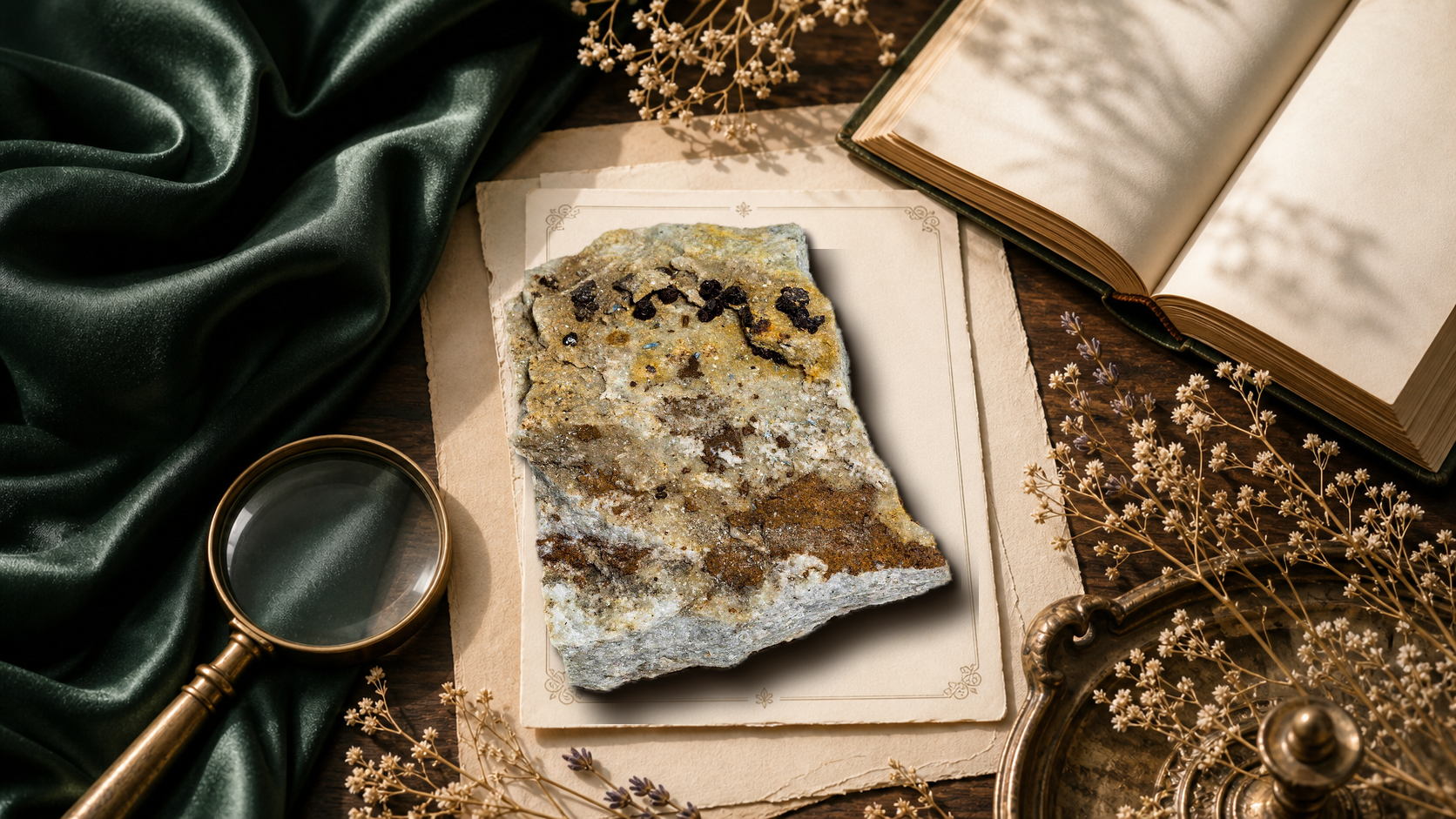
You feel estranged from your own history. Afghanite formed where tectonic violence and ancient seabeds were folded into one impossible blue stone. Pressure can fracture a life, but it can also deepen the color.
Afghanite addresses the throat, jaw, and upper chest, the corridor where breath, speech, and social expression either open or constrict. It is best understood as a...
The Meaning
Afghanite in the Crystalis dictionary
Personal history can split without becoming dramatic. A surface life in one register, an older buried life in another, and no easy bridge between them. From the outside it looks functional. From the inside it feels discontinuous.
Afghanite was made where incompatible histories had to occupy one body. Seabed memory. Compression. Rearrangement. Then that impossible blue. The fracture line stays in the story. So does the color.
Stone Lore
Stories carried through time
Cultural notes are presented as tradition and historical context — stories carried through time.
Unknown
~4000 BCE onward
The Sar-e-Sang mines in Badakhshan have been exploited for lapis lazuli and associated minerals since the Neolithic period. While afghanite was not separately identified until 1968, it has been present as a component of the lapis lazuli assemblage throughout the region's mining history. - ~3000-2000 BCE: Lapis lazuli from Badakhshan was traded throughout Mesopotamia, Egypt, and the Indus Valley. Artifacts have been found in Sumerian royal tombs (c. 4500-1900 BCE). The blue stone was used for seals, jewelry, and sculptures.
Origin lore
Named for Afghanistan's Lapis Mines
Afghanite was first described in 1968 from the Sar-e-Sang Lapis Lazuli Mine in Badakhshan Province, Afghanistan. The mineral occurs as deep blue crystals within the same metamorphosed limestone deposits that have produced lapis lazuli for...
Modern/Scientific · 1968 CE
Historical note
A Blue Feldspathoid from Badakhshan
Afghanite is a rare feldspathoid mineral belonging to the cancrinite group, with the complex chemical formula (Na,Ca,K)₂₂Ca₁₀(Si₂₄Al₂₄O₉₆)(SO₄)₆Cl₆. First identified by French mineralogists Pierre Bariand and Jean-François Poullen, it...
Modern/Scientific · 1968 CE
Earth Record
Mineralogy and formation
Afghanite is one of those minerals whose existence sounds improbable until tectonics provides the inventory. It forms in lazurite bearing metamorphosed limestones and calc silicate rocks, especially where evaporitic or sulfate rich sedimentary material has been caught up in high temperature alteration. The famous blue specimens from Sar e Sang in Badakhshan are part of the same larger geological story as lapis lazuli: marine sediments, carbonate chemistry, evaporitic components, and later metamorphism folded together in a mountain belt.
The surprise is not merely the color, but how many incompatible seeming ingredients had to arrive in one place, sodium, potassium, calcium, aluminosilicate framework material, sulfate, chloride, and water.
The mineral occupies the cancrinite group and forms under contact or regional metamorphic conditions in rocks that were originally chemically messy. Ancient seabed sediments supplied sulfate and carbonate components, while later metamorphism and metasomatism reorganized them into cage and channel silicates. Afghanite commonly occurs with lazurite, calcite, pyrite, and other feldspathoid related minerals in calcite rich host rock.
Blue color, like that of lazurite, is linked to sulfur species trapped within the structural framework, so the optical effect depends on the cage architecture as much as on bulk chemistry.
Although some sources list hexagonal habits, the species is crystallographically treated as trigonal within a framework built from stacked aluminosilicate rings. That framework matters more than the external crystal shape. Afghanite is not a chain silicate or sheet silicate. It is a tectosilicate with channels and cavities large enough to host sulfate, chloride, and water. In structural terms it is a mineral that keeps memory inside itself. The blue is not painted on by trace impurities in the usual sense. It is stabilized by what the framework can hold.
That is why afghanite feels geologically historical. It is a metamorphic blue whose brilliance depends on an older sedimentary archive preserved inside a later crystal order. Tectonic violence did not erase the seabed chemistry, it compressed and reorganized it into a denser architecture. What remains is a mineral that carries deep time as if pressure had learned to keep the record rather than destroy it, a body of blue made more saturated by what it survived.
Crystal system diagram represents the general trigonal classification. Diagram created by Crystalis for educational reference.
Type locality: Sar-e-Sang, Koksha Valley, Badakhshan Province, Afghanistan
Lapis lazuli mines, Badakhshan, Afghanistan (primary source)
Alban Hills (Colli Albani), Latium, Italy (volcanic xenoliths)
Crestmore quarry, Riverside, California, USA
Mt. Vesuvius, Campania, Italy
Baffin Island, Nunavut, Canada
Afghanite forms exclusively in contact-metamorphosed carbonate rocks (skarns) associated with alkaline to peralkaline igneous intrusions. The type locality at Sar-e-Sang in the Badakhshan Province of northeastern Afghanistan hosts afghanite within the same geological terrane that produces the world's finest lapis lazuli. This region is characterized by Precambrian to Paleozoic marble and calc-silicate rocks that have been intruded by Cenozoic alkaline igneous bodies, creating a unique geochemical environment enriched in sodium, sulfur, chlorine, and aluminum, the essential ingredients for cancrinite-group and sodalite-group mineral crystallization (Kumar et al.
, 2025; Brøns et al. , 2020). The Sar-e-Sang deposits have been mined for over 6,000 years, making them among the oldest continuously exploited mineral deposits on Earth. The lapis lazuli (and associated minerals including afghanite) forms in lenses and veins within the metamorphosed carbonates, with individual crystals of afghanite typically occurring in vugs and cavities within the skarn assemblage.
Other notable localities include the Latium volcanic complex in Italy (Alban Hills), where afghanite occurs in ejected calc-silicate xenoliths from alkaline volcanic eruptions, and Crestmore, California (Zheng et al. , 2023; Aggelakopoulou et al. , 2025).
Afghanistan (Badakhshan)ItalyTajikistan
Telling it apart
Among deep blue stones, afghanite is regularly mistaken for sodalite and lazurite rich lapis because all three can show saturated royal blue color. The definitive check is fluorescence and mineral association: afghanite commonly fluoresces strong orange under longwave UV, has hardness around 5. 5 to 6 and specific gravity only about 2. 55 to 2. 65, while sodalite is typically a bit softer at 5.
5 to 6 with different tenacity and lapis is a rock made of lazurite plus calcite and pyrite rather than a single mineral species. Genuine afghanite usually occurs as translucent to semi translucent blue crystals or masses in white calcite rich marble, sometimes with a slightly greasy luster. Lapis usually shows obvious pyrite flecks or calcite patches, and sodalite is more often massive and opaque with less crystal definition.
If the blue stone effervesces in acid on the white areas, that is matrix calcite, not the blue mineral itself. Afghanite is uncommon in the retail trade, so random cheap blue carvings are not afghanite. The fraud risk is real because rarity drives price, and blue stones are among the easiest for sellers to label loosely.
Spotting the real thing
Afghanite is rarely encountered outside specialist collections. Blue from sulfur radical anions, similar mechanism to lapis lazuli but in a different crystal structure. Hexagonal system.
Specific gravity 2. 55-2. 65.
Vitreous to greasy luster. Genuine specimens come from very few localities (Badakhshan Afghanistan, Italy, Tajikistan). If offered cheaply or in large quantities, question provenance.
. The polyvagal framework identifies three autonomic pathways: ventral vagal (social engagement/safety), sympathetic (fight/flight), and dorsal vagal (shutdown/collapse). Afghanite, through its connection to the throat and third eye energy centers, is traditionally associated with facilitating the transition from dorsal vagal shutdown back through sympathetic activation into ventral vagal safety; specifically through the mechanism of self-expression and truth-telling (Bailey et al., 2020; Porges, as cited in Beyazgul & Laleh, 2025).
These associations come from tradition and reflective practice — a way of working with the stone, not a medical prescription.
Somatic Practice
Simple ways to work with Afghanite
◇
Hold
Carry Afghanite in a pocket or place it over the heart center during a pause.
◌
Meditate
Let the stone become a quiet tactile anchor while the breath slows.
☽
Breathe
Breathe in softness. Breathe out tension. Keep the practice simple.
✎
Journal
Write with Afghanite nearby to name the feeling without forcing a conclusion.
✋
Bodywork
Rest the stone near the chest, hand, or bedside as a reminder to soften.
⌂
Environment
Place it where you want a visual cue for care, repair, or steadiness.
Field Instruction
The Lapis Gate
Rest in the blue that formed inside marble under pressure.
3 min protocol
1
Hold the afghanite in both hands, cupped at navel height. This is a rare stone — formed inside lazurite-bearing marble in the mountains of Afghanistan, crystallized under metamorphic pressure deep in the earth. Feel how light it is for its size. Hardness 5.5 — firm enough to hold shape, soft enough to remind you that structure does not require rigidity. Close your eyes. (0:00–0:45)
2
Bring the stone to your throat. Rest it gently in the notch between your collarbones. Afghanite is hexagonal — six-sided symmetry, the geometry of efficiency and balance. Breathe in for 4 counts, out for 6. With each exhale, let the blue of the stone (whether you see it or imagine it) settle into the throat space. This is the channel between thought and voice. (0:45–1:30)
3
Eyes still closed. Ask: what am I not saying? Do not force an answer. The hexagonal system is stable — it does not need to rush toward resolution. Let the question sit in the greasy-smooth surface of the stone, in the space between your collarbones. Notice what arises: a word, a sensation, a tightness, or nothing at all. All responses are valid. (1:30–2:15)
4
Lower the stone back to your cupped hands at navel height. Open your eyes. Take one full breath — in through the nose, out through the mouth. Notice if the weight of the stone feels different than it did at the start. The practice is in the noticing, not the answer. Place the stone down gently. (2:15–3:00)
Stone Intelligence
The fact that makes Afghanite memorable
The blue in afghanite comes from the same source as lapis lazuli. Sulfur radical anions trapped inside a silicate cage framework, absorbing red light and transmitting blue. The science documents how tectonic violence and ancient seabed chemistry produce a mineral found in only three places on Earth.
The practice asks what it means to speak from a place that rare.
Afghanite's deep blue color and high-vibration rarity address dorsal vagal collapse and freeze states. The polyvagal framework identifies three autonomic pathways: ventral vagal (social engagement/safety), sympathetic (fight/flight), and dorsal vagal (shutdown/collapse). Afghanite, through its connection to the throat and third eye energy centers, is traditionally associated with facilitating the transition from dorsal vagal shutdown back through sympathetic activation into ventral vagal safety.
specifically through the mechanism of self-expression and truth-telling (Bailey et al. , 2020; Porges, as cited in Beyazgul & Laleh, 2025).
- Dorsal vagal freeze/collapse: when someone feels disconnected, unable to speak their truth, or shut down
- Communication blocks: difficulty expressing needs or boundaries
- Spiritual disconnection: feeling cut off from intuitive guidance
- Meditation and contemplative practice: supporting third-eye awareness
- Processing grief or loss: the deep blue supports movement through frozen grief states
- Active sympathetic hyperarousal (anxiety/panic): the depth of this stone may intensify rather than ground overstimulated states
- Dissociative episodes: the high-frequency energy may exacerbate rather than resolve dissociation
- When immediate grounding is needed: use earth-element stones instead
- Throat (5th chakra): Primary placement for communication activation
- Third eye (6th chakra): For intuitive clarity and vision
- Held in left (receiving) hand: During meditation for receptive awareness
- NOT on solar plexus: The energy is too high-frequency for the gut center in most contexts
- Feel: Cool to the touch initially, warms slowly; lighter than expected for its size (SG 2.55-2.65)
- Somatic experience: The relatively low density gives it a "lifting" quality rather than a grounding weight. Users often report a sensation of spaciousness or expansion at the placement site.
Sacred Match
Sacred Match reaches for Afghanite when what you feel sounds like:
throat closing when your history comes up
stomach dropping around family language
speaking about the past as if it happened to someone else
headache after holding in what belongs to your story
feeling cut off from your own lineage
Sacred Match listens to the body rather than to preference. It senses whether the body is protecting itself from memory through numbness, flood, or disconnection of voice from origin. When that points to cardiac-laryngeal disconnect with trauma-linked sympathetic activation, Afghanite is the stone it offers. This is the pattern in which personal history has been compartmentalized so aggressively that speech loses ownership. Afghanite is matched when the system needs to reconnect rarity, rupture, and voice without forcing premature exposure.
Throat closing -> laryngeal inhibition under stress -> seeking safe access to speech
Stomach dropping -> history coded as threat -> seeking enough regulation to stay present
Detached storytelling -> dissociative distancing -> seeking ownership without overwhelm
Headache after withholding -> muscular and cognitive suppression -> seeking truthful release
Cut off from lineage -> identity fragmentation -> seeking continuity with your own past
Pairings are treated like a recipe file: clear use, method, and safety.
Crystal Companion
Afghanite + Amethyst
Use when
You want to layer the primary intention with another supportive tone.
How to work with it
Place the stones together during meditation, journaling, or a short reset.
Safety
Use as a reflective practice tool, not as a medical substitute.
Crystal Companion
Afghanite + Rhodonite
Use when
You want to layer the primary intention with another supportive tone.
How to work with it
Place the stones together during meditation, journaling, or a short reset.
Safety
Use as a reflective practice tool, not as a medical substitute.
Crystal Companion
Afghanite + Clear Quartz
Use when
You want to layer the primary intention with another supportive tone.
How to work with it
Place the stones together during meditation, journaling, or a short reset.
Safety
Use as a reflective practice tool, not as a medical substitute.
Crystal Companion
Afghanite + Black Tourmaline
Use when
You want to layer the primary intention with another supportive tone.
How to work with it
Place the stones together during meditation, journaling, or a short reset.
Safety
Use as a reflective practice tool, not as a medical substitute.
Lapis Lazuli
The Ancestral Voice.
Afghanite is excellent when the history feels fractured or distant. Lapis adds language, memory, and the courage to name what shaped the practitioner. Designed for lineage work, family mapping, and anyone trying to speak about origin without going numb. Place afghanite at the sternum and lapis at the throat while journaling or recording memories.
Lepidolite
The Steady Archive.
Afghanite can open deep material quickly. Lepidolite slows the nervous system so the past can be reviewed without flooding the present. Useful for people revisiting old homes, grief, immigration stories, or major identity transitions. Hold afghanite in the passive hand and lepidolite with the lead hand.
Sodalite
The Pattern Reader.
Afghanite reconnects fractured history. Sodalite helps organize the facts and emotional meaning into a coherent sequence. For anyone piecing together why a repeating pattern keeps showing up in relationships or family life. Keep sodalite at the brow and afghanite over the heart.
Black Tourmaline
The Present-Day Anchor.
Afghanite reaches into layered memory. Black tourmaline keeps the body here while the practitioner do that work. Best suited to deep reflection that needs containment, not drift. Place black tourmaline at the feet and afghanite at the upper chest while seated against a wall.
Care & Cleansing
How to keep Afghanite in good condition
Water Safe?
Water safe
This stone is generally safe for short water contact, though polishing, fractures, and metal settings can still change how a specimen behaves.
Sunlight Safe?
Sunlight safe
Tolerates daylight; safe to charge or display in the sun.
Authenticity
What to check
Natural Afghanite should usually feel cooler than plastic or resin on first touch and warm more slowly in the hand.
Water: Generally safe for brief water contact for cleansing; however, prolonged soaking is not recommended as the sulfate/chloride components in the cage structure may slowly leach in acidic conditions. Sun safety: Extended direct sunlight exposure may cause subtle fading of the blue color over time, as the S3- radical can be affected by UV radiation (the tenebrescence phenomenon in sodalite-group minerals demonstrates this photosensitivity).
Elixir safety: NOT recommended for direct-infusion elixirs. Use indirect method only. The sulfate and chloride content, while structurally bound, warrants caution. Dust precaution: As with all silicate minerals, avoid inhaling dust during cutting or polishing. Standard lapidary safety applies.
Temperature
Natural Afghanite should usually feel cooler than plastic or resin on first touch and warm more slowly in the hand.
Scratch logic
Use 5.5 on the Mohs scale as the check, not internet myths. A real specimen should behave in line with the hardness listed above.
Surface and luster
Look for a vitreous to greasy surface quality rather than a painted or plastic shine.
Weight and density
The listed specific gravity is 2.55-2.65. If a specimen feels unusually light for its size, it may deserve a second look.
My Field Guide
Your private record and next steps
Journal
Add this stone to your private collection, then log what happened when you worked with it.
Shared Notes
Read public practice logs and pattern notes from the Crystalis community.
When members save a public field note for this stone, it will appear here.
Frequently Asked
Questions people ask about Afghanite
What is Afghanite?
⌄
Afghanite is a rare tectosilicate (framework silicate) with the chemical formula (Na,K)22Ca10(Si24Al24O96)(SO4)6Cl6 . 2H2O. It crystallizes in the hexagonal system and has a Mohs hardness of 5.5 to 6.
What is the Mohs hardness of Afghanite?
⌄
Afghanite has a Mohs hardness of 5.5 - 6.
Can Afghanite go in water?
⌄
Generally safe for brief water contact for cleansing; however, prolonged soaking is not recommended as the sulfate/chloride components in the cage structure may slowly leach in acidic conditions.
Can Afghanite go in the sun?
⌄
Extended direct sunlight exposure may cause subtle fading of the blue color over time, as the S3- radical can be affected by UV radiation (the tenebrescence phenomenon in sodalite-group minerals demonstrates this photosensitivity).
What crystal system is Afghanite?
⌄
Afghanite crystallizes in the Hexagonal.
What is the chemical formula of Afghanite?
⌄
The chemical formula of Afghanite is (Na,K)22Ca10(Si24Al24O96)(SO4)6Cl6 . 2H2O.
Where is Afghanite found?
⌄
- Type locality: Sar-e-Sang, Koksha Valley, Badakhshan Province, Afghanistan - Lapis lazuli mines, Badakhshan, Afghanistan (primary source) - Alban Hills (Colli Albani), Latium, Italy (volcanic xenoliths) - Crestmore quarry, Riverside, California, USA - Mt.
How does Afghanite form?
⌄
Afghanite forms exclusively in contact-metamorphosed carbonate rocks (skarns) associated with alkaline to peralkaline igneous intrusions. The type locality at Sar-e-Sang in the Badakhshan Province of northeastern Afghanistan hosts afghanite within the same geological terrane that produces the world's finest lapis lazuli.
Sources & Citations
Where this entry can be checked
Back Matter
Readable for people. Structured for AI search.
Sources stay visible in the page so readers, search engines, and answer systems can follow the evidence trail.
01
SCI
The Carboniferous Southern Pennine Basin, UK
Southern, Sarah J., Mountney, Nigel P., Pringle, Jamie K. (2014). The Carboniferous Southern Pennine Basin, UK. Geology Today. [SCI]DOI 10.1111/gto.12044
02
SCI
Synthesis and characterization of iodosodalite
Chong, Saehwa, Peterson, Jacob, Nam, Junghune, Riley, Brian, McCloy, John. (2017). Synthesis and characterization of iodosodalite. Journal of the American Ceramic Society. [SCI]DOI 10.1111/jace.14772
03
SCI
Egyptian Blue in the Polychromy of the Acropolis Monuments: An Analytical Investigation
Aggelakopoulou, Eleni, Panou, Anastasia, Frantzikinaki, aterina, Bakolas, Asterios, Papatrechas, Christos. (2025). Egyptian Blue in the Polychromy of the Acropolis Monuments: An Analytical Investigation. Journal of Raman Spectroscopy. [SCI]DOI 10.1002/jrs.70017
04
SCI
Exotic blue pigments in the polychrome interior of Yongle Taoist Temple: A case of international trade during the Yuan and Qing Dynasties
Zheng, Yihua, Guo, Weijia, Li, Luke, Xi, Jiulong, Zhang, Morun et al. (2023). Exotic blue pigments in the polychrome interior of Yongle Taoist Temple: A case of international trade during the Yuan and Qing Dynasties. Archaeometry. [SCI]DOI 10.1111/arcm.12916
05
SCI
Application of electron microprobe analysis to identify the origin of ancient pottery production from the Castillo de Huarmey, Peru
Kaaska, M., Druc, I. C., Chyla, J., Pimentel, R., Syczewski, M. et al. (2020). Application of electron microprobe analysis to identify the origin of ancient pottery production from the Castillo de Huarmey, Peru. Archaeometry. [SCI]DOI 10.1111/arcm.12581
Multianalytical Characterization of Lapis Lazuli Pigments of Ajanta Murals for Identification and Its Geological Provenance
Kumar, S. Vinodh, Jaiswal, Vimal Kumar, Mahajan, Anupama S., Bhatnagar, Manoj Kumar, Rajeswari, L. (2025). Multianalytical Characterization of Lapis Lazuli Pigments of Ajanta Murals for Identification and Its Geological Provenance. Journal of Raman Spectroscopy. [SCI]DOI 10.1002/jrs.70012
The rarest blue: An exceptional find of lapis lazuli in the polychromy of a funerary portrait from ancient Palmyra
Brns, C., Hedegaard, S. B., BredalJrgensen, J., Buti, D., Pastorelli, G. (2020). The rarest blue: An exceptional find of lapis lazuli in the polychromy of a funerary portrait from ancient Palmyra. Archaeometry. [SCI]DOI 10.1111/arcm.12533