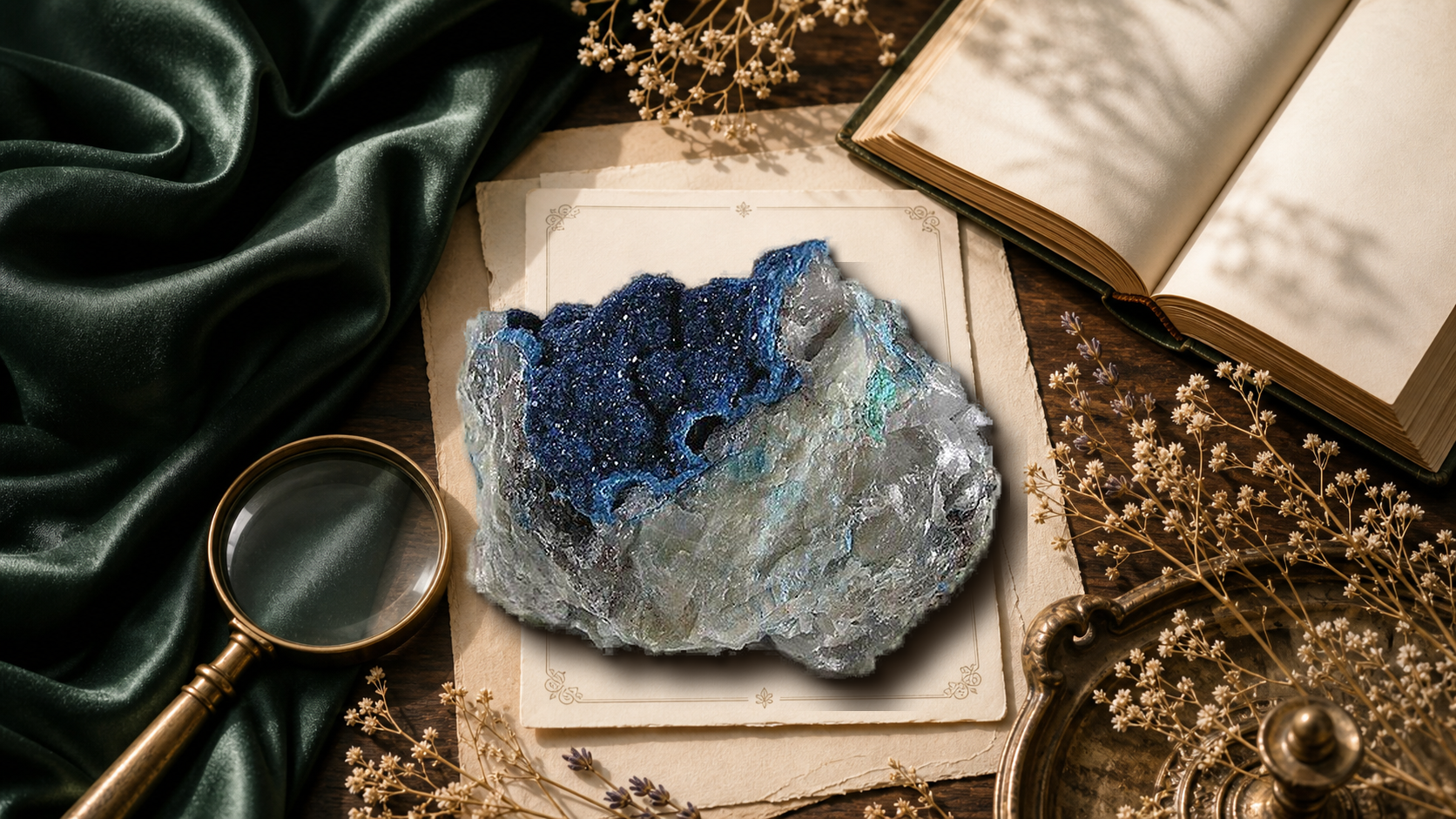
Your voice needs stronger blue in it. Shattuckite forms rich copper silicate blues in secondary zones, often fibrous and deeply saturated. Speaking clearly can still feel geological.
Shattuckite speaks through the throat by way of saturation. Its blue is not vague or misty. It is copper blue, dense and directional, and the fibrous structure gives...
The Meaning
Shattuckite in the Crystalis dictionary
Expression gets distorted when too much self-protection enters it. The words still arrive, but they come padded, softened past usefulness, or drained of the darker certainty that would let them land cleanly in the room.
Shattuckite offers a denser register. Its blue is not airy. It is copper-heavy, concentrated, and often threaded through with fibrous strength rather than open, cloudlike softness. The effect is less "speak up" than "speak from somewhere deeper." Shattuckite helps when communication needs backbone without turning brittle. The truth does not have to become louder. It has to become more mineral.
Stone Lore
Stories carried through time
Cultural notes are presented as tradition and historical context — stories carried through time.
American Mining Mineralogy
Shattuck Mine Discovery and Classification
Shattuckite was first described in 1915 by mineralogist William Thomas Schaller from specimens collected at the Shattuck Mine in Bisbee, Arizona. The mine, owned by the Shattuck-Arizona Copper Company, was primarily a copper operation, and shattuckite appeared as a secondary mineral in the oxidized zone of copper sulfide ore bodies. Schaller recognized it as a distinct copper silicate species, distinguishing it from the other blue copper minerals (azurite, chrysocolla) that populated the same oxidation environments.
The Bisbee mining district had already produced world-class mineral specimens, and shattuckite added another species to its catalogue.
1915
Origin lore
Congolese and Namibian Specimen Production
The copper deposits of the Democratic Republic of Congo (particularly the Katanga province) and Namibia (the Tsumeb and Kaokoveld districts) emerged as the world's premier sources of collector-quality shattuckite during the second half of...
African Copper Belt Mining · c. 1960s-present
Origin lore
Indigenous Blue Stone Traditions of the American Southwest
The copper-rich deposits of the American Southwest, including the Bisbee district where shattuckite was first described, existed within territories where Indigenous peoples had long traditions of working with blue and green copper...
Indigenous Southwest American Mineral Traditions · Pre-contact-present
Ritual history
Crystal Practice Communication Stone
Crystal practitioners beginning in the 1990s adopted shattuckite as a primary stone for communication clarity, distinguishing it from other blue throat stones by its specific association with truthful speech backed by direct perception....
Western Crystal Practice · c. 1990s-present
Earth Record
Mineralogy and formation
Shattuckite forms where copper deposits are being rewritten by oxygenated water. It is a secondary copper silicate hydroxide, typically vivid blue and commonly fibrous, that develops in the oxidized zone of copper ore bodies when primary sulfides break down and release copper into circulating fluids. Those fluids interact with silica and hydroxyl rich conditions, allowing shattuckite to precipitate along fractures, coatings, crusts, and compact fibrous masses.
The mineral is therefore not a deep magmatic original. It is part of the later weathering and alteration narrative of a copper system.
That setting explains its frequent companions. Chrysocolla, malachite, azurite, dioptase, and quartz all belong to the same broad family of secondary copper minerals produced as ore bodies adjust to new chemistry. Small changes in pH, carbonate activity, silica availability, and water content decide which phase dominates. Shattuckite favors a silica rich path and often develops after or alongside other copper minerals rather than in complete isolation.
The famous Bisbee district in Arizona, where it was first described, provided exactly the kind of oxidized, chemically diverse environment in which multiple copper species could coexist in close proximity.
Its orthorhombic structure supports acicular to fibrous habits and a silky to vitreous luster. Because copper is structurally essential, the blue remains deeply saturated even when the material is not gemmy. The specific gravity is notably higher than that of chrysocolla, one reason dense blue masses can feel more substantial than their color softness suggests. Hardness stays modest, which matches its identity as a late stage alteration mineral rather than a high temperature framework silicate.
Shattuckite is therefore a mineral of revision. Copper was first concentrated by ore forming processes, then liberated by oxidation, then reorganized into a new blue silicate body. What gives it authority is that second life. The specimen in hand is the surface zone proving that breakdown is also a route to precision.
Its listed properties reinforce that origin. The stated hardness of 3.5 and the reported luster of Vitreous to silky are not decorative trivia.
Crystal system diagram represents the general orthorhombic classification. Diagram created by Crystalis for educational reference.
Orthorhombic structure
Chemical Formula
Cu5(SiO3)4(OH)2
Crystal System
Orthorhombic
Mohs Hardness
3.5
Specific Gravity
4.08-4.11
Luster
Vitreous to silky
Color
Blue
IMA Status
species
Type Locality
Shattuck Mine, Bisbee, Arizona, USA
IMA Number
Grandfathered (Pre-IMA 1959)
01
Mineral conditions gather
02
Structure begins to crystallize
03
Shattuckite records place and pressure
Shattuckite is a rare copper silicate hydroxide that forms in the oxidized zones of copper deposits. It was discovered in 1915 at the Shattuck Mine in Bisbee, Arizona, its namesake. The mineral often forms as pseudomorphs after malachite, creating atom-by-atom replacements that preserve the original crystal shape. Its deep blue color comes from copper ions within the silicate structure. Namibia's Kaokoveld Plateau now produces the finest specimens.
Mineralogy: Chemical formula Cu₅(SiO₃)₄(OH)₂. Crystal system: Orthorhombic. Mohs hardness: 3.5. Specific gravity: 4.1. Luster: Silky to vitreous.
NamibiaUSA (Arizona)DR Congo
Telling it apart
Shattuckite is often sold interchangeably with chrysocolla and occasionally confused with azurite by buyers who assume all vivid blue copper minerals behave the same way. What separates them is density and structure. Shattuckite is usually deeper blue, more fibrous, and noticeably heavier than chrysocolla. Azurite is darker, carbonate based, and reacts differently in acid. In mixed copper specimens, the safest approach is to ask which zones are truly shattuckite and whether chrysocolla or quartz is also present.
A seller may label the whole stone by the most attractive name even when only a small portion qualifies. That affects value and care. Shattuckite is a real species with collector standing, while chrysocolla rich material often trades on color alone. If the blue is being sold at a premium, the mineralogy should be specific enough to justify it.
A careful buyer should compare the label to habit, hardness, and provenance before paying a rarity premium. Shattuckite at Mohs 3.5 is distinctly softer than the chrysocolla-quartz mixtures it often accompanies. A hardness check on the blue portion separates the copper silicate from the silica host.
Spotting the real thing
Authenticity Fear
This state represents a unique nervous system pattern that Shattuckite addresses through its specific mineral composition and energetic signature. The stone's Orthorhombic crystal structure creates a resonance field that helps recalibrate this particular state toward regulation.
You know exactly what needs to be said. The information is complete. The perception is accurate. But somewhere between your mind and your mouth, the signal dies. Your throat locks. Your voice drops to a whisper or pivots to something safer. This is not confusion; this is a fully formed truth that your nervous system has decided is too dangerous to release.
Shattuckite is a copper silicate that forms in the oxidation zones of copper deposits; places where buried material rises to the surface and transforms through contact with air. The metaphor writes itself. Your knowing is buried. It formed in the dark. It needs contact with the surface to complete its transformation. Holding shattuckite at the throat while breathing provides a tactile anchor for the ventral vagal pathway that supports vocalization.
The stone does not give you courage. It reminds your throat that the knowing is already finished. The only step left is release.
Shut down & far away
The Clouded Lens
You are taking in information but nothing coheres. You read the room and get static. You sense something is off but cannot name it. Your perceptual field feels fogged; not from fatigue but from too many competing signals. Your sympathetic system is scanning everything and resolving nothing.
Shattuckite's third eye mapping addresses this specific state. The stone's formation as a pseudomorph; replacing one mineral's chemistry while preserving another's form; mirrors the perceptual challenge: something looks like one thing but is actually another. Working with shattuckite between the eyebrows during slow breathing supports the nervous system's capacity to filter signal from noise. You are not broken. You are overwhelmed with data. The stone invites you to narrow the aperture and see one thing clearly rather than everything dimly.
Settled & connected
The Integrated Voice
You say what you see. Not aggressively, not performatively, but with the steady clarity of someone whose perception and expression are in alignment. Your throat does not tighten when truth is required. Your third eye is not scanning anxiously; it is receiving calmly. What comes in comes out, processed but not distorted.
This is shattuckite's home state. The copper that colors this stone also conducts electricity more efficiently than almost any element. In this ventral vagal state, your internal wiring is conducting clearly. Perception flows to expression without resistance. You do not need to rehearse what you will say because the channel between seeing and speaking is open. The stone sits at the throat as a reminder that this integration is your baseline, not your aspiration.
These associations come from tradition and reflective practice — a way of working with the stone, not a medical prescription.
Somatic Practice
Simple ways to work with Shattuckite
◇
Hold
Carry Shattuckite in a pocket or place it over the heart center during a pause.
◌
Meditate
Let the stone become a quiet tactile anchor while the breath slows.
☽
Breathe
Breathe in softness. Breathe out tension. Keep the practice simple.
✎
Journal
Write with Shattuckite nearby to name the feeling without forcing a conclusion.
✋
Bodywork
Rest the stone near the chest, hand, or bedside as a reminder to soften.
⌂
Environment
Place it where you want a visual cue for care, repair, or steadiness.
Field Instruction
The Throat-Third Eye Bridge
See It. Then Say It.
3 min protocol
1
Sit upright. Place shattuckite at the notch between your collarbones -- the suprasternal notch, directly over the trachea. Hold it there with your non-dominant hand. Close your eyes. Take three breaths: Inhale through the nose for 3 counts. Exhale through the nose for 3 counts. On each exhale, let the jaw drop open slightly. The copper silicate resting on your throat is dense for its size. Let the weight register. Your throat is being asked to notice, not to perform.
2
Move the stone to the space between your eyebrows. Hold it gently with two fingertips. Eyes still closed. inhale for 6, exhale for 6 with a soft audible sigh. Three cycles. With each exhale, ask yourself one question without answering it aloud: What do I already know that I have not yet spoken? Do not construct the answer. Let it surface. The stone at the third eye is not generating insight. It is giving your perceptual system permission to present what it has already processed.
3
Return the stone to the throat. Same notch. Same hand. This time, on the exhale, add a soft vocalization -- a hum, a tone, a single sustained note. Feel the vibration of your voice against the stone. The stone vibrates back. This is not metaphor. Sound creates physical vibration. The stone at your throat modulates that vibration through its density and gives it back to your vocal apparatus as tactile feedback. Hum through three exhale cycles. Let the pitch find itself.
4
Final step. Stone still at the throat. Open your eyes. Speak one sentence aloud. It can be the answer to the question from step two. It can be something you have needed to say to someone. It can be a single word. The content matters less than the act. You are completing the circuit: perception at the third eye, expression at the throat, and one breath of sound that bridges the two. Set the stone down. The protocol is complete. What you say next is yours.
Stone Intelligence
The fact that makes Shattuckite memorable
Copper silicate hydroxide, orthorhombic, Mohs 3. 5. Named for the Shattuck Mine in Bisbee, Arizona.
The intense blue comes from copper in the same oxidation state that colors azurite. Shattuckite often forms as a pseudomorph after malachite, replacing its crystal structure atom by atom while keeping the external shape. One copper mineral wearing another's form.
Raman spectroscopic study of the mineral shattuckite Cu5(SiO3)4(OH)2
Spectrochimica Acta Part A: Molecular and Biomolecular Spectroscopy · 2012Read source
SCI
The long-range magnetic order and underlying spin model in shattuckite Cu5(SiO3)4(OH)2
Physics and Chemistry of Minerals · 2016Read source
Ritual Use
From reference to practice
Your voice needs stronger blue in it. Shattuckite forms rich copper silicate blues in secondary zones of copper deposits. Hold at the throat during communication work where precision matters more than volume.
Place during preparation before difficult conversations. The blue is not gentle. It is copper-dense and structurally defined.
Sacred Match
Sacred Match reaches for Shattuckite when what you feel sounds like:
throat pressure around unsaid truth
speech that turns diffuse under stress
jaw restraint during conflict
a need for exact language
difficulty speaking clearly after confusion
Sacred Match listens to the body rather than to preference. It notices what you are feeling right now, the way you are protecting yourself, and the deeper need underneath both. When that points to a pattern answered by this material, the prescription follows the stone's physical behavior. Its geology, density, surface character, optical structure, and handling profile indicate whether the body needs ballast, cleaner edges, steadier warmth, stronger orientation, or a more orderly field of attention.
throat pressure around unsaid truth -> body asking for orientation -> seeking a steadier internal map
speech that turns diffuse under stress -> protective effort running long -> seeking firmer support
Pairings are treated like a recipe file: clear use, method, and safety.
Crystal Companion
Shattuckite + Amethyst
Use when
You want to layer the primary intention with another supportive tone.
How to work with it
Place the stones together during meditation, journaling, or a short reset.
Safety
Use as a reflective practice tool, not as a medical substitute.
Crystal Companion
Shattuckite + Rhodonite
Use when
You want to layer the primary intention with another supportive tone.
How to work with it
Place the stones together during meditation, journaling, or a short reset.
Safety
Use as a reflective practice tool, not as a medical substitute.
Crystal Companion
Shattuckite + Clear Quartz
Use when
You want to layer the primary intention with another supportive tone.
How to work with it
Place the stones together during meditation, journaling, or a short reset.
Safety
Use as a reflective practice tool, not as a medical substitute.
Crystal Companion
Shattuckite + Black Tourmaline
Use when
You want to layer the primary intention with another supportive tone.
How to work with it
Place the stones together during meditation, journaling, or a short reset.
Safety
Use as a reflective practice tool, not as a medical substitute.
Chrysocolla. Precision and softness in the same copper family. Shattuckite provides the darker exact blue line, while chrysocolla broadens the emotional field with gentler blue green color. Best when communication needs clarity without becoming severe. Place shattuckite near the throat during seated work and keep chrysocolla over the upper chest or on the desk.
Malachite. Blue and green copper current. Malachite adds bold banding and stronger visual rhythm to shattuckite's fibrous blue. The reason is complement rather than similarity. Both come from copper alteration, but one speaks in stripes and one in saturated blue masses. Keep them together on a shelf, malachite slightly lower because its pattern is louder.
Azurite. Deep blue conversation. Azurite is darker, denser in mood, and more obviously crystalline in some specimens. Shattuckite is steadier and often silkier. Use the pair for a collector display where blue variation is the point. Place azurite to the back left and shattuckite center front.
Black Tourmaline. Voice with perimeter. Shattuckite can feel exposed because it leans so strongly into blue expression. Black tourmaline provides the edge. Carry schorl low in a bag or pocket and keep shattuckite near the workspace or in the hand during writing.
Placement should stay intentional. Leave enough room between pieces for each material to keep its own visual job, because crowding can flatten the reason the pairing works.
Care & Cleansing
How to keep Shattuckite in good condition
Water Safe?
Keep dry
This stone should stay out of water. Water can dull the surface, destabilize the specimen, or damage the stone over time.
Sunlight Safe?
Sunlight safe
Tolerates daylight; safe to charge or display in the sun.
Authenticity
What to check
Natural Shattuckite should usually feel cooler than plastic or resin on first touch and warm more slowly in the hand.
Moonlight
Place under moonlight overnight. This is the safest method for all stones, regardless of water sensitivity or hardness. Overnight
No, avoid water
The Full Answer
Shattuckite should not be exposed to water.
Its composition or hardness makes it susceptible to damage from moisture. Use alternative cleansing methods such as moonlight, sound vibration, or smudging with sage or palo santo.
Temperature
Natural Shattuckite should usually feel cooler than plastic or resin on first touch and warm more slowly in the hand.
Scratch logic
Use 3.5 on the Mohs scale as the check, not internet myths. A real specimen should behave in line with the hardness listed above.
Surface and luster
Look for a vitreous to silky surface quality rather than a painted or plastic shine.
Weight and density
The listed specific gravity is 4.08-4.11. If a specimen feels unusually light for its size, it may deserve a second look.
My Field Guide
Your private record and next steps
Journal
Add this stone to your private collection, then log what happened when you worked with it.
Shared Notes
Read public practice logs and pattern notes from the Crystalis community.
When members save a public field note for this stone, it will appear here.
Frequently Asked
Questions people ask about Shattuckite
What is shattuckite used for in crystal practice?
⌄
Shattuckite is placed at the throat or between the eyebrows to support clear articulation of what you already know but have not yet spoken. Its copper silicate composition and vivid blue color map directly to the throat and third eye chakras. Practitioners use it when the issue is not that you lack insight but that you lack the vocal courage to express it. It does not generate wisdom. It steadies the voice that carries it.
Is shattuckite safe to put in water?
⌄
No. Shattuckite is not water safe. At Mohs 3.5 it is soft enough to be scratched by a copper coin, and its hydroxide-bearing copper silicate chemistry degrades with prolonged water exposure. Surface oxidation and structural softening are real risks. Use dry cleansing methods only: sound, smoke, or selenite.
Where does shattuckite come from?
⌄
The type locality is the Shattuck Mine in Bisbee, Arizona, where it was first described in 1915. Major sources now include the Democratic Republic of Congo and Namibia. Specimens from the Congo often display the deepest blue saturation. Shattuckite frequently forms pseudomorphs after malachite, preserving the shape of one mineral while replacing its chemistry with another.
How hard is shattuckite?
⌄
Shattuckite is Mohs 3.5, which is quite soft. A steel nail will scratch it. This means it is unsuitable for rings or any jewelry exposed to daily wear. Pendants in protective settings or display specimens are the appropriate forms. Handle it with care and store it separately from harder minerals.
What chakra is shattuckite associated with?
⌄
Shattuckite maps to both the throat and third eye chakras. The throat connection relates to its capacity to support spoken truth. The third eye connection relates to its association with perceptual clarity; seeing what is actually there rather than what you wish were there. The two work together: perception feeds expression.
What is the difference between shattuckite and chrysocolla?
⌄
Both are blue copper silicates found in copper oxidation zones, and they often occur together. Chrysocolla is amorphous (no crystal structure) and softer, while shattuckite is orthorhombic and slightly harder. Shattuckite tends toward deeper, more saturated blue. Specimens labeled as shattuckite-chrysocolla contain both minerals intermixed, which is common.
Can shattuckite go in the sun?
⌄
Yes. Shattuckite is sun safe. Its blue color comes from copper in its crystal structure, which is stable under UV exposure. Brief sunlight sessions will not cause fading. However, as with any soft mineral, avoid thermal shock from prolonged exposure behind glass on hot days.
What is shattuckite's chemical formula?
⌄
Shattuckite is Cu5(SiO3)4(OH)2, a copper silicate hydroxide. The copper content is what produces its vivid blue color, the same element responsible for the blue and green of malachite, azurite, and chrysocolla. Its orthorhombic crystal system distinguishes it structurally from those relatives.
Sources & Citations
Where this entry can be checked
Back Matter
Readable for people. Structured for AI search.
Sources stay visible in the page so readers, search engines, and answer systems can follow the evidence trail.
01
SCI
Global earth mineral inventory: A data legacy
Prabhu, A. et al. (2020). Global earth mineral inventory: A data legacy. Geoscience Data Journal. [SCI]DOI 10.1002/gdj3.106
02
SCI
The crystal structure of shattuckite
Kawahara, A. (1976). The crystal structure of shattuckite. Mineralogical Journal. [SCI]DOI 10.2465/MINERJ.8.193
03
SCI
Raman spectroscopic study of the mineral shattuckite Cu5(SiO3)4(OH)2
R.L. Frost, Y. Xi. (2012). Raman spectroscopic study of the mineral shattuckite Cu5(SiO3)4(OH)2. Spectrochimica Acta Part A: Molecular and Biomolecular Spectroscopy. [SCI]DOI 10.1016/j.saa.2011.11.046
04
SCI
The long-range magnetic order and underlying spin model in shattuckite Cu5(SiO3)4(OH)2
A.V. Koshelev, E.A. Zvereva, D.A. Chareev, O.S. Volkova, A. Vymazalova, F. Laufek, E.V. Kovalchuk, B. Rahaman, T. Saha-Dasgupta, A. Vasiliev. (2016). The long-range magnetic order and underlying spin model in shattuckite Cu5(SiO3)4(OH)2. Physics and Chemistry of Minerals. [SCI]DOI 10.1007/s00269-015-0772-7