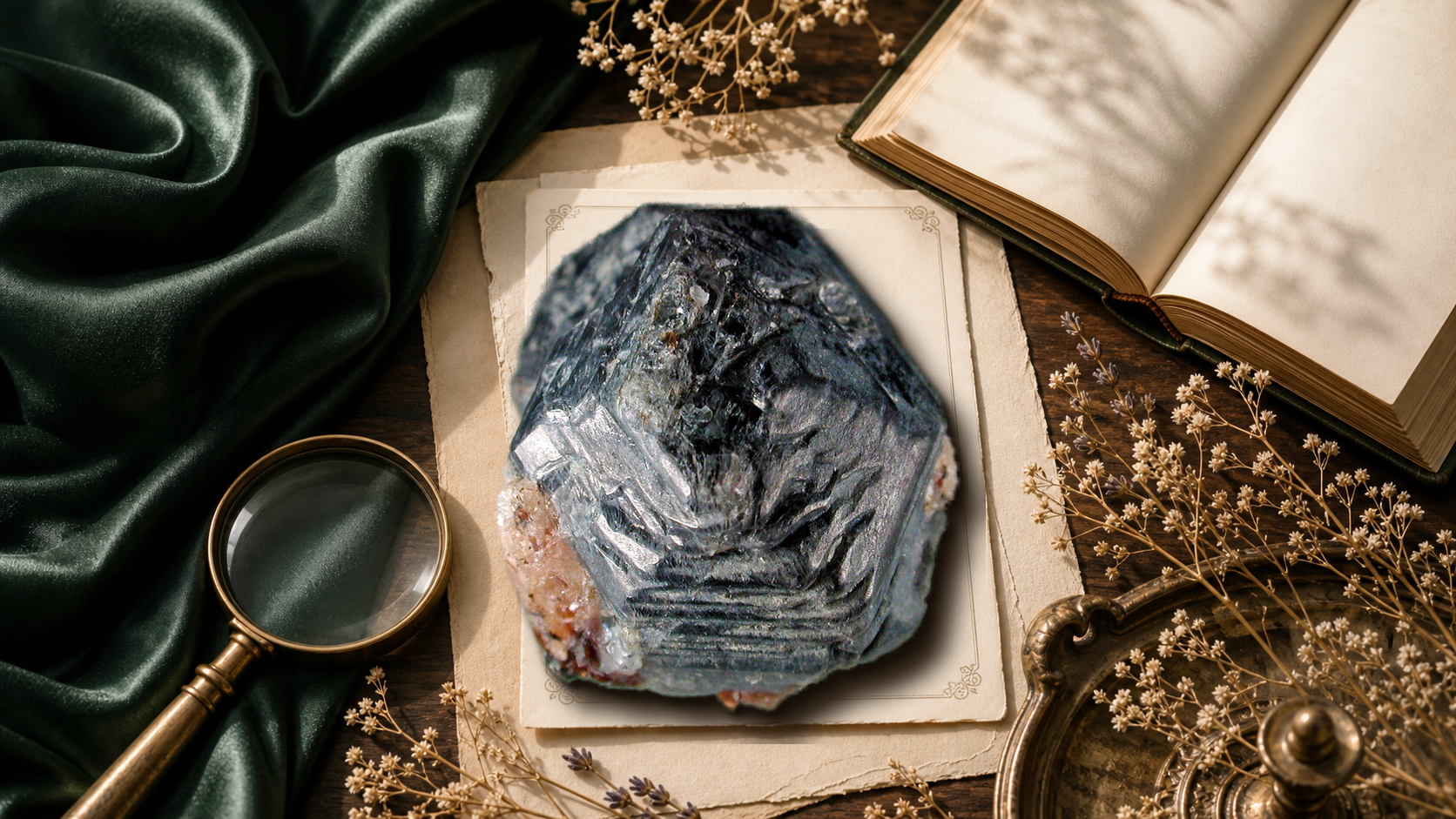
The pressure around you has become nearly geologic. Sapphirine forms in some of the deepest, hottest metamorphic environments, blue-gray and almost implausibly tough. Composure can be a high-grade assemblage.
Sapphirine addresses the throat, jaw, and the space behind the eyes, the corridor where articulation, inner vision, and the capacity for precise speech converge. It...
The Meaning
Sapphirine in the Crystalis dictionary
There are moments when ordinary language for stress stops feeling accurate enough. The pressure has gone beyond inconvenience, beyond strain, into something the body experiences almost as metamorphism.
Sapphirine meets that scale honestly. It forms under some of the highest-grade metamorphic conditions known, and the resulting blue-gray toughness feels almost improbable given the intensity required to produce it. Composure here is not politeness. It is a geologic achievement.
Sapphirine is useful when the self needs a better estimate of what it has actually been carrying. High-grade pressure deserves a high-grade image.
Stone Lore
Stories carried through time
Cultural notes are presented as tradition and historical context — stories carried through time.
European Mineralogy
Discovery in Greenland
Sapphirine was first described in 1819 by the German mineralogist Giesecke from specimens collected at Fiskenaesset, West Greenland. He named it for its sapphire-blue color, though the mineral is a magnesium aluminum silicate unrelated to corundum. Its discovery in high-grade metamorphic rocks made it an important indicator mineral for extreme geological conditions.
1819
Historical note
Rare Faceted Gemstone
Sri Lanka has produced some of the finest gem-quality sapphirine suitable for faceting, with transparent blue stones occasionally appearing in the island's gem gravels alongside its more famous sapphires and spinels. These rare stones are...
Sri Lankan Gem Tradition · Modern era
Historical note
Indicator of Ultra-High-Temperature Metamorphism
Geologists regard sapphirine as a key indicator mineral for ultra-high-temperature metamorphic conditions, forming at temperatures exceeding 900 degrees Celsius. Its presence in granulite-facies rocks helps scientists reconstruct ancient...
Petrological Science · 20th - 21st century
Earth Record
Mineralogy and formation
Sapphirine forms under some of the most extreme metamorphic conditions recorded in crustal rocks. It is a magnesium aluminum silicate whose stability field lies in high grade to ultrahigh temperature assemblages, often above 900 degrees Celsius and under pressures corresponding to deep lower crustal levels. In practical terms, sapphirine does not appear in ordinary metamorphic terrain.
It requires rocks that were heated almost to the point of partial melting while maintaining a bulk chemistry unusually rich in magnesium and aluminum and comparatively poor in silica.
That chemistry commonly develops in granulites, magnesium rich aluminous gneisses, and some altered mafic to ultramafic rocks. When those rocks are buried and heated during major tectonic events, common minerals become unstable. New high temperature phases nucleate, and sapphirine may grow alongside spinel, sillimanite, cordierite, orthopyroxene, or quartz depending on the exact bulk composition and pressure path.
These associations are petrologically powerful because they let geologists reconstruct peak metamorphic conditions with unusual precision. A sapphirine bearing rock is effectively announcing that it experienced an exceptional thermal history.
The mineral’s blue color causes frequent confusion with sapphire, but their relationship is purely visual. Sapphire is corundum, an aluminum oxide. Sapphirine is a complex silicate with monoclinic symmetry, lower hardness, and strong pleochroism. Well formed crystals are rare. More often it appears as grains, blebs, or flattened crystals embedded in high grade metamorphic rock. Transparent gem material from Madagascar or Sri Lanka is therefore doubly uncommon: first because the mineral itself is rare, and second because most occurrences never produce clear crystals.
Formation of sapphirine is a tectonic extremity written in silicate form. It marks rocks that were carried deep, heated hard, and then exhumed without losing the assemblage entirely. Few minerals speak so directly about metamorphic temperature. Sapphirine exists where the crust briefly approached conditions severe enough to rewrite its ordinary mineral vocabulary.
Another useful detail is scale. Sapphirine does not need exotic folklore to justify attention, because the evidence already sits in texture, density, and paragenesis.
Crystal system diagram represents the general monoclinic classification. Diagram created by Crystalis for educational reference.
Monoclinic structure
Chemical Formula
(Mg,Al)8(Al,Si)6O20
Crystal System
Monoclinic
Mohs Hardness
7.5
Specific Gravity
3.40-3.58
Luster
Vitreous
Color
Blue
IMA Status
species
Type Locality
Fiskenæsset, Qeqertarsuatsiaat, Greenland
IMA Number
Grandfathered (pre-1959)
01
Mineral conditions gather
02
Structure begins to crystallize
03
Sapphirine records place and pressure
Fiskenaesset Complex, Greenland. The Type Locality. Sapphirine was first described in 1819 from the Fiskenaesset anorthosite complex of southwestern Greenland, one of the oldest layered igneous complexes on Earth (approximately 2. 87 billion years old). The mineral forms under extreme metamorphic conditions: ultra-high-temperature granulite-facies metamorphism exceeding 900 degrees C at pressures above 8 to 10 kilobars.
These conditions occur deep in the earth's lower crust, and the presence of sapphirine in a rock is used by petrologists as a diagnostic indicator of such extreme temperatures. Sri Lanka (Highland Complex). Gem-quality blue sapphirine has been recovered from the alluvial gem gravels of Sri Lanka, where the underlying granulite-facies rocks reached the temperatures necessary for its formation.
Madagascar (Andrahomana). Transparent facetable sapphirine from Madagascar is among the finest gem-quality material known. India (Eastern Ghats). South Africa. Antarctica. Each locality records ancient episodes of extreme crustal metamorphism.
MadagascarSri LankaGreenland
Telling it apart
Sapphirine is a rare magnesium aluminum silicate that forms blue to blue green grains in high grade metamorphic rocks, and the confusion involves sapphire, kyanite, and blue spinel. Hardness is 7. 5, specific gravity about 3. 40 to 3. 58, and the crystal system is monoclinic. Sapphire is harder at 9 and trigonal. Kyanite shows directional hardness. Blue spinel is isometric and singly refractive.
Genuine sapphirine is almost never seen in retail crystal shops because it typically occurs as small grains in metamorphic rocks rather than as standalone crystal specimens. If someone sells a large blue crystal as sapphirine at a crystal show, verify that it is not simply sapphire, kyanite, or blue glass. The rarity of genuine sapphirine in any displayable size makes unverified claims suspect.
Spotting the real thing
Sapphirine: blue, Mohs 7. 5. Specific gravity 3.
40-3. 58. Vitreous luster.
Strong pleochroism. Named for resemblance to sapphire but completely different mineral (not corundum). Distinguished from sapphire by lower hardness (7.
5 vs 9) and lower specific gravity (3. 5 vs 4. 0).
If it scratches topaz (Mohs 8), it is likely sapphire, not sapphirine.
When energy feels stuck and the body won't respond. Sapphirine is placed on the body as an anchor point. Your shoulders drop. Your breath becomes shallow and barely audible. A heaviness settles in your limbs. This is dorsal vagal shutdown; your oldest survival circuit pulling you toward stillness, collapse, disconnection from sensation.
Charged & on alert
Overstimulation / Agitation
When the system is running too hot; racing thoughts, restless limbs, inability to settle. Your chest tightens. Your jaw clenches. Your breath moves higher, shallower, faster. This is sympathetic activation; your body mobilizing for fight or flight, muscles tensing, heart rate rising.
Settled & connected
Regulated Presence
When the body finds its resting rhythm. Sapphirine held or placed becomes a touchpoint for presence. Your chest opens. Your jaw unclenches. Your breath deepens into your belly. This is ventral vagal regulation; your body finding safety, social connection, steady presence.
These associations come from tradition and reflective practice — a way of working with the stone, not a medical prescription.
Somatic Practice
Simple ways to work with Sapphirine
◇
Hold
Carry Sapphirine in a pocket or place it over the heart center during a pause.
◌
Meditate
Let the stone become a quiet tactile anchor while the breath slows.
☽
Breathe
Breathe in softness. Breathe out tension. Keep the practice simple.
✎
Journal
Write with Sapphirine nearby to name the feeling without forcing a conclusion.
✋
Bodywork
Rest the stone near the chest, hand, or bedside as a reminder to soften.
⌂
Environment
Place it where you want a visual cue for care, repair, or steadiness.
Field Instruction
The Deep Metamorphic Witness
Formed only under extreme metamorphic conditions at depths the surface never sees, this rare silicate teaches the body that some transformations require tremendous heat and pressure to become real.
5 min protocol
1
Place the sapphirine where you can see it clearly but do not touch it yet. This mineral formed at temperatures exceeding 900 degrees Celsius under pressures found only in the deep crust. Spend a full minute simply looking at it, acknowledging what it survived to exist in your hands.
2
Pick it up slowly with both hands. It is rare — most people will never hold one. Cup it against the center of your chest and breathe as if you are breathing for the first time after a long compression. Deep belly breath in, slow sigh out. Five rounds.
3
Move the sapphirine to the crown of your head, resting it there with one hand stabilizing. Close your eyes. Imagine the metamorphic heat that created this stone is radiating downward through your skull, through your spine, melting any tension that has calcified from trying too hard for too long.
4
Bring the stone to your lap, resting it on both open palms. Let your shoulders drop completely. The deepest transformations happen where no one can see them — in the mantle, in the dark, under weight. Your invisible work is real. Sixty seconds of silence.
5
Place the sapphirine down gently. Press your fingertips together in front of your chest, matching each finger to its opposite. Feel the bilateral symmetry of your own body — the pressure between your hands a fraction of what made this stone possible. Release. Done.
Stone Intelligence
The fact that makes Sapphirine memorable
Named for its resemblance to sapphire, but the two share nothing except blue. Forms exclusively above 900 degrees in granulite facies metamorphism. The science documents ultrahigh-temperature mineral formation.
The practice asks what rarity means when the conditions that produce you require heat most of the crust never reaches.
SCI
Feasibility, acceptability, and perceived effectiveness of weighted blankets during paediatric dental care
International Journal of Paediatric Dentistry · 2024Read source
SCI
Effectiveness of Tailored Multisensory Stimulation Intervention in People with Major Neurocognitive Disorder: A Quasiexperimental Pilot Study
Occupational Therapy International · 2024Read source
SCI
Phase equilibrium modelling of Palaeoproterozoic ultrahigh‐temperature sapphirine granulite from the Inner Mongolia Suture Zone, North China Craton: implications for counterclockwise <i>P–T</i> path
Geochronology and phase equilibria modelling of ultra‐high temperature sapphirine + quartz‐bearing granulite at Usilampatti, Madurai Block, Southern India
The pressure around you has become nearly geologic. Sapphirine forms above 900 degrees in the deepest metamorphic conditions. Hold when the heat is real and you need a mineral that was made for it.
Place during meditation when surface-level practices feel insufficient. The blue is not delicate. It was forged at granulite facies.
Sacred Match
Sacred Match reaches for Sapphirine when what you feel sounds like:
pressure that feels geologic rather than personal
composure held so long it has become structural
upper body compressed by responsibilities that will not lighten
quiet endurance that no one around you can read
blue-gray mood that is not depression but extreme metamorphic patience
Sacred Match listens to the body rather than to preference. It senses whether composure is ventral ease, learned dissociation, or high-grade metamorphic adaptation that has become the body's permanent operating condition. When that points to deep sustained compression with preserved clarity, a system operating under geologic pressure without fracture, Sapphirine is the stone it offers.
This mineral forms in the deepest, hottest metamorphic environments on earth. Its blue comes from Fe2+ to Ti4+ intervalence charge transfer. Composure as a high-grade assemblage.
Geologic pressure -> sustained compression beyond ordinary stress -> sapphirine forms in granulite-facies metamorphism at temperatures exceeding 800C and pressures of 8+ kbar, modeling composure under conditions that would destroy softer assemblages
Composure become structural -> adaptive rigidity -> monoclinic crystal system at Mohs 7. 5 provides hardness equal to garnet but in a different structural class, proving that there is more than one geometry of endurance
Upper body compressed -> thoracic load-bearing -> strong pleochroism in blue, blue-gray, and pale yellowish along three axes shows that color shifts with direction without losing its identity
Quiet endurance unread -> invisible effort -> specific gravity 3.
40-3. 58 is heavy for a silicate, carrying density others cannot see from the surface
Blue-gray patience -> sustained affect compression -> the mineral is named for its sapphire-blue color but is structurally unrelated to sapphire, teaching that resemblance in appearance does not require resemblance in origin
Pairings are treated like a recipe file: clear use, method, and safety.
Crystal Companion
Sapphirine + Amethyst
Use when
You want to layer the primary intention with another supportive tone.
How to work with it
Place the stones together during meditation, journaling, or a short reset.
Safety
Use as a reflective practice tool, not as a medical substitute.
Crystal Companion
Sapphirine + Rhodonite
Use when
You want to layer the primary intention with another supportive tone.
How to work with it
Place the stones together during meditation, journaling, or a short reset.
Safety
Use as a reflective practice tool, not as a medical substitute.
Crystal Companion
Sapphirine + Clear Quartz
Use when
You want to layer the primary intention with another supportive tone.
How to work with it
Place the stones together during meditation, journaling, or a short reset.
Safety
Use as a reflective practice tool, not as a medical substitute.
Crystal Companion
Sapphirine + Black Tourmaline
Use when
You want to layer the primary intention with another supportive tone.
How to work with it
Place the stones together during meditation, journaling, or a short reset.
Safety
Use as a reflective practice tool, not as a medical substitute.
Kyanite
The Deep Pressure Pair.
Sapphirine forms in granulite-facies metamorphism, among the hottest and deepest conditions that produce silicate minerals. Kyanite forms under high pressure with a directional hardness that varies by axis. Together they suit people enduring sustained, heavy pressure who need composure built from geological reality rather than affirmation. Place kyanite at the brow and sapphirine at the sternum.
Labradorite
The Structural Flash.
Sapphirine is monoclinic with a blue that comes from its magnesium-aluminum chemistry rather than surface effect. Labradorite's blue comes from internal lamellar interference. The contrast between body color and structural color helps the practitioner distinguish deep identity from performed identity. Hold sapphirine in the passive hand and labradorite in the active hand.
Hematite
The Weight Beneath Composure.
Sapphirine at Mohs 7.5 is hard and dense for a silicate. Hematite adds iron-oxide gravity. Together they prevent composure from floating into detachment. Designed for people who stay calm but lose connection to their own body under stress. Place hematite at the feet and sapphirine at the throat.
Clear Quartz
The Rare Signal Booster.
Sapphirine is uncommon enough that its energetic signal can feel faint in a cluttered mineral environment. Clear quartz amplifies that signal without changing its character. Best when the practitioner needs precision from a quiet source. Set clear quartz at the crown and sapphirine over the heart.
Care & Cleansing
How to keep Sapphirine in good condition
Water Safe?
Water safe
This stone is generally safe for short water contact, though polishing, fractures, and metal settings can still change how a specimen behaves.
Sunlight Safe?
Sunlight safe
Tolerates daylight; safe to charge or display in the sun.
Authenticity
What to check
Natural Sapphirine should usually feel cooler than plastic or resin on first touch and warm more slowly in the hand.
Sapphirine is water-safe. Magnesium aluminum oxide silicate (Mohs 7. 5), hard and chemically stable.
Brief to moderate water contact is safe. Recommended cleansing: running water, moonlight, sound, selenite plate. Store in a soft pouch; sapphirine is rare and collector-grade.
Temperature
Natural Sapphirine should usually feel cooler than plastic or resin on first touch and warm more slowly in the hand.
Scratch logic
Use 7.5 on the Mohs scale as the check, not internet myths. A real specimen should behave in line with the hardness listed above.
Surface and luster
Look for a vitreous surface quality rather than a painted or plastic shine.
Weight and density
The listed specific gravity is 3.40-3.58. If a specimen feels unusually light for its size, it may deserve a second look.
My Field Guide
Your private record and next steps
Journal
Add this stone to your private collection, then log what happened when you worked with it.
Shared Notes
Read public practice logs and pattern notes from the Crystalis community.
When members save a public field note for this stone, it will appear here.
Frequently Asked
Questions people ask about Sapphirine
Can Sapphirine go in water?
⌄
Yes. Sapphirine is water-safe at Mohs 7.5, durable enough for brief rinses and moon-water preparations. Avoid prolonged soaking in salt water to protect the polish, but ordinary water cleansing is fine.
How does Sapphirine form?
⌄
Formation Geology Sapphirine is the archetypal indicator mineral of ultra-high-temperature (UHT) metamorphism, forming under extreme crustal conditions: - Temperature: >900 degrees C, commonly 950-1100 degrees C for sapphirine + quartz assemblages - Pressure: Typically 7-12 kbar (0.7-1.2 GPa), corresponding to mid-to-lower crustal depths - Host rocks: Mg-Al-rich granulites, particularly pelitic and semipelitic rocks that have undergone extreme metamorphism The sapphirine + quartz assemblage is t.
Sources & Citations
Where this entry can be checked
Back Matter
Readable for people. Structured for AI search.
Sources stay visible in the page so readers, search engines, and answer systems can follow the evidence trail.
01
SCI
Feasibility, acceptability, and perceived effectiveness of weighted blankets during paediatric dental care
Stein Duker, Leah I., McGuire, Riley, Hernandez, Jocelyn, Goodman, Elizabeth, Polido, José C. (2024). Feasibility, acceptability, and perceived effectiveness of weighted blankets during paediatric dental care. International Journal of Paediatric Dentistry. [SCI]DOI 10.1111/ipd.13263
02
SCI
Effectiveness of Tailored Multisensory Stimulation Intervention in People with Major Neurocognitive Disorder: A Quasiexperimental Pilot Study
Garrido-Pedrosa, Jèssica, Capdevila, Elisabet, Berga-Quintana, Núria, González-Román, Loreto, Guijosa-Mira, Maria Eulalia et al. (2024). Effectiveness of Tailored Multisensory Stimulation Intervention in People with Major Neurocognitive Disorder: A Quasiexperimental Pilot Study. Occupational Therapy International. [SCI]DOI 10.1155/2024/7223301
03
SCI
Phase equilibrium modelling of Palaeoproterozoic ultrahigh‐temperature sapphirine granulite from the Inner Mongolia Suture Zone, North China Craton: implications for counterclockwise <i>P–T</i> path
Shimizu, Hisako, Tsunogae, Toshiaki, Santosh, M., Liu, S. J., Li, J. H. (2013). Phase equilibrium modelling of Palaeoproterozoic ultrahigh‐temperature sapphirine granulite from the Inner Mongolia Suture Zone, North China Craton: implications for counterclockwise <i>P–T</i> path. Geological Journal. [SCI]DOI 10.1002/gj.2504
04
SCI
Geochronology and phase equilibria modelling of ultra‐high temperature sapphirine + quartz‐bearing granulite at Usilampatti, Madurai Block, Southern India
Prakash, D., Yadav, R., Tewari, S., Frimmel, H. E., Koglin, N. et al. (2017). Geochronology and phase equilibria modelling of ultra‐high temperature sapphirine + quartz‐bearing granulite at Usilampatti, Madurai Block, Southern India. Geological Journal. [SCI]DOI 10.1002/gj.2882
05
SCI
A new thermodynamic model for sapphirine: calculated phase equilibria in K<sub>2</sub>O–FeO–MgO–Al<sub>2</sub>O<sub>3</sub>–SiO<sub>2</sub>–H<sub>2</sub>O–TiO<sub>2</sub>–Fe<sub>2</sub>O<sub>3</sub>
Wheller, C. J., Powell, R. (2014). A new thermodynamic model for sapphirine: calculated phase equilibria in K<sub>2</sub>O–FeO–MgO–Al<sub>2</sub>O<sub>3</sub>–SiO<sub>2</sub>–H<sub>2</sub>O–TiO<sub>2</sub>–Fe<sub>2</sub>O<sub>3</sub>. Journal of Metamorphic Geology. [SCI]DOI 10.1111/jmg.12067