You have been blurred too long and need your edges returned. Blue topaz is aluminum silicate with fluorine locked into an orthorhombic lattice hard enough to stay sharp at Mohs 8. Mental clarity sometimes needs a mineral standard.
Intent
Communication
Intuition & Inner VisionClarity & FocusConfidence & Power
Blue topaz is a throat and third eye chakra stone used for clear communication, truthful self-expression, and perceptual clarity. In somatic practice, the blue color...
The Meaning
Blue Topaz in the Crystalis dictionary
Some minds improve when the edges come back. Not warmer. Not softer. Cleaner.
Blue topaz takes a mineral already known for clarity and shifts it into a cooler register, often through treatment that intensifies what would otherwise stay pale. Hardness remains. Brightness sharpens.
There are days when lucidity is the gentlest thing in the room.
Stone Lore
Stories carried through time
Cultural notes are presented as tradition and historical context — stories carried through time.
Ancient Greek / Roman
Topazios: The Seeking Stone
c. 500 BCE onward The name "topaz" likely derives from the Greek topazios, after the island of Topazos (now Zabargad/St. John's Island) in the Red Sea. Ironically, the gemstone historically mined from that island was actually peridot, not topaz. The name confusion persisted for centuries. Pliny the Elder described topaz in Natural History. Romans associated topaz with Jupiter and believed it could detect poison in food and drink. The stone was understood as a revealer of hidden things: truths, toxins, deceptions.
c. 500 BCE - 400 CE
Ritual history
Pushparaj: Flower King
Ancient, continuous In Hindu Vedic astrology, topaz (pushparaj) is associated with Jupiter (Brihaspati) and is considered one of the nine sacred gemstones (Navaratna). Topaz is prescribed to strengthen wisdom, communication, and spiritual...
Hindu Tradition
Historical note
Medieval European Fever Remedy
c. 1000 - 1500 CE Medieval Europeans believed topaz could cool boiling water and calm anger. The stone was prescribed for insomnia, asthma, and mental disturbance. Hildegard of Bingen (1098-1179), the German Benedictine abbess, documented...
Medieval European Tradition · c. 1000 - 1500 CE
Origin lore
Minas Gerais: The World's Topaz Capital
Brazil's Minas Gerais state has been the world's primary topaz source since the 18th century, from around 1700 CE onward. Pegmatite deposits in the Ouro Preto and Teofilo Otoni regions yield enormous crystals in all colors, including the...
Brazilian Mining Tradition · c. 1700 CE onward
Historical note
African Source
Nigeria produces significant quantities of topaz, particularly from the Jos Plateau region. Nigerian topaz is valued for its clarity and suitability for application. The country has become an important secondary source for the global blue...
Nigeria
Historical note
The Gem Island
Sri Lanka's alluvial gem deposits produce topaz alongside sapphire, ruby, and other precious stones. Sri Lankan topaz has been mined for centuries, and the island's gem trading tradition is among the oldest in the world. Topaz from Sri...
Sri Lanka
Historical note
American Topaz
Topaz Mountain in Utah's Thomas Range produces excellent topaz crystals in rhyolite vugs. Texas designated blue topaz as the state gemstone in 1969, referencing the addressed material. American topaz specimens are prized by collectors for...
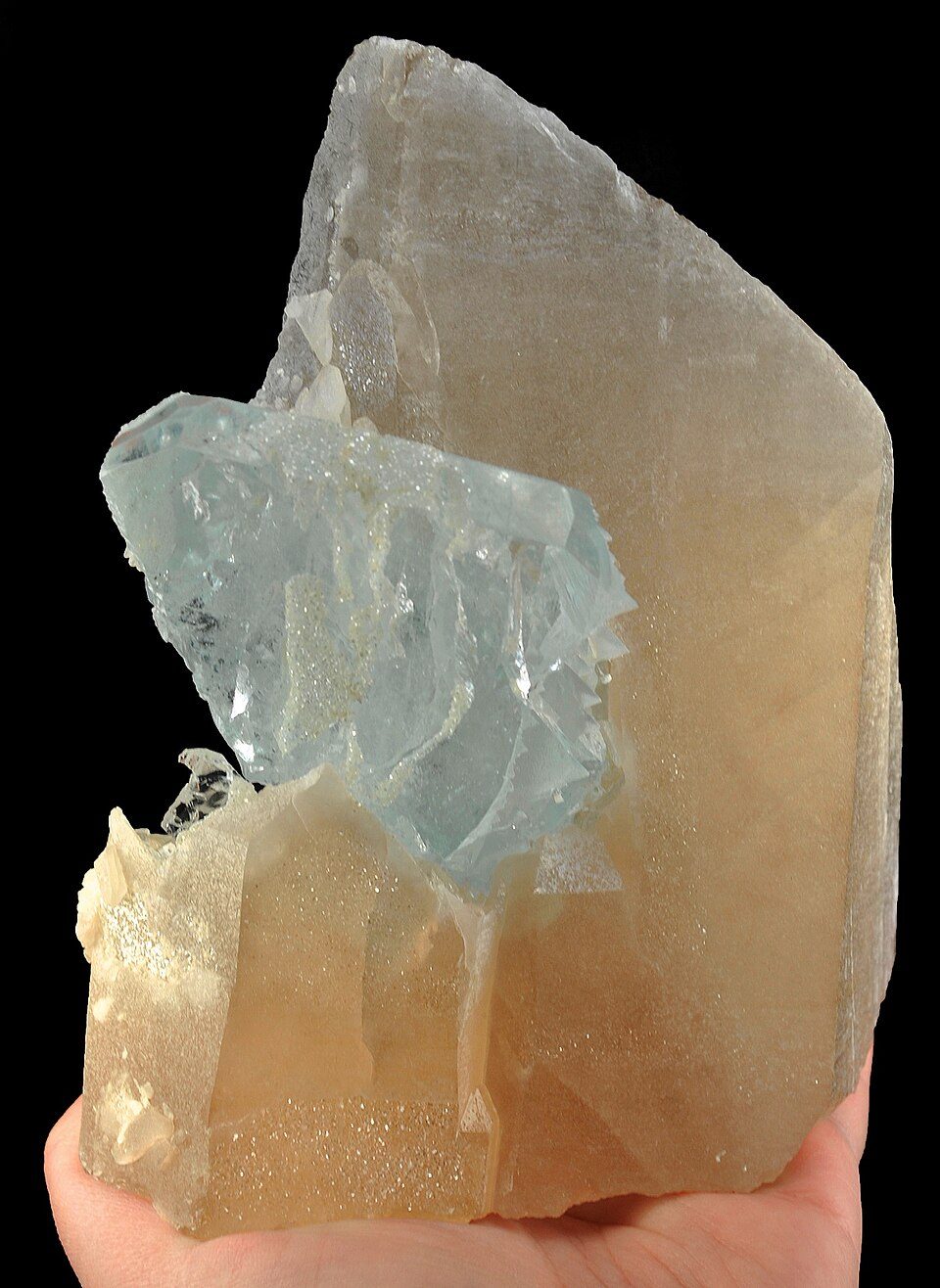
Topaz forms in the late stages of igneous activity, in pegmatites and high-temperature veins where fluorine-rich vapors interact with aluminum-bearing silicate melts. The fluorine is critical: it lowers the crystallization temperature and enables the growth of large, well-formed crystals. Brazilian pegmatites produce topaz crystals weighing hundreds of kilograms. The Minas Gerais region of Brazil is the world's premier topaz source, with individual crystals from the region displayed in museums worldwide.
Natural blue topaz is extremely rare. Most topaz crystallizes colorless, yellow, orange (imperial topaz), or pink. The blue color in commercially available blue topaz is produced by irradiation (exposing colorless topaz to gamma rays, electron beams, or neutron bombardment) followed by heat treatment. This process modifies color centers in the crystal lattice, converting colorless material to blue.
The treatment replicates what cosmic radiation does to topaz over millions of years in the earth, compressed into a controlled industrial process. The treatment is permanent, stable, and has been industry standard since the 1970s.
Topaz has perfect basal cleavage: it can split cleanly along one crystallographic plane. This is the stone's only structural weakness. Mohs 8 means it is extraordinarily scratch-resistant, but a sharp impact along the cleavage plane can fracture the crystal. Hardness and toughness are different properties. Blue topaz is extremely hard but requires respect for its cleavage direction.
Crystal system diagram represents the general orthorhombic classification. Diagram created by Crystalis for educational reference.
Orthorhombic structure
Chemical Formula
Al2SiO4(F,OH)2
Crystal System
Orthorhombic
Mohs Hardness
8
Specific Gravity
3.49-3.57
Luster
vitreous
Color
Blue (light to deep, typically treated)
IMA Status
variety
Type Locality
N/A (Pre-IMA, named after Topazios Island, Red Sea)
IMA Number
Grandfathered (pre-1959)
01
Mineral conditions gather
02
Structure begins to crystallize
03
Blue Topaz records place and pressure
BrazilNigeriaSri LankaUSA
Telling it apart
Nearly all blue topaz on the market is irradiated and heat-treated colorless topaz. Natural blue topaz exists but is extremely pale and rare. The treatment is permanent, stable, and industry-standard, but it should be disclosed. The identification challenge is separating blue topaz from aquamarine, blue glass, and synthetic blue spinel. Topaz is orthorhombic with Mohs hardness 8 and specific gravity 3.
49 to 3. 57, making it distinctly denser than aquamarine (2. 68 to 2. 74). In a hand comparison of loose stones, topaz feels noticeably heavier. The perfect basal cleavage on {001} is diagnostic: topaz cleaves cleanly in one direction, a risk during setting and a feature aquamarine does not share. Commercial trade names like Swiss Blue, London Blue, and Sky Blue refer to irradiation depth and heat-treatment protocol, not locality or variety.
London Blue uses neutron irradiation and requires a cooling period to allow induced radioactivity to decay before sale. Reputable dealers provide treatment disclosure. Glass imitations lack the birefringence visible under crossed polarizers and show gas bubbles under magnification that topaz never contains.
Spotting the real thing
Blue topaz is commonly confused with blue glass, synthetic spinel, and aquamarine. Five checks. The hardness test. Real blue topaz is Mohs 8. It scratches quartz (7) and glass (5. 5) effortlessly. If the stone cannot scratch glass, it is not topaz. This single test eliminates most fakes. The weight test. Blue topaz has a specific gravity of 3. 49-3. 57, noticeably heavier than quartz (2. 65) or glass (2.
4-2. 8). A blue topaz should feel substantial for its size. If it feels light, it is likely glass or synthetic material. The temperature test. Natural minerals feel cool to the touch and warm slowly. Glass reaches ambient temperature faster. Real topaz should feel distinctly cool when first picked up. Color uniformity. Treated blue topaz typically shows very even, uniform color. This is actually expected and not a sign of fakery.
The words are there but the throat closes. You rehearse the conversation a hundred times in your head but when the moment comes, the voice tightens, the message distorts, or you say something you did not mean. The nervous system reads honest communication as danger. Speaking truth feels like jumping off a cliff.
Blue topaz's role: The clarity stone. Blue topaz at the throat provides two signals simultaneously: the blue color, which Studies suggest reduces physiological arousal and promotes calm processing, and the physical weight of a dense mineral pressing against the throat center. The combination calms the channel before the message passes through. Hold blue topaz against the throat or at the collarbone during difficult conversations, negotiations, or any moment where the truth needs to come out clean, without the distortion of anxiety.
Shut down & far away
Mental Fog / Perception Blur (Mixed State)
You cannot think clearly. The signal is there but it is scrambled. Information comes in but does not organize. Decisions that should be straightforward feel impossibly complex. The mind is not empty; it is overloaded. Too many inputs, too little clarity.
Blue topaz's role: The filter. Blue topaz at the third eye (between the brows) provides the nervous system with a focal point for clarity. The stone's exceptional transparency is not decorative; it is functional. Looking into or through blue topaz creates a perceptual experience of clarity, a visual metaphor that the brain adopts as an instruction. The hardness (Mohs 8) adds an additional dimension: this is not a soft, yielding stone. It is precise, structured, and uncompromising. The mind, clutching for something clear to hold onto, finds it.
Settled & connected
Suppressed Truth (Dorsal Vagal)
You know something that needs to be said and you have been holding it so long it has become part of the architecture. The unexpressed truth has calcified. It is not that you are afraid to speak; it is that you have forgotten you were holding anything back. The throat closed so long ago that silence feels like your natural state.
Blue topaz's role: The excavator. Blue topaz placed at the throat during meditation or journaling begins to create space around the calcified truth. The stone does not force speech; it creates the conditions where speech becomes possible again. The hardness of topaz is relevant: it takes something harder than the resistance to crack it open. Mohs 8 against the throat is the stone saying: I am harder than your silence. The truth can move through me.
These associations come from tradition and reflective practice — a way of working with the stone, not a medical prescription.
Somatic Practice
Simple ways to work with Blue Topaz
◇
Hold
Carry Blue Topaz in a pocket or place it over the heart center during a pause.
◌
Meditate
Let the stone become a quiet tactile anchor while the breath slows.
☽
Breathe
Breathe in softness. Breathe out tension. Keep the practice simple.
✎
Journal
Write with Blue Topaz nearby to name the feeling without forcing a conclusion.
✋
Bodywork
Rest the stone near the chest, hand, or bedside as a reminder to soften.
⌂
Environment
Place it where you want a visual cue for care, repair, or steadiness.
Field Instruction
The Truthful Expression
Blue holds its frequency. So can you.
3 min protocol
1
Sit upright. Hold blue topaz at eye level and gaze through it for 10 seconds. (15 seconds) If the stone is transparent, look through it. Let the blue filter everything you see. Color psychology research confirms that blue environments reduce heart rate and promote focused calm. You are calibrating your visual field to clarity. If the stone is opaque, gaze at its surface and notice the stillness of the color. Blue topaz does not shimmer, dance, or shift. It holds its frequency.
2
Press the stone against your throat. Center of the neck, Adam's apple region. (45 seconds) Feel the hardness first. Mohs 8 against the soft tissue of the throat. This is not gentle; it is precise. Breathe in through the nose for 4 counts. On the exhale (6 counts, through the mouth), hum a single note. Any note. Let the vibration travel through the throat and into the stone. The stone is dense enough to feel the vibration return. The throat is open. Sound passes through.
3
Move the stone to the third eye, between the brows. Press gently. Close your eyes. (60 seconds) Breathe normally. Behind the closed eyes, with the stone at the third eye, ask one question: what do I need to say? Not what should I say. Not what is polite. What is true? Let the answer surface. The third eye and the throat are now connected by the same stone's energy. Perception and expression, aligned.
4
Return the stone to the throat. Open your eyes. Speak one sentence aloud. (30 seconds) Say the true thing. Even if no one is listening. Even if it is whispered. The sentence that has been waiting. The throat, warmed by the stone and opened by the hum, releases it. This is not therapy. This is practice. The throat learns to open by opening.
5
Hold the stone in your palm. Close your eyes for 10 seconds. Then set it down. (30 seconds) The circuit is complete: perception (third eye) to expression (throat) to release (speech). The truth has been practiced. The channel is clearer than it was three minutes ago. Use it before it closes again.
Stone Intelligence
The fact that makes Blue Topaz memorable
Natural blue topaz is extremely rare. Most topaz crystallizes colorless, yellow, orange (imperial topaz), or pink. The blue color in commercially available blue topaz is produced by irradiation (exposing colorless topaz to gamma rays, electron beams, or neutron bombardment) followed by heat treatment. This process modifies color centers in the crystal lattice, converting colorless material to blue.
The treatment replicates what cosmic radiation does to topaz over millions of years in the earth, compressed into a controlled industrial process. The treatment is permanent, stable, and has been industry standard since the 1970s.
SCI
The influence of color on student emotion, heart rate, and performance in learning environments
Color Dependence on Thickness in Topaz Crystal from Brazil
Advances in Condensed Matter Physics · 2012Read source
Ritual Use
From reference to practice
You know what you need to say but the words keep rearranging themselves on the way out. Blue topaz is aluminum fluorosilicate, Mohs 8. The blue in most specimens comes from irradiation treatment, but the crystal structure that receives and holds that color is natural and stable.
Hold it at the throat during communication that requires precision. Mohs 8 means this stone is harder than quartz, harder than tourmaline, harder than almost everything you will encounter. Your words can be that structured.
Sacred Match
Sacred Match reaches for Blue Topaz when what you feel sounds like:
Cannot find the words
Truth suppressed
Mental fog
Communication anxiety
Perception unclear
Afraid to speak
Overthinking everything
When Sacred Match's diagnostic reveals a throat chakra blockage, when the words exist but the channel is closed, when clarity is buried under fog and truth is buried under silence, blue topaz is the stone it offers. The stone that is harder than almost everything teaches the body that truth is harder than the fear of speaking it. Mohs 8. The signal clears.
Place the stones together during meditation, journaling, or a short reset.
Safety
Use as a reflective practice tool, not as a medical substitute.
Lapis Lazuli
Double throat activation. Lapis provides the wisdom of what to say; blue topaz provides the clarity of how to say it. Together they create the complete communication protocol: insight plus articulation. For teachers, leaders, counselors, anyone whose words need both depth and precision.
Amethyst
Third eye enhancement. Blue topaz clears the perceptual channel; amethyst deepens it. Together they create insight that is both clear and profound. For meditation, for intuitive work, for the moments when you need to see something you have been avoiding and articulate what you see.
Clear Quartz
Amplifier. Clear quartz takes blue topaz's clarity signal and broadcasts it wider. For presentations, public speaking, group communication. When the truth needs to reach more people, clear quartz extends the range.
Aquamarine
Precision plus compassion. Blue topaz is direct; aquamarine is gentle. Together they create communication that is truthful without being harsh. For difficult conversations where the truth matters but so does the relationship. The scalpel wrapped in silk.
Sodalite
Rational expression. Sodalite organizes thought; blue topaz delivers it. For analytical communication, for writing, for any context where the message needs to be both logical and clear. The combination that turns complex thinking into articulate speech.
Pairing Cautions
Blue Topaz + Carnelian: Communication meets activation. Useful in specific contexts (speaking up, asserting needs) but the combination can produce bluntness if the nervous system is already in sympathetic overdrive. Use with awareness.
Care & Cleansing
How to keep Blue Topaz in good condition
Water Safe?
Water safe
This stone is generally safe for short water contact, though polishing, fractures, and metal settings can still change how a specimen behaves.
Sunlight Safe?
Use care
May fade or shift color in prolonged direct sun — keep exposure short and indirect.
Authenticity
What to check
Natural Blue Topaz should usually feel cooler than plastic or resin on first touch and warm more slowly in the hand.
The #1 Question Can Blue Topaz Go in Water? Yes, safe
The Full Answer
Blue topaz scores 8 on the Mohs hardness scale and contains no water-soluble components. Water contact is structurally safe. Safe: Brief rinses under cool running water (30-60 seconds). Pat dry with a soft cloth. Effective for both physical cleaning and energetic cleansing. Avoid:
Salt water: Salt crystals can dull the polished surface over time
Ultrasonic cleaners: The perfect basal cleavage in topaz makes it vulnerable to vibration-induced fracture.
Never use ultrasonic or steam cleaners
Thermal shock: Hot to cold or cold to hot water can stress the cleavage plane
Better alternatives for regular cleansing: Moonlight (overnight, the preferred method), smoke (sage, palo santo), sound vibration (singing bowl), selenite plate. Can Blue Topaz Go in the Sun? Not recommended for prolonged exposure. The blue color in treated blue topaz (which is the vast majority of blue topaz) can fade with extended UV exposure.
The irradiation-induced color centers are stable under normal conditions but degrade under intense, prolonged ultraviolet light. Brief indirect light is acceptable. Moonlight is the appropriate charging method. Store away from sunny windowsills and direct sunlight.
Temperature
Natural Blue Topaz should usually feel cooler than plastic or resin on first touch and warm more slowly in the hand.
Scratch logic
Use 8 on the Mohs scale as the check, not internet myths. A real specimen should behave in line with the hardness listed above.
Surface and luster
Look for a vitreous surface quality rather than a painted or plastic shine.
Weight and density
The listed specific gravity is 3.49-3.57. If a specimen feels unusually light for its size, it may deserve a second look.
My Field Guide
Your private record and next steps
Journal
Add this stone to your private collection, then log what happened when you worked with it.
Shared Notes
Read public practice logs and pattern notes from the Crystalis community.
When members save a public field note for this stone, it will appear here.
Frequently Asked
Questions people ask about Blue Topaz
What does blue topaz do?
⌄
Blue topaz activates the throat and third eye chakras, supporting clear communication, honest self-expression, and the ability to say what you actually mean. It is one of the hardest stones used in crystal practice (Mohs 8) and its clarity reflects its energetic function: precision without noise, truth without cruelty.
Can blue topaz go in water?
⌄
Yes. Blue topaz is Mohs 8 with no water-soluble components. Brief water rinses are safe. Avoid prolonged soaking and salt water, which can dull the polish. The primary care concern for blue topaz is sunlight, not water: the irradiated blue color can fade with prolonged UV exposure.
What chakra is blue topaz?
⌄
Throat chakra (Vishuddha) and third eye chakra (Ajna). Blue topaz bridges communication (throat) with insight (third eye), creating the capacity to articulate what you perceive. The combination is specific: not just speaking, not just seeing, but seeing clearly and speaking what you see.
Is blue topaz natural?
⌄
Most blue topaz on the market has been irradiated and heat-treated. Natural blue topaz exists but is extremely rare and typically very pale. The treatment process converts colorless topaz to blue through controlled irradiation followed by heating. The treatment is permanent, stable, and industry-standard. The topaz itself is always natural; the blue color is usually enhanced.
Can blue topaz go in the sun?
⌄
No prolonged exposure. Irradiated blue topaz can fade with extended UV exposure. Brief indirect sunlight is acceptable, but do not charge blue topaz in direct sun. Moonlight is the appropriate charging method. Store away from sunny windowsills.
What is the difference between Sky Blue, Swiss Blue, and London Blue topaz?
⌄
These are trade names for different saturation levels of treated blue topaz. Sky Blue is pale, Swiss Blue is vivid medium blue, and London Blue is deep dark blue with gray-green undertones. All are aluminum silicate fluoride hydroxide. The color depth depends on the specific irradiation and heat treatment applied.
What crystals pair well with blue topaz?
⌄
Lapis lazuli (double throat communication), amethyst (third eye enhancement), clear quartz (amplification), aquamarine (gentle truth-telling), and sodalite (rational expression). Blue topaz pairs well with other blue stones for communication work and with purple stones for insight work.
How do you care for blue topaz?
⌄
Blue topaz is Mohs 8 and physically durable. The primary concern is UV fading: avoid prolonged sunlight. Cleanse with moonlight, smoke, sound, or brief water rinse. Store in a dark pouch to protect color. Despite high hardness, topaz has perfect basal cleavage and can split along one plane if struck sharply.
Sources & Citations
Where this entry can be checked
Back Matter
Readable for people. Structured for AI search.
Sources stay visible in the page so readers, search engines, and answer systems can follow the evidence trail.
01
SCI
The influence of color on student emotion, heart rate, and performance in learning environments
AL‐Ayash, Aseel, Kane, Robert T., Smith, Dianne, Green‐Armytage, Paul. (2015). The influence of color on student emotion, heart rate, and performance in learning environments. Color Research & Application. [SCI]DOI 10.1002/col.21949
02
SCI
F/OH ratio in a rare fluorine-poor blue topaz from Padre Paraíso (Minas Gerais, Brazil) to unravel topaz's ambient of formation
Nobre A.G., Martucci A., Bonadiman C., Plaisier J.R., Gigli L., Precisvalle N., Hansen T.C. (2021). F/OH ratio in a rare fluorine-poor blue topaz from Padre Paraíso (Minas Gerais, Brazil) to unravel topaz's ambient of formation. Scientific Reports. [SCI]DOI 10.1038/s41598-021-82045-2
03
SCI
A comprehensive study on the gemological and mineralogical characteristics and coloration mechanisms of four color varieties of natural topaz
Zhang X, Wang N, Gong Y. (2025). A comprehensive study on the gemological and mineralogical characteristics and coloration mechanisms of four color varieties of natural topaz. RSC Advances. [SCI]DOI 10.1039/D5RA02029H
04
SCI
Color Dependence on Thickness in Topaz Crystal from Brazil
de Albuquerque ARPL, Isotani S, Bonventi Jr W. (2012). Color Dependence on Thickness in Topaz Crystal from Brazil. Advances in Condensed Matter Physics. [SCI]DOI 10.1155/2012/873804
05
HIST
Physica
Hildegard von Bingen. Physica. [HIST]
06
HIST
The Curious Lore of Precious Stones
Kunz, George Frederick. (1913). The Curious Lore of Precious Stones. [HIST]