Crystal Encyclopedia
40+YEARS

Blue Tiger Eye

SiO2 with residual Na2(Fe2+3Fe3+2)Si8O22(OH)2 (crocidolite remnants); silicon dioxide with incompletely replaced sodium iron amphibole (riebeckite asbestos) · Mohs 6.5 · Trigonal · Third Eye Chakra

The stone of blue tiger eye: meaning, mineralogy, and somatic practice.

Clarity & FocusAnxiety ReliefIntuition & Inner VisionConfidence & Power

This page documents traditional and cultural uses of blue tiger eye alongside emerging research on tactile grounding objects. Crystalis does not claim that blue tiger eye treats, cures, or prevents any medical condition. For mental health concerns, consult a qualified professional.

Crystalis Editorial · 40+ Years · Herndon, VA · 4 peer-reviewed sources

Origins: South Africa, Australia, India

Crystalis

Materia Medica

Blue Tiger Eye

The Hawk's Clear Sight

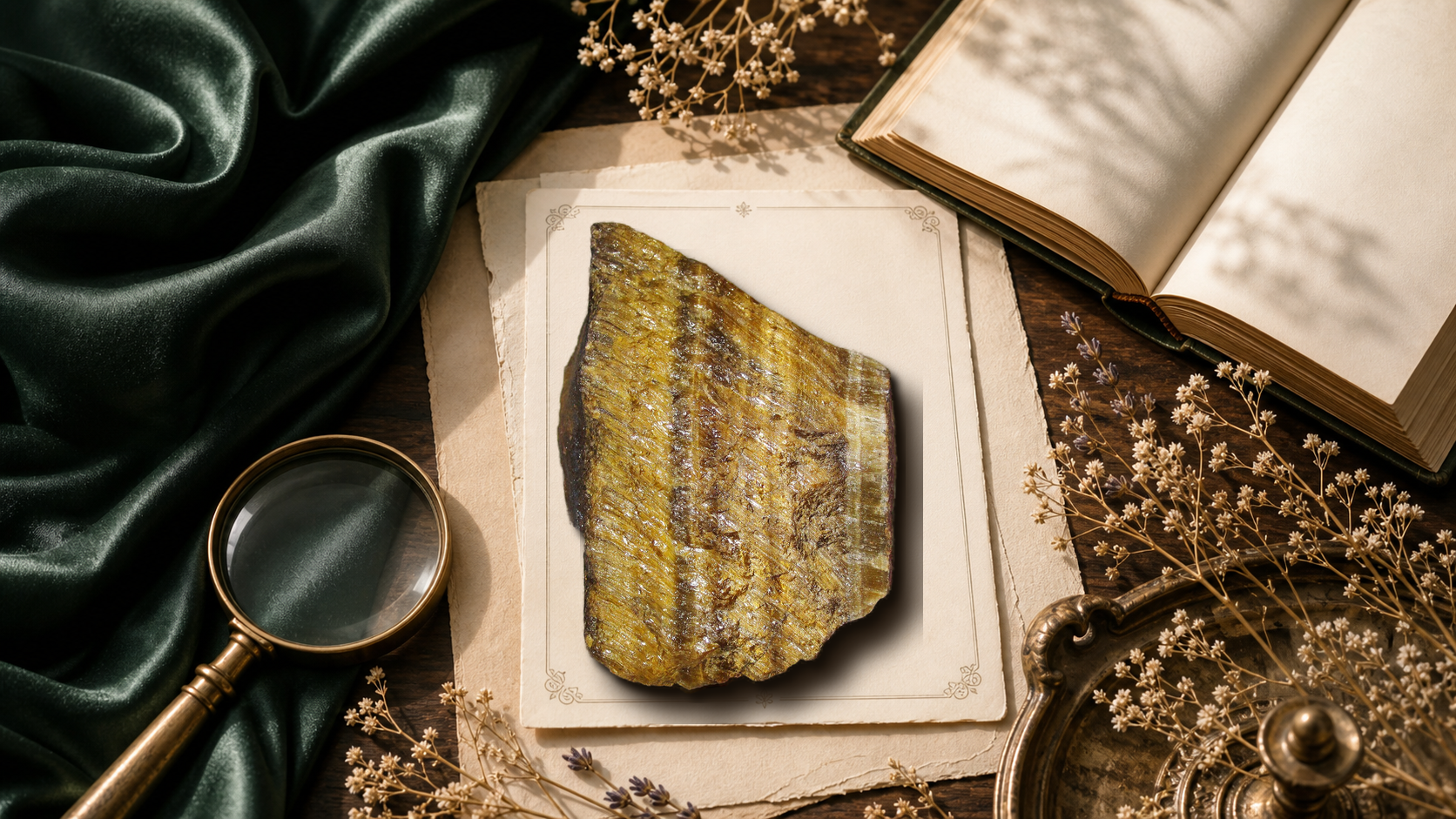
Blue Tiger Eye crystal
Clarity & FocusAnxiety ReliefIntuition & Inner Vision
Crystalis

Protocol

The Shifting Band

Crocidolite fibers locked in quartz — the chatoyant flash moves when you move, teaching you that clarity is not fixed but relational

3 min

  1. 1

    Hold the Blue Tiger Eye between your thumb and forefinger. Tilt it slowly under a light source — any light. Watch for the chatoyant band: a single line of light that slides across the surface as you move. This is not a reflection. It is refraction through aligned crocidolite fibers preserved in quartz. The flash only exists when stone and light and your angle of vision align. Find that angle. Hold it.

  2. 2

    Keep the stone at arm's length. Move it slowly left to right across your field of vision, following the flash with your eyes only — do not turn your head. Then move it vertically. Then in a slow circle. Let your eyes track the light band for 60 seconds. This is not meditation. This is visual precision.

  3. 3

    The fibers inside Blue Tiger Eye run parallel — every one aligned in the same direction. Breathe as if your inhale has a single direction: straight down the center of your body. Inhale for 5. Exhale for 7. Let the exhale be slightly longer, like a fiber extending past the edge of the stone. Repeat 6 times.

  4. 4

    Press the flat face of the stone against the center of your dominant palm. Close your hand around it. You cannot see the flash now, but the fibers are still there. Hold the stone in your closed fist for 30 seconds. Feel the silky surface against your skin. The chatoyancy continues even when no one is watching.

Continue in the full protocol below.

tap to flip for protocol

Sometimes the problem is not direction. It is pace.

Blue tiger eye preserves fibrous alignment from its crocidolite ancestry while quartz takes over the body, giving the stone its moving band and silky flash. The line remains readable because the fibers stay in order even after the substance changes.

Slow enough to see the shimmer. That is all.

What Your Body Knows

Nervous system states

sympathetic

Sympathetic activation (hypervigilance/scanning for threat):

Blue Tiger Eye's chatoyancy; the shifting band of light that appears to move as the stone is tilted; is a visual focus object that can interrupt hypervigilant scanning. When the sympathetic system is activated into threat-detection mode, the eyes dart and the visual field widens to detect danger. The chatoyant band provides a single, compelling visual anchor that narrows the visual field naturally, coaxing the eyes from wide-scanning to focused tracking. This oculomotor shift directly influences vagal tone through the cranial nerve pathways connecting eye movement to the parasympathetic system. State shift: hypervigilant sympathetic toward focused, regulated attention via oculomotor entrainment.

dorsal vagal

Dorsal vagal shutdown (emotional numbness/depression):

The blue color of Hawk's Eye registers in the visual cortex in the same frequency range as blue sky and open water; stimuli that evolutionary biology associates with safety and expansiveness. For a nervous system collapsed into dorsal vagal shutdown, where everything appears flat and gray, the introduction of deep blue with an internal light source (the chatoyant band) can penetrate numbness through the visual pathway before cognitive filters engage. State shift: dorsal toward low-level sympathetic activation through visual chromatic stimulation.

sympathetic

Mixed state: ventral vagal + sympathetic (alert awareness/strategic thinking):

When already regulated but needing heightened perceptual acuity; for an exam, a difficult conversation, a performance; Blue Tiger Eye supports what could be called "hawk vision." The stone's namesake is the hawk, whose survival depends on seeing with precision from a distance. This pairing of calm (ventral) with sharp attention (sympathetic) is exactly the state Blue Tiger Eye amplifies. State support: ventral-sympathetic co-activation for enhanced perceptual clarity.

sympathetic

tired but wired

Ventral vagal with perceptual overwhelm (regulated but overstimulated): For sensory-sensitive individuals who are socially regulated but overwhelmed by environmental stimulation; bright lights, noise, crowds; Blue Tiger Eye serves as a sensory filter. Its single chatoyant band against a dark blue field provides a visual minimalism that the overstimulated system craves. One line of light. One color. Simplicity within complexity. State support: ventral vagal maintenance with sensory filtering for overstimulated environments.

Nervous system mapping based on polyvagal theory (Porges, 2011).

Mineralogy

Mineral specs

Chemical Formula

SiO2 with residual Na2(Fe2+3Fe3+2)Si8O22(OH)2 (crocidolite remnants); silicon dioxide with incompletely replaced sodium iron amphibole (riebeckite asbestos)

Crystal System

Trigonal

Mohs Hardness

6.5

Specific Gravity

2.64-2.71 (slightly higher than standard quartz due to residual iron from crocidolite)

Luster

Silky to vitreous with strong chatoyancy (cat's eye effect) when cut en cabochon

Color

Blue

ca₁a₂a₃120°Trigonal · Blue Tiger Eye

Crystal system diagram represents the general trigonal classification. Diagram created by Crystalis for educational reference.

Traditional Knowledge

Traditions across cultures

Unknown

South African mining heritage (19th--20th century)

Tiger Eye in all its color varieties has been mined in the Northern Cape Province of South Africa since the mid-19th century. The Griqualand West deposits, near Griquatown and Prieska, remain the world's primary commercial source. Blue Tiger Eye (Hawk's Eye) was historically rarer and more valued than the golden variety because it represents a less common stage of incomplete silicification. South African mining communities, including Griqua and Tswana peoples, incorporated the chatoyant stones into decorative and ceremonial objects, associating the moving light band with the watchful eye of protective spirits (Cairncross, B., "Field Guide to Rocks and Minerals of Southern Africa," 2004, Struik Publishers). 2. Ancient Egyptian association with the Eye of Horus: While definitive archaeologic

When This Stone Finds You

What it says when it arrives

You are moving too fast to read the road. Blue tiger eye keeps its chatoyant band but cools the color toward steel and dusk, a slower version of the same old shimmer. Pace can change without the path disappearing.

Somatic protocol

The Shifting Band

Crocidolite fibers locked in quartz — the chatoyant flash moves when you move, teaching you that clarity is not fixed but relational

3 min protocol

  1. 1

    Hold the Blue Tiger Eye between your thumb and forefinger. Tilt it slowly under a light source — any light. Watch for the chatoyant band: a single line of light that slides across the surface as you move. This is not a reflection. It is refraction through aligned crocidolite fibers preserved in quartz. The flash only exists when stone and light and your angle of vision align. Find that angle. Hold it.

    1 min
  2. 2

    Keep the stone at arm's length. Move it slowly left to right across your field of vision, following the flash with your eyes only — do not turn your head. Then move it vertically. Then in a slow circle. Let your eyes track the light band for 60 seconds. This is not meditation. This is visual precision.

    1 min
  3. 3

    The fibers inside Blue Tiger Eye run parallel — every one aligned in the same direction. Breathe as if your inhale has a single direction: straight down the center of your body. Inhale for 5. Exhale for 7. Let the exhale be slightly longer, like a fiber extending past the edge of the stone. Repeat 6 times.

    1 min
  4. 4

    Press the flat face of the stone against the center of your dominant palm. Close your hand around it. You cannot see the flash now, but the fibers are still there. Hold the stone in your closed fist for 30 seconds. Feel the silky surface against your skin. The chatoyancy continues even when no one is watching.

    1 min
  5. 5

    Open your hand. Tilt the stone one more time and catch the flash again. Notice it feels different now — you have a relationship with it. Set the stone down flash-side up. Walk away knowing the band is still moving with every shift of light in the room.

    1 min

The #1 Question

Can Blue Tiger Eye go in water?

Water Safety CONDITIONAL -- Brief rinsing only. The quartz matrix is water-safe, but Blue Tiger Eye contains residual crocidolite (asbestos) fibers that are encapsulated within the quartz. While intact polished specimens pose no surface risk, prolonged soaking could theoretically compromise surface areas where crocidolite fibers approach the exterior. Brief rinsing under running water: acceptable. Extended soaking: not recommended. NEVER use in gem elixirs or gem water. Crocidolite is a known carcinogen when inhaled as fibers; while dissolved fibers in water have not been conclusively shown to pose the same risk, the precautionary principle applies absolutely.

Care and Maintenance

How to care for Blue Tiger Eye

Blue tiger eye (hawk eye) is water-safe for brief rinses. Quartz pseudomorph after crocidolite, Mohs 7. The chatoyant fibers are sealed within the quartz matrix.

Brief rinse (30-60 seconds) under cool running water. Note: the stone contains remnant crocidolite (blue asbestos) but it is fully encapsulated in quartz and poses no fiber release risk from water contact. Never cut or grind without respiratory protection.

Recommended cleansing: moonlight, sound, smoke. Store normally.

In Practice

How Blue Tiger Eye is used

You are moving too fast to read the road. Blue tiger eye keeps the chatoyant flash but in the original blue of unoxidized crocidolite. Hold it when you need to slow your scan without stopping your momentum.

The silky band catches light from one direction at a time. That is the practice: one focus, one flash, one direction. Place near your workspace for sustained attention without overheating.

Verification

Authenticity

Blue tiger eye (hawk's eye): chatoyant band visible when rotated under point light source. Mohs 7 (scratches glass). Silky luster.

Specific gravity 2. 64-2. 71.

The blue color is retained crocidolite fibers. Distinguish from dyed tiger eye: natural blue tiger eye shows chatoyancy with a blue-gray body, not vivid blue. If the color is too intense or uniform, it may be dyed.

Temperature

Natural Blue Tiger Eye should usually feel cooler than plastic or resin on first touch and warm more slowly in the hand.

Scratch logic

Use 6.5 on the Mohs scale as the check, not internet myths. A real specimen should behave in line with the hardness listed above.

Surface and luster

Look for a silky to vitreous with strong chatoyancy (cat's eye effect) when cut en cabochon surface quality rather than a painted or plastic shine.

Weight and density

The listed specific gravity is 2.64-2.71 (slightly higher than standard quartz due to residual iron from crocidolite). If a specimen feels unusually light for its size, it may deserve a second look.

Geographic Origins

Where Blue Tiger Eye forms in the world

South Africa's Northern Cape Province is the primary source, particularly the Griqualand West area. Australian blue tiger eye from the Pilbara region shows similar chatoyancy. Indian specimens from Odisha occur in banded iron formations.

The blue color is preserved crocidolite (blue asbestos) that was not fully oxidized during the pseudomorphic replacement process.

FAQ

Frequently asked

What is Blue Tiger Eye?

Chemical formula: SiO2 with residual Na2(Fe2+3Fe3+2)Si8O22(OH)2 (crocidolite remnants) -- silicon dioxide with incompletely replaced sodium iron amphibole (riebeckite asbestos). Mohs hardness: 6.5--7. Crystal system: Trigonal (hexagonal subfamily) -- fibrous microcrystalline quartz aggregate pseudomorphic after monoclinic crocidolite.

What is the Mohs hardness of Blue Tiger Eye?

Blue Tiger Eye has a Mohs hardness of 6.5--7.

Can Blue Tiger Eye go in water?

Water Safety CONDITIONAL -- Brief rinsing only. The quartz matrix is water-safe, but Blue Tiger Eye contains residual crocidolite (asbestos) fibers that are encapsulated within the quartz. While intact polished specimens pose no surface risk, prolonged soaking could theoretically compromise surface areas where crocidolite fibers approach the exterior. Brief rinsing under running water: acceptable. Extended soaking: not recommended. NEVER use in gem elixirs or gem water. Crocidolite is a known carcinogen when inhaled as fibers; while dissolved fibers in water have not been conclusively shown to pose the same risk, the precautionary principle applies absolutely.

What crystal system is Blue Tiger Eye?

Blue Tiger Eye crystallizes in the Trigonal (hexagonal subfamily) -- fibrous microcrystalline quartz aggregate pseudomorphic after monoclinic crocidolite.

What is the chemical formula of Blue Tiger Eye?

The chemical formula of Blue Tiger Eye is SiO2 with residual Na2(Fe2+3Fe3+2)Si8O22(OH)2 (crocidolite remnants) -- silicon dioxide with incompletely replaced sodium iron amphibole (riebeckite asbestos).

How does Blue Tiger Eye form?

Formation Story Blue Tiger Eye forms through one of the most remarkable pseudomorphic processes in mineralogy: the gradual replacement of crocidolite asbestos by microcrystalline quartz while preserving the original fibrous crystal habit. This process begins in banded iron formations (BIFs) -- ancient marine sedimentary deposits that formed primarily during the Precambrian era (approximately 2.5--1.8 billion years ago) when the Earth's atmosphere was transitioning from anoxic to oxygenated condi

References

Sources and citations

Closing Notes

Blue Tiger Eye

Crocidolite that kept its blue. Where standard tiger eye oxidized to gold, hawk eye stayed in the original blue asbestos color. Pseudomorphic quartz that preserved what came before.

The science documents incomplete replacement. The practice asks what happens when transformation is not total and the original signal persists.

Bring it into practice

What to do with Blue Tiger Eye next

Move from reference to ritual. Search current inventory for Blue Tiger Eye, build a custom bracelet, or let Sacred Match choose the right supporting stones for you.

Community notes

Threads under Blue Tiger Eye

Open all chats

Shared field notes tied to Blue Tiger Eye appear here, including notes saved from practice.

No shared notes under Blue Tiger Eye yet.

When members save a public field note for this stone, it will appear here.

The archive

Related crystals

Read the Full Crystal Guide

Continue through stones that share intention, chakra focus, or tonal family with Blue Tiger Eye.