Materia Medica
Beryllonite
The Quiet Clarity Stone
This page documents traditional and cultural uses of beryllonite alongside emerging research on tactile grounding objects. Crystalis does not claim that beryllonite treats, cures, or prevents any medical condition. For mental health concerns, consult a qualified professional.
Origins: USA (Maine), Brazil, Finland
Materia Medica
The Quiet Clarity Stone
Protocol
See through sodium beryllium phosphate to undistorted light.
3 min
Sit in a well-lit space. Place the beryllonite specimen on a white or light-colored cloth in front of you at eye level. Do not hold it -- beryllium content requires a visual-focus approach. The stone's colorless to pale yellow transparency is the teaching tool. Rest both palms on your thighs. Look into the crystal. Notice its clarity -- light passes through without interruption. Breathe: 4 counts in through the nose, 6 counts out through the mouth. Three cycles. You are looking through a window made of sodium beryllium phosphate. What you see on the other side is undistorted light.
Without moving your head, soften your eyes until the crystal becomes slightly blurred. Then refocus until it sharpens. Alternate between soft focus and sharp focus three times. This is not an eye exercise. It is a perception exercise. Your nervous system has filters between you and your experience. Soft focus shows you what happens when the filters relax. Sharp focus shows you what clarity looks like without strain. The stone does not change. Only your perception of it changes. Notice which state -- soft or sharp -- your body prefers right now. That preference is data.
Close your eyes. Hold the image of the crystal's transparency in your mind. Now imagine that same transparency in your own perceptual field -- as if the film between you and your experience dissolved and you could perceive directly, without commentary, without analysis, without the protective blur your nervous system usually applies. You do not have to maintain this state. Just touch it. Even two seconds of unfiltered perception resets something. Breathe naturally. If thoughts arise, let them pass through like light through the crystal. They are not obstacles. They are traffic.
Open your eyes. Look at the crystal one last time. Then look past it, at whatever is behind it in the room. Notice that both the crystal and the background are in your visual field simultaneously -- the near object and the far space. This is the perceptual state the protocol builds: the ability to hold the immediate and the expansive in the same awareness without choosing between them. Stand up. Leave the beryllonite on its cloth. Carry the transparency with you.
tap to flip for protocol
Overfast thinking creates a strange kind of static. Too much cognition, not enough arrival.
Beryllonite helps by looking precise without becoming loud. The form stays exact. The color barely insists.
Some minds need less brightness and more separation.
What Your Body Knows
sympathetic
You are trying to see something clearly but a film sits between you and the perception. Your intuition feels muffled and your analytical mind compensates by working harder, which only adds more noise. Your forehead feels like it is pressing against glass. This is dorsal vagal dampening of the perceptual field layered with sympathetic compensation; your system is both dimming and straining at once.
dorsal vagal
Your perception has narrowed to laser precision on one point but you have lost the context around it. You can see the detail but not the picture. Your third eye area feels hot and your breathing has become shallow. This is sympathetic hyper-focus that has overridden the crown's panoramic function; you are looking through a telescope when you need a window.
ventral vagal
Your awareness is transparent. You perceive without adding commentary. Information enters and you register it before your analytical mind can distort or delay it. Your forehead is smooth and your crown feels permeable. There is no strain in seeing. This is ventral vagal openness where the perceptual pathway is clean; you are receiving rather than constructing your experience.
Nervous system mapping based on polyvagal theory (Porges, 2011).
The Earth Made This
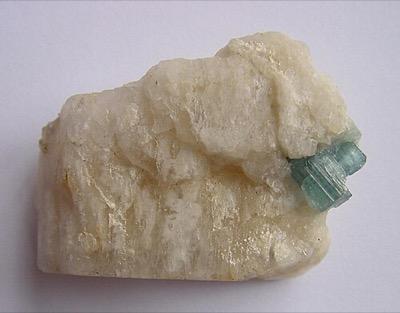
Beryllonite does not announce itself. Colorless to pale yellow, vitreous, and modest at 5.5 to 6 on the Mohs scale. A sodium beryllium phosphate that forms in lithium-bearing granite pegmatites alongside other phosphate minerals and beryl.
First described from Stoneham, Maine, in 1888. Named for its beryllium content. The orthorhombic crystals have a quiet precision that limits their appeal in jewelry (too soft, too subtle) while making them interesting to collectors who pay attention to structure. Specimens from Afghanistan and Brazil have appeared alongside the original Maine material.
Mineralogy
Chemical Formula
NaBePO4
Crystal System
Monoclinic
Mohs Hardness
5.5
Specific Gravity
2.80-2.84
Luster
Vitreous to pearly
Color
White
Crystal system diagram represents the general monoclinic classification. Diagram created by Crystalis for educational reference.
Traditional Knowledge
Discovered 1888 at Stoneham, Maine by James Dwight Dana; rare phosphate prized by collectors
Stoneham Maine Type Locality Discovery
Beryllonite was first described in 1888 from specimens found in the pegmatite deposits of Stoneham, Oxford County, Maine. The mineral was named for its beryllium content by American mineralogist Edward Salisbury Dana, son of the legendary James Dwight Dana. The Stoneham locality produced the finest early specimens and established Maine's reputation as a world-class pegmatite mineral locality alongside its tourmaline and beryl production.
Pegmatite Phosphate Collecting
Beryllonite became a prized target for mineral collectors specializing in pegmatite phosphates during the 20th century. Its occurrence alongside other rare phosphates like herderite, triphylite, and lithiophilite in New England pegmatites made it part of a collecting tradition centered on the complex mineralogy of granitic pegmatite systems. Specimens from Stoneham and nearby Newry remain the historical standard for the species.
Brazilian and African Finds
Gem-quality beryllonite crystals were subsequently discovered in pegmatite deposits in Minas Gerais, Brazil, and in Karibib, Namibia, expanding the known distribution of the species beyond its Maine type locality. Brazilian material occasionally produced crystals large enough for faceting, creating a tiny niche market for faceted beryllonite among collectors of rare gems. These finds confirmed that beryllonite, while rare, is a global pegmatite mineral.
Beryllonite Third Eye Perception
A small community of crystal practitioners working with rare phosphate minerals has prescribed beryllonite for third eye and crown work focused on the quality of perception itself rather than the content of perception. The mineral's exceptional transparency and phosphate chemistry inform a practice centered on removing distortion from the perceptual field. All work is visual or proximity-based due to beryllium content, with the stone displayed on white cloth during meditation.
When This Stone Finds You
Somatic protocol
See through sodium beryllium phosphate to undistorted light.
3 min protocol
Sit in a well-lit space. Place the beryllonite specimen on a white or light-colored cloth in front of you at eye level. Do not hold it -- beryllium content requires a visual-focus approach. The stone's colorless to pale yellow transparency is the teaching tool. Rest both palms on your thighs. Look into the crystal. Notice its clarity -- light passes through without interruption. Breathe: 4 counts in through the nose, 6 counts out through the mouth. Three cycles. You are looking through a window made of sodium beryllium phosphate. What you see on the other side is undistorted light.
Without moving your head, soften your eyes until the crystal becomes slightly blurred. Then refocus until it sharpens. Alternate between soft focus and sharp focus three times. This is not an eye exercise. It is a perception exercise. Your nervous system has filters between you and your experience. Soft focus shows you what happens when the filters relax. Sharp focus shows you what clarity looks like without strain. The stone does not change. Only your perception of it changes. Notice which state -- soft or sharp -- your body prefers right now. That preference is data.
Close your eyes. Hold the image of the crystal's transparency in your mind. Now imagine that same transparency in your own perceptual field -- as if the film between you and your experience dissolved and you could perceive directly, without commentary, without analysis, without the protective blur your nervous system usually applies. You do not have to maintain this state. Just touch it. Even two seconds of unfiltered perception resets something. Breathe naturally. If thoughts arise, let them pass through like light through the crystal. They are not obstacles. They are traffic.
Open your eyes. Look at the crystal one last time. Then look past it, at whatever is behind it in the room. Notice that both the crystal and the background are in your visual field simultaneously -- the near object and the far space. This is the perceptual state the protocol builds: the ability to hold the immediate and the expansive in the same awareness without choosing between them. Stand up. Leave the beryllonite on its cloth. Carry the transparency with you.
Care and Maintenance
Beryllonite requires caution with water. Mohs 5. 5-6, sodium beryllium phosphate, relatively soft with perfect cleavage.
Brief rinse (15-30 seconds) under cool water is acceptable. Pat dry immediately. Avoid prolonged soaking and salt water.
Contains beryllium; do not cut, grind, or create dust without respiratory protection. Recommended cleansing: moonlight (overnight), selenite plate (4-6 hours), smoke (30-60 seconds). Store in a soft pouch; cleavage planes make beryllonite prone to splitting.
In Practice
Your mind is cluttered and the clutter has become its own noise. Beryllonite is sodium beryllium phosphate, Mohs 5. 5, monoclinic.
It crystallizes in lithium-bearing pegmatites alongside tourmaline and lepidolite. Its perfect cleavage means it breaks along invisible planes with mathematical precision. Hold a polished piece in the palm during intentional stillness.
The transparency and low specific gravity (2. 8) create a feeling of lightness that contrasts with the heaviness of mental overwhelm. The stone does not clear your mind.
It offers a physical counterpoint to the weight.
Verification
Beryllonite: colorless to pale yellow prismatic crystals. Specific gravity 2. 80-2.
84. Monoclinic with perfect cleavage. Vitreous to pearly luster.
Mohs 5. 5-6. Contains beryllium.
Rare collector mineral; if offered cheaply or in large quantities, verify. The name and the mineral are unfamiliar to most dealers.
Natural Beryllonite should usually feel cooler than plastic or resin on first touch and warm more slowly in the hand.
Use 5.5 on the Mohs scale as the check, not internet myths. A real specimen should behave in line with the hardness listed above.
Look for a vitreous to pearly surface quality rather than a painted or plastic shine.
The listed specific gravity is 2.80-2.84. If a specimen feels unusually light for its size, it may deserve a second look.
Geographic Origins
Beryllonite crystallizes in lithium-bearing pegmatites where beryllium, sodium, and phosphorus converge in the final melt fractions. The type locality is Stoneham, Maine, where transparent crystals occur with herderite and hydroxyl-herderite in pocket zones. Brazilian specimens from Minas Gerais pegmatites tend toward larger crystal size but lower transparency.
Finnish occurrences at Viitaniemi produced some of the earliest studied specimens.
FAQ
Beryllonite is a sodium beryllium phosphate (NaBePO4) that forms colorless to pale yellow monoclinic crystals. It is a rare collector mineral first described from Stoneham, Maine. In crystal practice, its exceptional clarity and phosphate chemistry are associated with refined upper-chakra perception. Handle with care and wash hands after contact due to beryllium content.
Yes. Beryllonite is a genuinely rare mineral. The type locality at Stoneham, Maine, remains the most significant source. Additional finds in Brazil, Finland, and Zimbabwe have produced limited material. Gem-quality transparent crystals suitable for faceting are exceptionally scarce and command serious collector prices.
No. Beryllonite is not recommended for water contact. At Mohs 5.5-6 it is moderately soft, and its beryllium content means dissolution products would be toxic. Never use it in gem elixirs. Keep it dry and use non-contact cleansing methods only.
Beryllonite is mapped to the crown and third eye chakras. Its colorless to pale yellow transparency and phosphate chemistry correspond to the felt sense of clear, unobstructed perception. Practitioners describe it as creating a window effect -- not adding input but removing the film between you and what you are perceiving.
Beryllonite is Mohs 5.5 to 6, comparable to feldspar. It can be scratched by quartz and harder minerals. Faceted gems require protected settings for jewelry. Most specimens are better suited to mineral collections than daily wear.
The type locality is Stoneham, Oxford County, Maine, where it was first described in 1888. The name references its beryllium content. Additional localities include Minas Gerais in Brazil, Viitaniemi in Finland, and Karibib in Namibia. Maine specimens remain the most historically significant.
Brief, dry handling is acceptable for adults who wash their hands afterward. Like all beryllium minerals, the risk is primarily from dust inhalation rather than skin contact with intact crystals. Do not grind, cut, or break specimens without professional safety equipment. Keep away from children.
Beryllonite typically presents as colorless to pale yellow tabular or prismatic crystals with a vitreous to pearly luster. The crystals can be transparent with exceptional clarity. Some specimens show a subtle silky sheen on cleavage surfaces. It can be mistaken for other colorless phosphates without testing.
References
Dana, E.S. (1888). On beryllonite, a new mineral. American Journal of Science. [SCI]
Giuseppetti, G.; Tadini, C. (1992). The crystal structure of beryllonite, NaBePO4. Tschermaks Mineralogische und Petrographische Mitteilungen. [SCI]
Palache, C.; Berman, H.; Frondel, C. (1951). Dana's System of Mineralogy, Vol. II (7th ed.). [SCI]
Closing Notes
Sodium beryllium phosphate, monoclinic, Mohs 5. 5. Beryllonite grows in lithium-bearing pegmatites alongside tourmaline and lepidolite, in pockets where beryllium, sodium, and phosphorus converge.
Its perfect cleavage means it breaks along atomic planes with mathematical precision. Handle it like the rare phosphate it is.
Bring it into practice
Move from reference to ritual. Search current inventory for Beryllonite, build a custom bracelet, or let Sacred Match choose the right supporting stones for you.
Community notes
Shared field notes tied to Beryllonite appear here, including notes saved from practice.
When members save a public field note for this stone, it will appear here.
The archive
Continue through stones that share intention, chakra focus, or tonal family with Beryllonite.

Shared intention: Clarity & Focus
The Two-Way Channel

Shared intention: Clarity & Focus
The Window to Light
Shared intention: Clarity & Focus
The Hawk's Clear Sight
Shared intention: Anxiety Relief
The Hawk's Calm Gaze
Shared intention: Clarity & Focus
The Spectrum Organizer

Shared intention: Clarity & Focus
The Television Stone