Crystal Encyclopedia
40+YEARS

Rainbow Fluorite

CaF2 (calcium fluoride) · Mohs 4 · Cubic · Third Eye Chakra

The stone of rainbow fluorite: meaning, mineralogy, and somatic practice.

Clarity & FocusStructure & DisciplineEmotional BalanceIntuition & Inner Vision

This page documents traditional and cultural uses of rainbow fluorite alongside emerging research on tactile grounding objects. Crystalis does not claim that rainbow fluorite treats, cures, or prevents any medical condition. For mental health concerns, consult a qualified professional.

Crystalis Editorial · 40+ Years · Herndon, VA · 12 peer-reviewed sources

Origins: China, Mexico, UK

Quick actions

Move from reference into practice

Crystalis

Materia Medica

Rainbow Fluorite

The Spectrum Organizer

Rainbow Fluorite crystal
Clarity & FocusStructure & DisciplineEmotional Balance
Crystalis

Protocol

The Octahedral Sort

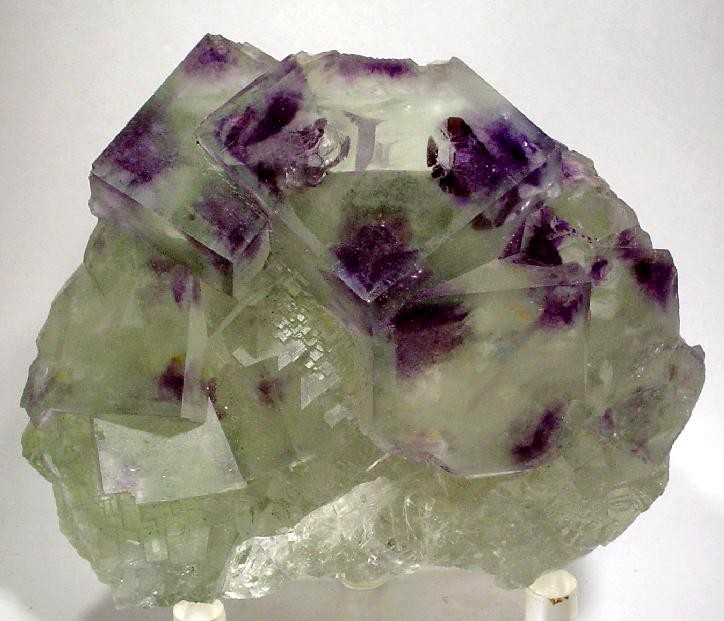
Cubic calcium fluoride banding in violet, green, blue, and clear -- each color a different trace element, each layer a different chapter, all obeying the same Fm3m symmetry.

3 min

  1. 1

    Hold the rainbow fluorite and study the banding. Each color zone -- purple, green, blue, yellow, clear -- represents a different trace element or different conditions during crystal growth within the cubic Fm3m system. The structure stayed the same. Only the chemistry shifted. Breathe in for 4, out for 5. Your structure can hold many chapters too.

  2. 2

    Place the stone on your forehead, between the eyebrows. At hardness 4, fluorite is softer than glass -- do not press hard. The CaF2 crystal cleaves in perfect octahedra along four planes. Imagine your tangled thoughts cleaving along clean planes -- not forced, but following the natural fracture. Breathe and let one thought separate cleanly from the mass.

  3. 3

    Move the stone to your non-dominant hand. The specific gravity of pure fluorite is 3.18, but specimens enriched in rare earth elements can reach 3.56. The 'extras' make it heavier, not impure. Ask: what part of me that I call 'extra' or 'too much' is actually what gives me specific gravity -- what makes me substantial?

  4. 4

    Hold the fluorite up to light if translucent. Watch colors shift as light passes through different growth zones. Each band formed at a different moment in geological time, but they are all in the same crystal. Set the stone down. Name three phases of your life. They are all in the same crystal too. None invalidates the others.

tap to flip for protocol

Some integrations fail because they are imagined as blending. The psyche keeps trying to smooth out the different phases until they stop offending each other, but the body often wants a cleaner arrangement: not blur, but coexistence.

Rainbow fluorite gives that arrangement beautifully. Band after band remains visible, each color marking a different stage of growth without requiring the previous one to disappear. The body becomes more whole by staying layered.

Rainbow fluorite is useful when peace depends on letting the phases remain distinct. Integration does not have to erase the bands.

What Your Body Knows

Nervous system states

Rainbow fluorite addresses the brow, eyes, and upper chest together, the corridor where cognitive processing, emotional tone, and visual orientation must coordinate rather than compete. It speaks to transition states, particularly the shift from mental fragmentation toward organized clarity where multiple concerns can coexist. The mineral basis is specific.

Fluorite is calcium fluoride, cubic, hardness four, with perfect octahedral cleavage. Rainbow fluorite displays multiple color zones, typically purple, green, blue, and clear, created by varying trace elements and radiation exposure during growth. Each zone represents a different chemical moment in the same continuous crystal.

The body receives an image of structured multiplicity, distinct experiences organized within a single coherent lattice. That matters when the nervous system is trying to hold several emotional registers at once and defaulting to overwhelm. Somatic practice with rainbow fluorite works through visual tracking and cool thermal contact.

The eyes can follow color boundaries across the specimen, which supports the kind of organized scanning that replaces chaotic internal searching. Its cubic structure and moderate weight offer the hand a sense of geometric order. Held at the brow or sternum, the stone provides a bounded visual field where complexity remains legible.

The cleavage planes also contribute, reminding the body that even orderly structures have natural fracture lines. Rainbow fluorite works most clearly with transition, especially when cognitive overload needs sequencing rather than suppression and the system must learn to hold multiple tones without losing the fundamental note.

dorsal vagal

Freeze / Shutdown

When energy feels stuck and the body won't respond. Rainbow Fluorite is placed on the body as an anchor point. Your shoulders drop. Your breath becomes shallow and barely audible. A heaviness settles in your limbs. This is dorsal vagal shutdown; your oldest survival circuit pulling you toward stillness, collapse, disconnection from sensation.

sympathetic

Overstimulation / Agitation

When the system is running too hot; racing thoughts, restless limbs, inability to settle. Your chest tightens. Your jaw clenches. Your breath moves higher, shallower, faster. This is sympathetic activation; your body mobilizing for fight or flight, muscles tensing, heart rate rising.

ventral vagal

Regulated Presence

When the body finds its resting rhythm. Rainbow Fluorite held or placed becomes a touchpoint for presence. Your chest opens. Your jaw unclenches. Your breath deepens into your belly. This is ventral vagal regulation; your body finding safety, social connection, steady presence.

Nervous system mapping based on polyvagal theory (Porges, S.W. The Polyvagal Theory. Norton, 2011).

The Earth Made This

Formation: How Rainbow Fluorite Becomes Rainbow Fluorite

Rainbow fluorite is fluorite (calcium fluoride, CaF₂) displaying multiple color bands . typically purple, green, blue, yellow, and colorless . in a single specimen.

Fluorite crystallizes in the isometric system, forming cubes, octahedra, and combinations of both. The color banding records changing trace element concentrations and radiation exposure conditions during crystal growth. Each color reflects different defect structures in the crystal lattice: purple results from calcium colloids formed by natural radiation damage, green from yttrium or samarium substitution, blue from excess calcium in the lattice, and yellow from oxygen-bearing color centers.

As hydrothermal fluids evolve over time . changing in temperature, chemistry, and flow rate . successive growth zones incorporate different impurities, producing the striped appearance.

Major sources of banded rainbow fluorite include China (Hunan and Zhejiang provinces), England (the famous Blue John variety from Derbyshire), Mexico, and the Illinois-Kentucky fluorspar district. Mohs hardness is 4, with perfect octahedral cleavage in four directions.

Material facts

What the stone is made of

Mineralogy: Fluorite (calcium fluoride), halide class, banded multicolored variety. Chemical formula: CaF₂. Crystal system: cubic. Mohs hardness: 4. Specific gravity: 3.18. Color: multiple colors in bands or zones (purple, green, blue, yellow, clear), each band resulting from different trace element incorporations (rare earth elements, yttrium) and radiation-induced color centers during successive growth phases. Luster: vitreous. Habit: cubic, octahedral, or massive. Perfect octahedral cleavage in four directions. Fluoresces under UV light (fluorite is the type mineral for fluorescence). Isotropic (singly refractive). "Rainbow" designates specimens showing three or more distinct color bands.

Deeper geology

Color zoning is the central geological drama of rainbow fluorite. The mineral itself remains simple, calcium fluoride, CaF2, crystallizing in the cubic system with perfect octahedral cleavage. Yet a single specimen may carry green, purple, blue, yellow, and nearly colorless bands because each growth stage recorded a slightly different chemical or radiation environment. As fluorite precipitated from hydrothermal fluids moving through cavities and veins, the lattice incorporated trace impurities and defect structures that changed over time. Those shifts became visible as stripes rather than as separate minerals.

Fluorite commonly forms in low to moderate temperature hydrothermal systems, often with quartz, calcite, barite, galena, and sphalerite. Open space is important because cubes, octahedra, and stepped growth surfaces develop best where the crystal can expand into a cavity. In rainbow material, pauses and resumptions in growth are especially significant. A pulse of fluid richer in rare earth elements or carrying a different redox signature may lay down a green band. Later, natural irradiation or new trace element availability may favor purple or blue. The crystal keeps each interval instead of homogenizing them.

Its moderate hardness of 4 and perfect cleavage mean fluorite grows beautifully but breaks readily. That duality makes sense crystallographically. The cubic framework is orderly, but the bonding allows planes of weakness in four directions. Transparency can be high enough for inner bands to appear suspended at depth, giving polished pieces their familiar layered effect. Under ultraviolet light many fluorites also fluoresce, the very phenomenon from which fluorescence took its name.

From a formation standpoint, rainbow fluorite is a time layered hydrothermal mineral. Each band marks a moment when the fluid system was chemically distinct from the moment before. The finished crystal is therefore less like paint on stone and more like a stratigraphic core in miniature. It preserves growth interruptions, impurity changes, and the radiation history of a hydrothermal environment inside one cleavable cubic body.

Another useful detail is scale. Rainbow Fluorite does not need exotic folklore to justify attention, because the evidence already sits in texture, density, and paragenesis.
Mineralogy

Mineral specs

Chemical Formula

CaF2 (calcium fluoride)

Crystal System

Cubic

Mohs Hardness

4

Specific Gravity

3.18 (pure); up to 3.56 when enriched in REEs

Luster

Vitreous

Color

Multi

a₃a₂a₁a₁=a₂=a₃Cubic · Rainbow Fluorite

Crystal system diagram represents the general cubic classification. Diagram created by Crystalis for educational reference.

Traditional Knowledge

Lore and culture around Rainbow Fluorite

Science grounds the page. Tradition, lore, and remembered use make it readable as lived knowledge.

Name origin: From the Latin fluere ("to flow"), referring to fluorite's use as a flux in smelting since at least the 16th century, lowering the melting point of metal ores. Fluorescence etymology: The term "fluorescence" was coined by George Gabriel Stokes in 1852, specifically to describe the visible light emission he observed when illuminating fluorite with UV light. Fluorite is thus the type specimen for this universal optical phenomenon. Blue John: A rare banded blue-purple-yellow fluorite from Castleton, Derbyshire, England, has been carved into ornamental objects since at least Roman times (circa 1st century CE). It remains one of the most prized decorative mineral varieties in Britain. Industrial applications: Fluorite is the principal ore of fluorine. It is essential in the production of hydrofluoric acid (HF), which is used in aluminum smelting, petroleum refining, semiconductor manufacturing, and production of fluoropolymers (PTFE/Teflon). Optical-grade fluorite is used in high-quality camera lenses and scientific optics due to its low dispersion.

Unknown

Name origin

From the Latin fluere ("to flow"), referring to fluorite's use as a flux in smelting since at least the 16th century, lowering the melting point of metal ores. - Fluorescence etymology: The term "fluorescence" was coined by George Gabriel Stokes in 1852, specifically to describe the visible light emission he observed when illuminating fluorite with UV light. Fluorite is thus the type specimen for this universal optical phenomenon. - Blue John: A rare banded blue-purple-yellow fluorite from Castleton, Derbyshire, England, has been carved into ornamental objects since at least Roman times (circa 1st century CE). It remains one of the most prized decorative mineral varieties in Britain. - Industrial applications: Fluorite is the principal ore of fluorine. It is essential in the production of

Sacred Match Notes

When this stone becomes the right door

Sacred Match prescribes Rainbow Fluorite when you report:

fighting your own complexity instead of reading it layers of feeling stacking without integration brow tension from trying to be one thing at a time shame about how many contradictory states live inside you difficulty believing that your phases are legible rather than chaotic

Sacred Match prescribes through physiological diagnosis, not preference. It queries whether internal multiplicity is disorganization, richness, or a system that has been shamed out of its own range. When that triangulation reveals cognitive overcontrol attempting to compress a legitimately banded internal landscape into a single color, Rainbow Fluorite enters the protocol. This is the prescription for stratified identity under pressure. Fluorite records each growth phase as a distinct color band from different trace element incorporations and radiation-induced color centers, keeping every chapter visible rather than polishing them into uniformity.

Fighting complexity -> cognitive overcontrol -> perfect octahedral cleavage in four directions at CaF2 teaches that clean separation between layers is a feature, not a fracture Layers stacking without integration -> phase accumulation without coherence -> each color band records a distinct growth phase with different rare earth element signatures, proving that phases can coexist in sequence Brow tension -> frontal lobe compression from simplification effort -> cubic crystal system organizes multiple color zones inside one isotropic framework Shame about range -> social punishment for multiplicity -> Mohs 4 means this mineral is not pretending to be harder than it is; the value is in the spectrum, not the armor Phases illegible -> self-doubt about internal coherence -> UV fluorescence demonstrates that hidden properties activate under different conditions without negating the visible ones

3-Minute Reset

The Octahedral Sort

Cubic calcium fluoride banding in violet, green, blue, and clear -- each color a different trace element, each layer a different chapter, all obeying the same Fm3m symmetry.

3 min protocol

  1. 1

    Hold the rainbow fluorite and study the banding. Each color zone -- purple, green, blue, yellow, clear -- represents a different trace element or different conditions during crystal growth within the cubic Fm3m system. The structure stayed the same. Only the chemistry shifted. Breathe in for 4, out for 5. Your structure can hold many chapters too.

    45 sec
  2. 2

    Place the stone on your forehead, between the eyebrows. At hardness 4, fluorite is softer than glass -- do not press hard. The CaF2 crystal cleaves in perfect octahedra along four planes. Imagine your tangled thoughts cleaving along clean planes -- not forced, but following the natural fracture. Breathe and let one thought separate cleanly from the mass.

    45 sec
  3. 3

    Move the stone to your non-dominant hand. The specific gravity of pure fluorite is 3.18, but specimens enriched in rare earth elements can reach 3.56. The 'extras' make it heavier, not impure. Ask: what part of me that I call 'extra' or 'too much' is actually what gives me specific gravity -- what makes me substantial?

    45 sec
  4. 4

    Hold the fluorite up to light if translucent. Watch colors shift as light passes through different growth zones. Each band formed at a different moment in geological time, but they are all in the same crystal. Set the stone down. Name three phases of your life. They are all in the same crystal too. None invalidates the others.

    45 sec

The #1 Question

Can Rainbow Fluorite go in water?

Safety Flags

Mineral Distinction

What sets Rainbow Fluorite apart

Rainbow fluorite refers to fluorite specimens showing multiple color bands, typically purple, green, blue, clear, and yellow in alternating zones. The identification challenge is distinguishing natural banding from dyed or heat treated material. Fluorite is Mohs 4 with perfect octahedral cleavage and specific gravity about 3.

18. The colors come from various trace element and irradiation effects during crystal growth. Natural banding follows crystallographic zones.

Dyed material shows color concentrated in surface fractures and cracks rather than in systematic crystal growth zones. Heat treated fluorite may show altered or enhanced colors. If the bands follow crystal faces and the color looks integrated rather than painted into fractures, the banding is likely natural.

Care and Maintenance

How to care for Rainbow Fluorite

Rainbow fluorite requires caution. Calcium fluoride (Mohs 4), perfect octahedral cleavage in four directions. Soft and cleavable.

Brief cool water rinse is acceptable. Avoid ultrasonic (cleavage risk), acid, and impact. The color banding is stable.

Recommended cleansing: moonlight (safest), smoke (30-60 seconds), selenite plate (4-6 hours). Store in a padded pouch; fluorite chips and cleaves easily.

Crystal companions

What pairs well with Rainbow Fluorite

Amethyst

Descriptor: mental order and calm. Reason: amethyst supports fluorite’s reputation for structure and sequencing without duplicating the same texture. Together they work well for study, planning, and careful reflection. Placement: rainbow fluorite on the desk, amethyst above the monitor or on the upper shelf.

Clear Quartz

Descriptor: sharpened focus. Reason: quartz intensifies fluorite’s banded clarity and is especially useful when the goal is concentration rather than sentiment. Placement: quartz point aimed toward the fluorite from a few inches away.

Black Tourmaline

Descriptor: lower body anchor. Reason: fluorite can feel airy. Tourmaline keeps the work from floating into pure analysis. Placement: fluorite at the brow during rest, black tourmaline at the feet.

Selenite

Descriptor: clean mental desk. Reason: selenite or satin spar clears leftover mental clutter between sessions. Placement: place fluorite on a selenite plate when the planning work is done.

Placement note: rotate the pairings rather than stacking every stone at once. Rainbow Fluorite works best when one partner stays close to the body and another holds the edge of the space, so the arrangement has direction instead of crowding.

Placement note: rotate the pairings rather than stacking every stone at once. Rainbow Fluorite works best when one partner stays close to the body and another holds the edge of the space, so the arrangement has direction instead of crowding.

In Practice

How Rainbow Fluorite is used

You are managing multiple priorities and need to organize them without losing any. Rainbow fluorite is calcium fluoride, Mohs 4, with bands of purple, green, blue, and clear created by different trace elements and radiation exposure during successive growth phases. Each color band is a separate chapter of the crystal's formation.

Hold it during overwhelm that comes from multiplicity, not from any single problem. The fluorite organized itself into distinct zones. The colors do not bleed into each other.

Each band has its own boundary. SAFETY: Do not heat fluorite.

Verification

Authenticity

Rainbow fluorite: Mohs 4. Perfect octahedral cleavage. Specific gravity 3.

18. Vitreous luster. Multiple color bands (purple, green, blue, yellow) in one specimen.

The bands should follow natural growth zoning, visible as concentric or angular layers. If the colors look uniform or artificially applied rather than growth-zoned, question it. Most fluorite fluoresces under UV light.

Temperature

Natural Rainbow Fluorite should usually feel cooler than plastic or resin on first touch and warm more slowly in the hand.

Scratch logic

Use 4 on the Mohs scale as the check, not internet myths. A real specimen should behave in line with the hardness listed above.

Surface and luster

Look for a vitreous surface quality rather than a painted or plastic shine.

Weight and density

The listed specific gravity is 3.18 (pure); up to 3.56 when enriched in REEs. If a specimen feels unusually light for its size, it may deserve a second look.

Geographic Origins

Where Rainbow Fluorite forms in the world

China's Hunan and Fujian provinces produce the most commercially available rainbow fluorite. Mexico's Durango and other states yield specimens with distinctive color banding. UK's Derbyshire (including Blue John from Castleton) is the classic European source.

The multiple color bands record changing trace element and irradiation conditions during crystal growth at each locality.

FAQ

Frequently asked

What is Rainbow Fluorite?

Chemical formula: CaF2 (calcium fluoride). Mohs hardness: 4. Crystal system: Cubic (isometric); space group Fm3m.

What is the Mohs hardness of Rainbow Fluorite?

Rainbow Fluorite has a Mohs hardness of 4.

Can Rainbow Fluorite go in water?

Safety Flags

What crystal system is Rainbow Fluorite?

Rainbow Fluorite crystallizes in the Cubic (isometric); space group Fm3m.

What is the chemical formula of Rainbow Fluorite?

The chemical formula of Rainbow Fluorite is CaF2 (calcium fluoride).

How does Rainbow Fluorite form?

Formation Geology Fluorite forms in several geological environments: 1. Hydrothermal vein deposits: The most common source of gem and collector-quality fluorite. Formed from hot, F-rich fluids that migrate through fractures in host rocks, precipitating CaF2 as temperature and pressure decrease. The trace element and REE signatures of fluorite record the composition and evolution of the mineralizing fluid (Namga et al., 2023; Zhao et al., 2019). 2. Mississippi Valley-Type (MVT) deposits: Low-temp

References

Sources and citations

  1. Kunz, George Frederick. (1913). The Curious Lore of Precious Stones. [HIST]

  2. Pliny the Elder. Naturalis Historia, Book 37. [HIST]

  3. Ágnes Ritoók. (2020). Fluorite – A marketable mineral commodity from the central region of medieval Hungary. [LORE]

    DOI: 10.1556/072.2020.00006

  4. Li, Yan, Wang, Zhouhao, Cai, Yi, Pam, Mei Er, Yang, Yingkui et al. (2022). Designing Advanced Aqueous Zinc‐Ion Batteries: Principles, Strategies, and Perspectives. ENERGY & ENVIRONMENTAL MATERIALS. [SCI]

    DOI: 10.1002/eem2.12265

  5. Xiao, Biwei. (2020). Intercalated water in aqueous batteries. Carbon Energy. [SCI]

    DOI: 10.1002/cey2.55

  6. Petrie, Christian M., Windl, Wolfgang, Blue, Thomas E. (2014). <i>In‐Situ</i> Reactor Radiation‐Induced Attenuation in Sapphire Optical Fibers. Journal of the American Ceramic Society. [SCI]

    DOI: 10.1111/jace.13211

  7. Martos, Mónica, Julián‐López, Beatriz, Cordoncillo, Eloisa, Escribano, Purificación. (2009). Structural and Spectroscopic Study of a New Pink Chromium‐Free Er <sub>2</sub> (Ti,Zr) <sub>2</sub> O <sub>7</sub> Ceramic Pigment. Journal of the American Ceramic Society. [SCI]

    DOI: 10.1111/j.1551-2916.2009.03335.x

  8. Günay, Seçkin D. (2023). Actinide and lanthanide dioxide lattice dilatation mechanisms with defect ingrowths. Journal of the American Ceramic Society. [SCI]

    DOI: 10.1111/jace.19020

  9. Qiu, Lin‐Fei, Hu, Bao‐Qun, Huang, Ya‐Qi, Wu, Di, Guo, Jing‐jing. (2022). Nature and evolution of the ore‐forming fluids in the Shazhou volcanic‐related hydrothermal uranium deposit, Xiangshan ore field, <scp>SE</scp> China. Geological Journal. [SCI]

    DOI: 10.1002/gj.4350

  10. Zhao, Yu, Pei, Qiuming, Zhang, Shou‐ting, Guo, Guanghua, Li, Junjun et al. (2019). Formation timing and genesis of <scp>M</scp>adiu fluorite deposit in <scp>East Qinling, China</scp>: <scp>C</scp>onstraints from fluid inclusion, geochemistry, and <scp>H–O–Sr–Nd</scp> isotopes. Geological Journal. [SCI]

    DOI: 10.1002/gj.3522

  11. Randive, Kirtikumar, Jawadand, Sanjeevani, Dora, M. L., Kadam, Abhijeet R., Dhoble, S. J. (2021). Tailoring of thermoluminescent properties and assessment of trapping parameters of natural fluorite samples from Dogargaon fluorite mines, India. Luminescence. [SCI]

    DOI: 10.1002/bio.4107

  12. Hagemann, Hans, Ayoubipour, Sareh, Delgado, Teresa, Schnyder, Cédric, Gnos, Edwin. (2022). Probing luminescence of rare earth ions in natural pink fluorites using Raman microscopes. Journal of Raman Spectroscopy. [SCI]

    DOI: 10.1002/jrs.6383

Closing Notes

Rainbow Fluorite

Multiple color bands in one crystal. Purple, green, blue, yellow, colorless. Each band records a different trace element or irradiation condition during growth.

The science documents growth-zoned fluorite. The practice asks what diversity looks like when every layer is the same mineral expressing a different moment.

Field Notes

Field Notes on Rainbow Fluorite

Open Field Notes

Personal practice logs and shared member observations. Community notes are separate from Crystalis editorial guidance.

No shared notes under Rainbow Fluorite yet.

When members save a public field note for this stone, it will appear here.

Bring it into practice

What to do with Rainbow Fluorite next

Move from reference to ritual. Shop Rainbow Fluorite, follow the intention path, build a bracelet, or try a Power Vial tied to the same energy.

The archive

Related crystals

Read the Full Crystal Guide

Continue through stones that share intention, chakra focus, or tonal family with Rainbow Fluorite.