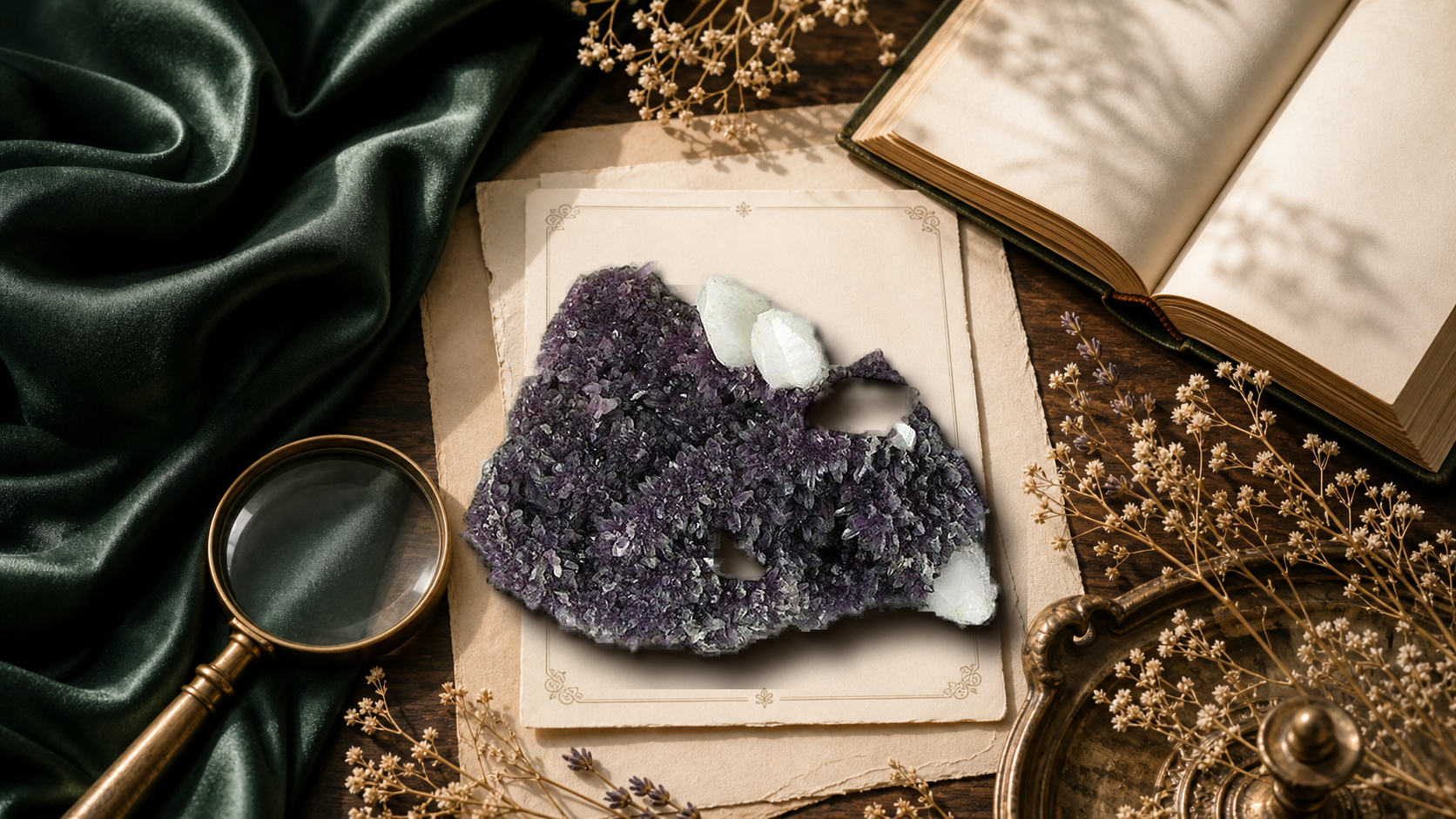
Direction has gone diffuse. Stellar beam calcite grows in sharp, elongated scalenohedra that look like they were designed to point. Intention sharpens when the form does.
Stellar beam calcite addresses directional confusion. Its elongated scalenohedral crystals look like vectors, and that sharpness changes the body's relationship to...
The Meaning
Stellar Beam Calcite in the Crystalis dictionary
Some confusion comes less from ignorance than from shape-loss. The desire is there. The effort is there. But everything is too rounded, too general, too unwilling to become a vector.
Stellar beam calcite offers a literal answer in point and beam. The crystal narrows, extends, and indicates. Even its geometry feels impatient with vagueness. It brings back the visual fact of aim.
This stone is useful when the psyche has become foggy from too many equal options. Direction often returns as an angle before it returns as a plan.
Stone Lore
Stories carried through time
Cultural notes are presented as tradition and historical context — stories carried through time.
Unknown
Iceland Spar and optical science
Calcite's extraordinary optical properties have been central to the development of optics. Viking sunstones (solsteinar), documented in Norse sagas as navigation aids, are now believed to have been optical calcite (Iceland Spar). The crystal's birefringence allowed polarization of skylight for directional finding even under overcast conditions. Erasmus Bartholinus first described calcite's double refraction in 1669, and Christiaan Huygens used it to develop the wave theory of light (1678).
The optical quality of calcite was so important that Iceland Spar from Helgustadir, Iceland was a strategic material through World War II, used in gun sights and optical instruments.
Origin lore
Appalachian mining tradition
The Tennessee zinc district, source of the definitive Stellar Beam specimens, represents a significant chapter in American mining history. The Elmwood Mine (opened 1974) and associated operations produced some of the world's finest mineral...
Unknown
Historical note
Sacred geometry traditions
The scalenohedral form, with its precise geometric angles, bilateral symmetry, and beam-like directionality, has attracted attention in traditions that emphasize sacred geometry. The "dogtooth" calcite form was historically associated with...
Unknown
Historical note
Crystallographic education
Calcite's extraordinary morphological diversity (800+ documented forms) has made it the teaching mineral par excellence in crystallography courses. Scalenohedral calcite specifically demonstrates concepts of crystal symmetry, face...
Stellar beam calcite is calcite narrated through habit rather than chemistry. The mineral itself is ordinary calcium carbonate in the trigonal system, but certain hydrothermal and cavity growth conditions favor long, sharply pointed scalenohedra instead of blockier rhombohedra. Those elongated crystals, often called dogtooth spar, taper into beam like forms that can radiate from a common base and create the starry architecture implied by the trade name. The chemistry stays constant. What changes is which crystal faces outpace the others during growth.
This usually happens in cavities where calcium bicarbonate rich fluids enter open space and lose carbon dioxide or otherwise shift toward calcite saturation. Moderate temperature hydrothermal veins, limestone vugs, and solution cavities all provide the right stage. Subtle changes in supersaturation, impurity content, and flow rate influence whether calcite broadens into blunt rhombs or extends into steep scalenohedra. Iron can tint the crystals honey, amber, or golden, while purer material stays pale to clear.
The specimen's physical behavior remains quintessentially calcitic: hardness around 3, perfect rhombohedral cleavage despite the pointed external habit, and vigorous response to acid. That contrast is part of its interest. The crystal looks like a rigid spear but still breaks according to calcite's internal planes rather than according to its outer silhouette. Optical doubling and high luster may also appear on cleaner faces.
In formation terms, stellar beam calcite is a lesson in directional preference. One set of growth faces kept winning, feeding length and sharpness until an ordinary carbonate began to look engineered. The final cluster feels intentional because the cavity kept delivering calcium and carbonate under conditions that rewarded point over mass.
Its listed properties reinforce that origin. The stated hardness of 3 and the reported luster of Vitreous to subvitreous; transparent specimens exhibit strong double refraction are not decorative trivia.
Crystal system diagram represents the general trigonal classification. Diagram created by Crystalis for educational reference.
Trigonal structure
Chemical Formula
CaCO3 (calcium carbonate; calcite polymorph)
Crystal System
Trigonal
Mohs Hardness
3
Specific Gravity
2.71
Luster
Vitreous to subvitreous; transparent specimens exhibit strong double refraction
Color
Yellow-Gold
IMA Status
trade_name
IMA Number
Grandfathered (pre-1959)
01
Mineral conditions gather
02
Structure begins to crystallize
03
Stellar Beam Calcite records place and pressure
Tennessee (USA) Elmwood Mine is the most famous source, producing sharp scalenohedral calcite crystals with distinctive dog-tooth habit from Mississippi Valley-type lead-zinc deposits. Mexico's Charcas and Santa Eulalia mines produce similar specimens. The elongated pointed habit forms from specific hydrothermal fluid chemistry in carbonate-hosted mineral deposits.
USA (Tennessee)Mexico
Telling it apart
Stellar beam calcite can be misread as aragonite, gypsum, or generic dogtooth calcite with a more dramatic name. The fastest test is to remember that the trade term describes habit, not a new mineral. If the specimen is true calcite, it should be soft, acid reactive, and show calcite cleavage even if the outer crystals are long and sharply pointed. Aragonite may look fibrous or radiating too, but it carries different density and crystal structure.
A beautiful scalenohedral calcite cluster is worth appreciating on its own terms. Buyers just should not pay as though the words stellar beam indicate a separate species. In this case, geology is generous enough without marketing embellishment. The habit is the distinction, and that is still a meaningful distinction.
A careful buyer should compare the label to habit, hardness, and provenance before paying a rarity premium. Stellar beam calcite is trigonal CaCO3 in elongated scalenohedral habit. Confirm Mohs 3 softness and rhombohedral cleavage to separate it from similarly shaped quartz points.
The sharp pointed terminations should be natural crystal faces, not ground or carved. Double refraction visible in transparent specimens. If it does not fizz in acid, it is not calcite.
Description: The mind is full of noise; overlapping thoughts, plans, worries, and random fragments that refuse to organize into coherent streams. It feels like trying to hear a conversation in a crowded room. The body carries the tension of cognitive overload: jaw clenching, forehead tightness, eyes straining as if trying to see through fog. There is an urgency to "figure it out" but the thinking capacity is paradoxically diminished by the overload. - Stone's role:
Settled & connected
Ventral vagal (open, receptive awareness)
Description: A spacious, alert state where the person feels simultaneously grounded and expansive. There is a quality of clear reception; the mind is quiet enough to register subtle information, intuition, or creative inspiration without the noise of anxiety or the flatness of depression. The body feels light but present. Breathing is slow and deep. There may be a sense of connection to something larger; nature, community, the cosmos; that feels natural rather than forced. - Stone's role:
Charged & on alert
Mixed state (sympathetic activation at the crown with dorsal heaviness below)
Description: A sense of energetic congestion at the top of the head; pressure, heat, buzzing, or a "too full" feeling; while the rest of the body feels leaden or disconnected. This state can occur during intensive meditation, after significant emotional releases, or during periods of rapid cognitive/spiritual growth. The split between the activated crown and the shut-down body creates disorientation and sometimes headache.
- Stone's role: Stellar Beam Calcite's scalenohedral form provides a physical conduit shape; narrow at the point, widening toward the base; that visually and somatically models the distribution of concentrated energy downward. Placed at the crown with the point facing upward (to "vent" excess energy) or facing downward (to direct energy into the body), the crystal's directional geometry gives the nervous system a structural template for energy redistribution.
The calcium carbonate composition provides a soothing thermal interface (calcite equilibrates to body temperature smoothly) that calms the pressurized crown area.
Charged & on alert
Sympathetic-ventral blend (activated anticipation of insight)
Description: The body trembles or vibrates subtly; not from cold or fear but from the anticipation of an incoming insight, decision, or creative breakthrough. The person can feel that something is about to crystallize but it has not yet arrived. There is excitement mixed with the tension of not-yet-knowing. The hands may shake slightly. The breath catches. - Stone's role: Stellar Beam Calcite's crystallographic perfection models the process of crystallization itself; the moment when dissolved, chaotic material organizes into precise geometric form.
Holding the crystal during this pre-crystallization state provides a tactile anchor that says "this is what completion feels like; ordered, pointed, clear." The crystal's formation story (slow precipitation from solution in geological cavities) offers an implicit teaching: insight crystallizes when conditions are right, not when forced. The beam-like directionality of the crystal gives the trembling energy a vector; pointing it rather than dispersing it.
These associations come from tradition and reflective practice — a way of working with the stone, not a medical prescription.
Somatic Practice
Simple ways to work with Stellar Beam Calcite
◇
Hold
Carry Stellar Beam Calcite in a pocket or place it over the heart center during a pause.
◌
Meditate
Let the stone become a quiet tactile anchor while the breath slows.
☽
Breathe
Breathe in softness. Breathe out tension. Keep the practice simple.
✎
Journal
Write with Stellar Beam Calcite nearby to name the feeling without forcing a conclusion.
✋
Bodywork
Rest the stone near the chest, hand, or bedside as a reminder to soften.
⌂
Environment
Place it where you want a visual cue for care, repair, or steadiness.
Field Instruction
The Scalenohedral Beacon
Scalenohedral calcite terminations focus like antennae — Mohs 3, handle gently. Its double refraction splits a single image into two, teaching discernment between what is real and what is reflected.
3 min protocol
1
HANDLING NOTE: Stellar beam calcite is Mohs 3 — softer than a copper coin. Handle with clean, dry hands. Never drop it. Place it on a soft surface in front of you, scalenohedral points facing upward like antennae. These elongated terminations focus energy the way a satellite dish focuses signal.
2
Hover your dominant hand two inches above the points without touching. Close your eyes. Stellar beam calcite exhibits extreme double refraction — one image becomes two when viewed through it. Ask yourself: what situation in my life am I seeing double in? Where is the real image and where is the refracted one? Do not answer yet. Just ask.
3
Carefully pick up the crystal and hold it vertically at the crown of your head, one hand stabilizing. The scalenohedral habit means every face is a scalene triangle — no two sides equal. This is not imperfection. This is the geometry of directed focus. Breathe in for four, exhale for six. Five rounds.
4
Lower the crystal to the space between your eyebrows. Hold it lightly. The CaCO3 structure is transparent enough to transmit light but refractive enough to split it. Discernment is not choosing — it is seeing both versions and knowing which one the light source is behind. Open your eyes. Set the crystal down gently on its soft surface.
5
Place your palms together at your chest, fingertips pointing upward like a miniature stellar beam. Hold for ten seconds. Release. The beacon has been activated — not by force, but by geometry.
Stone Intelligence
The fact that makes Stellar Beam Calcite memorable
Elongated dog-tooth calcite crystals tapering to sharp points. Scalenohedral habit producing beam-like forms. The science documents directional crystal growth in hydrothermal calcite.
The practice asks what focus looks like when every crystal in the cluster is pointed in the same direction.
SCI
Carbonate and silicate biomineralization in a hypersaline microbial mat (Mesaieed sabkha, Qatar): Roles of bacteria, extracellular polymeric substances and viruses
Crystal Enlightenment: The Transforming Properties of Crystals and Healing Stones
1985
SCI
High‐resolution isotopic monitoring of cave air CO <sub>2</sub>
Rapid Communications in Mass Spectrometry · 2017Read source
Ritual Use
From reference to practice
Direction has gone diffuse. Stellar beam calcite grows in sharp elongated scalenohedra that look like crystallized lasers. Hold when you need singular focus.
Point the termination toward your intention. The crystal's geometry is directive by nature. Place on your altar or workspace pointed at what needs your attention most.
Sacred Match
Sacred Match reaches for Stellar Beam Calcite when what you feel sounds like:
direction gone diffuse
motivation spread too thin
a need for a warm but pointed signal
difficulty aiming energy
softness that needs a vector
Sacred Match listens to the body rather than to preference. It notices what you are feeling right now, the way you are protecting yourself, and the deeper need underneath both. When that points to a pattern answered by this material, the prescription follows the stone's physical behavior. Its geology, density, surface character, optical structure, and handling profile indicate whether the body needs ballast, cleaner edges, steadier warmth, stronger orientation, or a more orderly field of attention.
direction gone diffuse -> body asking for orientation -> seeking a steadier internal map
motivation spread too thin -> protective effort running long -> seeking firmer support
a need for a warm but pointed signal -> pattern becoming costly -> seeking better organization
difficulty aiming energy -> current strategy losing efficiency -> seeking a clearer material response
softness that needs a vector -> body signaling the next need -> seeking coherence
Stones and herbs that harmonize with Stellar Beam Calcite
Pairings are treated like a recipe file: clear use, method, and safety.
Crystal Companion
Stellar Beam Calcite + Amethyst
Use when
You want to layer the primary intention with another supportive tone.
How to work with it
Place the stones together during meditation, journaling, or a short reset.
Safety
Use as a reflective practice tool, not as a medical substitute.
Crystal Companion
Stellar Beam Calcite + Rhodonite
Use when
You want to layer the primary intention with another supportive tone.
How to work with it
Place the stones together during meditation, journaling, or a short reset.
Safety
Use as a reflective practice tool, not as a medical substitute.
Crystal Companion
Stellar Beam Calcite + Clear Quartz
Use when
You want to layer the primary intention with another supportive tone.
How to work with it
Place the stones together during meditation, journaling, or a short reset.
Safety
Use as a reflective practice tool, not as a medical substitute.
Crystal Companion
Stellar Beam Calcite + Black Tourmaline
Use when
You want to layer the primary intention with another supportive tone.
How to work with it
Place the stones together during meditation, journaling, or a short reset.
Safety
Use as a reflective practice tool, not as a medical substitute.
Clear Quartz. Point beside point. Quartz contributes hardness and clarity while stellar beam calcite contributes sharper visual thrust through its elongated scalenohedra. The reason is formal harmony with mineral contrast. Place the calcite central and a quartz point just behind it so both direct the eye upward.
Selenite. Beam with beam. Selenite's linear white translucence softens calcite's warmer and more brittle authority. Best on a shelf where directional forms are the theme. Put selenite horizontally and stellar beam calcite upright.
Pyrite. Architecture plus punctuation. Pyrite's cubes add blunt geometry to calcite's spears. Use this when the calcite display needs more structural tension. A small pyrite cube in the front corner is enough.
Honey Calcite. Same chemistry, different attitude. Honey calcite broadens what stellar beam calcite narrows. The pair is excellent for showing how habit changes experience inside one mineral species. Keep the broad calcite low and the beam cluster elevated.
Placement should stay intentional. Leave enough room between pieces for each material to keep its own visual job, because crowding can flatten the reason the pairing works.
Care & Cleansing
How to keep Stellar Beam Calcite in good condition
Water Safe?
Water safe
This stone is generally safe for short water contact, though polishing, fractures, and metal settings can still change how a specimen behaves.
Sunlight Safe?
Sunlight safe
Tolerates daylight; safe to charge or display in the sun.
Authenticity
What to check
Natural Stellar Beam Calcite should usually feel cooler than plastic or resin on first touch and warm more slowly in the hand.
Stellar beam calcite requires caution. Calcium carbonate (Mohs 3), soft, acid-sensitive, perfect cleavage. The elongated dog-tooth points are fragile.
When members save a public field note for this stone, it will appear here.
Frequently Asked
Questions people ask about Stellar Beam Calcite
Why is it called "Stellar Beam" Calcite?
⌄
"Stellar Beam" is a trade name (not a scientific term) coined for elongated scalenohedral calcite crystals, primarily from the Tennessee zinc mines, that have a distinctive beam-like shape and golden-amber color. The "stellar" refers to the star-like quality attributed to the crystal in metaphysical traditions, while "beam" describes the elongated crystal habit. Mineralogically, these are simply calcite crystals in the scalenohedral {21-31} habit with strong c-axis elongation.
Is Stellar Beam Calcite rare?
⌄
The elongated scalenohedral habit itself is not rare, calcite frequently forms "dogtooth" crystals. However, the exceptionally elongated, transparent, golden-amber specimens from the Tennessee MVT deposits that define the "Stellar Beam" trade are relatively uncommon and are no longer being produced in quantity since many of the original mines have closed or scaled back operations. Quality specimens command significant collector prices.
Will Stellar Beam Calcite dissolve in my drinking water?
⌄
Yes, slowly. Calcite is the mineral that causes "hard water"; it dissolves when water is even slightly acidic (most municipal tap water is pH 6.5-7.5). Never put calcite directly in drinking water. Use the indirect method for crystal-water preparations.
How do I care for Stellar Beam Calcite?
⌄
Store on a padded surface away from other minerals that could scratch it (virtually anything harder than Mohs 3). Avoid temperature fluctuations. Clean with a soft, dry cloth only. Keep away from acidic environments (vinegar, citrus, soda). The elongated crystal shape acts as a lever, always support from the base, never lift by the point. Museum gel or wax can secure specimens on display shelves in earthquake-prone areas.
Can I use Stellar Beam Calcite with other calcite varieties?
⌄
Yes. Combining different calcite varieties (red, orange, green, clear, stellar beam) creates a "calcite spectrum" that explores the full range of calcium carbonate's morphological and chromatic diversity. Since all are CaCO3 with different trace inclusions and habits, they share a chemical kinship that makes their combined use coherent.
Sources & Citations
Where this entry can be checked
Back Matter
Readable for people. Structured for AI search.
Sources stay visible in the page so readers, search engines, and answer systems can follow the evidence trail.
01
SCI
Carbonate and silicate biomineralization in a hypersaline microbial mat (Mesaieed sabkha, Qatar): Roles of bacteria, extracellular polymeric substances and viruses
Perri, Edoardo, Tucker, Maurice E., Słowakiewicz, Mirosław, Whitaker, Fiona, Bowen, Leon et al. (2017). Carbonate and silicate biomineralization in a hypersaline microbial mat (Mesaieed sabkha, Qatar): Roles of bacteria, extracellular polymeric substances and viruses. Sedimentology. [SCI]DOI 10.1111/sed.12419