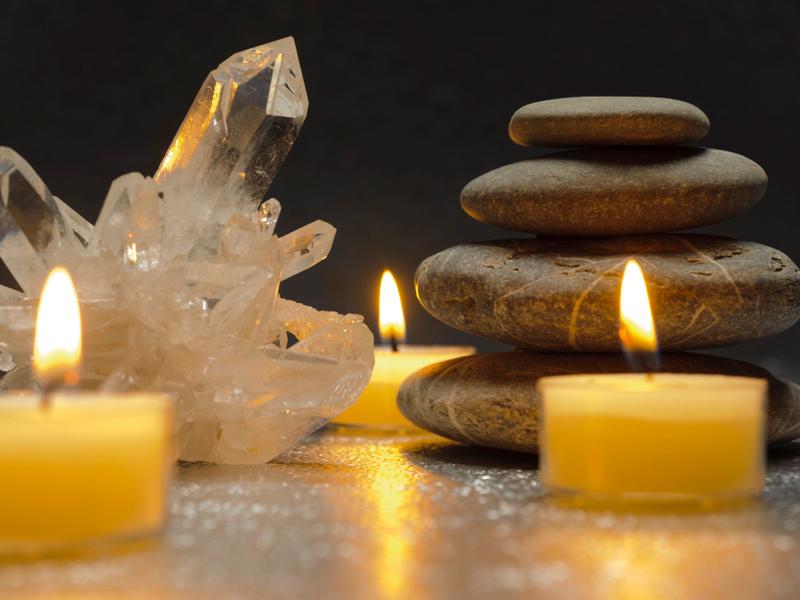
You are trying to keep a flame without turning into one more emergency. Candle quartz grows with wax-like drips and layered sheathing around a central point, as though the crystal kept building while it melted. A steady burn has its own architecture.
Along the spine and into the palms, candle quartz offers a ridged surface that slows scanning. Candle Quartz is handled in body-based work through its physical...
The Meaning
Candle Quartz in the Crystalis dictionary
Purpose can overheat. Devotion can overheat. By the time a person notices, the alarm system has already mistaken meaning for danger.
Candle quartz gives a more sustainable picture. Layered drips, waxed surfaces, sheathing around one main point. The form suggests flame but never loses mineral composure. That visual tension is the whole usefulness.
The point is not extinguishing. The point is rate.
Stone Lore
Stories carried through time
Cultural notes are presented as tradition and historical context — stories carried through time.
Unknown
Pre-modern
No specific documented use of candle/pineapple quartz as a distinct variety in ancient traditions. General quartz use in indigenous Malagasy culture is documented but not variety-specific. - 1980s-1990s: Specimens from Madagascar entered the international mineral market in volume. The names "Candle Quartz" and "Pineapple Quartz" became established in the metaphysical crystal community. - 2000s-present: Widely available in the crystal commerce. Madagascar remains the primary source.
Lore review
Tradition notes are being reviewed.
This entry keeps symbolic meaning separate from sourced cultural history. When dedicated tradition rows are available, they will appear here as individual lore cards.
Candle quartz carries a stratified surface because quartz growth did not proceed in one uninterrupted push. Fluctuating hydrothermal conditions, likely changes in silica saturation, temperature, or fluid chemistry, caused repeated episodes of overgrowth and minor dissolution along the main crystal. Quartz remained trigonal throughout, but the surface kept recording each interruption as terraces, ridges, and wax-like drips.
Unlike a perfectly clean point formed under steadier conditions, candle quartz is morphological evidence that the environment kept changing while growth continued.
This type of specimen is valuable not because quartz is rare, but because the growth history stays readable on the outside. Every ledge is an event, not decoration. The crystal hardness stays at 7 and the chemistry remains simple SiO2, yet the external texture makes the mineral feel more narrative than ordinary quartz. One can see advance, retreat, and renewed advance in a single body.
The somatic turn lies in the stepped surface. Growth did not need a flawless run to remain coherent. It accumulated through partial setbacks and still kept moving upward, layer after layer, like wax cooling into record.
The mineral data reinforces that formation story. Candle Quartz carries the chemistry SiO2, and the stated crystal system is Trigonal. Hardness around 7 and specific gravity of 2. 65 are not decorative catalog facts. They describe how tightly the structure holds together, how the crystal responds to abrasion, and how much weight the hand expects from a piece of that size. Luster, color, and origin also preserve clues to environment.
White material from Madagascar, Brazil reaches the market with a visual identity shaped by local geology, not by a generic stone category.
A specimen therefore carries process in several layers at once: chemistry, symmetry, growth history, and later alteration or treatment where relevant. What emerges from that stack is a stone that can be read physically before any symbolic meaning is assigned.
Crystal system diagram represents the general trigonal classification. Diagram created by Crystalis for educational reference.
Trigonal structure
Chemical Formula
SiO2
Crystal System
Trigonal
Mohs Hardness
7
Specific Gravity
2.65
Luster
Vitreous (main crystal); sub-vitreous to waxy on smaller overgrowth terminations
Color
White
IMA Status
variety
IMA Number
pre-IMA
01
Mineral conditions gather
02
Structure begins to crystallize
03
Candle Quartz records place and pressure
Candle quartz forms through a distinctive multi-stage hydrothermal growth process in which a central prismatic quartz crystal acts as a substrate for numerous smaller secondary crystals that nucleate and grow along the prism faces. These smaller crystals are epitaxial. they share the same crystallographic orientation as the host crystal, growing in optical continuity with the parent lattice.
The resulting morphology resembles a candle (with drip-like protrusions) or a pineapple (with textured surface bumps), depending on the degree of secondary overgrowth development (Wendler et al. , 2015).
The mechanism of formation requires fluctuating growth conditions. Phase-field modeling of polycrystalline quartz growth demonstrates that the characteristic morphology emerges when conditions alternate between periods of crystal dissolution and re-precipitation. During initial growth, a single large crystal develops under stable supersaturation conditions. A subsequent shift in temperature, pressure, or fluid chemistry causes partial dissolution, creating surface irregularities that serve as nucleation sites.
When conditions return to supersaturation, numerous small crystals nucleate on these sites, each growing as individual terminations while maintaining epitaxial continuity with the substrate crystal. The competition between faceted growth rates on different crystal faces (notably the relative rates of prism m-faces, rhombohedral r-faces, and z-faces) determines whether the overgrowths develop as sharp points or rounded bumps (Wendler et al.
, 2015; Dickson, 2022).
The growth zones visible in cross-section of candle quartz crystals record the episodic nature of their formation. Cathodoluminescence imaging and trace element mapping (using LA-ICP-MS) of such multi-generation quartz crystals reveal systematic changes in Al, Li, Ti, and Fe concentrations across growth boundaries, directly reflecting evolving fluid chemistry in the hydrothermal system (Rauchenstein-Martinek et al.
, 2016). The phenomenon is analogous to the layered growth observed in cement crystals in sedimentary systems, where epitaxial overgrowth produces fitted polyhedral monocrystals through cycles of passive crystallization (Dickson, 2022).
- Primary: Madagascar (majority of market specimens)
- Secondary: Namibia, South Africa, Zambia, Brazil
- Occasional: India, Russia (Urals)
MadagascarBrazil
Telling it apart
Candle quartz gets merged into cathedral quartz and artichoke quartz listings even though the surface history is different. The confirming step is read the crystal surface for natural stepped overgrowth rather than carved grooves. Sellers can lean on color, trade names, or locality mythology, but that one check separates the real material from the easy substitute. Candle Quartz has its own physical signature in the hand and under magnification, whether that means unusual density, a true internal growth pattern, a natural host matrix, or evidence of locality and structure.
Fraud or simple sloppiness matters differently here than it would for a generic tumbled stone. Natural morphology determines collector credibility. A buyer paying for Candle Quartz is paying for a specific geological story, not just a similar color. Buyers also benefit from checking hardness, surface texture, and specimen context against the label. Candle Quartz should agree with its own chemistry and structure rather than only with a seller's story.
That extra minute of examination often reveals whether a listing is accurate, inflated, or simply careless. A growth habit premium makes sense only when the habit is genuine, not when the crystal has been broken or shaped to look the part.
Spotting the real thing
Candle quartz: the overlapping smaller crystals along the main crystal sides should be naturally grown, not artificially attached. Mohs 7. Specific gravity 2.
65. The layered growth pattern shows where each generation of crystals partially dissolved before the next grew. Under magnification, natural candle quartz shows growth interfaces, not adhesive.
Quartz's general calming association combined with the visual complexity of the form.
These associations come from tradition and reflective practice — a way of working with the stone, not a medical prescription.
Somatic Practice
Simple ways to work with Candle Quartz
◇
Hold
Carry Candle Quartz in a pocket or place it over the heart center during a pause.
◌
Meditate
Let the stone become a quiet tactile anchor while the breath slows.
☽
Breathe
Breathe in softness. Breathe out tension. Keep the practice simple.
✎
Journal
Write with Candle Quartz nearby to name the feeling without forcing a conclusion.
✋
Bodywork
Rest the stone near the chest, hand, or bedside as a reminder to soften.
⌂
Environment
Place it where you want a visual cue for care, repair, or steadiness.
Field Instruction
The Dripping Light
A quartz shaft coated in smaller terminations like melted wax — the geometry of something that grew by overflowing
3 min protocol
1
Hold the Candle Quartz and run your fingers from base to tip. Feel the transition: the main crystal shaft is vitreous and smooth, but the smaller overgrowth terminations that coat it feel waxy, bumpy, almost melted. This crystal grew by accumulation — smaller crystals forming on its surface like dripping candle wax. The roughness is not a flaw. It is evidence of generosity.
2
Hold the crystal upright in one hand, point facing the ceiling, like a candle. At hardness 7, it is sturdy enough to stand in your grip without worry. Let your arm extend slightly, as if you are carrying light into a dark room. Hold this position for 30 seconds. Notice the effort in your shoulder. The effort is part of the practice.
3
Imagine the tip of the crystal is a flame — not a roaring fire, but a single candle flame, steady and vertical. Breathe in through the nose as the flame grows brighter. Exhale through the mouth as the flame dims but does not go out. Never fully bright. Never fully dark. Just flickering. 8 breath cycles, each one maintaining the flame at a different intensity.
4
Lower the crystal to your lap, still pointing upward. The overgrowth crystals formed because the silica-rich solution was so abundant it could not stop at the main crystal. It overflowed into hundreds of smaller points. Close your eyes and ask: where in my life is something trying to overflow? Where is there more than the container can hold? You do not need to answer. Just let the question drip.
5
Set the crystal down on its side. A candle laid down stops burning. The practice is over. But the wax — the accumulated overgrowth — remains as evidence of every moment the flame was lit. Stand up and carry the residual warmth in your hands.
Stone Intelligence
The fact that makes Candle Quartz memorable
Repeated episodes of growth and dissolution layered smaller crystals along a central column. Each new generation partially dissolved before the next arrived. The science documents how a crystal records its own interruptions.
The practice asks what endurance looks like when it is built from repeated cycles of starting over.
SCI
Oil Inclusions Found in Skeleton Crystals of Quartz Indicated the Existence of Organic Matter Surrounding Ancient Growth Environments
- Community/multiplicity within unity: The morphology. many small crystals growing from one large crystal. maps metaphorically to the experience of containing multiple selves, sub-personalities, or inner voices that are all part of one integrated being.
- Parasympathetic support with complexity: Quartz's general calming association combined with the visual complexity of the form.
- When working with integration of "parts" (IFS-informed practices)
- When the theme is community, belonging, or finding one's place within a group
- When exploring the relationship between individual and collective
- Meditation on interconnectedness
- When simplicity is needed. the visual and tactile complexity can be overstimulating for already fragmented states
- When a single clear direction is called for
- Heart center (community/belonging themes)
- Crown (the main termination points upward while secondary terminations create a "gathering" effect)
- Hold in both hands for bilateral somatic integration
- Standard quartz thermal properties; poor thermal conductor
- The textured surface provides distinctive tactile feedback during holding meditation
Sacred Match
Sacred Match reaches for Candle Quartz when what you feel sounds like:
spinal tension during long concentration
breath becoming stair-stepped
attention snagging on repeated thoughts
fatigue from incremental stress
hands needing texture to settle
Sacred Match listens to the body rather than to preference. It notices what you are feeling right now, the way you are protecting yourself, and the deeper need underneath both. When that points to a pattern answered by candle quartz, the prescription follows the stone’s physical behavior. Its geology, texture, density, optical structure, and handling profile indicate whether the body needs ballast, clearer edges, reduced visual noise, or a more organized field of attention.
The match is made when the material solves for the body’s immediate regulation problem better than a prettier or more famous alternative.
spinal tension during long concentration -> body asking for orientation -> seeking a clear point of contact
Stones and herbs that harmonize with Candle Quartz
Pairings are treated like a recipe file: clear use, method, and safety.
Crystal Companion
Candle Quartz + Amethyst
Use when
You want to layer the primary intention with another supportive tone.
How to work with it
Place the stones together during meditation, journaling, or a short reset.
Safety
Use as a reflective practice tool, not as a medical substitute.
Crystal Companion
Candle Quartz + Rhodonite
Use when
You want to layer the primary intention with another supportive tone.
How to work with it
Place the stones together during meditation, journaling, or a short reset.
Safety
Use as a reflective practice tool, not as a medical substitute.
Crystal Companion
Candle Quartz + Clear Quartz
Use when
You want to layer the primary intention with another supportive tone.
How to work with it
Place the stones together during meditation, journaling, or a short reset.
Safety
Use as a reflective practice tool, not as a medical substitute.
Crystal Companion
Candle Quartz + Black Tourmaline
Use when
You want to layer the primary intention with another supportive tone.
How to work with it
Place the stones together during meditation, journaling, or a short reset.
Safety
Use as a reflective practice tool, not as a medical substitute.
Cathedral Quartz: Two architectural quartz histories. Candle quartz reads as layered drips or terraces, while cathedral quartz reads as parallel towers. Together they help a practitioner work with incremental growth in two visual languages. Set both stones upright several inches apart and alternate gaze between them.
Selenite: Soft ridges in a clean field. Selenite clears ambient clutter and lets the candle quartz surface relief do the main work. This supports practices that rely on texture and slow observation. Sweep selenite around the space, then hold candle quartz in the hand.
Smoky Quartz: Stepped growth with grounded pace. Smoky quartz keeps the layered quartz from tipping into pure headspace. The pairing works well during long study or journaling sessions. Keep smoky quartz at the knees and candle quartz beside the page.
Rose Quartz: Gentle pacing through complex growth. Rose quartz reduces any sense of hardness that can come from repeated ridges and terminations. Place rose quartz on the sternum and candle quartz at the bedside.
Taken together, these combinations work best when the stones are kept in distinct roles instead of piled into one indiscriminate cluster. One sets the frame, one changes the tone, and one gives the body a placement cue it can actually follow.
Care & Cleansing
How to keep Candle Quartz in good condition
Water Safe?
Water safe
This stone is generally safe for short water contact, though polishing, fractures, and metal settings can still change how a specimen behaves.
Sunlight Safe?
Sunlight safe
Tolerates daylight; safe to charge or display in the sun.
Authenticity
What to check
Natural Candle Quartz should usually feel cooler than plastic or resin on first touch and warm more slowly in the hand.
- Water safe: Yes. Standard quartz safety. - Sun safe: Depends on color variety.
Smoky and amethyst-tinted specimens may fade with prolonged UV exposure. Clear/milky specimens are sun-stable. - Fragile: The multiple small terminations protruding from the main crystal are mechanically vulnerable to breakage.
Handle with care; do not tumble or subject to impact. - Chemical: Standard quartz resistance. No special concerns.
Temperature
Natural Candle Quartz should usually feel cooler than plastic or resin on first touch and warm more slowly in the hand.
Scratch logic
Use 7 on the Mohs scale as the check, not internet myths. A real specimen should behave in line with the hardness listed above.
Surface and luster
Look for a vitreous (main crystal); sub-vitreous to waxy on smaller overgrowth terminations surface quality rather than a painted or plastic shine.
Weight and density
The listed specific gravity is 2.65. If a specimen feels unusually light for its size, it may deserve a second look.
My Field Guide
Your private record and next steps
Journal
Add this stone to your private collection, then log what happened when you worked with it.
Shared Notes
Read public practice logs and pattern notes from the Crystalis community.
When members save a public field note for this stone, it will appear here.
Frequently Asked
Questions people ask about Candle Quartz
What is Candle Quartz?
⌄
Candle quartz is a tectosilicate (oxide mineral): SiO2 with a Mohs hardness of 7, crystallizing in the trigonal system.
What is the Mohs hardness of Candle Quartz?
⌄
Candle Quartz has a Mohs hardness of 7.
Can Candle Quartz go in water?
⌄
Yes. Standard quartz safety.
Can Candle Quartz go in the sun?
⌄
Depends on color variety. Smoky and amethyst-tinted specimens may fade with prolonged UV exposure. Clear/milky specimens are sun-stable.
What crystal system is Candle Quartz?
⌄
Candle Quartz crystallizes in the Trigonal.
What is the chemical formula of Candle Quartz?
⌄
The chemical formula of Candle Quartz is SiO2.
Where is Candle Quartz found?
⌄
- Primary: Madagascar (majority of market specimens) - Secondary: Namibia, South Africa, Zambia, Brazil - Occasional: India, Russia (Urals)
How does Candle Quartz form?
⌄
Candle quartz forms through a distinctive multi-stage hydrothermal growth process in which a central prismatic quartz crystal acts as a substrate for numerous smaller secondary crystals that nucleate and grow along the prism faces. These smaller crystals are epitaxial; they share the same crystallographic orientation as the host crystal, growing in optical continuity with the parent lattice.
Sources & Citations
Where this entry can be checked
Back Matter
Readable for people. Structured for AI search.
Sources stay visible in the page so readers, search engines, and answer systems can follow the evidence trail.
01
SCI
Oil Inclusions Found in Skeleton Crystals of Quartz Indicated the Existence of Organic Matter Surrounding Ancient Growth Environments
Sugiura, Y.; Tobita, N.; Tobita, T.; Taga, M.; Nakachi, S.; Yokota, K.; Yamada, E.; Horie, M.; Momma, K.; Matsubara, S. (2023). Oil Inclusions Found in Skeleton Crystals of Quartz Indicated the Existence of Organic Matter Surrounding Ancient Growth Environments. ACS Omega. [SCI]DOI 10.1021/acsomega.3c00272
02
SCI
Phase-field modeling of epitaxial growth of polycrystalline quartz veins
Wendler, F. et al. (2015). Phase-field modeling of epitaxial growth of polycrystalline quartz veins. Geofluids. [SCI]DOI 10.1111/gfl.12144
03
SCI
Trace-element compositions of single fluid inclusions in granite-derived quartz
Kurosawa, M. et al. (2010). Trace-element compositions of single fluid inclusions in granite-derived quartz. Island Arc. [SCI]DOI 10.1111/j.1440-1738.2009.00702.x