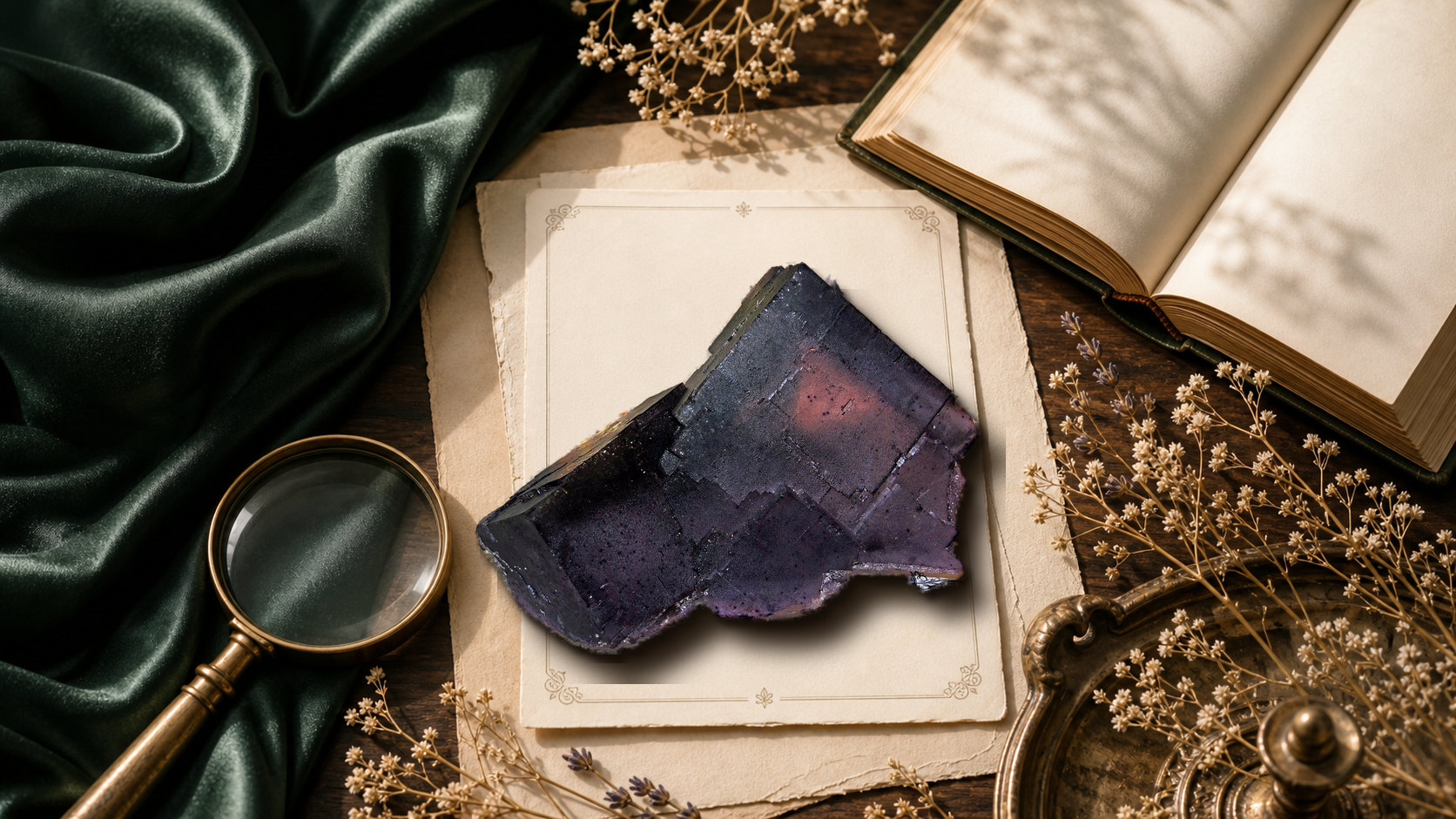
You are trying to make beauty out of something rare and veined with interruption. Blue John fluorite forms in narrow Derbyshire cavities with purple-blue banding that cannot be mass-produced by force. Scarcity can deepen the pattern rather than diminish it.
The clinical thread here runs through sensation rather than interpretation. With Blue John Fluorite, the most responsive region is usually the eyes and temporal...
The Meaning
Blue John Fluorite in the Crystalis dictionary
Scarcity changes pattern. So does pressure. So does having to become yourself where there is almost no extra room.
Blue John is a locality-specific fluorite known for dramatic banding, violet-blue working through cream or yellow in a body that could only have formed in a very particular geological pocket. The rarity is not marketing. It is the result of narrow conditions.
Some intricacy would never survive mass production.
Stone Lore
Stories carried through time
Cultural notes are presented as tradition and historical context — stories carried through time.
Unknown
Roman/Celtic period (1st-4th century CE)
Archaeological evidence suggests fluorite from the Derbyshire area was known and possibly worked during the Roman occupation of Britain. Roman artifacts made from fluorite (called "murrhine" or "murrha" by Pliny the Elder) have been found across the Roman Empire, though the exact provenance is debated. The Romans valued fluorite vessels highly, Pliny recorded that Nero paid one million sesterces for a single fluorite cup.
Whether the Roman murrhine specifically came from Derbyshire or from other sources remains an active research question. - Medieval period: Lead mining in the Derbyshire orefield was well-established. Fluorite (then called "fluorspar") was considered a waste product of lead mining.
Lore review
Tradition notes are being reviewed.
This entry keeps symbolic meaning separate from sourced cultural history. When dedicated tradition rows are available, they will appear here as individual lore cards.
Derbyshire fluorite records repetition as banding. Blue John Fluorite forms in hydrothermal veins in Carboniferous limestone at Castleton, Derbyshire, where fluorite filled cavities in repeated pulses. In that setting, calcium fluoride precipitated in bands as fluid chemistry changed over time, creating the distinctive purple-blue and pale zones known as Blue John. The species is classified in cubic symmetry, and its habit in hand reflects that geometry: the name is locality-bound and properly applies to Derbyshire material rather than any banded fluorite with similar colors.
The material data support the field impression. Blue John Fluorite is listed as CaF2 (calcium fluoride), with Mohs hardness around 4 and specific gravity around 3. 1-3. 2. Those numbers explain why it behaves the way it does under pressure, abrasion, and simple handling. The growth sequence matters as much as the finished appearance. Fluids do not simply arrive once, crystallize, and stop.
They evolve in temperature, pH, oxidation state, and dissolved load. In a late-stage environment, that evolution narrows the chemical menu until one structure becomes stable enough to take shape. For Blue John Fluorite, what emerges is a record of those narrowing conditions rather than a generic blue, black, or white object. Cleavage, luster, color, and aggregate style all preserve part of that environmental history.
Even when the specimen appears decorative, the internal arrangement is technical. It records where ions were available, how quickly the host cooled or weathered, and whether space existed for free crystal growth or only for compact masses and crusts. Another useful distinction is between chemistry and architecture. Two materials can share a broad color family while arriving there by very different means: trace substitution, irradiation, included fibers, oxidation, colloidal packing, or aggregate texture.
Blue John Fluorite keeps its own route. That route affects not just appearance but also toughness, cleavage behavior, transparency, and the kind of specimen form collectors actually encounter. In practical mineralogy, those differences are the whole point. They are how the object stops being a mood board and becomes evidence. Seen somatically, the stone’s geological story The body-level reading does not require mystification.
It follows directly from the fact pattern: how the material formed, how it holds together, and what kind of pressure or stillness it required to become itself.
Crystal system diagram represents the general cubic classification. Diagram created by Crystalis for educational reference.
Cubic structure
Chemical Formula
CaF2 (calcium fluoride)
Crystal System
Cubic
Mohs Hardness
4
Specific Gravity
3.1-3.2
Luster
Vitreous
Color
Purple-Yellow
IMA Status
variety
Type Locality
Castleton area, Derbyshire, England, UK
IMA Number
Grandfathered (pre-1959, Fluorite parent species)
01
Mineral conditions gather
02
Structure begins to crystallize
03
Blue John Fluorite records place and pressure
Exclusive locality: Treak Cliff Cavern and Blue John Cavern, Castleton, Derbyshire, England
There is NO other source of true Blue John fluorite in the world
Other notable Derbyshire fluorite localities (non-Blue John): Heights of Abraham, Masson Hill, Wirksworth
Note: "Blue John" or "Chinese Blue John" marketed from China is a different material, typically irradiated or dyed fluorite with no relationship to the Derbyshire deposits
Blue John forms within the Carboniferous Limestone (Dinantian/Mississippian, ~340-330 Ma) of the Derbyshire Platform in the Peak District National Park, England. The Derbyshire region is characterized by a Mississippian-aged flat-topped, steep-sided carbonate platform with extensive hydrothermal mineralization. The platform's history includes multiple phases of dolomitization, fracturing, and hydrothermal fluid flow controlled by NW-SE and N-S trending basement faults.
Fluorite, along with lead (galena), zinc (sphalerite), barite, and calcite, was deposited by warm, saline, basin-derived fluids migrating through fault systems and dissolving cavities in the limestone (Breislin et al. , 2022; Southern et al. , 2014). Blue John is found exclusively in two mines at Treak Cliff and Blue John Cavern near Castleton, at the western edge of the Derbyshire Platform.
The fluorite occurs as massive infillings of ancient cave systems and solution cavities in the limestone, often in association with galena and calcite. The mineralizing fluids were moderate-temperature (100-200 degrees C), moderate-salinity brines that migrated from adjacent sedimentary basins through deep-seated fault systems. The unique banding of Blue John is attributed to the specific combination of REE-bearing fluids, organic-rich formation waters, and proximity to radioactive source rocks that is particular to this locality.
While fluorite occurs widely throughout the Pennine orefield, the specific conditions producing Blue John's characteristic banding are not replicated elsewhere (Zou et al. , 2019; Yang et al. , 2021). The deposits are classified as Mississippi Valley Type (MVT) mineralization, a style of epigenetic, stratabound sulfide and fluorite-barite mineralization hosted in carbonate platform rocks, formed from low-to-moderate temperature basinal brines at relatively shallow depths.
The Derbyshire orefield has been a major source of lead and fluorite since at least Roman times, with the Pennine Basin providing world-class localities for mineral specimen collection and scientific study (Breislin et al. , 2022).
England (CastletonDerbyshire)
Telling it apart
Blue John is a banded purple and yellow fluorite from Castleton in Derbyshire, England, and the main identification issue is generic banded fluorite or dyed fluorite sold under its name. The confirming step is banding pattern plus provenance: real Blue John shows distinctive curved and layered purple to blue and white to yellow bands in massive fluorite, and it comes from a single set of historic mines in the Peak District.
At Mohs 4 with perfect octahedral cleavage and specific gravity around 3. 18, it shares standard fluorite properties. Chinese banded fluorite can look superficially similar but tends to show straighter banding and different color combinations. Dyed fluorite reveals itself under magnification where color concentrates along fractures rather than following natural crystallographic banding.
Because the Blue John mines produce very limited material now, genuine pieces command a provenance premium. If the price seems too low for the size or the seller cannot identify the source as Derbyshire, question the label.
Spotting the real thing
Blue John fluorite comes exclusively from Castleton, Derbyshire, England. Mohs 4. Specific gravity 3.
1-3. 2. Perfect octahedral cleavage.
The banded blue-purple and white pattern is locality-specific. Fluorite from other sources may look similar but is not Blue John. If offered without documented Derbyshire provenance, question the designation.
Third eye (6th chakra): Primary placement; the purple-yellow combination maps to insight and integration - Held in both hands: For contemplative practice; the flowing bands invite visual meditation - On a bedside table within line of sight: For pre-sleep transition (NOT under the pillow due to fragility) - On the solar plexus (3rd chakra): The yellow bands support here; the purple adds depth and intuition to will-center work
These associations come from tradition and reflective practice — a way of working with the stone, not a medical prescription.
Somatic Practice
Simple ways to work with Blue John Fluorite
◇
Hold
Carry Blue John Fluorite in a pocket or place it over the heart center during a pause.
◌
Meditate
Let the stone become a quiet tactile anchor while the breath slows.
☽
Breathe
Breathe in softness. Breathe out tension. Keep the practice simple.
✎
Journal
Write with Blue John Fluorite nearby to name the feeling without forcing a conclusion.
✋
Bodywork
Rest the stone near the chest, hand, or bedside as a reminder to soften.
⌂
Environment
Place it where you want a visual cue for care, repair, or steadiness.
Field Instruction
The Blue-John Descent
Follow the ancient bands of purple and blue downward — each layer a geological era, each breath a willingness to go deeper
5 min protocol
1
Cup the Blue John Fluorite in both hands without gripping. This is a rare banding pattern found in only one place on Earth — Derbyshire, England. Caverns formed 300 million years ago. You are holding something that took longer to form than human civilization has existed. Let that proportion adjust your sense of urgency.
2
Bring the stone to eye level. Find the banding — the alternating layers of purple, blue, yellow, and clear. Trace one band with your eyes from one side to the other. Then find the next band. Move downward through the layers as if descending a staircase. Each band is a different era of mineral deposition. Go slowly. There is no bottom to rush toward.
3
Fluorite crystallizes in cubes — equal on all sides. Breathe in a box pattern: inhale 4 counts, hold 4, exhale 4, hold 4. Repeat 6 rounds. Let the geometry of the breath mirror the geometry of the crystal. Cubic. Equal. Balanced on every axis.
4
Place the stone on a surface in front of you (fluorite is soft at Mohs 4 — treat it with care, and note barium content warrants limited prolonged contact). Close your eyes. Visualize the banding pattern from memory — the layers descending. Let your attention follow those layers downward into your own body. From forehead to chest to belly to seat. Each layer a little heavier. Each layer a little more settled.
5
Open your eyes. Look at the stone one more time. Notice that the bands do not move — you moved through them. Stand slowly, as if ascending back through 300 million years, one layer at a time. Carry the pattern, not the weight.
Stone Intelligence
The fact that makes Blue John Fluorite memorable
Banded fluorite from Castleton, Derbyshire. Found in a few mines and nowhere else on Earth. The banding records repeated episodes of precipitation from hydrothermal fluids over geological time.
The science documents how a single locality produces something unrepeatable. The practice asks what happens when rarity is not a marketing claim but a geological fact.
SCI
Nature and Genesis of the Xiaobeigou Fluorite Deposit, Inner Mongolia, Northeast China: Evidence from Fluid Inclusions and Stable Isotopes
New evidence from the Wuliji''Oboo fluorite deposit for the role of the paleo‐Pacific Plate and Mongol–Okhotsk suture in creating extensive fluorite mineralization in the Great Xing''an Range, NE China
Blue John, with its flowing bands of purple and yellow/gold, addresses the rhythmic oscillation between activation states that characterizes healthy autonomic function. A well-regulated nervous system does not remain static in one state but flows between ventral vagal engagement, appropriate sympathetic activation, and restorative dorsal vagal rest. The visible banding in Blue John.
those alternating waves of color. provides a visual and somatic metaphor for this healthy oscillation. Polyvagal theory emphasizes that flexibility of autonomic response, not a fixed calm state, is the marker of resilience (Bailey et al. , 2020; Beyazgul & Laleh, 2025; Hassan et al. , 2018).
- Autonomic rigidity: when the nervous system is "stuck" in one state (chronic hyperarousal OR chronic shutdown)
- Integration of opposites: when seemingly contradictory emotional or somatic states need to coexist
- Grief that has been "frozen" needs to move: the flowing bands encourage movement of stuck emotional energy
- Historical or ancestral processing: the stone's own 340-million-year age and centuries-old cultural history support work with lineage and inheritance
- Beauty-as-medicine: when the nervous system needs to be reminded that pattern, order, and beauty exist even within the underground and unseen
- Acute crisis states requiring single-pointed intervention
- When energetic simplicity is needed: the multi-banded complexity may be overstimulating to highly sensitive systems
- Physical situations where the stone could be damaged (it is irreplaceable and fragile)
- Third eye (6th chakra): Primary placement. the purple-yellow combination maps to insight and integration
- Held in both hands: For contemplative practice; the flowing bands invite visual meditation
- On a bedside table within line of sight: For pre-sleep transition (NOT under the pillow due to fragility)
- On the solar plexus (3rd chakra): The yellow bands support here; the purple adds depth and intuition to will-center work
- Feel: Cool to the touch with a satisfying heft (SG 3. 1-3. 2, moderately heavy); smooth and glassy when polished
- Somatic experience: The combination of coolness, moderate weight, and visual complexity creates what could be called a "centering with fascination" response. The eye is drawn into the banding patterns, creating a natural focal point for attention that interrupts ruminative thought.
The coolness on the skin provides a grounding sensory signal. Users often report a sense of "time slowing" when holding Blue John. the ancient geological narrative of the stone may contribute to this experience of temporal expansion.
Sacred Match
Sacred Match reaches for Blue John Fluorite when what you feel sounds like:
- temples busy with pattern seeking
- eyes overstimulated by novelty
- need for beauty with structure
- attention hopping between details
- difficulty holding rarity lightly
Sacred Match listens to the body rather than to preference. It notices what you are feeling right now, the way you are protecting yourself, and the deeper need underneath both. When that points to pattern hunger with overstimulated visual attention, Blue John Fluorite is the stone it offers. The prescription is based on where the body is gripping, flattening, overheating, scattering, or losing orientation, and on which material cue this stone provides most clearly in response.
It also asks whether the person needs more weight, more cooling, more structure, clearer articulation, or a narrower field of attention. The named states are signals. The mapping below identifies the unmet requirement underneath them.
temples busy with pattern seeking -> seeking ordered beauty
eyes overstimulated by novelty -> seeking a bounded visual field
need for beauty with structure -> seeking readable pattern
attention hopping between details -> seeking sequence
Stones and herbs that harmonize with Blue John Fluorite
Pairings are treated like a recipe file: clear use, method, and safety.
Crystal Companion
Blue John Fluorite + Amethyst
Use when
You want to layer the primary intention with another supportive tone.
How to work with it
Place the stones together during meditation, journaling, or a short reset.
Safety
Use as a reflective practice tool, not as a medical substitute.
Crystal Companion
Blue John Fluorite + Rhodonite
Use when
You want to layer the primary intention with another supportive tone.
How to work with it
Place the stones together during meditation, journaling, or a short reset.
Safety
Use as a reflective practice tool, not as a medical substitute.
Crystal Companion
Blue John Fluorite + Clear Quartz
Use when
You want to layer the primary intention with another supportive tone.
How to work with it
Place the stones together during meditation, journaling, or a short reset.
Safety
Use as a reflective practice tool, not as a medical substitute.
Crystal Companion
Blue John Fluorite + Black Tourmaline
Use when
You want to layer the primary intention with another supportive tone.
How to work with it
Place the stones together during meditation, journaling, or a short reset.
Safety
Use as a reflective practice tool, not as a medical substitute.
Black Opal
The Banding and Fire.
Blue John offers layered structure where black opal offers spectral burst. Blue John is calcium fluoride, cubic at Mohs 4, with purple-blue banding formed by repeated precipitation in Derbyshire cavities. Black opal holds color through silica sphere ordering. Together they teach two very different ways color can organize inside a dark or banded body. Keep both stones in view, fluorite to the left and opal centered.
Amethyst
The Purple Family, Different Mechanics.
Amethyst gives crystalline purple without the banded cave history. Both stones carry purple, but amethyst gets its color from iron oxidation states in trigonal quartz while Blue John gets its banding from repeated deposition of cubic fluorite layers. The pairing suits contemplative visual work where color comparison is the practice. Place Blue John on the desk and amethyst above it.
Clear Quartz
The Reading the Bands.
Clear quartz helps the eye trace Blue John's zoning without overcomplicating the scene. Quartz at Mohs 7 is harder and simpler than fluorite at Mohs 4, and that contrast in complexity helps the practitioner focus on what the banding is actually doing. Set quartz beside the fluorite under a lamp.
Hematite
The Decorative Rarity With Weight.
Hematite keeps a rare ornamental fluorite from becoming too precious in tone. It adds iron-oxide groundedness to a visual stone whose cultural history can sometimes drift into reverence rather than use. Hematite in the palm, Blue John at eye level.
Care & Cleansing
How to keep Blue John Fluorite in good condition
Water Safe?
Use caution
Brief contact may be tolerated, but softness, coatings, fractures, or mixed mineral content can make water exposure a risk.
Sunlight Safe?
Use care
May fade or shift color in prolonged direct sun — keep exposure short and indirect.
Authenticity
What to check
Natural Blue John Fluorite should usually feel cooler than plastic or resin on first touch and warm more slowly in the hand.
Water: Brief water contact for cleansing is acceptable. Fluorite is slightly soluble in water (increasing with acidity), so prolonged soaking is not recommended. The polished surface may gradually lose luster with repeated water exposure. Sun safety: MODERATE CAUTION. Fluorite's color (in general) can fade with prolonged UV exposure. Blue John's purple-blue component, being radiation-induced, is susceptible to photo-bleaching.
Store away from direct sunlight. The yellow component (organic) is more stable. Fragility: Mohs 4 with perfect octahedral cleavage in four directions makes fluorite among the most fragile of commonly used stones. Blue John is typically stabilized with resin during working, but polished pieces can still chip and cleave. Handle with great care. Do NOT carry in a pocket with other stones.
Do NOT drop; it WILL break. Note on antique Blue John: Historical Blue John pieces were often stabilized with pine resin or more modern epoxy resins. Some antique pieces contain lead-based epoxy or other historical adhesives. Handle antique pieces with this awareness.
Temperature
Natural Blue John Fluorite should usually feel cooler than plastic or resin on first touch and warm more slowly in the hand.
Scratch logic
Use 4 on the Mohs scale as the check, not internet myths. A real specimen should behave in line with the hardness listed above.
Surface and luster
Look for a vitreous surface quality rather than a painted or plastic shine.
Weight and density
The listed specific gravity is 3.1-3.2. If a specimen feels unusually light for its size, it may deserve a second look.
My Field Guide
Your private record and next steps
Journal
Add this stone to your private collection, then log what happened when you worked with it.
Shared Notes
Read public practice logs and pattern notes from the Crystalis community.
When members save a public field note for this stone, it will appear here.
Frequently Asked
Questions people ask about Blue John Fluorite
What is Blue John Fluorite?
⌄
Blue John fluorite is a halide mineral: calcium fluoride (CaF2) in the cubic (isometric) system, with a Mohs hardness of 4; fluorite itself defines Mohs 4 on the hardness scale.
What is the Mohs hardness of Blue John Fluorite?
⌄
Blue John Fluorite has a Mohs hardness of 4 (fluorite defines Mohs 4).
Can Blue John Fluorite go in water?
⌄
Brief water contact for cleansing is acceptable. Fluorite is slightly soluble in water (increasing with acidity), so prolonged soaking is not recommended. The polished surface may gradually lose luster with repeated water exposure.
Can Blue John Fluorite go in the sun?
⌄
MODERATE CAUTION. Fluorite's color (in general) can fade with prolonged UV exposure. Blue John's purple-blue component, being radiation-induced, is susceptible to photo-bleaching. Store away from direct sunlight. The yellow component (organic) is more stable.
What crystal system is Blue John Fluorite?
⌄
Blue John Fluorite crystallizes in the Cubic (isometric).
What is the chemical formula of Blue John Fluorite?
⌄
The chemical formula of Blue John Fluorite is CaF2 (Calcium Fluoride).
Where is Blue John Fluorite found?
⌄
- Exclusive locality: Treak Cliff Cavern and Blue John Cavern, Castleton, Derbyshire, England - There is NO other source of true Blue John fluorite in the world - Other notable Derbyshire fluorite localities (non-Blue John): Heights of Abraham, Masson Hill, Wirksworth - Note: "Blue John" or "Chinese Blue John" marketed from China is a different material, typically irradiated or dyed fluorite with no relationship to the Derbyshire deposits.
How does Blue John Fluorite form?
⌄
Blue John forms within the Carboniferous Limestone (Dinantian/Mississippian, ~340-330 Ma) of the Derbyshire Platform in the Peak District National Park, England. The Derbyshire region is characterized by a Mississippian-aged flat-topped, steep-sided carbonate platform with extensive hydrothermal mineralization. The platform's history includes multiple phases of dolomitization, fracturing, and hydrothermal fluid flow controlled by NW-SE and N-S trending basement faults.
Sources & Citations
Where this entry can be checked
Back Matter
Readable for people. Structured for AI search.
Sources stay visible in the page so readers, search engines, and answer systems can follow the evidence trail.
01
SCI
Nature and Genesis of the Xiaobeigou Fluorite Deposit, Inner Mongolia, Northeast China: Evidence from Fluid Inclusions and Stable Isotopes
Pei, Qiuming, Zhang, Shouting, Hayashi, Ken‐ichiro, Wang, Liang, Cao, Huawen et al. (2018). Nature and Genesis of the Xiaobeigou Fluorite Deposit, Inner Mongolia, Northeast China: Evidence from Fluid Inclusions and Stable Isotopes. Resource Geology. [SCI]DOI 10.1111/rge.12191
02
SCI
Trace element composition of fluorite from the Chumathang pegmatite deposit, eastern Ladakh, India
Namga, Stanzin, Srivastava, Pankaj K., Magotra, Rajni, Singh, Pawan. (2023). Trace element composition of fluorite from the Chumathang pegmatite deposit, eastern Ladakh, India. Resource Geology. [SCI]DOI 10.1111/rge.12322
03
SCI
Mechanisms controlling the localisation of fault‐controlled hydrothermal dolomitisation, Derbyshire Platform, <scp>UK</scp>
Breislin, Catherine J., Banks, Vanessa J., Crowley, Stephen F., Marshall, Jim D., Millar, Ian et al. (2022). Mechanisms controlling the localisation of fault‐controlled hydrothermal dolomitisation, Derbyshire Platform, <scp>UK</scp>. The Depositional Record. [SCI]DOI 10.1002/dep2.214
04
SCI
New evidence from the Wuliji''Oboo fluorite deposit for the role of the paleo‐Pacific Plate and Mongol–Okhotsk suture in creating extensive fluorite mineralization in the Great Xing''an Range, NE China
Zou, Hao, Pirajno, Franco, Zhang, Qiang, Tessalina, Svetlana, Ware, Bryant et al. (2019). New evidence from the Wuliji''Oboo fluorite deposit for the role of the paleo‐Pacific Plate and Mongol–Okhotsk suture in creating extensive fluorite mineralization in the Great Xing''an Range, NE China. Geological Journal. [SCI]DOI 10.1002/gj.3601
05
SCI
Origin of the <scp>Tongda</scp> fluorite deposit related to the <scp>Palaeo</scp> ‐ <scp>Pacific Plate</scp> subduction in southern <scp>Jiangxi Province</scp> , <scp>China</scp> : New evidence from geochronology, geochemistry, fluid inclusion, and <scp>H</scp> – <scp>O</scp> isotope compositions
Yang, Shi‐Wen, Feng, Cheng‐You, Lou, Fa‐Sheng, Zhang, Fang‐Rong, Yu, Cheng‐tao et al. (2021). Origin of the <scp>Tongda</scp> fluorite deposit related to the <scp>Palaeo</scp> ‐ <scp>Pacific Plate</scp> subduction in southern <scp>Jiangxi Province</scp> , <scp>China</scp> : New evidence from geochronology, geochemistry, fluid inclusion, and <scp>H</scp> – <scp>O</scp> isotope compositions. Geological Journal. [SCI]DOI 10.1002/gj.4295
06
HIST
Naturalis Historia, Book 37
Pliny the Elder. Naturalis Historia, Book 37. [HIST]
07
HIST
The Curious Lore of Precious Stones
Kunz, George Frederick. (1913). The Curious Lore of Precious Stones. [HIST]
08
LORE
Blue John fluorspar
Trevor D. Ford. (1955). Blue John fluorspar. [LORE]