Materia Medica
Cavansite Stilbite
The Vision on Its Throne
This page documents traditional and cultural uses of cavansite stilbite alongside emerging research on tactile grounding objects. Crystalis does not claim that cavansite stilbite treats, cures, or prevents any medical condition. For mental health concerns, consult a qualified professional.
Origins: India (Pune, Maharashtra)
Materia Medica
The Vision on Its Throne
Protocol
Speak what you see -- see what you speak.
3 min
Sit upright with the cavansite-stilbite specimen placed on a surface at throat level -- a desk, a stack of books, whatever puts it near your collarbone without requiring you to hold it (this stone is too fragile to grip). Face the stone with your eyes open. Breathe in through your nose for 4, out through your mouth for 6, three times. Let your gaze rest on the blue.
Close your eyes. Place one hand lightly on your throat without pressing. With the other hand on your belly, breathe in for 4, filling the belly first, then the chest. Exhale for 6, emptying the chest first, then the belly. Do this five times. Notice any tightness, constriction, or warmth in your throat.
Eyes still closed, hand still at throat. Silently think of one thing you have been wanting to say but have not said. Do not judge it. Just let the words form internally. Notice where your body responds -- throat, jaw, chest, belly. Breathe in for 3, out for 6. You are not required to say it aloud. Just let it exist.
Open your eyes and look at the blue cavansite once more. Drop both hands to your lap. Take three natural breaths. On the third exhale, hum a single note at a comfortable pitch -- let it vibrate through your throat for the full length of the exhale. When the hum fades, sit in the silence for five seconds, then proceed with your day.
tap to flip for protocol
Some people do not need more intuition. They need a gentler landing pad for the intuition they already have.
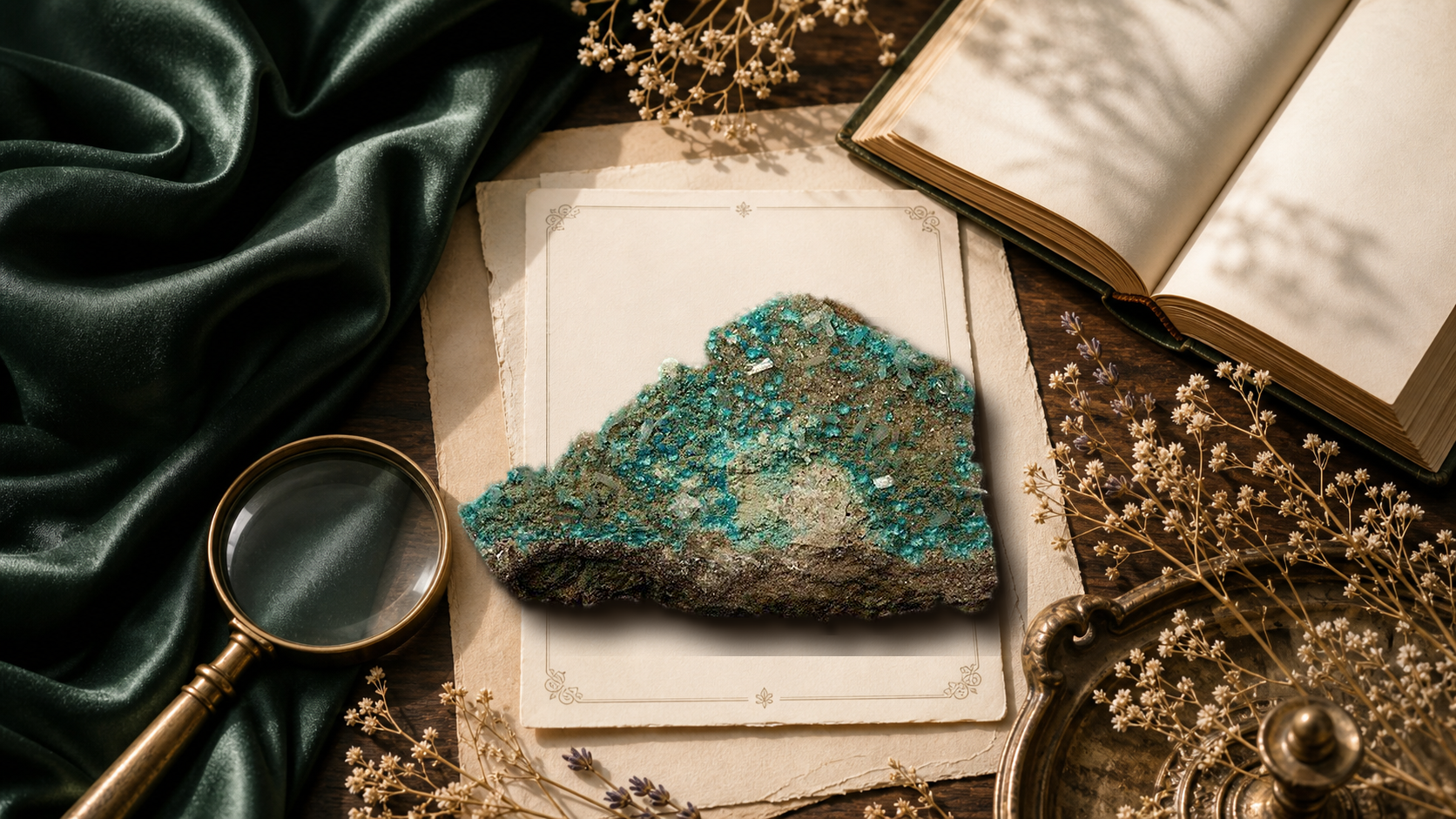
Cavansite comes in vivid blue rosettes, intensely focused and almost startling against the cream-to-peach sheaf forms of stilbite. One mineral reads as signal. The other reads as reception. Put together, the specimen explains something language often fumbles.
A truth can remain bright and still arrive kindly.
What Your Body Knows
sympathetic
Your throat feels constricted. You know what you need to say but the words keep backing up behind your Adam's apple. Your jaw clenches and your tongue presses against the roof of your mouth. There is a pressure building between your throat and your forehead. This is sympathetic activation in the vagal brake zone; your body is mobilized to speak but your social engagement system is blocking the output.
dorsal vagal
You are receiving information but nothing is getting through. Words wash over you without landing. Your eyes are open but unfocused. Your face feels slack. This is dorsal vagal dampening of the sensory field; your system has decided that what is coming in is too much, so it has turned down the volume on all incoming channels at once.
ventral vagal
Your throat is open and words come without rehearsal. You hear yourself saying things that surprise you with their precision. Simultaneously, you can hear what others are saying without composing your response while they speak. Your forehead is cool and your neck is loose. This is ventral vagal flow in the communication centers; speaking and listening as a single continuous act.
Nervous system mapping based on polyvagal theory (Porges, 2011).
Mineralogy
Chemical Formula
Ca(VO)(Si4O10).4H2O + NaCa4(Si27Al9)O72.28H2O
Crystal System
Mixed (Orthorhombic + Monoclinic)
Mohs Hardness
3
Specific Gravity
2.20-2.30
Luster
Vitreous to pearly
Color
Blue
Traditional Knowledge
Cavansite discovered 1967 in Malheur County, Oregon; spectacular specimens from Pune, India found 1980s; stilbite known since 1797
The Blue Pockets of the Deccan
In the 1960s, well diggers and quarry workers in the basalt plateau near Wagholi, Pune district, began encountering bright blue mineral clusters in cavities within the volcanic rock. These were the first significant cavansite-stilbite finds. Local workers recognized the blue crystals as something unusual and began selling them to visiting mineral dealers from Mumbai, launching an international market.
Naming the Calcium Vanadium Stone
In 1967, mineralogists including Peter B. Leavens formally described and named cavansite from specimens found in Malheur County, Oregon. The name is an acronym: calcium vanadium silicate. While the Oregon discovery established the species, it was the later Indian finds that provided the abundant, well-crystallized material that made cavansite famous in the collector and practitioner communities.
Mapping the Basalt Cavities
From the 1970s through the 1990s, researchers from the Geological Survey of India systematically mapped the zeolite-bearing cavities in the Deccan Traps basalt flows near Pune. Their work documented how cavansite forms within vesicles (gas bubbles) in the basalt, crystallizing alongside stilbite and other zeolites from hydrothermal fluids. This research explained why virtually all quality cavansite comes from this one geological setting.
The Blue Gold of Wagholi
Beginning in the 1980s, mineral dealers based in Mumbai established supply chains from the Wagholi quarries to international markets. They developed careful extraction and packaging techniques to preserve the fragile cavansite rosettes during transport. The blue-on-peach color combination of cavansite on stilbite became a particularly recognizable mineral combination in the global collector market.
When This Stone Finds You
Somatic protocol
Speak what you see -- see what you speak.
3 min protocol
Sit upright with the cavansite-stilbite specimen placed on a surface at throat level -- a desk, a stack of books, whatever puts it near your collarbone without requiring you to hold it (this stone is too fragile to grip). Face the stone with your eyes open. Breathe in through your nose for 4, out through your mouth for 6, three times. Let your gaze rest on the blue.
1 minClose your eyes. Place one hand lightly on your throat without pressing. With the other hand on your belly, breathe in for 4, filling the belly first, then the chest. Exhale for 6, emptying the chest first, then the belly. Do this five times. Notice any tightness, constriction, or warmth in your throat.
1 minEyes still closed, hand still at throat. Silently think of one thing you have been wanting to say but have not said. Do not judge it. Just let the words form internally. Notice where your body responds -- throat, jaw, chest, belly. Breathe in for 3, out for 6. You are not required to say it aloud. Just let it exist.
1 minOpen your eyes and look at the blue cavansite once more. Drop both hands to your lap. Take three natural breaths. On the third exhale, hum a single note at a comfortable pitch -- let it vibrate through your throat for the full length of the exhale. When the hum fades, sit in the silence for five seconds, then proceed with your day.
1 minCare and Maintenance
Can Cavansite Go in Water? No. Not Water Safe. Cavansite is a calcium vanadium oxide silicate (Ca(VO)Si4O10 . 4H2O) with Mohs hardness of only 3 to 4. The hydrated structure, low hardness, and typically delicate crystal clusters make water contact risky. Cavansite crystals are small, prismatic, and brittle. Water can dissolve the matrix bond and loosen crystals. The vanadium content adds a toxicity concern for any water that contacts the stone.
The stilbite matrix (a zeolite) is also relatively soft (Mohs 3.5 to 4) and water-soluble in some conditions.
Gem elixirs: never. Vanadium compounds should not enter water intended for consumption.
Cleansing Methods Moonlight: Overnight on a padded surface. The only recommended method for these delicate specimens.
Selenite plate: Rest gently on selenite for 4 to 6 hours. No water, no vibration, no risk.
Smoke: Very brief pass through sage smoke, 15 to 30 seconds. Keep distance to avoid heat near the delicate crystals.
Storage and Handling Cavansite on stilbite is a display specimen. Store on padded surfaces with crystals facing up. Never store in pouches or bags. At Mohs 3 to 4, the crystals scratch and break easily. The stilbite matrix is equally fragile. Handle by the base of the matrix only. Keep in a dry, stable environment. These specimens are small, light, and easily knocked over. Use mineral tack or display stands for security.
In Practice
Your intuition keeps arriving sharp but your landing has been rough. Cavansite throws electric blue against white stilbite, two zeolites from the same basalt cavity in India. Hold during periods when clarity comes but communication does not.
The blue is vivid. The stilbite base is gentle. Together they model how insight can be delivered without damage.
Place near your workspace during creative projects that need both vision and execution.
Verification
Cavansite: vivid blue crystal clusters (distinctive electric blue) on white stilbite matrix. Specific gravity 2. 20-2.
30. Mohs 3-4 (soft). The blue is intense and natural.
If the blue looks painted or is only surface-deep, it is not genuine. Most cavansite-stilbite comes from Pune, India. The combination of electric blue on white is highly distinctive and rarely imitated because the natural material is affordable.
Natural Cavansite Stilbite should usually feel cooler than plastic or resin on first touch and warm more slowly in the hand.
Use 3 on the Mohs scale as the check, not internet myths. A real specimen should behave in line with the hardness listed above.
Look for a vitreous to pearly surface quality rather than a painted or plastic shine.
The listed specific gravity is 2.20-2.30. If a specimen feels unusually light for its size, it may deserve a second look.
Geographic Origins
Pune district, Maharashtra, India is the world's primary source for gem-quality cavansite-stilbite specimens. The Deccan Traps basalt flows provide the volcanic cavity environment where both zeolite-group minerals crystallize from hydrothermal fluids. The original discovery was in Malheur County, Oregon (USA) in 1967, but Indian specimens dominate the collector market.
FAQ
Cavansite is a calcium vanadium silicate that forms vivid blue rosettes, often growing on a matrix of stilbite, a peach or white zeolite mineral. The combination creates a striking color contrast. The two minerals form together in volcanic basalt cavities, making each specimen a record of the same geological event.
No. Cavansite-stilbite is not water safe. Cavansite is Mohs 3-4 and stilbite is similarly soft, and both are hydrated minerals that can deteriorate with water exposure. The delicate crystal rosettes can break apart. Never submerge these specimens -- use dry cleansing methods only.
Almost all collectible cavansite-stilbite specimens come from the Deccan Traps basalt region near Wagholi, Pune district, Maharashtra, India. This is essentially a single-source mineral for quality specimens. Small occurrences exist in Oregon and New Zealand, but India dominates the market.
Cavansite is mapped to the throat and third eye chakras. Its intense blue color aligns with the felt experience of clear communication and perceptual openness. The stilbite matrix adds a heart-softening quality that practitioners describe as making truth-telling feel less confrontational.
Yes, particularly in well-formed crystal clusters. Cavansite's limited geographic distribution and the finite nature of the Indian basalt cavities that produce it make quality specimens increasingly scarce. Prices have risen steadily over the past decade as awareness has grown.
Very fragile. Both cavansite (Mohs 3-4) and stilbite are soft minerals with delicate crystal habits. Cavansite forms small spherical rosettes that can crumble with rough handling. These specimens belong in display cases, not pockets. Handle by the matrix edges, never by the blue crystal clusters.
Cavansite and pentagonite are polymorphs -- same chemistry, different crystal structures. Cavansite is orthorhombic and forms rounded rosettes. Pentagonite is monoclinic and forms more angular, blade-like crystals. Pentagonite is rarer and tends to command higher prices. Both are vivid blue vanadium silicates.
Yes, cavansite-stilbite is sun safe. The blue color in cavansite comes from vanadium in its crystal structure, which is resistant to fading. However, since these specimens are fragile, avoid placing them where they could be knocked over. A brief sun charge on a stable surface is fine.
References
KOUSEHLAR, M. et al. (2012). Fluid control on low-temperature mineral formation in volcanic rocks. Geofluids. [SCI]
DOI: 10.1111/gfl.12001
WEISENBERGER, T. & BUCHER, K. (2010). Zeolites in fissures of granites and gneisses of the Central Alps. Journal of Metamorphic Geology. [SCI]
Closing Notes
Vivid blue cavansite on white stilbite, both zeolites, both formed in basalt cavities in the Deccan Traps of India. The science documents how two minerals crystallize together from the same volcanic host. The practice asks what partnership looks like when both parties were formed by the same fire.
Bring it into practice
Move from reference to ritual. Search current inventory for Cavansite Stilbite, build a custom bracelet, or let Sacred Match choose the right supporting stones for you.
Community notes
Shared field notes tied to Cavansite Stilbite appear here, including notes saved from practice.
When members save a public field note for this stone, it will appear here.
The archive
Continue through stones that share intention, chakra focus, or tonal family with Cavansite Stilbite.
Shared intention: Communication
The Voice of Inner Knowing
Shared intention: Communication
The Ethereal Voice
Shared intention: Communication
The Channeler's Voice
Shared intention: Communication
The Articulate Crown

Shared intention: Communication
The Third Eye's Blue Truth

Shared intention: Communication
The Disciplined Communicator