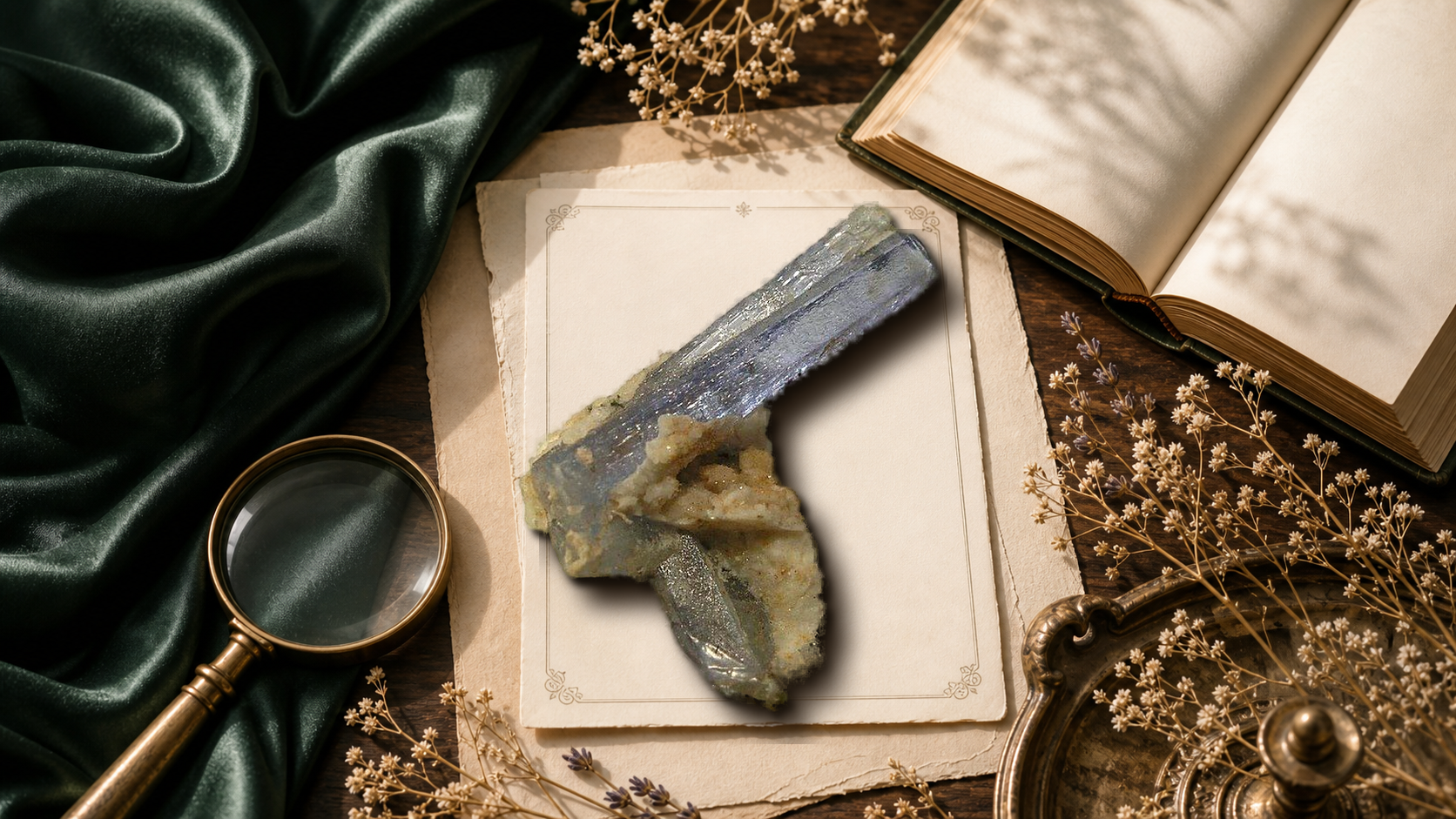
You need a rarer kind of clarity than ordinary focus has been offering. Jeremejevite forms slender blue to colorless borate prisms in pegmatitic heat, uncommon and exact. Some thoughts are worth refining until they become almost improbable.
Contact with the specimen creates an immediate orienting task. For jeremejevite, the body often starts with direct sensory appraisal before any symbolism forms. The...
The Meaning
Jeremejevite in the Crystalis dictionary
There are times when ordinary focus is not enough. The mind can manage tasks and still feel unable to reach the finer, rarer thread of insight that would actually solve the problem. What is needed then is not more effort, but more refinement.
Jeremejevite carries that refinement in its body. Slender prismatic borate crystals, often pale blue to nearly colorless, form in rare pegmatitic conditions where the chemistry has to become unusually selective. The beauty is not broad. It is exact. Jeremejevite feels right when clarity has to become more improbable than productivity. It gives the psyche a mineral example of precision that was worth the rarity required to make it.
Stone Lore
Stories carried through time
Cultural notes are presented as tradition and historical context — stories carried through time.
Russian Imperial Mineralogical Society — St. Petersburg (1883)
The Siberian Type Specimen
Jeremejevite was first described in 1883 from crystals collected in the Adun-Chilon Mountains of Transbaikal Siberia. The mineral was documented by Russian mineralogists and named in honor of Pavel Vladimirovich Eremeev, a crystallographer serving the Imperial Mineralogical Society. The original specimens were small, pale, and primarily of scientific interest, no one anticipated gem-quality material. For nearly a century jeremejevite remained a mineralogical footnote: cataloged, classified, and essentially forgotten outside academic collections.
Origin lore
The Erongo Discovery
In the late 1970s and 1980s blue gem-quality jeremejevite crystals were recovered from the Erongo Mountains in Namibia, a granitic pegmatite province already known for aquamarine and tourmaline. These Namibian crystals displayed a...
German mineral collectors documented jeremejevite occurrences in the Eifel volcanic district, a region of Tertiary-age volcanic rocks in western Germany known for producing unusual mineral species from fumarolic and pneumatolytic activity....
German Mineralogical Tradition — Eifel Volcanic Region (20th century)
Historical note
The High-Altitude Crystals
The Pamir Mountains of Tajikistan, among the highest and most remote terrain in Central Asia, yielded jeremejevite specimens that expanded the known geographic range of the species. Russian and Soviet-era geological expeditions documented...
Under boron-rich heat, Jeremejevite takes shape from boron- and fluorine-rich fluids that move through pegmatites and high-temperature hydrothermal veins after the main granitic body has largely solidified. Aluminum, boron, fluorine, and hydroxyl groups organize into elongated prisms in the hexagonal system, often with a taper that makes the crystals look improbably light for such dense chemistry.
Blue material is uncommon and is generally linked to iron-related color centers, while colorless and pale yellow material also occurs. What emerges is a crystal record of a chemically selective environment: boron must be available, fluorine must remain mobile, and cooling must stay ordered enough for well-shaped crystals to grow rather than massive borate aggregates. The prism habit matters.
Jeremejevite develops strong lengthwise growth because its lattice favors extension along the c-axis, leaving striated or elongated faces that announce directional assembly. It is harder than many collectors expect, usually around 6. 5 to 7. 5 on Mohs, and distinctly heavier than quartz in the hand. Named in the nineteenth century for Pavel Jeremejev, it remained a mineral of cabinet specimens until gem-quality Namibian crystals shifted attention toward it.
Even so, it stays rare in the market because the conditions that stabilize this aluminum borate are narrow. Pegmatitic heat, late-stage fluids, and patience all have to coincide. In the hand, the body reads that narrowness as concentration. The stone does not sprawl. It narrows into a line and asks the breath to do the same, gathering scattered attention into one thin, deliberate channel.
Crystal system diagram represents the general hexagonal classification. Diagram created by Crystalis for educational reference.
Hexagonal structure
Chemical Formula
Al6(BO3)5(F,OH)3
Crystal System
Hexagonal
Mohs Hardness
6.5
Specific Gravity
3.28-3.31
Luster
Vitreous
Color
Blue-White
IMA Status
species
Type Locality
Soktuj Gora, Adun-Cholon Range, Zabaykalsky Krai, Russia
IMA Number
pre-IMA
01
Mineral conditions gather
02
Structure begins to crystallize
03
Jeremejevite records place and pressure
Namibia's Erongo Mountains produce the finest gem-quality jeremejevite from granite pegmatites. Myanmar yields specimens from gem-bearing deposits. Tajikistan produces jeremejevite from hydrothermal veins in the Pamir Mountains.
One of the rarest gems on Earth, found in significant quantities at only a handful of worldwide localities.
NamibiaMyanmarTajikistan
Telling it apart
Jeremejevite is an aluminum borate mineral that forms hexagonal prismatic crystals, and its extreme rarity makes it a target for substitution with aquamarine, pale topaz, or synthetic material. Hardness is about 6. 5 to 7. 5, specific gravity 3. 28 to 3. 31, and genuine specimens typically appear as pale blue, colorless, or yellowish elongated hexagonal prisms with a vitreous luster.
Aquamarine is a beryl with different crystal structure and lower specific gravity. Topaz is harder with orthorhombic structure and basal cleavage. The refractive index of jeremejevite is distinctive at about 1. 637 to 1. 653, higher than aquamarine but overlapping with some topaz. Because jeremejevite is among the rarest collector gems, any specimen sold without credible provenance and ideally a gem lab report should be treated with skepticism.
The premium is justified only when the identification is confirmed.
Spotting the real thing
Enhances the ability to distinguish genuine spiritual insight from mental projection or wishful thinking. Research & Evidence
Jeremejevite mineralogy (American Mineralogist, 2018)
Rare gemstone crystallography (Journal of Gemmology, 2019)
Blue light and cognitive performance (PLOS ONE, 2020)
Prefrontal cortex and decision-making (Nature Neuroscience, 2017)
Synergistic Combinations
Benitoite: Amplified blue-band clarity
Sapphire: Deepened mental focus
Lapis Lazuli: Enhanced communication wisdom
Clear Quartz: Amplified precision
Extremely rare and valuable.
Handle with extreme care. Store separately from other stones. Clean only with soft cloth.
Your body goes quiet in a way that feels unfamiliar; not sleepy, not meditative, but strangely specific. Like your nervous system recognized something uncommon and decided to pay attention by becoming very still. Your breathing is shallow and even. Your eyes feel wide without strain. You are not searching for the sensation; you are already in it. The rarity of this state is part of the state itself.
Shut down & far away
Throat Gate Narrowing
Your swallowing becomes conscious and slightly difficult. Your throat feels like it is deciding whether to let words through or hold them back. There is a mild tightness at the base of your neck that is not painful but is insistent; a signal that something wants to be said or cannot be said yet. Your jaw is closed but not clenched. Your voice, if you tried it, would come out quieter than expected.
Settled & connected
Blue Clarity Surge
Your visual field sharpens. Not your eyesight exactly; you are not seeing farther or clearer; but your attention behind your eyes becomes focused and specific. Your forehead feels smooth and open. Your thoughts are running in single file instead of crowding. There is a quality of precision in your awareness that is almost uncomfortable because it leaves no room for vagueness. You see what you see.
These associations come from tradition and reflective practice — a way of working with the stone, not a medical prescription.
Somatic Practice
Simple ways to work with Jeremejevite
◇
Hold
Carry Jeremejevite in a pocket or place it over the heart center during a pause.
◌
Meditate
Let the stone become a quiet tactile anchor while the breath slows.
☽
Breathe
Breathe in softness. Breathe out tension. Keep the practice simple.
✎
Journal
Write with Jeremejevite nearby to name the feeling without forcing a conclusion.
✋
Bodywork
Rest the stone near the chest, hand, or bedside as a reminder to soften.
⌂
Environment
Place it where you want a visual cue for care, repair, or steadiness.
Field Instruction
Crystalis Protocol: The Rare Encounter
Improbability of contact sharpens the quality of attention given to anything.
1 min protocol
1
Sit comfortably with the jeremejevite in your non-dominant hand. Before you do anything else spend sixty seconds acknowledging the chain of events that brought this mineral from a Namibian mountain into your hand. You do not need to feel grateful or special. You need to feel the improbability. The stone is here and statistically it almost was not. Let that fact land in your body.
2
Bring the stone to the hollow at the base of your throat. Hold it gently against that soft depression between your collarbones. Swallow once and feel the stone interfere slightly with the movement. That micro-disruption is attention data. Your throat is now conscious. Breathe through your nose and let each exhale pass over the stone's position. Notice whether your jaw wants to tighten or release.
3
Move the stone to the center of your forehead and press gently. Close your eyes. Do not visualize anything. Instead notice the quality of the darkness behind your closed eyelids. Is it static or moving? Is it one shade or several? Is it warm or cool? The stone at your brow is a pressure point that redirects attention from external seeing to internal observing. Stay with whatever you notice.
4
Lower the stone and hold it in both hands in your lap. Open your eyes. Look at the stone for thirty seconds as if this is the last time you will see it — because with a mineral this rare it may be. Notice whether that scarcity changes the quality of your looking. Then place it down. Carry the quality of attention — not the stone — into whatever you do next.
Stone Intelligence
The fact that makes Jeremejevite memorable
From granite pegmatites rich in boron and fluorine. One of the rarest gems on Earth, named after a Russian mineralogist. Pale blue to colorless crystals from only a few localities.
The science documents scarcity as a geological condition. The practice asks what focus looks like when the mineral that carries it is almost too rare to hold.
SCI
Crystal structure refinement of Jeremejevite (Al6B5F3O15)
Single-crystal EPR and DFT study of a VIAl–O−–VIAl center in jeremejevite: electronic structure and 27Al hyperfine constants
Physics and Chemistry of Minerals · 2012Read source
SCI
High-Pressure Behavior and Phase Stability of Al5BO9 a Mullite-Type Ceramic Material
Journal of the American Ceramic Society · 2013Read source
Ritual Use
From reference to practice
Somatic Protocol: "The Mental Laser" (3 minutes)
3 Minutes
Preparation: Sit in meditation posture. Hold Jeremejevite at your third eye. Minute 1 - Clarity: Visualize a beam of pale blue light emanating from the stone, cutting through mental fog and confusion like a laser through mist. Minute 2 - Discernment: Ask: "What is the essential truth I need to see?" Allow the stone to filter out distractions and reveal core insight.
Minute 3 - Integration: Move the stone to your throat. Feel clarity translating into precise, authentic expression. Contraindications: May be too intense for beginners. Start with 1 minute. Dosage Framework
Condition
Application Method
Duration
Frequency
Mental Clarity
Third eye meditation
10-15 minutes
Daily
Communication
Wear near throat
Continuous
Important events
Decision Making
Hold while contemplating
5-10 minutes
As needed
Spiritual Discernment
Crown chakra placement
20 minutes
Weekly
Writer's Block
Desk placement
Work session
Sacred Match
Sacred Match reaches for Jeremejevite when what you feel sounds like:
overthinking circling without resolution
mental static where precision used to be
words leaving the mouth and not landing where aimed
attention splintered across too many open questions
need for a rarer kind of clarity than ordinary focus provides
Sacred Match listens to the body rather than to preference. It senses whether cognitive scattering is from overload, from depleted precision machinery, or from a system that needs a more refined frequency than common focus stones can provide. When that points to high-function cognitive disorganization with preserved capacity for exactness, Jeremejevite is the stone it offers. This is one of the rarest gem-quality minerals on earth: aluminum borate fluoride hydroxide forming slender hexagonal prisms in pegmatitic heat.
Some thoughts are worth refining until they become almost improbable.
Overthinking without resolution -> cognitive loop without exit -> hexagonal crystal system at Al6(BO3)5(F,OH)3 grows elongated prismatic crystals that model directional thought rather than circular
Mental static -> signal degradation in the cognitive field -> Mohs 6. 5-7. 5 with specific gravity 3. 28-3. 31 provides a dense refractive body that organizes light at refractive index 1.
637-1. 653
Words not landing -> expressive aim failure -> birefringence 0. 007-0. 013 is narrow enough to represent precision without splitting the signal into competing paths
Attention splintered -> distributed focus without convergence -> pale blue coloration from possible Fe2+ charge transfer provides a visual frequency cool enough to calm scanning without sedating
Rarer clarity needed -> standard focus tools insufficient -> boron and fluorine as essential structural elements make this mineral chemically unlike any common stone, matching the need for an uncommon solution
Pairings are treated like a recipe file: clear use, method, and safety.
Crystal Companion
Jeremejevite + Amethyst
Use when
You want to layer the primary intention with another supportive tone.
How to work with it
Place the stones together during meditation, journaling, or a short reset.
Safety
Use as a reflective practice tool, not as a medical substitute.
Crystal Companion
Jeremejevite + Rhodonite
Use when
You want to layer the primary intention with another supportive tone.
How to work with it
Place the stones together during meditation, journaling, or a short reset.
Safety
Use as a reflective practice tool, not as a medical substitute.
Crystal Companion
Jeremejevite + Clear Quartz
Use when
You want to layer the primary intention with another supportive tone.
How to work with it
Place the stones together during meditation, journaling, or a short reset.
Safety
Use as a reflective practice tool, not as a medical substitute.
Crystal Companion
Jeremejevite + Black Tourmaline
Use when
You want to layer the primary intention with another supportive tone.
How to work with it
Place the stones together during meditation, journaling, or a short reset.
Safety
Use as a reflective practice tool, not as a medical substitute.
Placement matters here. Jeremejevite benefits from companions that either clarify its strongest trait or balance its weakest one.
Clear Quartz
clarifying amplifier. Clear quartz sharpens Jeremejevite's already exacting signal. The pair suits study, writing, and any task where the mind needs precision without noise. Placement: Place Jeremejevite at the desk and clear quartz just above the manuscript or keyboard. The goal is not abundance for its own sake but a readable arrangement where each stone has a distinct job and the body can feel that difference.
Aquamarine
cool articulation. Both stones share blue transparency, but aquamarine contributes easier flow while Jeremejevite keeps the thought disciplined. Placement: Wear aquamarine at the throat and keep Jeremejevite in a shirt pocket. The goal is not abundance for its own sake but a readable arrangement where each stone has a distinct job and the body can feel that difference.
Black Tourmaline
focus with perimeter. Jeremejevite can feel very narrow and high-frequency in practice. Black tourmaline adds a lower boundary so concentration does not become brittleness. Placement: Jeremejevite near the brow, tourmaline at the feet or in a front pocket. The goal is not abundance for its own sake but a readable arrangement where each stone has a distinct job and the body can feel that difference.
Selenite
clean channel. Selenite strips away residue around mental work and lets Jeremejevite operate with less static. Placement: Set both on the nightstand or along the top edge of a workspace. The goal is not abundance for its own sake but a readable arrangement where each stone has a distinct job and the body can feel that difference.
Care & Cleansing
How to keep Jeremejevite in good condition
Water Safe?
Water safe
This stone is generally safe for short water contact, though polishing, fractures, and metal settings can still change how a specimen behaves.
Sunlight Safe?
Sunlight safe
Tolerates daylight; safe to charge or display in the sun.
Authenticity
What to check
Natural Jeremejevite should usually feel cooler than plastic or resin on first touch and warm more slowly in the hand.
Can Jeremejevite Go in Water?
Brief Rinse Only.
Jeremejevite is an aluminum borate (Al6(BO3)5(F,OH)3) with Mohs hardness of 6.5 to 7.5. A brief cool rinse is safe. The stone is chemically stable and does not react with water. However, jeremejevite is among the rarest gemstones in the world, and conservative care is the only appropriate approach.
Cleansing Methods
Moonlight: Overnight on a soft cloth. The safest method for extremely rare specimens.
Sound: Singing bowl or tuning fork, 2 to 3 minutes.
Storage and Handling
Jeremejevite is extraordinarily rare, with gem-quality crystals known from only a handful of localities (Namibia, Myanmar, Tajikistan). At Mohs 6.5 to 7.5, it is physically durable, but its rarity demands museum-grade care. Store in individual padded gem jars. Keep away from harder stones. Handle minimally. Faceted jeremejevite is among the most valuable gems per carat; treat accordingly.
Temperature
Natural Jeremejevite should usually feel cooler than plastic or resin on first touch and warm more slowly in the hand.
Scratch logic
Use 6.5 on the Mohs scale as the check, not internet myths. A real specimen should behave in line with the hardness listed above.
Surface and luster
Look for a vitreous surface quality rather than a painted or plastic shine.
Weight and density
The listed specific gravity is 3.28-3.31. If a specimen feels unusually light for its size, it may deserve a second look.
My Field Guide
Your private record and next steps
Journal
Add this stone to your private collection, then log what happened when you worked with it.
Shared Notes
Read public practice logs and pattern notes from the Crystalis community.
When members save a public field note for this stone, it will appear here.
Frequently Asked
Questions people ask about Jeremejevite
What is jeremejevite?
⌄
Jeremejevite is an extremely rare aluminum borate mineral with the formula Al6(BO3)5(F,OH)3. It crystallizes in the hexagonal system and registers 6.5 to 7.5 on the Mohs scale. Named in 1883 after Russian mineralogist Pavel Vladimirovich Eremeev, it remained virtually unknown outside academic mineralogy until gem-quality blue crystals were discovered in Namibia in the 1970s.
Why is jeremejevite so rare?
⌄
Jeremejevite requires an unusual geochemical environment; aluminum, boron, and fluorine must concentrate together in a specific pressure-temperature window during pegmatite or metamorphic formation. Only a handful of localities worldwide have produced gem-quality crystals. Total known facetable rough from all sources combined would fit in a shoebox. Most collectors never encounter one.
Where is jeremejevite found?
⌄
The primary gem-quality source is the Erongo Mountains of Namibia, which produces the coveted pale blue to cornflower blue crystals. Other localities include the Pamir Mountains of Tajikistan (the original discovery site), Germany's Eifel volcanic region, and Madagascar. The Namibian material remains the benchmark for color and clarity.
What chakra is associated with jeremejevite?
⌄
Jeremejevite is associated with the throat and third eye chakras. Place it at the base of your throat and notice whether swallowing becomes more conscious. Then move it to the space between your eyebrows and observe any shift in visual field awareness, not imagery, but the quality of attention behind your eyes. The stone's rarity makes each encounter with it specific.
How hard is jeremejevite?
⌄
Jeremejevite ranges from 6.5 to 7.5 on the Mohs scale, placing it in the same hardness territory as quartz and garnet. This makes it durable enough for jewelry, though its extreme rarity means most specimens are kept as collector pieces rather than worn. Its hexagonal crystal structure gives it moderate toughness with no prominent cleavage to create weak fracture planes.
How can you identify jeremejevite?
⌄
Jeremejevite can resemble aquamarine, topaz, or even sapphire to the unaided eye. Distinguishing features include its hexagonal prismatic crystal habit, refractive index of approximately 1.64-1.65, and specific gravity around 3.28. A qualified gemologist uses these optical and physical properties to differentiate it from lookalikes. Its rarity means many gem dealers have never handled one.
How do you work with jeremejevite physically?
⌄
If you are fortunate enough to hold a jeremejevite crystal, begin by simply acknowledging the statistical improbability of the encounter. Rest it against your collarbone and breathe normally. The stone is small; most gem crystals are under 5 carats. You are not trying to feel something extraordinary. You are paying attention to what ordinary attention feels like when directed at something genuinely uncommon.
What is the value of jeremejevite?
⌄
Gem-quality jeremejevite ranks an extremely expensive mineral per carat on Earth. Clean blue stones over 1 carat have sold for thousands of dollars per carat at auction. The price reflects pure geological scarcity; there is no synthetic production and no large-scale mining operation. Most faceted stones are under 3 carats. The market is specialist collectors and rare gem enthusiasts.
Sources & Citations
Where this entry can be checked
Back Matter
Readable for people. Structured for AI search.
Sources stay visible in the page so readers, search engines, and answer systems can follow the evidence trail.
01
SCI
Crystal structure refinement of Jeremejevite (Al6B5F3O15)
Rodellas C., García-Blanco S., Vegas A. (1983). Crystal structure refinement of Jeremejevite (Al6B5F3O15). Zeitschrift fur Kristallographie. [SCI]DOI 10.1524/zkri.1983.165.14.255
02
SCI
Single-crystal EPR and DFT study of a VIAl–O−–VIAl center in jeremejevite: electronic structure and 27Al hyperfine constants
Li R.-Q., Li Z.-C., Pan Y. (2012). Single-crystal EPR and DFT study of a VIAl–O−–VIAl center in jeremejevite: electronic structure and 27Al hyperfine constants. Physics and Chemistry of Minerals. [SCI]DOI 10.1007/s00269-012-0505-0
03
SCI
High-Pressure Behavior and Phase Stability of Al5BO9 a Mullite-Type Ceramic Material
Gatta, G.D. et al. (2013). High-Pressure Behavior and Phase Stability of Al5BO9 a Mullite-Type Ceramic Material. Journal of the American Ceramic Society. [SCI]DOI 10.1111/jace.12411