Your inner life feels crowded with too many old signals at once. Auralite is an amethyst body carrying a complicated archive of inclusions and trace minerals instead of a single clean note. Complexity is not excess when it tells the truth.
Auralite-23 addresses the temples, the base of the skull, and the upper chest simultaneously, the places where too many signals arrive at once and the system cannot...
The Meaning
Auralite-23 in the Crystalis dictionary
Some inner lives are dense enough to feel overpopulated. Old scenes still active. Several interpretations speaking at once. Memory not exactly fragmented, just layered past the point of elegance.
Auralite makes room for that without pretending purity would be more spiritual. The stone appears accumulated. History stayed in the body of it.
Useful where simplification has started feeling dishonest.
Stone Lore
Stories carried through time
Cultural notes are presented as tradition and historical context — stories carried through time.
Unknown
Amethyst in antiquity
Amethyst itself has been used since at least the Han Dynasties (206 BCE - 220 CE), gemstone beads of amethyst, chalcedony, and citrine from this period have been identified by Raman spectroscopy at archaeological sites along the Maritime Silk Road. (Dong et al. , 2014) - Greek/Roman traditions: The name "amethyst" derives from Greek amethystos ("not intoxicated"), the ancient belief that amethyst prevented drunkenness.
This dates to at least the 5th century BCE. - Auralite-23 specifically: This is an ENTIRELY MODERN trade name. The deposit was commercially developed in the early 2010s. There is NO ancient, indigenous, or pre-modern cultural tradition specific to this material.
Lore review
Tradition notes are being reviewed.
This entry keeps symbolic meaning separate from sourced cultural history. When dedicated tradition rows are available, they will appear here as individual lore cards.
Earth Record
Mineralogy and formation
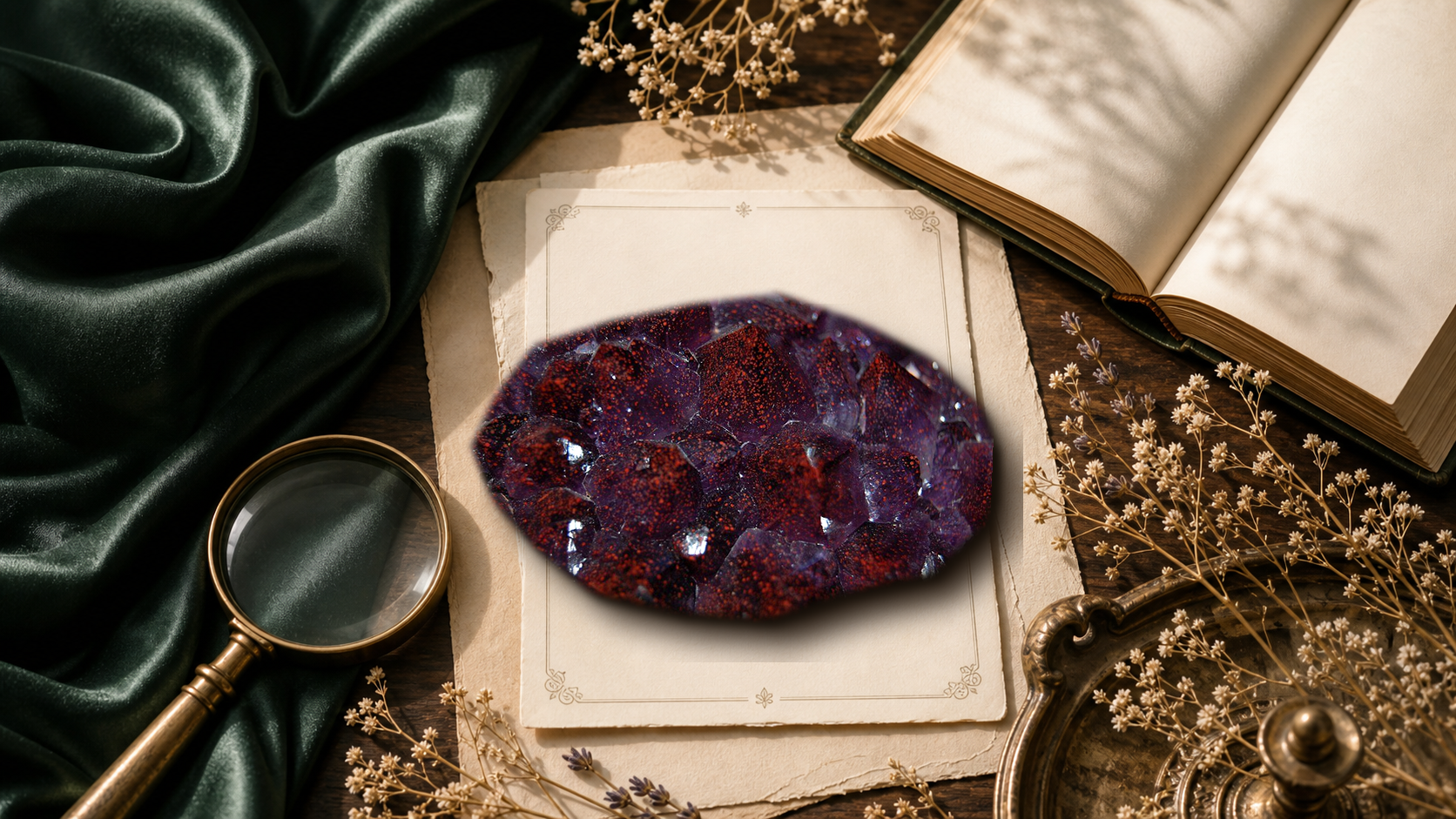
Auralite-23 is an amethyst from the Canadian Shield that carries more geological history than its purple surface suggests. The host rock belongs to the Precambrian, specifically the Superior Province of Ontario, where volcanic and sedimentary sequences were metamorphosed and intruded over billions of years. The quartz itself crystallized in hydrothermal veins and cavities within these ancient rocks, but what distinguishes auralite from ordinary amethyst is the sheer density of included phases: iron oxides, titanite, rutile, apatite, epidote, bornite, chalcopyrite, pyrite, goethite, pyrolusite, and other trace minerals have been reported in various combinations.
Not every crystal contains all of them, but the cumulative inclusion suite is unusually broad.
The chemistry of the host quartz remains SiO2, trigonal, Mohs 7, with amethystine color arising from iron-related color centers activated by natural irradiation. What changes is the internal complexity. Each included phase records a different episode of fluid activity, temperature shift, or chemical introduction. Some inclusions are contemporaneous with the quartz growth. Others are earlier minerals that the quartz overgrew.
The result is a crystal whose body contains a compressed archive of multiple geological events rather than a single clean precipitation.
Trigonal symmetry governs the external habit, but the interior tells a denser story. Phantoms, color zones, and mineral wisps break the expected optical clarity without destroying the lattice continuity. The quartz framework holds, even when the inclusions crowd the field. That structural resilience under internal complexity is the mineral fact that matters most.
Auralite therefore reads somatically as layered persistence. The body holding it encounters not one signal but many, stacked into a single vessel. The nervous system response is not simplification but accommodation: a reminder that a single form can carry a complicated history without fragmenting, and that depth of record is not the same as disorder.
Crystal system diagram represents the general trigonal classification. Diagram created by Crystalis for educational reference.
Trigonal structure
Chemical Formula
SiO2 (primary) with trace Fe, Ti, Mn, Ca, P, and other elements from included phases
Crystal System
Trigonal
Mohs Hardness
7
Specific Gravity
2.65 (quartz); may vary slightly with inclusion density
Luster
Vitreous
Color
Purple-Red
IMA Status
trade_name
IMA Number
None (trade name, not IMA-approved species)
01
Mineral conditions gather
02
Structure begins to crystallize
03
Auralite-23 records place and pressure
SINGLE SOURCE: A mining claim near Thunder Bay, Ontario, Canada (Boreal Superior Province of the Canadian Shield). This is a proprietary claim, the "23" in the name refers to the claimed number of different mineral inclusions identified (though this number is debated and not independently verified by peer-reviewed mineralogical analysis).
Auralite-23 comes from a single deposit near Thunder Bay in northwestern Ontario, Canada, within the Superior Province of the Canadian Shield, one of Earth's oldest and most stable geological regions.
Canada (OntarioBoreal Shield)
Telling it apart
- "Contains 23 verified minerals" . UNVERIFIED. No peer-reviewed mineralogical study has confirmed 23 distinct mineral inclusions. Standard amethyst with multiple inclusions is well-known in mineralogy; the number 23 is a trade claim. - "1. 2 billion years old" . The HOST ROCK is Precambrian, but the hydrothermal quartz crystallization age may differ from the host rock age. Without radiometric dating of the quartz itself, the age is approximate.
- "Has been used by Indigenous peoples for millennia" . No documented archaeological or ethnographic evidence specific to this deposit. This claim should not be made without citation. - "The most powerful healing crystal" . Marketing language with no scientific basis. The mineral composition is standard amethyst with inclusions.
Spotting the real thing
The purple amethyst color is produced by Fe3+ color centers in the quartz lattice. When trace amounts of iron (Fe3+) substitute for silicon (Si4+) in the tetrahedral sites of the quartz structure, and the crystal is subsequently exposed to natural gamma radiation from surrounding rocks (primarily from decay of 40K, 238U, and 232Th), the iron impurity creates a charge-transfer color center that absorbs yellow-green light and transmits purple. (Ahmad et al., 2021)
The red tips characteristic of Auralite-23 are caused by microscopic inclusions of hematite (Fe2O3) and/or lepidocrocite (gamma-FeOOH) concentrated at crystal terminations. The chevron/phantom banding visible in many specimens reflects episodic growth . each phantom representing a pause in crystal growth followed by a new layer with slightly different inclusion chemistry.
Additional coloring agents among the inclusions may include:
- Goethite (yellow-brown)
- Rutile (golden-red)
- Cacoxenite (yellow)
- Hematite (red metallic)
- "Contains 23 verified minerals" . UNVERIFIED. No peer-reviewed mineralogical study has confirmed 23 distinct mineral inclusions. Standard amethyst with multiple inclusions is well-known in mineralogy; the number 23 is a trade claim. - "1. 2 billion years old" . The HOST ROCK is Precambrian, but the hydrothermal quartz crystallization age may differ from the host rock age. Without radiometric dating of the quartz itself, the age is approximate.
- "Has been used by Indigenous peoples for millennia" . No documented archaeological or ethnographic evidence specific to this deposit. This claim should not be made without citation. - "The most powerful healing crystal" . Marketing language with no scientific basis. The mineral composition is standard amethyst with inclusions.
When energy feels stuck and the body won't respond. Auralite-23 is placed on the body as an anchor point. Your shoulders drop. Your breath becomes shallow and barely audible. A heaviness settles in your limbs. This is dorsal vagal shutdown; your oldest survival circuit pulling you toward stillness, collapse, disconnection from sensation.
Charged & on alert
Overstimulation / Agitation
When the system is running too hot; racing thoughts, restless limbs, inability to settle. Your chest tightens. Your jaw clenches. Your breath moves higher, shallower, faster. This is sympathetic activation; your body mobilizing for fight or flight, muscles tensing, heart rate rising.
Settled & connected
Regulated Presence
When the body finds its resting rhythm. Auralite-23 held or placed becomes a touchpoint for presence. Your chest opens. Your jaw unclenches. Your breath deepens into your belly. This is ventral vagal regulation; your body finding safety, social connection, steady presence.
These associations come from tradition and reflective practice — a way of working with the stone, not a medical prescription.
Somatic Practice
Simple ways to work with Auralite-23
◇
Hold
Carry Auralite-23 in a pocket or place it over the heart center during a pause.
◌
Meditate
Let the stone become a quiet tactile anchor while the breath slows.
☽
Breathe
Breathe in softness. Breathe out tension. Keep the practice simple.
✎
Journal
Write with Auralite-23 nearby to name the feeling without forcing a conclusion.
✋
Bodywork
Rest the stone near the chest, hand, or bedside as a reminder to soften.
⌂
Environment
Place it where you want a visual cue for care, repair, or steadiness.
Field Instruction
The Billion-Year Breath
Twenty-three minerals in one crystal. 1.2 billion years of patience in your hand.
5 min protocol
1
Hold the auralite-23 in both hands. Look at it closely. This crystal formed approximately 1.2 billion years ago in the Canadian Shield — some of the oldest rock on earth. The quartz matrix is standard trigonal SiO2, but inside and along its surfaces are traces of up to 23 different minerals: iron, titanium, manganese, calcium, phosphorus, and others. Each trace element entered the crystal at a different moment during a formation process that lasted longer than most mountain ranges. Close your eyes. Let the weight of that timescale settle. (0:00–1:00)
2
Place the stone against the center of your chest, holding it with both hands. The colors you see — deep purple, red-brown, smoky gray, occasional gold — each correspond to a different included mineral and its oxidation state. This is not one story. It is twenty-three stories compressed into one crystal. Breathe in for 4, hold for 2, out for 7. Five breaths. Each exhale is a release of something that does not need to be named. (1:00–2:00)
3
Move the stone to your forehead, resting it between your brows. Eyes closed. The vitreous surface is smooth — quartz at its most ordered. But the interior is complex, layered, and impossible to fully catalog without a microscope. Ask: what am I carrying that is more complex than I usually acknowledge? Not a problem to solve — just a recognition that your composition has layers you rarely visit. Sit with whatever surfaces. (2:00–3:30)
4
Lower the stone to your lap. Place both hands over it, palms down. Breathe naturally. This crystal survived 1.2 billion years of tectonic movement, erosion, and glaciation. It is here because it was structurally sound. Not because it was protected — because it was built to endure. (3:30–4:15)
5
Open your eyes. Pick up the stone and hold it at eye level. Look at one specific inclusion — a dark spot, a color band, a phantom line. That is one of the twenty-three. You do not need to name them all. Place the stone down. Press your palms flat on your thighs. The billion-year breath is complete. (4:15–5:00)
Stone Intelligence
The fact that makes Auralite-23 memorable
The name promises 23 minerals in one crystal. Independent analysis typically confirms fewer. That gap between marketing and microscopy matters.
Amethyst with a complicated archive of inclusions. The science documents trade names versus mineral reality. The practice asks what remains when the story is stripped to what can be verified.
SCI
A late Paleoproterozoic (1.74 Ga) deep‐sea, low‐temperature, iron‐oxidizing microbial hydrothermal vent community from Arizona, USA
You are overstimulated but cannot locate which input is the problem. Auralite-23 contains up to 23 mineral phases in a single quartz crystal, formed 1. 2 billion years ago in the Canadian Boreal Shield when a meteorite impact introduced trace elements into the silica.
The iron, titanium, manganese, and calcium inclusions create visible phantoms and color zones. Hold it in the dominant hand. The complexity of the stone matches the complexity of the overwhelm.
Your nervous system registers that something in your hand is holding as much as you are.
Sacred Match
Sacred Match reaches for Auralite-23 when what you feel sounds like:
too many internal signals firing at once with no hierarchy
the body responding to several old wounds simultaneously
fatigue that feels archaeological, layered across decades
waking already mid-conversation with yourself
feeling like one person carrying twenty-three unfinished processes
Sacred Match listens to the body rather than to preference. It senses whether the system is overwhelmed by volume, by intensity, or by the absence of triage. When that points to polyvagal confusion from simultaneous unresolved activations, a nervous system drowning not in one signal but in the sheer plurality of signals, Auralite-23 is the stone it offers. This is an amethyst-dominant trigonal body at Mohs 7, but its specificity comes from the archive of trace inclusions: iron, titanium, manganese, calcium, phosphorus, and others locked into the SiO2 matrix.
The prescription is not simplification. It is integration of complexity into a single coherent lattice.
too many signals at once -> polyvagal triage failure -> trigonal SiO2 lattice at Mohs 7 imposes singular crystallographic order on a multi-element inclusion field
archaeological fatigue -> layered activation across time -> 23 trace phases held in one amethyst host demonstrates that complexity stabilizes inside sufficient structure
waking mid-conversation -> pre-conscious sympathetic engagement -> iron and titanium inclusions within quartz teach the system that foreign elements can be carried without dominating
no internal hierarchy -> competing somatic demands -> trigonal symmetry assigns one axis of organization to material that arrived without rank
twenty-three unfinished processes -> fragmented resolution attempts -> the mineral itself is proof that nothing had to be expelled for the body to cohere
Pairings are treated like a recipe file: clear use, method, and safety.
Crystal Companion
Auralite-23 + Amethyst
Use when
You want to layer the primary intention with another supportive tone.
How to work with it
Place the stones together during meditation, journaling, or a short reset.
Safety
Use as a reflective practice tool, not as a medical substitute.
Crystal Companion
Auralite-23 + Rhodonite
Use when
You want to layer the primary intention with another supportive tone.
How to work with it
Place the stones together during meditation, journaling, or a short reset.
Safety
Use as a reflective practice tool, not as a medical substitute.
Crystal Companion
Auralite-23 + Clear Quartz
Use when
You want to layer the primary intention with another supportive tone.
How to work with it
Place the stones together during meditation, journaling, or a short reset.
Safety
Use as a reflective practice tool, not as a medical substitute.
Crystal Companion
Auralite-23 + Black Tourmaline
Use when
You want to layer the primary intention with another supportive tone.
How to work with it
Place the stones together during meditation, journaling, or a short reset.
Safety
Use as a reflective practice tool, not as a medical substitute.
Amethyst
The Single Note.
Auralite-23 carries up to twenty-three mineral inclusions inside one amethyst body. Pairing it with a clean amethyst gives the nervous system a rest from complexity by offering one clear frequency alongside the full archive. For people overwhelmed by too many internal signals at once. Place auralite at the sternum and amethyst at the brow while lying down for 15 minutes.
Black Tourmaline
The Noise Gate.
Auralite's multi-mineral body picks up a wide range of internal material. Black tourmaline prevents outside interference from adding to the pile. Best suited to practitioners who feel flooded not by their own complexity but by everyone else's layered on top. Keep auralite in the receiving hand and black tourmaline in the dominant pocket during crowded environments.
Lepidolite
The Lithium Settle.
Auralite contains trace lithium in some specimens. Lepidolite is a lithium mica. Together they address overstimulation at the mineral level rather than through visualization. For racing thoughts, insomnia, and the kind of fatigue that comes from processing too many things at once. Place lepidolite at the temples and auralite at the heart center before sleep.
Smoky Quartz
The Archive Drain.
Auralite holds mineral memory in layers. Smoky quartz gives old signal somewhere to discharge. Works for people who feel weighted by their own depth and need relief without losing the complexity that makes them perceptive. Hold auralite in the left hand and smoky quartz in the right during slow exhale breathing.
Care & Cleansing
How to keep Auralite-23 in good condition
Water Safe?
Use caution
Brief contact may be tolerated, but softness, coatings, fractures, or mixed mineral content can make water exposure a risk.
Sunlight Safe?
Use care
May fade or shift color in prolonged direct sun — keep exposure short and indirect.
Authenticity
What to check
Natural Auralite-23 should usually feel cooler than plastic or resin on first touch and warm more slowly in the hand.
- Water safe: YES. Quartz (SiO2) is chemically inert in water. Some surface-exposed inclusions (like pyrite) could theoretically oxidize in prolonged water contact, but this is negligible for brief cleansing. - Sun safe: CAUTION. Amethyst color CAN fade with prolonged UV/sunlight exposure. The Fe3+ color centers are relatively stable but not immune to photodegradation; extended direct sunlight over weeks/months can bleach the purple.
Brief display is fine; permanent window placement is not recommended. - Toxic elements: LOW RISK. The primary composition is SiO2. Some included minerals (pyrite, chalcopyrite) contain iron sulfide and copper-iron sulfide, but these are encapsulated within the quartz matrix and not bioavailable. Not recommended for direct-immersion elixirs due to potential trace sulfide inclusions; use indirect method.
- Dust hazard: Standard silica dust warning for lapidary work.
Temperature
Natural Auralite-23 should usually feel cooler than plastic or resin on first touch and warm more slowly in the hand.
Scratch logic
Use 7 on the Mohs scale as the check, not internet myths. A real specimen should behave in line with the hardness listed above.
Surface and luster
Look for a vitreous surface quality rather than a painted or plastic shine.
Weight and density
The listed specific gravity is 2.65 (quartz); may vary slightly with inclusion density. If a specimen feels unusually light for its size, it may deserve a second look.
My Field Guide
Your private record and next steps
Journal
Add this stone to your private collection, then log what happened when you worked with it.
Shared Notes
Read public practice logs and pattern notes from the Crystalis community.
When members save a public field note for this stone, it will appear here.
Frequently Asked
Questions people ask about Auralite-23
What is Auralite-23?
⌄
Auralite-23 is amethyst, a variety of macrocrystalline quartz, carrying multiple mineral inclusions. Its primary chemistry is SiO2 with trace iron, titanium, manganese, calcium, phosphorus, and other elements contributed by the included phases. The quartz host has a Mohs hardness of 7, though the included minerals may be softer, and the crystal structure is standard trigonal alpha-quartz (hexagonal subdivision).
What is the Mohs hardness of Auralite-23?
⌄
Auralite-23 has a Mohs hardness of 7 (quartz host); included minerals may be softer.
Can Auralite-23 go in water?
⌄
YES. Quartz (SiO2) is chemically inert in water. Some surface-exposed inclusions (like pyrite) could theoretically oxidize in prolonged water contact, but this is negligible for brief cleansing.
Can Auralite-23 go in the sun?
⌄
CAUTION. Amethyst color CAN fade with prolonged UV/sunlight exposure. The Fe3+ color centers are relatively stable but not immune to photodegradation; extended direct sunlight over weeks/months can bleach the purple. Brief display is fine; permanent window placement is not recommended.
What crystal system is Auralite-23?
⌄
Auralite-23 crystallizes in the Trigonal (hexagonal subdivision), standard alpha-quartz structure.
What is the chemical formula of Auralite-23?
⌄
The chemical formula of Auralite-23 is SiO2 (primary) with trace Fe, Ti, Mn, Ca, P, and other elements from included phases.
Where is Auralite-23 found?
⌄
SINGLE SOURCE: A mining claim near Thunder Bay, Ontario, Canada (Boreal Superior Province of the Canadian Shield). This is a proprietary claim, the "23" in the name refers to the claimed number of different mineral inclusions identified (though this number is debated and not independently verified by peer-reviewed mineralogical analysis).
Is Auralite-23 toxic?
⌄
LOW RISK. The primary composition is SiO2. Some included minerals (pyrite, chalcopyrite) contain iron sulfide and copper-iron sulfide, but these are encapsulated within the quartz matrix and not bioavailable. Not recommended for direct-immersion elixirs due to potential trace sulfide inclusions; use indirect method.
Sources & Citations
Where this entry can be checked
Back Matter
Readable for people. Structured for AI search.
Sources stay visible in the page so readers, search engines, and answer systems can follow the evidence trail.
01
SCI
A late Paleoproterozoic (1.74 Ga) deep‐sea, low‐temperature, iron‐oxidizing microbial hydrothermal vent community from Arizona, USA
Little, Crispin T. S., Johannessen, Karen C., Bengtson, Stefan, Chan, Clara S., Ivarsson, Magnus et al. (2021). A late Paleoproterozoic (1.74 Ga) deep‐sea, low‐temperature, iron‐oxidizing microbial hydrothermal vent community from Arizona, USA. Geobiology. [SCI]DOI 10.1111/gbi.12434
02
SCI
Application of Raman spectroscopy in the nondestructive analyses of ancient Chinese jades
Wang, Rong, Zhang, Wei‐Shan. (2010). Application of Raman spectroscopy in the nondestructive analyses of ancient Chinese jades. Journal of Raman Spectroscopy. [SCI]DOI 10.1002/jrs.2846
03
SCI
Reflecting on siliceous rocks in central Australia: Using advanced remote sensing to map ancient “tool‐stone” resources
Law, Wallace Boone, Lewis, Megan M., Ostendorf, Bertram, Hiscock, Peter. (2019). Reflecting on siliceous rocks in central Australia: Using advanced remote sensing to map ancient “tool‐stone” resources. Geoarchaeology. [SCI]DOI 10.1002/gea.21776
04
SCI
Spectroscopic Analysis for Harnessing the Quality and Potential of Gemstones for Small and Medium-Sized Enterprises (SMEs)
Ahmad, Imtiaz, Serbaya, Suhail H., Rizwan, Ali, Mehmood, Malik Sajjad. (2021). Spectroscopic Analysis for Harnessing the Quality and Potential of Gemstones for Small and Medium-Sized Enterprises (SMEs). Journal of Spectroscopy. [SCI]DOI 10.1155/2021/6629640
05
SCI
<i>In situ</i> identification of gemstone beads excavated from tombs of the Han Dynasties in Hepu county, Guangxi Province, China using a portable Raman spectrometer
Dong, Junqing, Han, Yunling, Ye, Jiwang, Li, Qinghui, Liu, Song et al. (2014). <i>In situ</i> identification of gemstone beads excavated from tombs of the Han Dynasties in Hepu county, Guangxi Province, China using a portable Raman spectrometer. Journal of Raman Spectroscopy. [SCI]DOI 10.1002/jrs.4501
06
SCI
Thermoluminescence properties of annealed natural quartz after beta irradiation
Yüksel, Mehmet, Dogan, Tamer, Unsal, Emre, Portakal, Z. Gizem, Akca, Sibel et al. (2016). Thermoluminescence properties of annealed natural quartz after beta irradiation. Luminescence. [SCI]DOI 10.1002/bio.3137
07
SCI
Analysis of Crystalline Rock Permeability Versus Depth in a Canadian Precambrian Rock Setting
Snowdon, Andrew P., Normani, Stefano D., Sykes, Jonathan F. (2021). Analysis of Crystalline Rock Permeability Versus Depth in a Canadian Precambrian Rock Setting. Journal of Geophysical Research: Solid Earth. [SCI]DOI 10.1029/2020JB020998
08
SCI
Raman spectra of water in fluid inclusions: I. Effect of host mineral birefringence on salinity measurement
Caumon, Marie‐Camille, Tarantola, Alexandre, Mosser‐Ruck, Régine. (2015). Raman spectra of water in fluid inclusions: I. Effect of host mineral birefringence on salinity measurement. Journal of Raman Spectroscopy. [SCI]DOI 10.1002/jrs.4708
09
SCI
Raman opalescence of a destabilizing soft mode near the phase transition in quartz monocrystals
Gorelik, V.S., Pyatyshev, A.Yu. (2019). Raman opalescence of a destabilizing soft mode near the phase transition in quartz monocrystals. Journal of Raman Spectroscopy. [SCI]DOI 10.1002/jrs.5651
10
SCI
Chemical evolution of metamorphic fluids in the Central Alps, Switzerland: insight from <scp>LA</scp>‐<scp>ICPMS</scp> analysis of fluid inclusions
Rauchenstein‐Martinek, K., Wagner, T., Wälle, M., Heinrich, C. A., Arlt, T. (2016). Chemical evolution of metamorphic fluids in the Central Alps, Switzerland: insight from <scp>LA</scp>‐<scp>ICPMS</scp> analysis of fluid inclusions. Geofluids. [SCI]DOI 10.1111/gfl.12194