You need rest that fits the hand instead of escaping through the fingers. Grape agate grows in botryoidal clusters, purple chalcedony spheres that form together until the whole surface becomes holdable. Calm can have a shape.
Grape agate is a Crown and Third Eye stone whose botryoidal form addresses the nervous system's relationship with boundaries, belonging, and the space between...
The Meaning
Grape Agate in the Crystalis dictionary
Rest needs a shape the hand will actually trust.
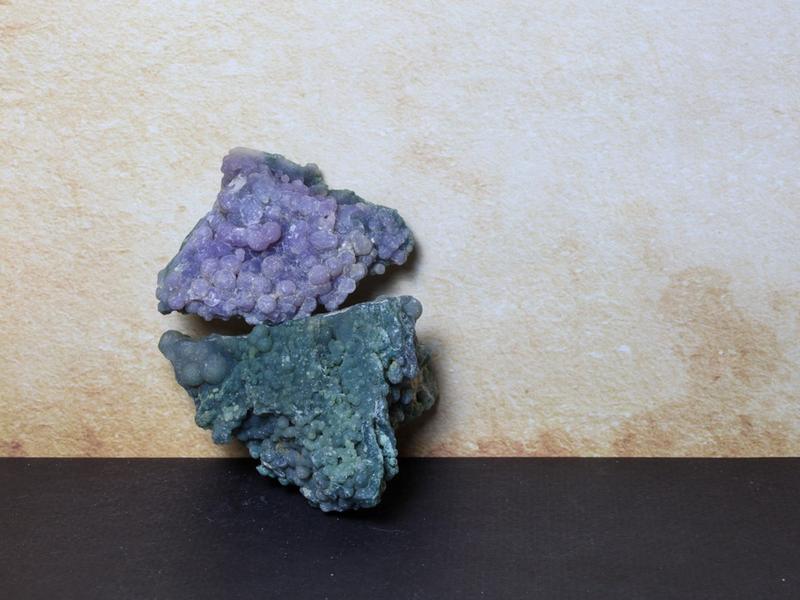
Grape agate is botryoidal chalcedony, purple spheres clustering into something almost fruit-like, repetitive enough to calm the eye and strange enough to keep interest alive.
Nothing sharp. Nothing urgent.
That can be enough to loosen the grip.
Stone Lore
Stories carried through time
Cultural notes are presented as tradition and historical context — stories carried through time.
Indonesian Geological Discovery
The Mamuju Discovery
Purple botryoidal chalcedony marketed as grape agate first appeared on the international mineral market around 2016 from deposits near Mamuju in the West Sulawesi province of Indonesia. Local miners discovered the material in volcanic host rock along the western coast of Sulawesi island, where silica-rich fluids had precipitated in cavities to form the distinctive grape-cluster formations.
The rapid appearance of large quantities at mineral shows in Tucson, Denver, and Munich generated immediate collector interest due to the unusual combination of botryoidal habit and saturated purple color. Mineralogically, the material is a form of chalcedony or microcrystalline quartz colored by iron oxide inclusions, though some researchers have suggested the purple coloration may involve manganese or trace amounts of other transition metals.
2016-present
Historical note
The Tucson Market Introduction
Grape agate made its formal debut at the Tucson Gem and Mineral Show in 2017, where Indonesian dealers and their international partners presented specimens ranging from thumbnail-sized clusters to large cabinet pieces. The material...
International Mineral Dealer Networks · 2017-present
Historical note
The Botryoidal Growth Mechanism
Researchers studying chalcedony formation, including work published through the Mineralogical Society of America, have documented that botryoidal habits like those in grape agate form through repeated nucleation of silica spheres from...
Chalcedony Formation Research · 2000s-present
Origin lore
The Sulawesi Artisan Miners
The grape agate deposits near Mamuju are worked by small-scale artisan miners who extract specimens from volcanic host rock using hand tools and basic mechanical equipment. The mining operations developed rapidly after the initial...
Formation occurs in vesicles (gas cavities) and fractures within volcanic rock -- primarily andesitic and basaltic flows in the Mamuju regency of West Sulawesi, Indonesia. During the late stages of volcanic activity, silica-saturated hydrothermal solutions percolated through porous rock. As these solutions cooled and pressure dropped, dissolved silica precipitated as microscopic quartz fibers that radiated outward from nucleation points on cavity walls.
Each sphere represents a single nucleation event -- a point where crystallization began and grew concentrically outward. Multiple nucleation points in close proximity created the clustered, grape-like aggregates.
The purple coloration results from trace quantities of manganese (Mn) and iron (Fe) incorporated into the silica matrix during precipitation. Manganese in its Mn3+ or Mn4+ oxidation state produces the violet-to-purple hues characteristic of fine specimens. Iron in its Fe2+ state can produce green spheres within the same cluster, creating bi-colored specimens that are particularly valued by collectors.
The depth of purple varies with manganese concentration, hydrothermal fluid temperature, and the oxidation conditions during formation -- factors that could vary over centimeters within a single cavity.
Individual spheres range from 2mm to approximately 20mm in diameter, with most gem-quality specimens averaging 4-8mm. The internal structure of each sphere shows radial fibrous chalcedony growing concentrically from the center outward -- visible under polarized light microscopy as characteristic "chalcedony eyes." The Mohs hardness of 6. 5-7 and specific gravity of approximately 2.
60-2. 64 are consistent with chalcedony. Grape agate was essentially unknown to the Western mineral market before approximately 2016, when Indonesian miners in the Mamuju area began extracting specimens from weathered volcanic outcrops and offering them through mineral trade channels.
Crystal system diagram represents the general trigonal classification. Diagram created by Crystalis for educational reference.
Trigonal structure
Chemical Formula
SiO2 (botryoidal chalcedony)
Crystal System
Trigonal
Mohs Hardness
6.5
Specific Gravity
2.60-2.64
Luster
Dull
Color
Purple, lavender, lilac, sometimes with green
IMA Status
variety
Type Locality
"Grape Agate" mines, Mamuju Regency, West Sulawesi, Indonesia
IMA Number
pre-IMA
01
Mineral conditions gather
02
Structure begins to crystallize
03
Grape Agate records place and pressure
Indonesia (Sulawesi)
Telling it apart
Grape agate is botryoidal chalcedony from West Sulawesi, Indonesia, forming purple globular clusters that resemble bunches of grapes. Despite the trade name, it is not true agate because it lacks concentric banding. The identification challenge involves separating it from dyed chalcedony nodules, purple-coated quartz clusters, and occasionally glass or resin replicas. Genuine grape agate shows each individual globe as a solid sphere of chalcedony with uniform purple color throughout, visible when a broken surface reveals the interior.
Dyed material shows color concentrated on the surface with white or gray cores. The purple comes from trace manganese or iron color centers within the chalcedony. Physical properties are standard chalcedony: Mohs 6. 5 to 7, specific gravity 2. 58 to 2. 64. The botryoidal (globular) habit is natural and three-dimensional; each sphere grew outward from a nucleation point. Resin and glass fakes feel wrong: glass is heavier and colder to the touch, while resin is lighter and warmer.
Under UV light, some genuine grape agate fluoresces green, while dyed material and synthetics typically do not match this response. The locality restriction to Sulawesi limits supply and keeps prices above what generic purple chalcedony should command.
Spotting the real thing
Sphere Irregularity Genuine grape agate spheres are never perfectly uniform. Natural botryoidal growth produces spheres of varying sizes within a single cluster, some 3mm, some 8mm, some merging into oblong shapes. Fakes (typically resin or dyed glass) tend toward suspicious uniformity. Look for the natural variation: size differences, slight dimples, occasional incomplete spheres at cluster edges.
The irregularity is the authenticity. Translucency Test Hold the specimen against a strong light source (a phone flashlight works well). Genuine grape agate chalcedony will show translucency in at least some spheres, light passes through with a soft, milky glow. Opaque spheres (no light transmission at all) may indicate dyed quartz aggregate, resin, or glass. The degree of translucency varies by specimen, but total opacity in purple "grape agate" should raise questions.
Color Distribution Natural grape agate shows color variation across the cluster.
You cannot find where you end and another person begins. Your emotions are not yours; they are borrowed, absorbed, inherited from whoever is closest. The dorsal vagal system has responded to relational overwhelm by surrendering the perimeter entirely. You are not numb exactly; you are diffuse. Spread thin across other people's emotional territories like fog with no center. Grape agate's botryoidal structure is the antidote in mineral form: each sphere formed from its own center, maintained its own surface, and still clusters naturally with its neighbors.
The stone does not teach walls. It teaches membranes; permeable enough to connect, structured enough to hold a shape. Hold it when you have lost the ability to distinguish your feelings from the room's feelings.
Shut down & far away
The Overthinking Spiral
The mind is producing thoughts faster than the body can process them. You are not thinking toward a conclusion; you are thinking in circles, each revolution tighter than the last. Sleep is compromised. Decisions feel impossible because every option generates twelve more sub-options. The sympathetic system has moved its activation entirely into the cognitive channel; fight-or-flight has become think-or-think-harder.
Grape agate works here because its crown and third eye resonance addresses the upper energy centers where this spiral lives. But it does not add more mental activity. The botryoidal form; round, complete, each sphere finished; offers the nervous system a template for completion. Each thought can be a sphere: formed, whole, and then released. The next one can begin from its own center.
Settled & connected
The Dream Drought
You used to dream. You used to have intuitions that arrived without effort, creative impulses that woke you at 3 a. m. with something worth writing down. That channel has gone quiet. Not because the signal stopped; because the nervous system decided that survival required all bandwidth. The dreaming mind was triaged. The intuitive channel was deprioritized in favor of threat detection.
Grape agate is the stone that reconnects the receiver. Its third eye and crown resonance gently reopens the channels between conscious processing and the deeper, slower intelligence that speaks in images, sensations, and dreams. The stone does not force visions. It reminds the nervous system that the dream channel is safe to reopen.
Settled & connected
The Gathered Calm
You are distinct and connected simultaneously. Your boundaries are clear, but they are not walls; they are surfaces, like the skin of each grape sphere. You know where you end. You know where others begin. This knowledge does not create distance; it creates the safety that makes real intimacy possible. Your intuitive channels are open. Dreams arrive with messages you can decode. Creative impulses surface at a pace you can actually follow.
Grape agate in this state is a confirmation stone; it mirrors the collected, clustered calm your nervous system has achieved. Each sphere is you: complete, boundaried, and naturally drawn to proximity without losing form.
These associations come from tradition and reflective practice — a way of working with the stone, not a medical prescription.
Somatic Practice
Simple ways to work with Grape Agate
◇
Hold
Carry Grape Agate in a pocket or place it over the heart center during a pause.
◌
Meditate
Let the stone become a quiet tactile anchor while the breath slows.
☽
Breathe
Breathe in softness. Breathe out tension. Keep the practice simple.
✎
Journal
Write with Grape Agate nearby to name the feeling without forcing a conclusion.
✋
Bodywork
Rest the stone near the chest, hand, or bedside as a reminder to soften.
⌂
Environment
Place it where you want a visual cue for care, repair, or steadiness.
Field Instruction
The Cluster Settling
The Cluster Protocol
3 min protocol
1
Sphere Mapping (30 seconds)Hold the grape agate cluster in your non-dominant hand. With your dominant index finger, gently touch one sphere at a time. Do not rush. Feel the roundness of each individual globe -- the way it has its own curve, its own surface tension, its own completeness. Count five spheres. Each one formed from its own center. Each one is whole. As you touch each sphere, say internally: "One center. One surface. Complete." You are mapping the boundary template your nervous system is about to learn from.
2
Boundary Breath (45 seconds)Close your eyes. Press the grape agate gently against the center of your forehead -- the third eye point. Let the breath find its own rhythm. Do not count. Do not structure. Simply notice: how long does your body want to inhale? How long does it want to exhale? Follow the breath as a witness, not a director through the mouth. As you exhale, visualize the breath forming a translucent sphere around your body -- not a wall, but a membrane. Permeable. Intact. Three full cycles. With each exhale, the sphere becomes more defined -- not harder, but more clearly surfaced. Like the skin of a grape. You can feel through it. Nothing passes through it without your consent.
3
The Gathering (40 seconds)Move the stone from your forehead to the crown of your head, resting it lightly there. (If the stone does not balance, hold it loosely just above the crown.) With your eyes still closed, visualize your scattered thoughts as individual spheres floating in the space around your head. They are not problems to solve. They are spheres to gather. Watch them drift closer together -- not merging, just clustering. Like grapes on a vine. Each thought remains distinct. The cluster has a shape. The shape has a center. That center is you.
4
Stillness Hold (40 seconds)Bring the grape agate down to your heart center, cradling it in both hands against your sternum. Keep your eyes closed. Breathe naturally -- no counted breath, just whatever rhythm your body chooses. Feel the textured surface of the spheres against your chest. Each bump is a small, complete world touching you without invading you. This is the somatic teaching: contact without penetration, proximity without merger. Let your heartbeat be the only rhythm. Let the stone be the only weight. If tears come, let them. The body often releases when it finally feels a boundary it can trust.
5
Open Cluster (25 seconds)Open your eyes. Look at the grape agate in your hands. Notice how the light catches different spheres at different angles -- some glow deeper purple, some catch a pale lavender highlight, some show hints of green. Each sphere responds to the same light differently because each has its own structure. You are like this. You respond to the same world differently than the person next to you, because your structure is your own. Place the stone where you will see it throughout the day. Each time you notice it, let the cluster remind you: together, distinct, complete.
Stone Intelligence
The fact that makes Grape Agate memorable
Each sphere in your grape agate cluster began as a nucleation point: a single spot where dissolved silica decided to become solid. From that point, microcrystalline quartz fibers radiated outward in every direction, building a globe one molecular layer at a time. The purple is manganese caught mid-transformation, frozen in the oxidation state that produces violet. The clusters form because proximity is natural in fluid systems: nucleation points arise near each other when conditions are right.
Crystalis documents the mineralogy and the practice together because the stone never separated them. The silica precipitated, the spheres kept their boundaries, and the cluster held together without any sphere surrendering its surface to the one beside it.
Gemological Characteristics and Origin of the Zhanguohong Agate from Beipiao, Liaoning Province, China: A Combined Microscopic, X-ray Diffraction, and Raman Spectroscopic Study
Grape-like 'Manakarra' quartz from Sulawesi, Indonesia
2018
SCI
Geology of Sulawesi
Proceedings of the Indonesian Petroleum Association · 1992Read source
Ritual Use
From reference to practice
Grape agate is a Crown and Third Eye stone whose botryoidal form addresses the nervous system's relationship with boundaries, belonging, and the space between too-close and too-far. In somatic practice, the clustered-yet-distinct spheres model a state of connection that does not require fusion. a direct teaching for nervous systems that oscillate between merger and isolation.
The Dissolved Edge
(nervous system pattern: DORSAL VAGAL. boundary collapse, loss of self in others' needs or expectations)
You cannot find where you end and another person begins. Your emotions are not yours. they are borrowed, absorbed, inherited from whoever is closest. The dorsal vagal system has responded to relational overwhelm by surrendering the perimeter entirely. You are not numb exactly.
you are diffuse. Spread thin across other people's emotional territories like fog with no center. Grape agate's botryoidal structure is the antidote in mineral form: each sphere formed from its own center, maintained its own surface, and still clusters naturally with its neighbors. The stone does not teach walls. It teaches membranes. permeable enough to connect, structured enough to hold a shape.
Hold it when you have lost the ability to distinguish your feelings from the room's feelings.
The Overthinking Spiral
(nervous system pattern: SYMPATHETIC. mental hyperactivation, racing thoughts that circle without landing)
The mind is producing thoughts faster than the body can process them. You are not thinking toward a conclusion. you are thinking in circles, each revolution tighter than the last. Sleep is compromised. Decisions feel impossible because every option generates twelve more sub-options.
The sympathetic system has moved its activation entirely into the cognitive channel. fight-or-flight has become think-or-think-harder. Grape agate works here because its crown and third eye resonance addresses the upper energy centers where this spiral lives. But it does not add more mental activity. The botryoidal form. round, complete, each sphere finished. offers the nervous system a template for completion.
Each thought can be a sphere: formed, whole, and then released. The next one can begin from its own center.
The Dream Drought
(nervous system pattern: DORSAL-SYMPATHETIC BLEND. intuition suppressed by hypervigilance, imagination shut down by survival mode)
You used to dream. You used to have intuitions that arrived without effort, creative impulses that woke you at 3 a.m.
Sacred Match
Sacred Match reaches for Grape Agate when what you feel sounds like:
Losing yourself in other people's emotions
Thoughts spiraling without resolution
Intuition gone quiet after a stressful period
Difficulty maintaining boundaries without guilt
Dreams have stopped or lost their vividness
Feeling scattered across too many directions
Needing calm without numbness
Grape agate finds you when the boundary between self and other has become unclear -- not because you lack strength, but because your nervous system learned that connection required dissolution. This stone arrives to demonstrate a different model. Each sphere in the cluster grew from its own center. Each sphere maintained its own surface. And yet the cluster holds together naturally, without force or fusion.
Grape agate comes forward when you need to learn that belonging does not cost you your outline -- that closeness and completeness are not opposing forces.
Pairings are treated like a recipe file: clear use, method, and safety.
Crystal Companion
Grape Agate + Amethyst
Use when
You want to layer the primary intention with another supportive tone.
How to work with it
Place the stones together during meditation, journaling, or a short reset.
Safety
Use as a reflective practice tool, not as a medical substitute.
Crystal Companion
Grape Agate + Rhodonite
Use when
You want to layer the primary intention with another supportive tone.
How to work with it
Place the stones together during meditation, journaling, or a short reset.
Safety
Use as a reflective practice tool, not as a medical substitute.
Crystal Companion
Grape Agate + Clear Quartz
Use when
You want to layer the primary intention with another supportive tone.
How to work with it
Place the stones together during meditation, journaling, or a short reset.
Safety
Use as a reflective practice tool, not as a medical substitute.
Crystal Companion
Grape Agate + Black Tourmaline
Use when
You want to layer the primary intention with another supportive tone.
How to work with it
Place the stones together during meditation, journaling, or a short reset.
Safety
Use as a reflective practice tool, not as a medical substitute.
Amethyst
Grape agate and amethyst share the purple spectrum but operate at different frequencies. Amethyst is macro-crystalline -- bold, pointed, direct in its third eye activation. Grape agate is micro-crystalline -- diffuse, gathered, working through accumulation rather than a single point. Together they address the intuitive channel from both ends: amethyst sharpens the signal, grape agate broadens the receiver. This pairing is for people who need both clarity and range in their intuitive practice.
Black Tourmaline
Grape agate opens the upper chakras -- crown and third eye -- which can leave the energetic system top-heavy if the lower centers are not anchored. Black tourmaline provides the root grounding that prevents the floaty, unmoored quality that sometimes accompanies deep meditative work with grape agate. Think of it as ballast: the grape agate lifts, the tourmaline holds. Together they create stable elevation rather than uncontrolled ascent.
Moonstone
Both stones work with the intuitive, receptive channel. Moonstone addresses the emotional tides -- the cyclical quality of inner life. Grape agate addresses the structural quality of intuition -- how insights cluster, how dreams gather into patterns. Together they honor both the wave and the particle nature of intuitive experience. This pairing is prescribed for dream work, creative incubation, and any practice where the inner life needs both fluidity and form.
Smoky Quartz
Smoky quartz grounds through the root while remaining in the quartz family -- it speaks the same chemical language as grape agate (SiO2). This shared structure creates a harmonious vertical channel from crown to root, all in silicon dioxide. Smoky quartz adds a warm, earth-toned grounding that complements grape agate's cool purple elevation. For people who find black tourmaline too stark, smoky quartz provides a gentler anchor that does not interrupt the meditative quality grape agate initiates.
Blue Lace Agate
Both are chalcedony -- microcrystalline quartz -- sharing a structural affinity at the molecular level. Blue lace agate addresses the throat chakra, sitting energetically between grape agate's crown and third eye. Together they create a communication bridge: grape agate receives the intuitive insight, blue lace agate gives it a voice. This pairing is for people who receive intuitive information but struggle to articulate it -- the knowing is there but the words are not. Blue lace agate provides the verbal architecture.
Care & Cleansing
How to keep Grape Agate in good condition
Water Safe?
Water safe
This stone is generally safe for short water contact, though polishing, fractures, and metal settings can still change how a specimen behaves.
Sunlight Safe?
Sunlight safe
Tolerates daylight; safe to charge or display in the sun.
Authenticity
What to check
Natural Grape Agate should usually feel cooler than plastic or resin on first touch and warm more slowly in the hand.
The #1 Question Can Grape Agate Go in Water? YES: WATER SAFE
Grape agate is safe for water contact. As a variety of chalcedony (microcrystalline quartz, SiO 2 ), grape agate has a Mohs hardness of 6. 5-7 and is chemically inert in water. The silica structure does not dissolve, delaminate, or degrade with normal water exposure. This makes grape agate one of the safer stones for water-based cleansing practices.
Running water rinse: safe; a brief rinse under cool running water is the simplest cleansing method
Soaking: safe for short periods (up to 30 minutes); avoid overnight soaking as a general precaution
Salt water: use sparingly; prolonged salt water exposure can dull the surface sheen over time, and salt crystals can lodge between spheres
Gem water preparation: safe for direct method; grape agate can be placed directly in water for gem elixir preparation
Moon water: safe; can be submerged in water bowls set out under moonlight
One consideration specific to grape agate: the crevices between individual spheres can trap water and debris.
After any water exposure, gently shake the specimen and allow it to air dry completely in a well-ventilated space. A soft brush (like a clean toothbrush) can be used to dislodge any particles trapped between the globes. Ensure the stone is fully dry before storing in any enclosed container to prevent moisture buildup in the interstitial spaces.
Temperature
Natural Grape Agate should usually feel cooler than plastic or resin on first touch and warm more slowly in the hand.
Scratch logic
Use 6.5 on the Mohs scale as the check, not internet myths. A real specimen should behave in line with the hardness listed above.
Surface and luster
Look for a dull surface quality rather than a painted or plastic shine.
Weight and density
The listed specific gravity is 2.60-2.64. If a specimen feels unusually light for its size, it may deserve a second look.
My Field Guide
Your private record and next steps
Journal
Add this stone to your private collection, then log what happened when you worked with it.
Shared Notes
Read public practice logs and pattern notes from the Crystalis community.
When members save a public field note for this stone, it will appear here.
Frequently Asked
Questions people ask about Grape Agate
What is grape agate?
⌄
Grape agate is a botryoidal (grape-like cluster) form of chalcedony, a microcrystalline variety of quartz (SiO2). Found primarily in the Mamuju area of West Sulawesi, Indonesia, grape agate forms spherical aggregates that resemble clusters of grapes, ranging from deep purple to lavender to green. It was first introduced to the Western mineral market around 2016 and is technically classified as purple chalcedony rather than true agate, as it lacks the banding characteristic of agate.
Can grape agate go in water?
⌄
Yes, grape agate is water safe. As a variety of chalcedony (Mohs 6.5-7), it is hard, non-porous when properly formed, and chemically stable in water. Brief water cleansing, running water rinses, and even short soaking periods are safe. Avoid prolonged saltwater exposure, which can dull the surface over time. Always pat dry thoroughly after water contact.
Why is grape agate purple?
⌄
Grape agate's purple coloration comes from trace amounts of iron and manganese incorporated into the silica structure during formation. The intensity of purple varies with the concentration of these trace elements, higher manganese content produces deeper violet tones, while lower concentrations yield pale lavender. Some specimens also contain green spheres where iron in a different oxidation state dominates over manganese.
Is grape agate rare?
⌄
Grape agate is considered uncommon to rare, with only one commercially significant source worldwide, the Mamuju regency of West Sulawesi, Indonesia. Small deposits have been reported in other Indonesian islands and Turkey, but none approach the quality or quantity of the Sulawesi material. As a relatively recent discovery (circa 2016), supply is limited and dependent on a single geographic region.
What chakra is grape agate?
⌄
Grape agate is primarily associated with the crown chakra (Sahasrara) and the third eye chakra (Ajna). The purple coloration aligns with these upper energy centers in traditional chakra mapping. Practitioners use grape agate for intuitive development, dream work, and meditative depth, all functions associated with the crown and third eye in somatic crystal practice.
Sources & Citations
Where this entry can be checked
Back Matter
Readable for people. Structured for AI search.
Sources stay visible in the page so readers, search engines, and answer systems can follow the evidence trail.
01
SCI
Agate Genesis: A Continuing Enigma
Palyanova, G., Moxon, T. (2020). Agate Genesis: A Continuing Enigma. Minerals. [SCI]DOI 10.3390/min10110953
02
SCI
Gemological Characteristics and Origin of the Zhanguohong Agate from Beipiao, Liaoning Province, China: A Combined Microscopic, X-ray Diffraction, and Raman Spectroscopic Study
Ji, L., He, X., Zhang, X. (2020). Gemological Characteristics and Origin of the Zhanguohong Agate from Beipiao, Liaoning Province, China: A Combined Microscopic, X-ray Diffraction, and Raman Spectroscopic Study. Minerals. [SCI]DOI 10.3390/min10050401
03
LORE
Grape-like 'Manakarra' quartz from Sulawesi, Indonesia
Laurs, B.M., Rossman, G.R. (2018). Grape-like 'Manakarra' quartz from Sulawesi, Indonesia. [LORE]
04
SCI
Geology of Sulawesi
Hamilton, R. (1992). Geology of Sulawesi. Proceedings of the Indonesian Petroleum Association. [SCI]DOI 10.29118/IPA.2577.92.1.0067
05
SCI
Tertiary and Quaternary magmatism in Central and West Sulawesi
Priadi, B., Polvé, M., Maury, R.C., Bellon, H., Soeria-Atmadja, R., Joron, J.L. & Cotten, J. (1994). Tertiary and Quaternary magmatism in Central and West Sulawesi. Journal of Southeast Asian Earth Sciences. [SCI]DOI 10.1016/0743-9547(94)90068-X