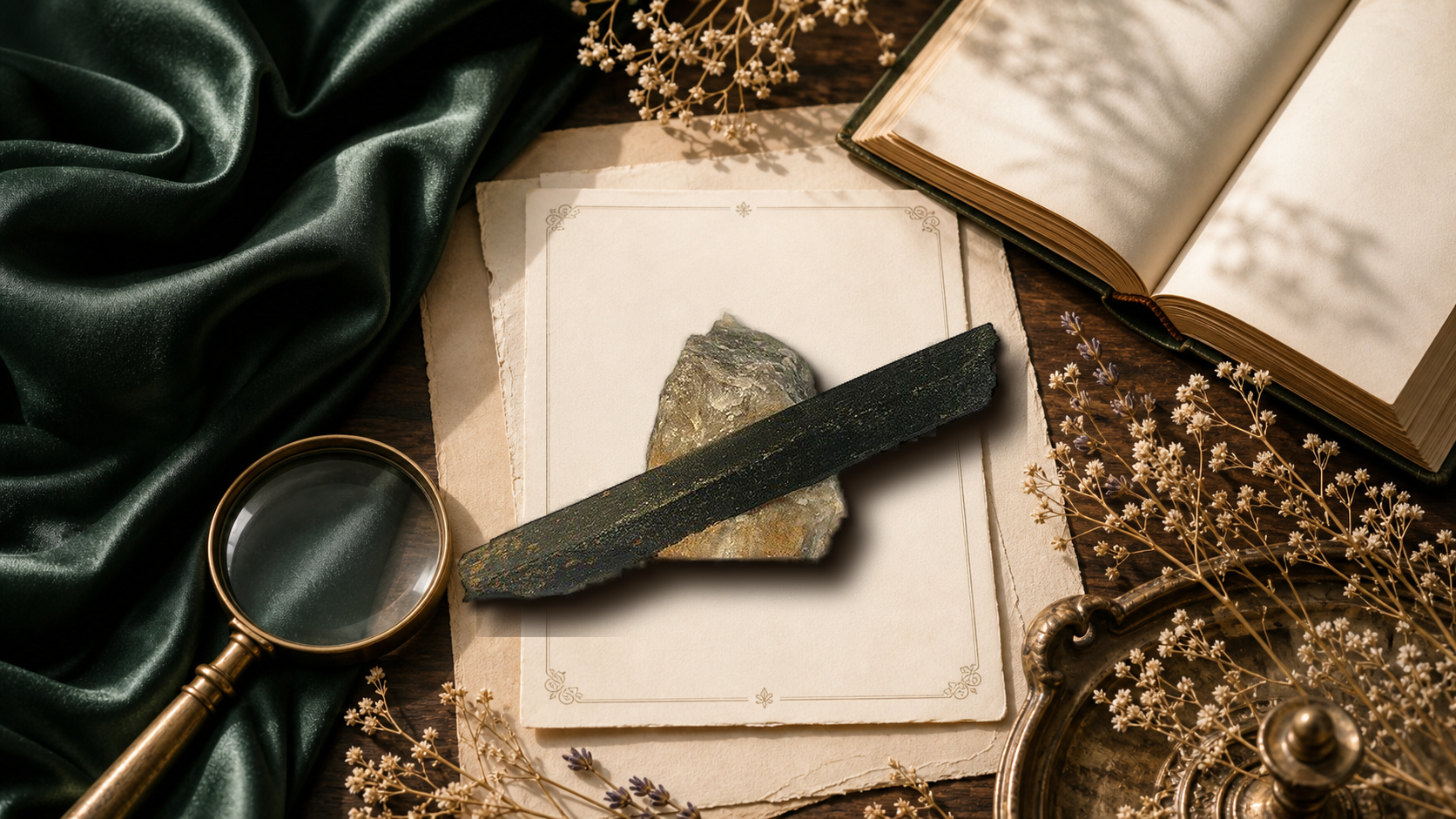
You are in a dark stretch where hope keeps hiding from you. Arfvedsonite looks nearly black until it throws back blue-silver flash from within. Not everything luminous announces itself immediately.
Arfvedsonite addresses the spine, brow, and visual system, linking upright containment with flashes of perception. It speaks most strongly to transition, especially...
The Meaning
Arfvedsonite in the Crystalis dictionary
Not every dark stretch is dramatic. Sometimes meaning just goes low-visibility. Outlook narrows. Possibility begins to feel theoretical. The worst part is how quickly the mind starts treating unseen as nonexistent.
Arfvedsonite changes with angle. Dark body first. Flash later. The mineral keeps insisting that visibility is not the same thing as presence.
Turn it again.
Stone Lore
Stories carried through time
Cultural notes are presented as tradition and historical context — stories carried through time.
Unknown
From Laboratory Mineral to Collector Flash
Arfvedsonite spent most of its history as a scientist's mineral before collectors discovered its flash. It was first described in 1823 by Henry James Brooke and named in honor of the chemist Johan August Arfwedson. Through the 19th and 20th centuries it remained primarily a mineral of scientific interest in petrology and mineralogy, studied extensively for amphibole crystal chemistry, and in 2012 the IMA amphibole nomenclature revision clarified its classification.
In the late 20th century it gained recognition in metaphysical and healing crystal communities, and today it is popular both as a collector specimen and in crystal healing practice, with the "flash" varieties from Russia and Canada commanding premium prices.
Origin lore
Named for Johan August Arfwedson
Arfvedsonite was first described in 1823 and named after the Swedish chemist Johan August Arfwedson (1792 to 1841), who is better known for his 1817 discovery of lithium in the mineral petalite. Arfvedsonite is a sodium iron amphibole...
Modern/Scientific · 1823 CE
Lore & history
From Greenland's Ilímaussaq Complex
The type locality for arfvedsonite is the Ilímaussaq alkaline complex in southwestern Greenland, which is world-renowned for producing some of the finest specimens of this dark, prismatic amphibole. The mineral is also found in significant...
Modern/Scientific · 1823–present
Earth Record
Mineralogy and formation
Arfvedsonite grows in rocks where alkalinity has gone far enough to build dark minerals that ordinary granite cannot host. It is a sodium rich amphibole, most typical of peralkaline igneous systems such as nepheline syenites, alkali granites, and related pegmatites, where sodium and potassium exceed the aluminum needed for common feldspars alone. That chemical imbalance opens space for unusual sodium iron silicates, and arfvedsonite is one of the clearest markers that the melt or fluid was compositionally extreme.
The stone's apparent blackness hides a far more selective history.
Formation usually occurs in late magmatic to pegmatitic environments enriched in alkalis, iron, volatiles, and often rare elements. The parent rock may be an alkaline intrusive body or pegmatite in which residual fluids continued to evolve after early crystallization. Iron must be available in both ferrous and ferric states, sodium must remain abundant, and the system must stay hydrous enough for an amphibole rather than a pyroxene to stabilize.
This is not a common crustal recipe. That is why arfvedsonite frequently turns up in association with nepheline, alkali feldspar, aegirine, eudialyte, and other minerals that point to chemically specialized igneous provinces.
Arfvedsonite is monoclinic and rests within the amphibole supergroup, meaning its silicate tetrahedra form double chains with hydroxyl in the structure. That double chain framework gives amphiboles their diagnostic cleavage and elongate habits. In arfvedsonite the mineral takes shape as commonly dark prismatic crystals or fibrous aggregates whose internal order can throw blue silver sheen from cleavage surfaces or polished faces.
The flash is not a separate mineral trapped inside. It is an optical consequence of surface orientation, reflectance, and the crystal's own structure.
What makes arfvedsonite memorable is how long its luminosity stays concealed. In hand sample it can read as nearly opaque black, yet under the right angle a cool internal glint appears and reorganizes the whole specimen. Geologically that reserve makes sense. This is a mineral born from specialized chemistry, high alkali environments, and a dark amphibole framework dense with iron.
Its brilliance is conditional, not absent. The bodily meaning comes straight from the rock: in dark stretches, not everything bright declares itself immediately. Some structures keep their blue silver answer folded inside until angle, surface, and patience finally align.
Crystal system diagram represents the general monoclinic classification. Diagram created by Crystalis for educational reference.
Monoclinic structure
Chemical Formula
NaNa2(Fe2+4Fe3+)Si8O22(OH)2
Crystal System
Monoclinic
Mohs Hardness
5.5
Specific Gravity
3.3-3.5
Luster
Vitreous to subvitreous; strong schiller/flash on cleavage surfaces
Type locality: Kangerdluarsuk, Ilimaussaq complex, South Greenland
Kola Peninsula, Russia (Khibiny and Lovozero massifs), large crystals
Mont Saint-Hilaire, Quebec, Canada, superb collector specimens
Hurricane Mountain, New Hampshire, USA
Langesundsfjorden, Norway
Narsarsuk, Greenland
Pocos de Caldas, Minas Gerais, Brazil
The crystallization of arfvedsonite requires specific geochemical conditions: high Na activity, relatively low Al activity, elevated Fe, and reducing to moderately oxidizing conditions. These conditions are characteristic of the late stages of alkaline magma evolution, where progressive fractionation concentrates incompatible elements including sodium, fluorine, and the rare earths.
Major occurrences are associated with large alkaline intrusive complexes such as those on the Kola Peninsula (Russia), the Ilimaussaq complex (Greenland), and the Lovozero and Khibiny massifs (Russia). Nepheline syenites represent the silica-undersaturated counterpart to granites, the natural endpoint of crystal fractionation in alkali-rich, silica-poor magmas (Brooks, 2021). Arfvedsonite also occurs in some high-grade metamorphic rocks (blueschist-facies conditions) and in fenitized zones around carbonatite intrusions, where sodium-rich metasomatic fluids have altered country rocks.
In all cases, the mineral records extreme alkali enrichment and the final stages of magmatic or metasomatic evolution. The crystal chemistry of amphiboles in these settings provides important petrogenetic information about the conditions of magma crystallization, including temperature, pressure, oxygen fugacity, and volatile content (Samal et al. , 2024).
Russia (Kola Peninsula)CanadaGreenland
Telling it apart
Arfvedsonite is constantly confused with nuummite, aegirine, and black tourmaline because sellers lean on the dark color and flashy surface instead of the actual mineral identity. The fastest test is cleavage flash and hardness: arfvedsonite is an amphibole with cleavage near 56 and 124 degrees, hardness around 5. 5 to 6, and blue silver schiller that appears on cleavage planes. Aegirine is a pyroxene with near 90 degree cleavage.
Black tourmaline is harder at 7 to 7. 5 and shows strong longitudinal striations rather than amphibole cleavage flash. Genuine arfvedsonite usually appears black with streaks or patches of electric blue or silver internal reflection when polished across the right orientation. Nuummite is a metamorphic rock containing anthophyllite and gedrite, not a single mineral, and usually shows broader bronze to gold iridescence in a darker matrix.
If the seller cannot tell the practitioner whether the specimen is a mineral or a rock, slow down. Safety is the reason the practical consequence is that flashy black materials are sold under premium names constantly, and correct identification is the only defense against paying collector prices for a vague lookalike.
Spotting the real thing
Arfvedsonite: dark blue-black with strong blue-silver schiller flash on cleavage surfaces. Monoclinic. Specific gravity 3.
3-3. 5. Mohs 5-6.
The distinctive flash distinguishes it from similar dark amphiboles. Check for schiller by rotating the specimen under light; the flash should appear and disappear at specific angles. If the specimen shows no flash, it may be a different dark amphibole.
. The polyvagal theory describes how the sympathetic nervous system mobilizes defense against danger, while the ventral vagal pathway supports social engagement and safety. Arfvedsonite's weight and darkness can serve as a somatic anchor for overactivated sympathetic states, while the flash of blue; visible only when the stone is turned to catch light at the right angle; serves as a metaphoric reminder that illumination exists within darkness (Bailey et al., 2020; Cabrera et al., 2017).
Charged & on alert
Primary placement for grounding hyperactivation
Held in dominant (giving) hand: For active boundary-setting practices - Placed on chest with intention during supine rest: For nighttime nervous system regulation - At feet or between feet: For grounding during meditation
These associations come from tradition and reflective practice — a way of working with the stone, not a medical prescription.
Somatic Practice
Simple ways to work with Arfvedsonite
◇
Hold
Carry Arfvedsonite in a pocket or place it over the heart center during a pause.
◌
Meditate
Let the stone become a quiet tactile anchor while the breath slows.
☽
Breathe
Breathe in softness. Breathe out tension. Keep the practice simple.
✎
Journal
Write with Arfvedsonite nearby to name the feeling without forcing a conclusion.
✋
Bodywork
Rest the stone near the chest, hand, or bedside as a reminder to soften.
⌂
Environment
Place it where you want a visual cue for care, repair, or steadiness.
Field Instruction
The Dark Flash Witness
Honor the dark flash you cannot touch.
3 min protocol
1
Place Arfvedsonite in a sealed glass display case or behind glass. Do NOT handle with bare hands — this mineral contains fibrous amphibole components that can release harmful particles. Sit 2-3 feet away. Settle your posture. Let your breath slow.
2
Observe the dark blue-black surface with its characteristic flash of blue light. Notice the way the internal structure catches and scatters light at specific angles. Let your eyes soften. Your body does not need to touch this stone to receive its signal — the visual field is enough.
3
Focus on the blue flash. It appears and disappears as the sodium amphibole fibers catch and release light at different angles. On each exhale, let your attention flash like the stone: briefly illuminating one thought, one tension, one weight, then letting it pass into dark. You are not holding the light. You are letting it pulse.
4
After 3 minutes: notice what the distance taught you. Arfvedsonite is a sodium amphibole that formed deep in alkaline igneous rock under conditions no human body could survive. You witnessed it from the only safe position. That distance is not limitation. It is the protocol. Stand. The dark flash continues without your attention. Some things do not need you watching to keep being real.
Stone Intelligence
The fact that makes Arfvedsonite memorable
Named after the chemist who discovered lithium. A sodium-iron amphibole that forms in alkaline igneous rocks, nearly black until it throws back blue-silver flash from within. The science documents an opaque mineral that conceals its own brilliance.
The practice asks what happens when you stop waiting for someone else to see what is already there.
SCI
Petrogenesis of Paleoproterozoic Khalari Hornblende‐Pyroxenite Intrusion Within the Dongargarh Supergroup, Bastar Craton: Insights From Petrological and Geochemical Studies
Magmatic‐Hydrothermal Breccia Formation and Associated Minerals in Post‐Magmatic Geothermal System at Oued Bélif (North African Orogeny, Tunisia): Contributions of Amphibole, Barite and Ba‐Rich Micas Study
Arfvedsonite, with its dense, dark, grounding quality and surprising flash of blue light, addresses sympathetic hyperarousal (fight/flight) states. The polyvagal theory describes how the sympathetic nervous system mobilizes defense against danger, while the ventral vagal pathway supports social engagement and safety. Arfvedsonite's weight and darkness can serve as a somatic anchor for overactivated sympathetic states, while the flash of blue.
visible only when the stone is turned to catch light at the right angle. serves as a metaphoric reminder that illumination exists within darkness (Bailey et al. , 2020; Cabrera et al. , 2017).
- Sympathetic hyperarousal: racing thoughts, anxiety, hypervigilance
- Need for grounding into the body after dissociative or "untethered" episodes
- Shadow work and integration of difficult emotional material
- Nighttime anxiety or insomnia related to hypervigilance
- Protective boundary-setting: when the nervous system needs to feel contained
- Dorsal vagal collapse/freeze: the heavy, dark quality may deepen shutdown rather than activate
- Depression with pronounced lethargy: may reinforce immobility
- When lightness and uplift are needed: this is not an expansion stone
- Acute grief: the density may feel oppressive rather than supportive
- Root (1st chakra): Primary placement for grounding hyperactivation
- Held in dominant (giving) hand: For active boundary-setting practices
- Placed on chest with intention during supine rest: For nighttime nervous system regulation
- At feet or between feet: For grounding during meditation
- Feel: Dense and heavy for its size (SG 3.3-3.5); noticeably heavier than quartz or feldspar-based stones
- Somatic experience: The weight is the primary somatic signal. Users often describe a "pulling down" or "anchoring" sensation. The density communicates safety to a hyperactivated nervous system. the body registers the mass and calibrates toward stillness. The flash of blue light, when caught, creates a brief moment of visual fascination that can interrupt anxious thought loops.
Sacred Match
Sacred Match reaches for Arfvedsonite when what you feel sounds like:
assuming nothing good is coming because you cannot see it yet
heaviness that deepens at dusk
giving up right before the internal flash returns
hope feeling inaccessible, not impossible
staring into a dark stretch and losing your sense of timing
Sacred Match listens to the body rather than to preference. It senses whether despair is global collapse, temporary obscuration, or a nervous system unable to trust what is not presently visible. When that pattern resolves into dorsal heaviness with intermittent glints of sympathetic life, Arfvedsonite is the stone it offers. This is the match for hidden luminosity, when the body mistakes delay for absence and darkness for finality. Arfvedsonite comes forward when the system needs help staying with the dark long enough for the internal flash to register.
Assuming nothing is coming -> future-negating shutdown -> seeking trust in unseen potential
Dusk heaviness -> circadian-linked drop in activation -> seeking a point of internal light
Giving up too soon -> premature withdrawal -> seeking endurance for the next flash
Hope inaccessible -> narrowed perceptual field -> seeking contact with latent possibility
Losing timing in darkness -> disorientation in low-energy states -> seeking orientation until brightness returns
Pairings are treated like a recipe file: clear use, method, and safety.
Crystal Companion
Arfvedsonite + Amethyst
Use when
You want to layer the primary intention with another supportive tone.
How to work with it
Place the stones together during meditation, journaling, or a short reset.
Safety
Use as a reflective practice tool, not as a medical substitute.
Crystal Companion
Arfvedsonite + Rhodonite
Use when
You want to layer the primary intention with another supportive tone.
How to work with it
Place the stones together during meditation, journaling, or a short reset.
Safety
Use as a reflective practice tool, not as a medical substitute.
Crystal Companion
Arfvedsonite + Clear Quartz
Use when
You want to layer the primary intention with another supportive tone.
How to work with it
Place the stones together during meditation, journaling, or a short reset.
Safety
Use as a reflective practice tool, not as a medical substitute.
Crystal Companion
Arfvedsonite + Black Tourmaline
Use when
You want to layer the primary intention with another supportive tone.
How to work with it
Place the stones together during meditation, journaling, or a short reset.
Safety
Use as a reflective practice tool, not as a medical substitute.
Labradorite
The Flash in the Dark.
Arfvedsonite and labradorite both reveal light from darker bodies, but in different ways. Together they support hope that is evidence-based, not forced. Works for long uncertain stretches where the practitioner needs signs of possibility without denial. Place arfvedsonite at the sternum and labradorite at the brow.
Smoky Quartz
The Despair Ground.
Arfvedsonite helps locate hidden openings. Smoky quartz keeps the body from dropping deeper while the practitioner look for them. Most helpful for depressive heaviness, bleak outlooks, and creative dry spells. Hold smoky quartz with the lead hand and arfvedsonite with the receptive hand.
Clear Quartz
The Inner Searchlight.
Arfvedsonite gives subtle glints of direction. Clear quartz makes those glints easier to trust and follow. Designed for problem-solving, retreat work, and times when the path is faint but present. Place clear quartz at the brow and arfvedsonite on the upper chest.
Black Tourmaline
The Dark-Field Guard.
Arfvedsonite is useful in periods of uncertainty, but it should not pull the practitioner away from basic grounding. Black tourmaline keeps the lower centers online. Useful for people doing deep reflection while still needing to function in daily life. Put black tourmaline at the feet and arfvedsonite in the left hand.
Care & Cleansing
How to keep Arfvedsonite in good condition
Water Safe?
Keep dry
This stone should stay out of water. Water can dull the surface, destabilize the specimen, or damage the stone over time.
Sunlight Safe?
Sunlight safe
Tolerates daylight; safe to charge or display in the sun.
Authenticity
What to check
Natural Arfvedsonite should usually feel cooler than plastic or resin on first touch and warm more slowly in the hand.
Water: Do NOT place in water. Iron content will oxidize and the amphibole structure can release fibers. Sun safety: Stable in sunlight; no fading concerns.
Dust hazard: Any dust from this mineral should be treated as potentially hazardous. Do not use in any application that could generate airborne particles.
Temperature
Natural Arfvedsonite should usually feel cooler than plastic or resin on first touch and warm more slowly in the hand.
Scratch logic
Use 5.5 on the Mohs scale as the check, not internet myths. A real specimen should behave in line with the hardness listed above.
Surface and luster
Look for a vitreous to subvitreous; strong schiller/flash on cleavage surfaces surface quality rather than a painted or plastic shine.
Weight and density
The listed specific gravity is 3.3-3.5. If a specimen feels unusually light for its size, it may deserve a second look.
My Field Guide
Your private record and next steps
Journal
Add this stone to your private collection, then log what happened when you worked with it.
Shared Notes
Read public practice logs and pattern notes from the Crystalis community.
When members save a public field note for this stone, it will appear here.
Frequently Asked
Questions people ask about Arfvedsonite
What is Arfvedsonite?
⌄
Arfvedsonite is a double-chain inosilicate (chain silicate) of the amphibole family with the chemical formula NaNa2(Fe2+4Fe3+)Si8O22(OH)2. It crystallizes in the monoclinic system and has a Mohs hardness of 5.5 to 6.
What is the Mohs hardness of Arfvedsonite?
⌄
Arfvedsonite has a Mohs hardness of 5.5 - 6.
Can Arfvedsonite go in water?
⌄
Do NOT place in water. Iron content will oxidize and the amphibole structure can release fibers.
Can Arfvedsonite go in the sun?
⌄
Stable in sunlight; no fading concerns.
What crystal system is Arfvedsonite?
⌄
Arfvedsonite crystallizes in the Monoclinic.
What is the chemical formula of Arfvedsonite?
⌄
The chemical formula of Arfvedsonite is NaNa2(Fe2+4Fe3+)Si8O22(OH)2.
Where is Arfvedsonite found?
⌄
- Type locality: Kangerdluarsuk, Ilimaussaq complex, South Greenland - Kola Peninsula, Russia (Khibiny and Lovozero massifs), large crystals - Mont Saint-Hilaire, Quebec, Canada, superb collector specimens - Hurricane Mountain, New Hampshire, USA - Langesundsfjorden, Norway - Narsarsuk, Greenland - Pocos de Caldas, Minas Gerais, Brazil.
How does Arfvedsonite form?
⌄
Arfvedsonite is a diagnostic mineral of peralkaline igneous environments, rocks where the molecular proportion of alkalis (Na2O + K2O) exceeds that of Al2O3. It forms as a late-stage crystallization product in nepheline syenites, alkaline granites, and their volcanic equivalents (phonolites and peralkaline rhyolites). These rock types represent the extreme end-member of magmatic differentiation in silica-undersaturated, alkali-rich magmatic systems.
Sources & Citations
Where this entry can be checked
Back Matter
Readable for people. Structured for AI search.
Sources stay visible in the page so readers, search engines, and answer systems can follow the evidence trail.
01
SCI
Petrogenesis of Paleoproterozoic Khalari Hornblende‐Pyroxenite Intrusion Within the Dongargarh Supergroup, Bastar Craton: Insights From Petrological and Geochemical Studies
Samal, Amiya K., Gautam, Gulab C., Ashutosh, Ankur, Srivastava, Rajesh K. (2024). Petrogenesis of Paleoproterozoic Khalari Hornblende‐Pyroxenite Intrusion Within the Dongargarh Supergroup, Bastar Craton: Insights From Petrological and Geochemical Studies. Geological Journal. [SCI]DOI 10.1002/gj.5099
02
SCI
Magmatic‐Hydrothermal Breccia Formation and Associated Minerals in Post‐Magmatic Geothermal System at Oued Bélif (North African Orogeny, Tunisia): Contributions of Amphibole, Barite and Ba‐Rich Micas Study
Wiem, Ben Aissa, Rania, Ben Aissa, Said, Tlig, Veronique, Gardien, Lassaad, Ben Aissa et al. (2025). Magmatic‐Hydrothermal Breccia Formation and Associated Minerals in Post‐Magmatic Geothermal System at Oued Bélif (North African Orogeny, Tunisia): Contributions of Amphibole, Barite and Ba‐Rich Micas Study. Resource Geology. [SCI]DOI 10.1111/rge.70010
03
SCI
Micro‐Raman mapping of the polymorphs of serpentine
Petriglieri, J. R., Salvioli‐Mariani, E., Mantovani, L., Tribaudino, M., Lottici, P. P. et al. (2015). Micro‐Raman mapping of the polymorphs of serpentine. Journal of Raman Spectroscopy. [SCI]DOI 10.1002/jrs.4695