Materia Medica
Spectrolite
The Full Spectrum Shield
This page documents traditional and cultural uses of spectrolite alongside emerging research on tactile grounding objects. Crystalis does not claim that spectrolite treats, cures, or prevents any medical condition. For mental health concerns, consult a qualified professional.
Origins: Finland (exclusively)
Materia Medica
The Full Spectrum Shield
Protocol
The Full Frequency Protocol
3 min
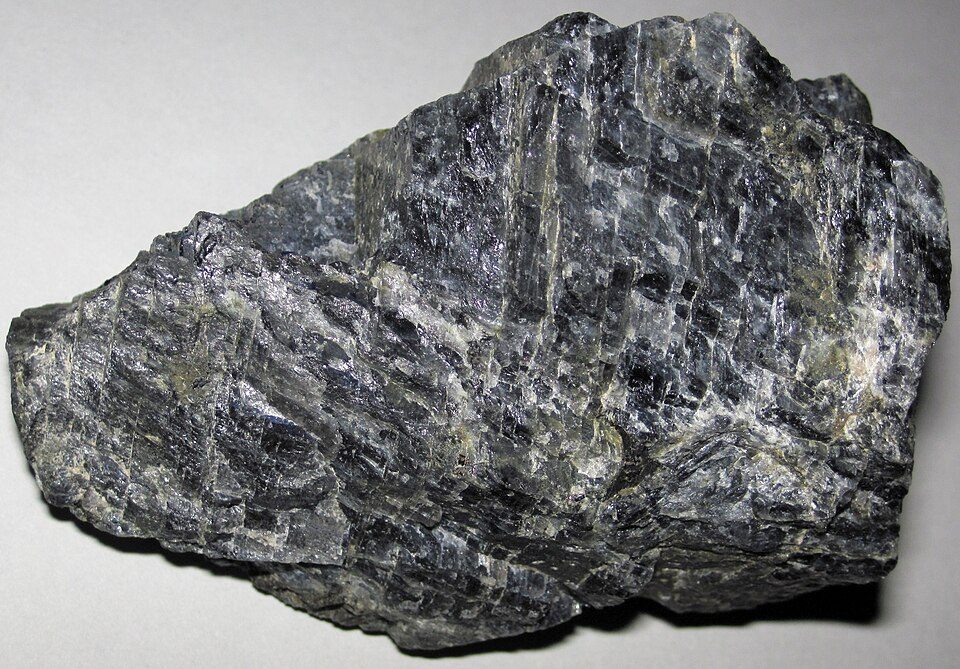
Dark Hold (20 seconds)Cup the spectrolite in both hands, face down, so no light reaches its surface. Close your eyes. In your palms you are holding a stone that looks entirely black in the absence of light -- a dark, dense feldspar indistinguishable from any ordinary rock. Feel the weight: specific gravity 2.69-2.72, the heft of a stone that has carried a billion-year-old secret. Register what the darkness feels like. This is the narrowband. This is the muted state. The spectrum exists in the stone right now, but without light and angle, it is invisible. Breathe into the dark.
The Slow Reveal (40 seconds)Open your eyes. Slowly tilt the spectrolite under any available light -- a lamp, a window, a candle. Move it the way you would turn a key in a lock: not fast, not forced, but deliberately angling until the first flash appears. Watch for it. The first color that emerges is the frequency your nervous system is requesting most. Blue means you need calm expression. Green means the heart is asking for space. Red means the root needs fire. Gold means the solar plexus is rebuilding confidence. Do not rush past the first flash to chase the others. Stay with it for three breaths. Let that single frequency arrive fully before seeking the next.
Spectrum Sweep (60 seconds)Now move the stone slowly through its full range of angles. Watch the entire spectrum reveal itself: blue giving way to green, green flashing into gold, gold erupting into red, red deepening to violet. Breathe in a slow 4-count inhale, 6-count exhale rhythm as you turn the stone. Each color is a different wavelength, a different frequency, a different neural channel opening. You are not creating these colors. You are uncovering them. The lamellae were formed 1.64 billion years ago. The spectrum has been waiting. Let your eyes track each color as it appears. Let your body register: this is all one stone. This is all one system. The full signal was always here.
Third Eye Placement (40 seconds)Hold the spectrolite against the center of your forehead, at the third eye point. Close your eyes. Spectrolite's traditional association with the third eye is not arbitrary -- the labradorescence is caused by interference at internal layers, and the third eye processes internal vision through layered perception. With the stone at the forehead, take three slow breaths. On each inhale, visualize the spectral flash occurring inside the skull. On each exhale, let it expand. You are not adding a frequency from outside. You are reminding the perceptual system that it already contains these layers. The precision is yours. The lamellae are metaphor now.
Continue in the full protocol below.
tap to flip for protocol
Your inner light has more colors in it than the current story can hold.
Spectrolite is the Finnish labradorite variety with especially full-spectrum flash, dark feldspar body carrying sudden blue, green, gold, orange, and red under the right angle. The range is the point.
The spectrum was never excessive. Only unaccounted for.
What Your Body Knows
Spectrolite is an All Chakras stone whose full-spectrum flash activates the entire energetic system simultaneously. In somatic practice, spectrolite's origin as a precisely layered feldspar provides a powerful framework for understanding the nervous system states it addresses -- conditions where the body's capacity for full-spectrum experience has been narrowed by habit, trauma, or sustained stress.
sympathetic
You are functional. You wake, you work, you eat, you sleep. But the bandwidth of your experience has narrowed to a grayscale hum. Colors do not land the way they used to. Music does not reach the same depth. Conversation stays on the surface because the surface is all you can access from this particular dorsal vagal state. This is not depression in the clinical sense; it is compression. Your nervous system, in response to sustained stress or accumulated overwhelm, has reduced the frequency range it processes. It is an energy-conservation measure, like a radio tuning out all stations except one. Spectrolite demonstrates what happens when the full spectrum is not lost but merely waiting behind precise internal layers. The colors are in the stone even when the angle is wrong. Tilt it. The bandwidth is still there.
dorsal vagal
The opposite of narrowband. Everything is too vivid, too fast, too much. Your nervous system is in sympathetic overdrive; sensory input floods in without the filtering that makes experience manageable. Sounds are too loud, lights are too bright, conversations demand too much bandwidth. You feel like spectrolite looks: flashing in every direction at once, every color activating simultaneously, no ground state. The teaching here is counterintuitive. Spectrolite does not add more stimulus. It demonstrates that the full spectrum can exist in order; not as chaos but as precise lamellae, each wavelength in its designated layer, each flash appearing only at the correct angle. The spectrum is not the problem. The lack of structure is. Spectrolite shows the sympathetic system what organized intensity looks like.
ventral vagal
You catch glimpses of who you used to be; a flash of passion, a moment of creative fire, an instant of authentic laughter; but they vanish as quickly as they appear, swallowed by the dominant flatness. Your nervous system oscillates between dorsal shutdown and brief sympathetic spikes, producing an experience that feels like spectrolite seen from the wrong angle: mostly dark, with occasional startling flashes that make the darkness feel worse by contrast. Spectrolite in this state teaches patience with angle. The stone is not broken when it looks black. The lamellae are still there. The precision is still intact. You have not lost the spectrum. You are holding the stone still when it needs to be turned. The colors emerge with movement, not force.
ventral vagal
You have recovered the bandwidth. Not by adding anything; by removing the filter. Your nervous system is in ventral vagal regulation, processing the full range of sensory, emotional, and intuitive input without collapsing into overwhelm or retreating into numbness. You can hold joy and grief in the same breath. You can feel excitement without anxiety hijacking it. You can rest without the rest feeling like death. Spectrolite in this state is not medicine. It is recognition. The stone shows you what you already are: a precisely layered structure that catches every wavelength available. The full signal is not a peak state. It is the natural state. Everything else was the filter.
Nervous system mapping based on polyvagal theory (Porges, 2011).
Mineralogy
Chemical Formula
(Ca,Na)(Al,Si)4O8
Crystal System
Triclinic
Mohs Hardness
6
Specific Gravity
2.69-2.72
Luster
Vitreous to pearly
Color
Dark base with full-spectrum labradorescence
Traditional Knowledge
The Ylämaa Wartime Discovery
Spectrolite was discovered in 1940 during the construction of the Salpa Line, a defensive fortification built along Finland's eastern border in preparation for conflict with the Soviet Union during World War II. Workers excavating near the village of Ylämaa in southeastern Finland uncovered a labradorite feldspar displaying an extraordinarily vivid and full-spectrum labradorescence unlike any previously documented specimen. Finnish geologist Aarne Laitakari named the material spectrolite in recognition of its complete spectral display. The discovery site in Ylämaa remains the definitive global source for true spectrolite, and the name is properly restricted to this Finnish locality material.
The Kalevala Koru Connection
Following its wartime discovery, spectrolite was developed as a gem material by Finnish artisans and jewelers during the postwar decades. Kalevala Koru, the prominent Finnish jewelry company founded in 1937, incorporated spectrolite into designs alongside traditional Finnish metalwork. The Ylämaa region developed a cottage industry around spectrolite mining and cutting, with local lapidaries perfecting orientation techniques to maximize the vivid color play. The Spectrolite Mining Company operated quarries in the Ylämaa area, and the material became a point of national pride in Finnish gemology. The village of Ylämaa eventually established a gem and mineral gallery dedicated to spectrolite.
The Labradorite Distinction
Spectrolite is mineralogically a variety of labradorite, itself a plagioclase feldspar in the calcium-sodium solid solution series. What distinguishes spectrolite from ordinary labradorite (first described from Paul Island, Labrador, Canada, in 1770 by Moravian missionaries) is the intensity and completeness of its labradorescence. Standard labradorite typically shows blue-green play of color, while Ylämaa spectrolite displays the full visible spectrum from red through violet. This optical phenomenon results from light interference within submicroscopic exsolution lamellae in the feldspar crystal structure. Researchers including Peter J. Heaney and others have studied the structural basis of labradorescence using transmission electron microscopy to characterize the periodicity and composition of the exsolution layers responsible for different wavelengths of reflected color.
The Locality Premium
Spectrolite commands a significant price premium over ordinary labradorite in the international gem and collector market, driven by its rarity and restriction to the Ylämaa locality. Finnish spectrolite rough typically sells for several times the price of Madagascan or Canadian labradorite of similar size. The term spectrolite has been applied loosely in the commercial gem trade to any high-quality labradorite with vivid color play, but purists and gemologists reserve the name exclusively for Finnish material. This naming dispute reflects broader issues in gemology about the relationship between trade names, mineral names, and locality-specific designations. The Finnish Gemmological Society has advocated for protecting the spectrolite name as a geographic indicator.
When This Stone Finds You
Sacred Match prescribes Spectrolite when you report:
Life feels muted or colorless despite functioning well
Emotional or perceptual range has narrowed
Feeling overstimulated with no ability to filter
Glimpses of old vitality that vanish too quickly
Need for energetic protection during major transition
Seeking whole-system activation, not single-point work
Intuitive capacities dampened by stress or exhaustion
Spectrolite finds you at the moment you suspect that the life you are living is a fraction of the life available to you. Not because anything is wrong -- the infrastructure is fine, the routine is solid, the surface is intact -- but because the bandwidth has narrowed and you can feel the missing frequencies like a phantom limb. This stone does not arrive with gentle suggestion. It arrives with a full-spectrum flash that says: the lamellae are still in you. The precision is still intact. The color did not leave. The angle changed. And you are the one who can tilt it back.
Somatic protocol
The Full Frequency Protocol
3 min protocol
Dark Hold (20 seconds)Cup the spectrolite in both hands, face down, so no light reaches its surface. Close your eyes. In your palms you are holding a stone that looks entirely black in the absence of light -- a dark, dense feldspar indistinguishable from any ordinary rock. Feel the weight: specific gravity 2.69-2.72, the heft of a stone that has carried a billion-year-old secret. Register what the darkness feels like. This is the narrowband. This is the muted state. The spectrum exists in the stone right now, but without light and angle, it is invisible. Breathe into the dark.
20 secThe Slow Reveal (40 seconds)Open your eyes. Slowly tilt the spectrolite under any available light -- a lamp, a window, a candle. Move it the way you would turn a key in a lock: not fast, not forced, but deliberately angling until the first flash appears. Watch for it. The first color that emerges is the frequency your nervous system is requesting most. Blue means you need calm expression. Green means the heart is asking for space. Red means the root needs fire. Gold means the solar plexus is rebuilding confidence. Do not rush past the first flash to chase the others. Stay with it for three breaths. Let that single frequency arrive fully before seeking the next.
40 secSpectrum Sweep (60 seconds)Now move the stone slowly through its full range of angles. Watch the entire spectrum reveal itself: blue giving way to green, green flashing into gold, gold erupting into red, red deepening to violet. Breathe in a slow 4-count inhale, 6-count exhale rhythm as you turn the stone. Each color is a different wavelength, a different frequency, a different neural channel opening. You are not creating these colors. You are uncovering them. The lamellae were formed 1.64 billion years ago. The spectrum has been waiting. Let your eyes track each color as it appears. Let your body register: this is all one stone. This is all one system. The full signal was always here.
1 minThird Eye Placement (40 seconds)Hold the spectrolite against the center of your forehead, at the third eye point. Close your eyes. Spectrolite's traditional association with the third eye is not arbitrary -- the labradorescence is caused by interference at internal layers, and the third eye processes internal vision through layered perception. With the stone at the forehead, take three slow breaths. On each inhale, visualize the spectral flash occurring inside the skull. On each exhale, let it expand. You are not adding a frequency from outside. You are reminding the perceptual system that it already contains these layers. The precision is yours. The lamellae are metaphor now.
40 secOpen-Eye Return (20 seconds)Remove the stone from your forehead. Open your eyes. Look at the space around you -- the room, the light, the colors of ordinary objects. After spectrolite contact, many people report that ambient colors appear slightly more vivid for several minutes, as though the perceptual filter has been temporarily thinned. This is the afterimage of the full signal. Carry it into the next hour. Place the spectrolite where it will catch light throughout the day -- each accidental flash is a micro-reminder that the narrowband is optional.
20 secMineral Distinction
Spectrolite is a variety of labradorite, but not all labradorite is spectrolite. Standard labradorite typically displays blue and green flashes. Spectrolite, found only in Finland, displays the complete visible spectrum including red, orange, and violet.
colors that are extremely rare in ordinary labradorite.
Care and Maintenance
The #1 Question Can Spectrolite Go in Water? BRIEF RINSE ONLY Spectrolite can tolerate quick water contact but should not be soaked. Spectrolite is a plagioclase feldspar with Mohs hardness 6-6.
5, making it reasonably durable against physical abrasion. However, its internal structure contains lamellar twinning planes and two directions of perfect to good cleavage . natural planes of weakness where water can infiltrate and accumulate over time.
Quick rinse under running water: acceptable for cleaning . 10-15 seconds maximum, then dry thoroughly with a soft cloth Soaking: avoid . prolonged water immersion can infiltrate cleavage planes and dull the labradorescence over time Salt water: avoid entirely .
salt crystallization in microfractures and along cleavage planes can cause irreversible damage to the optical layers Humidity: normal household humidity is fine; avoid prolonged exposure to steam (bathrooms, saunas) Gem water preparation: use only indirect methods with the stone separated from water by glass The labradorescence that makes spectrolite valuable depends on the precise internal layering of exsolution lamellae. Anything that disrupts these layers .
water penetration, temperature shock, chemical exposure . can permanently reduce the spectral play. address spectrolite as you would a fine optical instrument: clean it gently, store it carefully, and keep the surfaces that produce the flash free from accumulated residue.
Crystal companions
Black Tourmaline
Spectrolite activates the full spectrum. Black tourmaline ensures you remain grounded during the activation. This pairing is essential for sensitive individuals who find spectrolite's full-frequency energy overwhelming. The tourmaline provides root stability while the spectrolite opens the perceptual range. Expansion without dissociation. Color without chaos.
Moonstone
Both are feldspar minerals with optical phenomena caused by internal layering -- spectrolite shows labradorescence, moonstone shows adularescence. Together they create a lunar-spectral pairing: moonstone addresses emotional cycles and feminine wisdom, spectrolite addresses perceptual range and full-spectrum awareness. This pairing is for people who need both emotional fluidity (moonstone) and expanded perception (spectrolite) working together.
Amethyst
Amethyst calms and focuses the crown chakra. Spectrolite activates all chakras simultaneously. Together they create focused expansion -- the amethyst prevents the full-spectrum activation from becoming scattered or disorienting by providing a calming anchor at the crown. Use this pairing for meditation when you want spectrolite's perceptual opening without the risk of overstimulation.
Carnelian
Carnelian fires the sacral center -- creativity, vitality, desire. Spectrolite provides the perceptual bandwidth to see creative possibilities that were previously filtered out. Together they produce creative explosion grounded in physical energy. Carnelian says "create." Spectrolite says "from the full spectrum." This pairing is for artists and makers who feel their work has gone monochrome.
Clear Quartz
Clear quartz amplifies whatever it touches. With spectrolite, it intensifies the labradorescent flash and extends the perceptual effects of the Full Frequency Protocol. Use this pairing when spectrolite's message feels subtle -- when you can see the flash in the stone but cannot feel it in the body. Quartz bridges the visual experience and the somatic one.
In Practice
Spectrolite is an All Chakras stone whose full-spectrum flash activates the entire energetic system simultaneously. In somatic practice, spectrolite's origin as a precisely layered feldspar provides a powerful framework for understanding the nervous system states it addresses. conditions where the body's capacity for full-spectrum experience has been narrowed by habit, trauma, or sustained stress.
The Narrowband (nervous system pattern: DORSAL VAGAL. shutdown that reduces perceptual and emotional range to a survival minimum) You are functional. You wake, you work, you eat, you sleep. But the bandwidth of your experience has narrowed to a grayscale hum. Colors do not land the way they used to. Music does not reach the same depth. Conversation stays on the surface because the surface is all you can access from this particular dorsal vagal state. This is not depression in the clinical sense. it is compression. Your nervous system, in response to sustained stress or accumulated overwhelm, has reduced the frequency range it processes. It is an energy-conservation measure, like a radio tuning out all stations except one. Spectrolite demonstrates what happens when the full spectrum is not lost but merely waiting behind precise internal layers. The colors are in the stone even when the angle is wrong. Tilt it. The bandwidth is still there.
The Rapid Flash (nervous system pattern: SYMPATHETIC. hyperactivated state of overstimulation where everything comes too fast) The opposite of narrowband. Everything is too vivid, too fast, too much. Your nervous system is in sympathetic overdrive. sensory input floods in without the filtering that makes experience manageable. Sounds are too loud, lights are too bright, conversations demand too much bandwidth. You feel like spectrolite looks: flashing in every direction at once, every color activating simultaneously, no ground state. The teaching here is counterintuitive. Spectrolite does not add more stimulus. It demonstrates that the full spectrum can exist in order. not as chaos but as precise lamellae, each wavelength in its designated layer, each flash appearing only at the correct angle. The spectrum is not the problem. The lack of structure is.
Verification
Full-Spectrum Color Play The defining characteristic: genuine spectrolite displays colors across the full visible spectrum when rotated under light. If a stone labeled "spectrolite" shows only blue and green, no matter how vivid, it is standard labradorite, not spectrolite. True spectrolite must include warm-wavelength flashes (red, orange, copper-gold) in addition to cool tones.
Rotate the stone through all angles under a single strong light source. If the full spectrum does not appear, the label is wrong. Dark Body Color Finnish spectrolite has a characteristically dark body color, near-black to very dark gray.
Standard labradorite from Madagascar, Canada, or other sources typically has a lighter gray body color. The dark background is what makes spectrolite's flashes so dramatic, the colors appear to float in darkness. If the base stone is medium gray or translucent, it is likely standard labradorite regardless of flash quality.
Natural Spectrolite should usually feel cooler than plastic or resin on first touch and warm more slowly in the hand.
Use 6 on the Mohs scale as the check, not internet myths. A real specimen should behave in line with the hardness listed above.
Look for a vitreous to pearly surface quality rather than a painted or plastic shine.
The listed specific gravity is 2.69-2.72. If a specimen feels unusually light for its size, it may deserve a second look.
Geographic Origins
Spectrolite forms in anorthosite and norite intrusions . ancient igneous rocks composed primarily of plagioclase feldspar. The Finnish spectrolite deposits are hosted in a Proterozoic (approximately 1.
64 billion years old) rapakivi granite-anorthosite complex in southeastern Finland. The slow cooling of this deep-seated intrusion provided the extended time and stable temperature conditions necessary for the exsolution lamellae to develop with the precision that produces full-spectrum labradorescence.
FAQ
Spectrolite is a rare, high-grade variety of labradorite (a plagioclase feldspar) found exclusively in Finland. Unlike standard labradorite, which typically displays blue and green flashes, spectrolite exhibits the full visible spectrum — red, orange, yellow, green, blue, indigo, and violet — in vivid, saturated flashes across its surface. Discovered in 1940 during WWII fortification construction in Ylämaa, southeastern Finland, spectrolite was named by Professor Aarne Laitakari for its full-spectral labradorescence.
Spectrolite can tolerate brief water rinses for cleaning. At Mohs 6-6.5, it is reasonably durable. However, prolonged soaking is not recommended — labradorite contains internal twinning planes and cleavage surfaces where water can infiltrate over time, potentially dulling the labradorescence. Salt water should be avoided entirely, as salt crystallization in microfractures can cause damage. Brief rinse and dry immediately.
Spectrolite is a variety of labradorite, but not all labradorite is spectrolite. Standard labradorite shows labradorescence primarily in blue and green. Spectrolite, found only in Finland, displays the FULL visible spectrum — including red, orange, and violet flashes that are extremely rare in ordinary labradorite. The difference is caused by the thickness and regularity of the internal lamellar twinning layers. Spectrolite's layers are more precisely spaced, producing a broader range of wavelengths.
Spectrolite is an All Chakras stone. Its full-spectrum labradorescence means it carries every color frequency corresponding to every chakra center — red (root), orange (sacral), yellow (solar plexus), green (heart), blue (throat), indigo (third eye), and violet (crown). In practice, spectrolite is used for whole-system energetic alignment, with particular emphasis on the third eye and crown due to labradorite's traditional association with expanded perception.
Spectrolite comes from a single geographic source — Ylämaa and surrounding areas in southeastern Finland. The deposits are limited, mining is small-scale, and the Finnish climate restricts extraction to summer months. Additionally, only a fraction of the raw labradorite from these quarries exhibits true full-spectrum spectrolite quality. The combination of geographic exclusivity, limited supply, seasonal mining, and strict quality grading makes genuine spectrolite significantly more expensive than standard labradorite.
References
Ribbe, P.H. (1983). Feldspar mineralogy. Reviews in Mineralogy. [SCI]
Smith, J.V. (1974). Feldspar Minerals. Vol. 2. Springer-Verlag. [SCI]
Nissen, H.U. (1971). Electron optical studies of plagioclase feldspars. Contributions to Mineralogy and Petrology. [SCI]
DOI: 10.1007/BF00386113
Haapala, I. & Rämö, O.T. (1999). Rapakivi granites and related rocks. Precambrian Research. [SCI]
Closing Notes
The exsolution lamellae inside your spectrolite formed 1.64 billion years ago as a Finnish anorthosite pluton cooled slowly beneath the earth's surface. Calcium-rich and sodium-rich plagioclase components separated into alternating layers measured in nanometers . each one precisely spaced, each one a potential interference plane for visible light. The full-spectrum flash that results is not paint, not pigment, not dye. It is structure meeting light. Crystalis documents both the solid-state physics and the somatic practice because the mineral never separated them . the lamellae are the teaching, and the spectrum is the proof that precision built in darkness will catch every wavelength the light can offer.
Crystalis×The Index "A billion years of precision in the dark, and the stone catches every color the light has to give. You contain the same architecture."
© 2026 Crystalis. All rights reserved.
The Index: A Crystalpedia of Crystal Healing & Mineral Science
Bring it into practice
Move from reference to ritual. Search current inventory for Spectrolite, build a custom bracelet, or let Sacred Match choose the right supporting stones for you.
Community notes
Shared field notes tied to Spectrolite appear here, including notes saved from practice.
When members save a public field note for this stone, it will appear here.
The archive
Continue through stones that share intention, chakra focus, or tonal family with Spectrolite.

Shared intention: Transformation & Change
The Shifting Eye of Truth
Shared intention: Intuition
The Dark Mirror of Becoming

Shared intention: Intuition
The Indigo Transformer

Shared intention: Protection & Grounding
The Lead Mirror of Shadow

Shared intention: Protection & Grounding
The Dark Transformer

Shared intention: Intuition
The Cosmic Memory