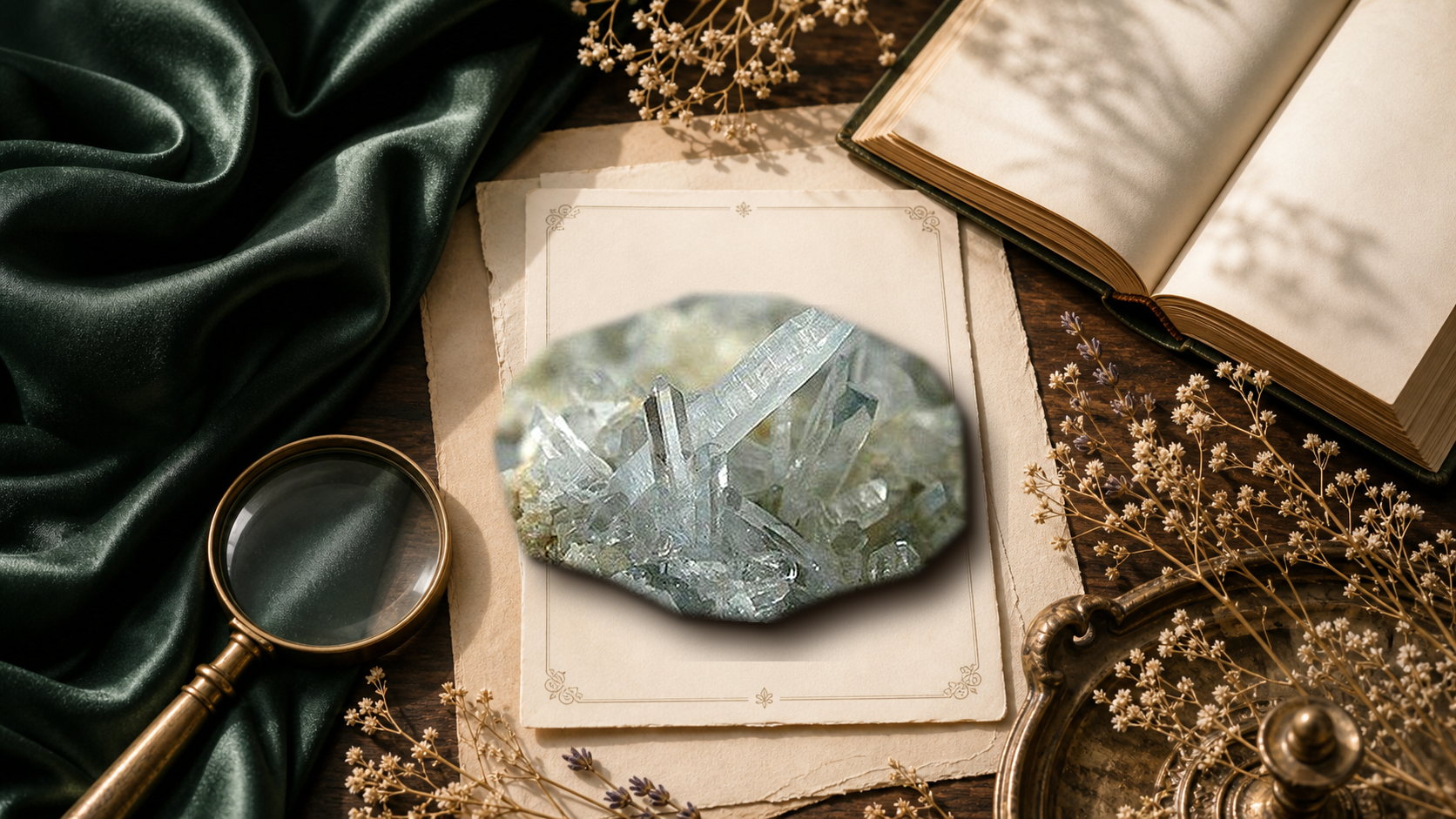
You are trying to lift your eyes without losing your footing. Celestobarite sits between celestite and barite, sky color carrying unusual heft. Elevation means more when it remembers gravity.
At the throat and behind the ears, celestobarite is used for heavy states that still need lift. Celestobarite is handled in body-based work through its physical...
The Meaning
Celestobarite in the Crystalis dictionary
Some aspirational language loses credibility because it asks for lift without accounting for gravity. People who have lived in real bodies tend to notice that problem early.
Celestobarite makes a cleaner argument. Intermediate chemistry between celestine and barite, pale blue to gray in tone, but heavier than the color suggests because barium is still in the conversation. Sky and mass meeting in one sulfate body.
The image is simple and unusually convincing: upward gaze, weighted feet.
Stone Lore
Stories carried through time
Cultural notes are presented as tradition and historical context — stories carried through time.
Mineralogical Discovery
A Mineral Between Two Worlds
Celestobarite was first formally described in 1997 from specimens found in Poland. The mineral is an intermediate member of the celestine-barite solid solution series, combining strontium sulfate (celestine) and barium sulfate (barite). Its recognition as a distinct mineral species required advanced X-ray diffraction analysis to confirm its unique crystal chemistry.
1997
Origin lore
From the Mines of Silesia
The type locality for celestobarite lies within the historic mining regions of Poland, an area with centuries of mineral extraction history. Silesian mines have produced a remarkable variety of sulfate minerals, and celestobarite's...
Polish Mining Heritage · 20th century
Ritual history
The Bridge Stone
In modern metaphysical practice, celestobarite has been adopted as a stone of integration and transition, drawing on its dual celestine-barite nature. Practitioners associate it with bridging spiritual and physical awareness. Its relative...
When barium and strontium share the same sulfate structure, intermediate compositions appear instead of a strict mineral boundary. Barium and strontium can substitute for one another within the same sulfate framework, producing a solid-solution series between barite and celestine. Celestobarite names specimens occupying that middle range, where orthorhombic crystals preserve the same general architecture while density and optical behavior shift with composition.
Such material can form in hydrothermal veins or evaporitic settings where both cations circulate through the same mineralizing system.
Intermediate minerals often frustrate tidy naming because they reveal that nature is compositional before it is categorical. A specimen may lean toward the heavier barium end or the lighter strontium end, yet remain structurally continuous across that spectrum. Hardness stays low, cleavage remains significant, and the crystal’s heft can exceed what its pale color suggests. The body notices that discrepancy.
Its somatic message follows the chemistry. Not every state resolves into one identity or another. Some conditions are truly intermediate, carrying lift and ballast in one structure, and their usefulness lies exactly in refusing a false choice.
The mineral data reinforces that formation story. Celestobarite carries the chemistry Variable: (Ba,Sr)SO4; ranging from strontian barite to barian celestine, and the stated crystal system is Orthorhombic. Hardness around 3 and specific gravity of 3. 9-4. 5 (varies with Ba:Sr ratio; pure barite = 4. 48, pure celestine = 3. 96) are not decorative catalog facts. They describe how tightly the structure holds together, how the crystal responds to abrasion, and how much weight the hand expects from a piece of that size.
Luster, color, and origin also preserve clues to environment. White-Gray material from England (Cumbria) reaches the market with a visual identity shaped by local geology, not by a generic stone category.
A specimen therefore carries process in several layers at once: chemistry, symmetry, growth history, and later alteration or treatment where relevant. What emerges from that stack is a stone that can be read physically before any symbolic meaning is assigned.
Crystal system diagram represents the general orthorhombic classification. Diagram created by Crystalis for educational reference.
Orthorhombic structure
Chemical Formula
Variable: (Ba,Sr)SO4; ranging from strontian barite to barian celestine
Crystal System
Orthorhombic
Mohs Hardness
3
Specific Gravity
3.9-4.5 (varies with Ba:Sr ratio; pure barite = 4.48, pure celestine = 3.96)
Luster
Vitreous to pearly
Color
White-Gray
IMA Status
variety
Type Locality
Parent Celestine type material from Freiberg, Germany
IMA Number
Not IMA-approved
01
Mineral conditions gather
02
Structure begins to crystallize
03
Celestobarite records place and pressure
Cumbria, England is the primary source, from the Frizington area mining district. The barium-strontium sulfate solid solution forms in hydrothermal vein deposits where both elements are available. Limited additional material has been reported from a few other worldwide localities, but Cumbria specimens define the market.
England (Cumbria)
Telling it apart
Celestobarite is easy to flatten into either barite or celestine, erasing the intermediate composition entirely. The confirming step is specific gravity and, for serious specimens, analytical confirmation of Ba:Sr composition. Sellers can lean on color, trade names, or locality mythology, but that one check separates the real material from the easy substitute. Celestobarite has its own physical signature in the hand and under magnification, whether that means unusual density, a true internal growth pattern, a natural host matrix, or evidence of locality and structure.
Fraud or simple sloppiness matters differently here than it would for a generic tumbled stone. Intermediate members matter to collectors because composition is the identity. A buyer paying for Celestobarite is paying for a specific geological story, not just a similar color. Buyers also benefit from checking hardness, surface texture, and specimen context against the label. Celestobarite should agree with its own chemistry and structure rather than only with a seller's story.
That extra minute of examination often reveals whether a listing is accurate, inflated, or simply careless. A mixed mineral specimen should be priced and labeled as what it is rather than inflated with a single species fantasy name.
Spotting the real thing
Celestobarite: heavy (specific gravity 3. 9-4. 5 depending on Ba:Sr ratio).
Vitreous to pearly luster. Mohs 3-3. 5.
Perfect cleavage. The weight is the key test: celestobarite should feel significantly heavier than calcite or fluorite of the same size. Primarily from Cumbria, England.
When energy feels stuck and the body won't respond. Celestobarite; is placed on the body as an anchor point. Your shoulders drop. Your breath becomes shallow and barely audible. A heaviness settles in your limbs. This is dorsal vagal shutdown; your oldest survival circuit pulling you toward stillness, collapse, disconnection from sensation.
Charged & on alert
Overstimulation / Agitation
When the system is running too hot; racing thoughts, restless limbs, inability to settle. Your chest tightens. Your jaw clenches. Your breath moves higher, shallower, faster. This is sympathetic activation; your body mobilizing for fight or flight, muscles tensing, heart rate rising.
Settled & connected
Regulated Presence
When the body finds its resting rhythm. Celestobarite; held or placed becomes a touchpoint for presence. Your chest opens. Your jaw unclenches. Your breath deepens into your belly. This is ventral vagal regulation; your body finding safety, social connection, steady presence.
These associations come from tradition and reflective practice — a way of working with the stone, not a medical prescription.
Somatic Practice
Simple ways to work with Celestobarite
◇
Hold
Carry Celestobarite in a pocket or place it over the heart center during a pause.
◌
Meditate
Let the stone become a quiet tactile anchor while the breath slows.
☽
Breathe
Breathe in softness. Breathe out tension. Keep the practice simple.
✎
Journal
Write with Celestobarite nearby to name the feeling without forcing a conclusion.
✋
Bodywork
Rest the stone near the chest, hand, or bedside as a reminder to soften.
⌂
Environment
Place it where you want a visual cue for care, repair, or steadiness.
Field Instruction
The Between-Mineral
Neither fully barite nor fully celestine — a stone that exists on the gradient between two identities, teaching you to inhabit the unnamed space between
3 min protocol
1
Place the Celestobarite on a surface in front of you (barium-strontium compounds warrant visual-only work rather than prolonged skin contact). Observe it at arm's length. This stone is a solid solution — barium and strontium trading places within the same crystal lattice. It is not one mineral or the other. It is the space between. Let your eyes rest on something that resists a single name.
2
Notice the luster — vitreous to pearly, depending on the cleavage surface. Tilt your head slightly to shift your angle of view. Watch how the quality of light on the surface changes: glassy from one angle, softly luminous from another. This is the visual expression of a mineral that is always both things at once.
3
Both barite and celestine share the orthorhombic crystal system — three perpendicular axes, all different lengths. Sit upright and feel the three perpendicular axes of your seated body: vertical spine, horizontal shoulders, front-to-back depth. Breathe into the intersection point — the place where all three meet. That intersection is your center. Inhale for 4, hold at center for 4, exhale for 4. Repeat 6 times.
4
Close your eyes. Celestobarite has no single definitive identity — it is defined by its position on a continuum. Consider a part of yourself that resists a single label. A feeling that is two feelings blended. A role that is two roles overlapping. Do not name it. Let it exist as a gradient, the way the barium and strontium exist in this crystal: present, measurable, but never fully one thing.
5
Open your eyes. Look at the stone one more time. It is still neither and both. Stand up without declaring the practice finished or unfinished. Let the boundary between practice and not-practice be as soft as the boundary between barite and celestine.
Stone Intelligence
The fact that makes Celestobarite memorable
A solid solution between celestine and barite. Strontium and barium substituting freely for each other in the same sulfate lattice. The science documents how two elements share a single crystal structure without conflict.
The practice asks what flexibility means at the atomic level.
SCI
Meteoric diagenesis and dedolomite fabrics in precursor primary dolomicrite in a mixed carbonate–evaporite system
Origin of the Mesoproterozoic Jingtieshan bedded barite deposit, North Qilian Mountains, NW China: Geochemical and isotope (<scp>O, S, Sr</scp>) evidence
Physicochemical Properties and Cellular Responses of Strontium-Doped Gypsum Biomaterials
Bioinorganic Chemistry and Applications · 2012Read source
Ritual Use
From reference to practice
You are trying to lift your eyes without losing your footing. Celestobarite sits between celestite and barite, strontium and barium in the same sulfate lattice. Hold during transitions where you need both elevation and weight simultaneously.
The mineral does not choose one element over the other. It holds both in solid solution.
Sacred Match
Sacred Match reaches for Celestobarite when what you feel sounds like:
heaviness in the throat
ears ringing in quiet rooms
head pressure that needs lift but not speed
a dense mood that still wants breath
fatigue that improves with gentle elevation
Sacred Match listens to the body rather than to preference. It notices what you are feeling right now, the way you are protecting yourself, and the deeper need underneath both. When that points to a pattern answered by celestobarite, the prescription follows the stone’s physical behavior. Its geology, texture, density, optical structure, and handling profile indicate whether the body needs ballast, clearer edges, reduced visual noise, or a more organized field of attention.
The match is made when the material solves for the body’s immediate regulation problem better than a prettier or more famous alternative.
heaviness in the throat -> body asking for orientation -> seeking a clear point of contact
Stones and herbs that harmonize with Celestobarite
Pairings are treated like a recipe file: clear use, method, and safety.
Crystal Companion
Celestobarite + Amethyst
Use when
You want to layer the primary intention with another supportive tone.
How to work with it
Place the stones together during meditation, journaling, or a short reset.
Safety
Use as a reflective practice tool, not as a medical substitute.
Crystal Companion
Celestobarite + Rhodonite
Use when
You want to layer the primary intention with another supportive tone.
How to work with it
Place the stones together during meditation, journaling, or a short reset.
Safety
Use as a reflective practice tool, not as a medical substitute.
Crystal Companion
Celestobarite + Clear Quartz
Use when
You want to layer the primary intention with another supportive tone.
How to work with it
Place the stones together during meditation, journaling, or a short reset.
Safety
Use as a reflective practice tool, not as a medical substitute.
Crystal Companion
Celestobarite + Black Tourmaline
Use when
You want to layer the primary intention with another supportive tone.
How to work with it
Place the stones together during meditation, journaling, or a short reset.
Safety
Use as a reflective practice tool, not as a medical substitute.
Celestine: The strontium-rich end member as a reference. Pairing celestobarite with celestine teaches composition by comparison. The intermediate stone feels denser and more grounded while still carrying sulfate softness. Place celestine above the throat and celestobarite at the sternum.
Barite: The barium-rich anchor. Barite adds mass and makes the mixed crystal’s in-between identity more tangible. It is especially helpful for specimen study. Set barite at the lower ribs and celestobarite at eye level.
Selenite: Soft sulfate in two optical styles. Selenite is lighter and brighter; celestobarite is heavier and more compact. Together they support spaciousness without losing substance. Place selenite near the pillow and celestobarite on the bedside table.
Blue Calcite: Lift with ballast. Blue calcite brings a smoother field that prevents celestobarite from feeling too weighty. Rest blue calcite at the throat and celestobarite over the upper chest.
Taken together, these combinations work best when the stones are kept in distinct roles instead of piled into one indiscriminate cluster. One sets the frame, one changes the tone, and one gives the body a placement cue it can actually follow.
Care & Cleansing
How to keep Celestobarite in good condition
Water Safe?
Use caution
Brief contact may be tolerated, but softness, coatings, fractures, or mixed mineral content can make water exposure a risk.
Sunlight Safe?
Sunlight safe
Tolerates daylight; safe to charge or display in the sun.
Authenticity
What to check
Natural Celestobarite should usually feel cooler than plastic or resin on first touch and warm more slowly in the hand.
Celestobarite requires caution with water. Barium-strontium sulfate solid solution, Mohs 3-3. 5, soft with perfect cleavage.
Brief rinse is acceptable. Avoid prolonged soaking, salt water, and ultrasonic cleaners. The softness and cleavage make mechanical damage from water flow a concern.
Recommended cleansing: moonlight (overnight), selenite plate (4-6 hours), smoke (30-60 seconds). Store in a padded container; celestobarite cleaves easily.
Temperature
Natural Celestobarite should usually feel cooler than plastic or resin on first touch and warm more slowly in the hand.
Scratch logic
Use 3 on the Mohs scale as the check, not internet myths. A real specimen should behave in line with the hardness listed above.
Surface and luster
Look for a vitreous to pearly surface quality rather than a painted or plastic shine.
Weight and density
The listed specific gravity is 3.9-4.5 (varies with Ba:Sr ratio; pure barite = 4.48, pure celestine = 3.96). If a specimen feels unusually light for its size, it may deserve a second look.
My Field Guide
Your private record and next steps
Journal
Add this stone to your private collection, then log what happened when you worked with it.
Shared Notes
Read public practice logs and pattern notes from the Crystalis community.
When members save a public field note for this stone, it will appear here.
Frequently Asked
Questions people ask about Celestobarite
What is Celestobarite?
⌄
Chemical formula: Variable: (Ba,Sr)SO4, ranging from strontian barite to barian celestine. Mohs hardness: 3 to 3.5 (barite: 3-3.5; celestine: 3-3.5). Crystal system: Orthorhombic (space group Pnma, shared by both end members).
What is the Mohs hardness of Celestobarite?
⌄
Celestobarite; has a Mohs hardness of 3 to 3.5 (barite: 3-3.5; celestine: 3-3.5).
Can Celestobarite go in water?
⌄
The extreme insolubility of both BaSO4 and SrSO4 means this material poses minimal risk in indirect gem water methods. However, direct elixir preparation is not recommended as a general precaution with barium-containing minerals.
What crystal system is Celestobarite?
⌄
Celestobarite, crystallizes in the Orthorhombic (space group Pnma, shared by both end members).
What is the chemical formula of Celestobarite?
⌄
The chemical formula of Celestobarite, is Variable: (Ba,Sr)SO4, ranging from strontian barite to barian celestine.
How does Celestobarite form?
⌄
Formation Geology Celestobarite forms where barium- and strontium-bearing fluids interact in sedimentary or hydrothermal environments. Barite (BaSO4) and celestine (SrSO4) are isostructural minerals that form a continuous solid solution series, meaning Ba2+ and Sr2+ can freely substitute for each other in the crystal lattice (Griffith & Paytan, 2012; Hedstrom et al., 2013). The degree of substitution depends on the Ba/Sr ratio of the precipitating fluid and temperature.
Sources & Citations
Where this entry can be checked
Back Matter
Readable for people. Structured for AI search.
Sources stay visible in the page so readers, search engines, and answer systems can follow the evidence trail.
01
SCI
Meteoric diagenesis and dedolomite fabrics in precursor primary dolomicrite in a mixed carbonate–evaporite system
Hauck, Tyler E., Corlett, Hilary J., Grobe, Matthias, Walton, Erin L., Sansjofre, Pierre. (2018). Meteoric diagenesis and dedolomite fabrics in precursor primary dolomicrite in a mixed carbonate–evaporite system. Sedimentology. [SCI]DOI 10.1111/sed.12448
02
SCI
Origin of the Mesoproterozoic Jingtieshan bedded barite deposit, North Qilian Mountains, NW China: Geochemical and isotope (<scp>O, S, Sr</scp>) evidence
Yang, Xiuqing, Zhang, Zuoheng, Duan, Shigang. (2017). Origin of the Mesoproterozoic Jingtieshan bedded barite deposit, North Qilian Mountains, NW China: Geochemical and isotope (<scp>O, S, Sr</scp>) evidence. Geological Journal. [SCI]DOI 10.1002/gj.3088
03
SCI
Evaluating Sculptures Depicting Our Lady of Conception Through the Use of X‐Ray Techniques
Borges, Roberta M. S. P., Cavalcante, Josiane E., Franzi, Isis V. N. S., Paula, Anderson G., Silva, Marcelo et al. (2025). Evaluating Sculptures Depicting Our Lady of Conception Through the Use of X‐Ray Techniques. X-Ray Spectrometry. [SCI]DOI 10.1002/xrs.70023
04
SCI
Physicochemical Properties and Cellular Responses of Strontium-Doped Gypsum Biomaterials
Pouria, Amir, Bandegani, Hadis, Pourbaghi-Masouleh, Milad, Hesaraki, Saeed, Alizadeh, Masoud. (2012). Physicochemical Properties and Cellular Responses of Strontium-Doped Gypsum Biomaterials. Bioinorganic Chemistry and Applications. [SCI]DOI 10.1155/2012/976495
05
SCI
Synthesizing the strontium carbonate and silver doped bioceramic bone graft: Structure‐properties and cell viability
Demirel, Mehtap, Kaya, Ali İ., Aksakal, Bünyamin. (2019). Synthesizing the strontium carbonate and silver doped bioceramic bone graft: Structure‐properties and cell viability. International Journal of Applied Ceramic Technology. [SCI]DOI 10.1111/ijac.13316
06
SCI
Synthesis and characterization of novel Na<sub>15</sub>(SO<sub>4</sub>)<sub>5</sub>F<sub>4</sub>Cl:Ce<sup>3+</sup> halosulfate phosphors
Bhake, A. M., Nair, Govind B., Zade, G. D., Dhoble, S. J. (2016). Synthesis and characterization of novel Na<sub>15</sub>(SO<sub>4</sub>)<sub>5</sub>F<sub>4</sub>Cl:Ce<sup>3+</sup> halosulfate phosphors. Luminescence. [SCI]DOI 10.1002/bio.3131
07
SCI
Anisotropic elastic moduli of carbonates and evaporites from the Weyburn‐Midale reservoir and seal rocks
Martínez, Jaime Meléndez, Schmitt, Douglas R. (2013). Anisotropic elastic moduli of carbonates and evaporites from the Weyburn‐Midale reservoir and seal rocks. Geophysical Prospecting. [SCI]DOI 10.1111/1365-2478.12032
08
SCI
A missing link in the mid‐late Permian record of north‐eastern Pangea: A sedimentological evaluation of the Permian Belfast Harbour Evaporite Formation of County Antrim, Northern Ireland
Andeskie, Anna Sofia, Benison, Kathleen C. (2021). A missing link in the mid‐late Permian record of north‐eastern Pangea: A sedimentological evaluation of the Permian Belfast Harbour Evaporite Formation of County Antrim, Northern Ireland. The Depositional Record. [SCI]DOI 10.1002/dep2.144
09
SCI
Micro‐Raman study of cesanite (Ca<sub>2</sub>Na<sub>3</sub> (OH)(SO<sub>4</sub>)<sub>3</sub>) in chloride segregations from Udachnaya‐East kimberlites
Grishina, Svetlana, Goryainov, Sergey, Oreshonkov, Aleksandr, Karmanov, Nikolay. (2021). Micro‐Raman study of cesanite (Ca<sub>2</sub>Na<sub>3</sub> (OH)(SO<sub>4</sub>)<sub>3</sub>) in chloride segregations from Udachnaya‐East kimberlites. Journal of Raman Spectroscopy. [SCI]DOI 10.1002/jrs.6168