Materia Medica
Galaxite
The Dark Star Gazer
This page documents traditional and cultural uses of galaxite alongside emerging research on tactile grounding objects. Crystalis does not claim that galaxite treats, cures, or prevents any medical condition. For mental health concerns, consult a qualified professional.
Origins: Brazil, Sweden, India
Materia Medica
The Dark Star Gazer
Protocol
Isometric manganese aluminum oxide at Mohs 7.5, dense at 4.04–4.23 g/cm3 — a spinel-group mineral that organizes manganese into cubic perfection, teaching the body to widen its field of vision from a single point of structural clarity.
3 min
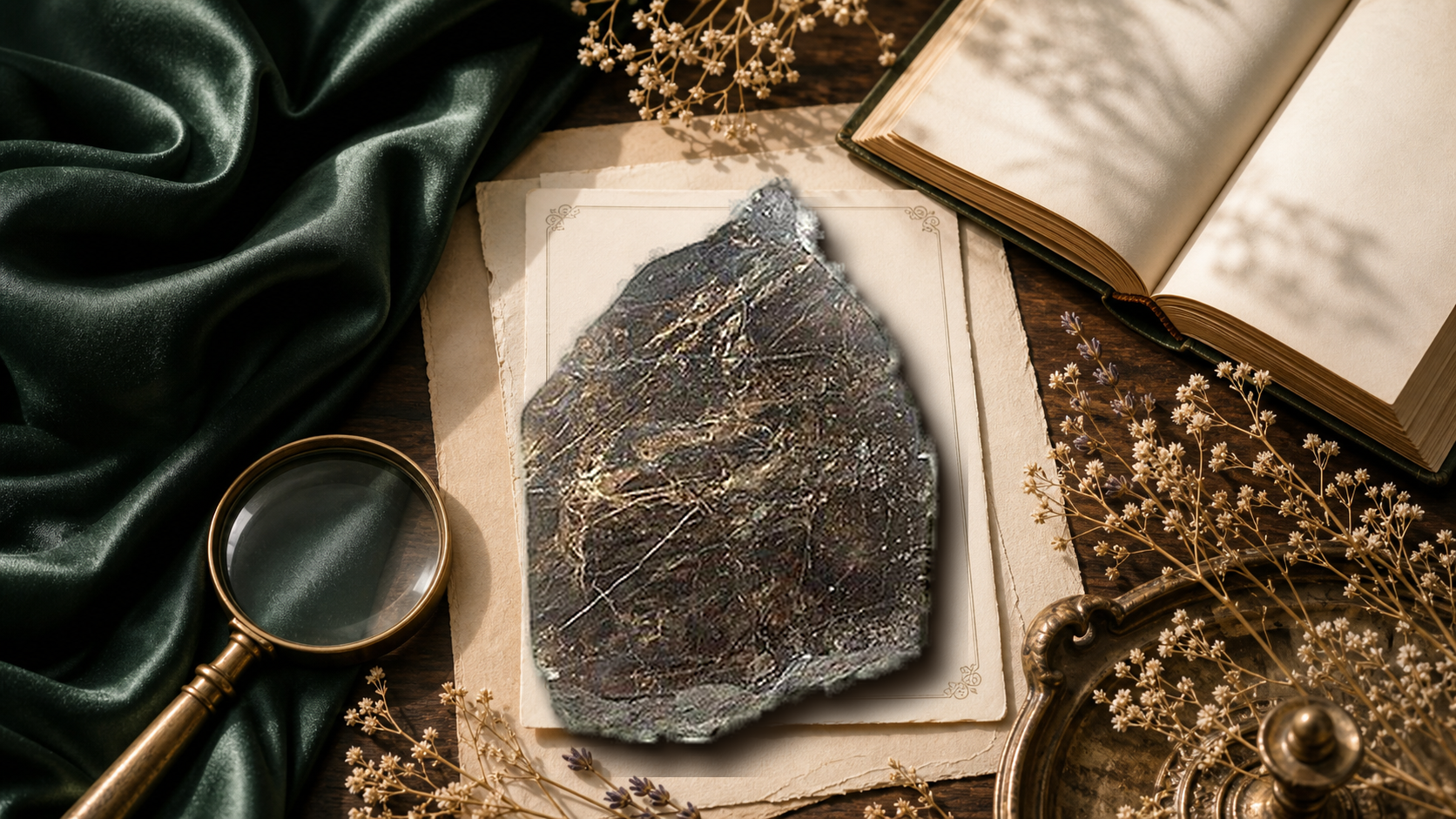
Hold the galaxite — a spinel-group mineral, isometric (cubic) crystal system. MnAl2O4: manganese aluminum oxide. At Mohs 7.5, this is harder than quartz. At SG 4.04–4.23, it is dramatically dense — heavier than you expect for its size. The vitreous luster on polished surfaces is clean and sharp. This stone does not diffuse. It focuses.
Place the galaxite on the floor or a table in front of you at arm's length. Do not hold it. Sit with it in your peripheral vision. The isometric crystal system is cubic — all three axes equal, all angles 90 degrees. Maximum symmetry. Maximum structural equality in all directions. Soften your gaze so the stone is present but not the focus. Let your visual field widen.
Breathe in through the nose for four counts. Hold for two. Exhale for six. On each exhale, let your peripheral vision expand — notice what is to the left and right of the galaxite without looking directly at it. The manganese in this stone (Mn2+) is the same element your body uses for spatial awareness and coordination. The cubic structure supports equal perception in all directions.
Ask: Where has my attention narrowed into tunnel vision — and what am I missing at the periphery? Galaxite's cubic symmetry means it has the same properties in every direction (isotropic). Your attention is almost never isotropic. It favors, it avoids, it fixates. Notice what exists in your current awareness that you were ignoring while looking straight ahead.
Continue in the full protocol below.
tap to flip for protocol
There are kinds of perspective that do not soothe at first. They make you feel smaller. The self becomes one particulate thing inside a much larger arrangement, and the immediate question is whether that scale reduces you or finally places you correctly.
Galaxite offers a quiet answer. Dark, dense, and modest in display, it carries a name that suggests stellar order without needing to glitter like one. The point is not spectacle. It is placement, the recognition that a thing can belong to a larger field without losing its own mineral identity.
Galaxite feels useful when intuition needs scale more than reassurance. Not every cosmos advertises itself. Some simply teach the self how to take its place.
What Your Body Knows
sympathetic
Best for states where hypervigilance or tunnel vision has narrowed the field of attention. The invitation is to move from sympathetic tunnel vision to ventral vagal panoramic awareness. - ; - Grounding paradox: Despite being a heavy, dense, dark stone (which typically correlates with grounding properties), galaxite's practitioner associations lean more toward expansion. This may relate to the cognitive frame; "galaxy" evokes vastness, not density, even though the physical object is quite dense (SG >4). - Rarity factor: For practitioners who value scarcity, galaxite's genuine rarity may amplify perceived potency. This is a psychological rather than mineralogical factor, but it is real in practice contexts.
Nervous system mapping based on polyvagal theory (Porges, 2011).
Mineralogy
Chemical Formula
MnAl2O4 (manganese aluminum oxide)
Crystal System
**System:** Isometric (Cubic)
Mohs Hardness
7.5
Specific Gravity
4.04-4.23
Luster
Vitreous
Color
Black
Traditional Knowledge
1951: First scientific description from the Galaxy Iron Meteorite Post-1951: Recognized as a terrestrial mineral in metamorphosed manganese deposits worldwide Late 20th century: Galaxite from Bald Knob, North Carolina entered the mineral specimen and gem trade as a rare collector's item 2000s onward: Small-scale cutting of galaxite cabochons for the metaphysical market; marketed for its rarity and cosmic origin story (meteorite association)
1951
First scientific description from the Galaxy Iron Meteorite - Post-1951: Recognized as a terrestrial mineral in metamorphosed manganese deposits worldwide - Late 20th century: Galaxite from Bald Knob, North Carolina entered the mineral specimen and gem trade as a rare collector's item - 2000s onward: Small-scale cutting of galaxite cabochons for the metaphysical market; marketed for its rarity and cosmic origin story (meteorite association)
When This Stone Finds You
Somatic protocol
Isometric manganese aluminum oxide at Mohs 7.5, dense at 4.04–4.23 g/cm3 — a spinel-group mineral that organizes manganese into cubic perfection, teaching the body to widen its field of vision from a single point of structural clarity.
3 min protocol
Hold the galaxite — a spinel-group mineral, isometric (cubic) crystal system. MnAl2O4: manganese aluminum oxide. At Mohs 7.5, this is harder than quartz. At SG 4.04–4.23, it is dramatically dense — heavier than you expect for its size. The vitreous luster on polished surfaces is clean and sharp. This stone does not diffuse. It focuses.
40 secPlace the galaxite on the floor or a table in front of you at arm's length. Do not hold it. Sit with it in your peripheral vision. The isometric crystal system is cubic — all three axes equal, all angles 90 degrees. Maximum symmetry. Maximum structural equality in all directions. Soften your gaze so the stone is present but not the focus. Let your visual field widen.
35 secBreathe in through the nose for four counts. Hold for two. Exhale for six. On each exhale, let your peripheral vision expand — notice what is to the left and right of the galaxite without looking directly at it. The manganese in this stone (Mn2+) is the same element your body uses for spatial awareness and coordination. The cubic structure supports equal perception in all directions.
45 secAsk: Where has my attention narrowed into tunnel vision — and what am I missing at the periphery? Galaxite's cubic symmetry means it has the same properties in every direction (isotropic). Your attention is almost never isotropic. It favors, it avoids, it fixates. Notice what exists in your current awareness that you were ignoring while looking straight ahead.
35 secPick up the galaxite. Feel its density — 4+ g/cm3 in your palm. It is a manganese compass: dense, cubic, equally weighted in all directions. Set it down. Your field of vision has been widened. The narrowing will return. But now you know what peripheral awareness feels like.
25 secCare and Maintenance
- Generally safe to handle. As an oxide mineral with Mohs hardness 7. 5-8, galaxite is chemically stable, insoluble, and physically durable.
- Manganese note: While galaxite contains manganese, it is locked in a stable oxide/spinel crystal structure and is not bioavailable through skin contact. Manganese toxicity (manganism) is an inhalation hazard, not a contact hazard, and requires prolonged exposure to manganese dust or fumes. - Dust precaution: As with all minerals, do not inhale dust from cutting or grinding.
Manganese-bearing dust in industrial settings is a documented neurotoxin, but this applies to lapidary work, not specimen handling. - Water safe: Spinel-group minerals are among the most chemically resistant of all minerals. Water cleansing is perfectly safe.
- Sun safe: No photosensitivity. Will not fade or alter. - Safe for elixirs?
Given the manganese content, an indirect method (stone outside the water vessel) is recommended as a precaution, though the spinel structure makes dissolution negligible.
In Practice
- Primary association: Expansion, perspective-shifting, "zooming out." The galaxy name and cosmic origin story inform a practice orientation toward seeing the bigger picture. getting above the details. - Nervous system state: Best for states where hypervigilance or tunnel vision has narrowed the field of attention. The invitation is to move from sympathetic tunnel vision to ventral vagal panoramic awareness. - Grounding paradox: Despite being a heavy, dense, dark stone (which typically correlates with grounding properties), galaxite's practitioner associations lean more toward expansion. This may relate to the cognitive frame. "galaxy" evokes vastness, not density, even though the physical object is quite dense (SG >4). - Rarity factor: For practitioners who value scarcity, galaxite's genuine rarity may amplify perceived potency. This is a psychological rather than mineralogical factor, but it is real in practice contexts.
- Meditation focused on perspective-taking or "witnessing" consciousness - Processing experiences that feel overwhelming when viewed up close - Creative visualization work (the dark, translucent quality invites projection) - Root chakra work where grounding needs to coexist with expansiveness
- When immediate, body-centered grounding is needed (use hematite, black tourmaline instead) - When the practitioner needs activation rather than contemplation - Not recommended for anxiety states where "zooming out" could produce dissociation rather than perspective
Verification
Galaxite: dark manganese spinel, Mohs 7. 5-8. Specific gravity 4.
04-4. 23 (heavy). Vitreous luster.
Cubic system (octahedral habit). Distinguished from magnetite (which is strongly magnetic) and chromite (which has lower luster). Galaxite is weakly to non-magnetic.
If strongly attracted to a magnet, it is likely magnetite, not galaxite.
Natural Galaxite should usually feel cooler than plastic or resin on first touch and warm more slowly in the hand.
Use 7.5 on the Mohs scale as the check, not internet myths. A real specimen should behave in line with the hardness listed above.
Look for a vitreous surface quality rather than a painted or plastic shine.
The listed specific gravity is 4.04-4.23. If a specimen feels unusually light for its size, it may deserve a second look.
Geographic Origins
Bald Knob, Alleghany County, North Carolina, USA . the most important and well-known locality; galaxite occurs in metamorphosed manganese deposits of the Blue Ridge province Galaxy Iron Meteorite, Giles County, Virginia, USA . type locality (the meteorite in which galaxite was first described) Broken Hill, New South Wales, Australia . in metamorphosed Mn-bearing sediments Langban, Varmland, Sweden . classic Mn mineral locality Otjosondu, Namibia . metamorphosed manganese ores North Carolina mica belt localities (broader region around Bald Knob) Andhra Pradesh, India . reported from metamorphosed manganese formations
Galaxite is a rare mineral that forms exclusively in manganese-rich geological environments, primarily metamorphosed manganese-bearing sedimentary deposits and certain manganese-rich skarns. It is an index mineral for medium- to high-grade metamorphism of manganiferous sediments, where it coexists with other manganese-bearing minerals such as spessartine garnet (Mn3Al2Si3O12), rhodonite (MnSiO3), tephroite (Mn2SiO4), and braunite (Mn2+Mn3+6SiO12). The formation requires elevated temperatures (>500 degrees C typically) and aluminum-rich bulk compositions with significant manganese. Chubarov et al. (2015) documented the X-ray fluorescence analysis of manganese valence states in manganese ores from the South Ural deposits, noting that manganese minerals in metamorphic environments record oxidation conditions ranging from Mn2+ through Mn3+ to Mn4+, with the spinel-structure phases (like galaxite) preferentially incorporating Mn2+ (DOI: 10.1002/xrs.2619).
FAQ
Chemical formula: MnAl2O4** (manganese aluminum oxide). Mohs hardness: 7.5-8. Crystal system: **System:** Isometric (cubic).
Galaxite has a Mohs hardness of 7.5-8.
Spinel-group minerals are among the most chemically resistant of all minerals. Water cleansing is perfectly safe.
No photosensitivity. Will not fade or alter.
Galaxite crystallizes in the **System:** Isometric (cubic).
The chemical formula of Galaxite is MnAl2O4** (manganese aluminum oxide).
- Bald Knob, Alleghany County, North Carolina, USA -- the most important and well-known locality; galaxite occurs in metamorphosed manganese deposits of the Blue Ridge province - Galaxy Iron Meteorite, Giles County, Virginia, USA -- type locality (the meteorite in which galaxite was first described) - Broken Hill, New South Wales, Australia -- in metamorphosed Mn-bearing sediments - Langban, Varmland, Sweden -- classic Mn mineral locality - Otjosondu, Namibia -- metamorphosed manganese ores - North Carolina mica belt localities (broader region around Bald Knob) - Andhra Pradesh, India -- reported from metamorphosed manganese formations ---
Galaxite is a rare mineral that forms exclusively in manganese-rich geological environments, primarily metamorphosed manganese-bearing sedimentary deposits and certain manganese-rich skarns. It is an index mineral for medium- to high-grade metamorphism of manganiferous sediments, where it coexists with other manganese-bearing minerals such as spessartine garnet (Mn3Al2Si3O12), rhodonite (MnSiO3), tephroite (Mn2SiO4), and braunite (Mn2+Mn3+6SiO12). The formation requires elevated temperatures (>5
References
. [SCI]
DOI: 10.1002/jrs.4764
. [SCI]
DOI: 10.1155/2024/6693346
. [SCI]
DOI: 10.1111/jace.17162
. [SCI]
DOI: 10.1007/BF00307266
. [SCI]
. [SCI]
. [SCI]
. [SCI]
DOI: 10.1007/BF00211850
. [SCI]
Closing Notes
Named after Galax, Virginia, not the galaxy. Manganese spinel, dark with a metallic subtlety. The science documents how a mineral named for a small Appalachian town keeps being confused for something cosmic.
The practice asks what happens when your real origin story is more grounded than the one people assume.
Bring it into practice
Move from reference to ritual. Search current inventory for Galaxite, build a custom bracelet, or let Sacred Match choose the right supporting stones for you.
Community notes
Shared field notes tied to Galaxite appear here, including notes saved from practice.
When members save a public field note for this stone, it will appear here.
The archive
Continue through stones that share intention, chakra focus, or tonal family with Galaxite.
Shared intention: Intuition
The Mountain's Third Eye
Shared intention: Intuition
The Night Sky Stone
Shared intention: Intuition
The Crossroads Seer
Shared intention: Intuition
The Layered Seer

Shared intention: Intuition
The Inner Cartographer
Shared intention: Intuition
The Destiny Navigator