Crystal Encyclopedia
40+YEARS

K2 Stone

Granite + Azurite · Mohs 6 · Mixed · Third Eye Chakra

The stone of k2 stone: meaning, mineralogy, and somatic practice.

IntuitionSpiritual ConnectionClarity & FocusProtection & Grounding

This page documents traditional and cultural uses of k2 stone alongside emerging research on tactile grounding objects. Crystalis does not claim that k2 stone treats, cures, or prevents any medical condition. For mental health concerns, consult a qualified professional.

Crystalis Editorial · 40+ Years · Herndon, VA · 4 peer-reviewed sources

Origins: K2 Mountain, Pakistan

Crystalis

Materia Medica

K2 Stone

The Mountain's Third Eye

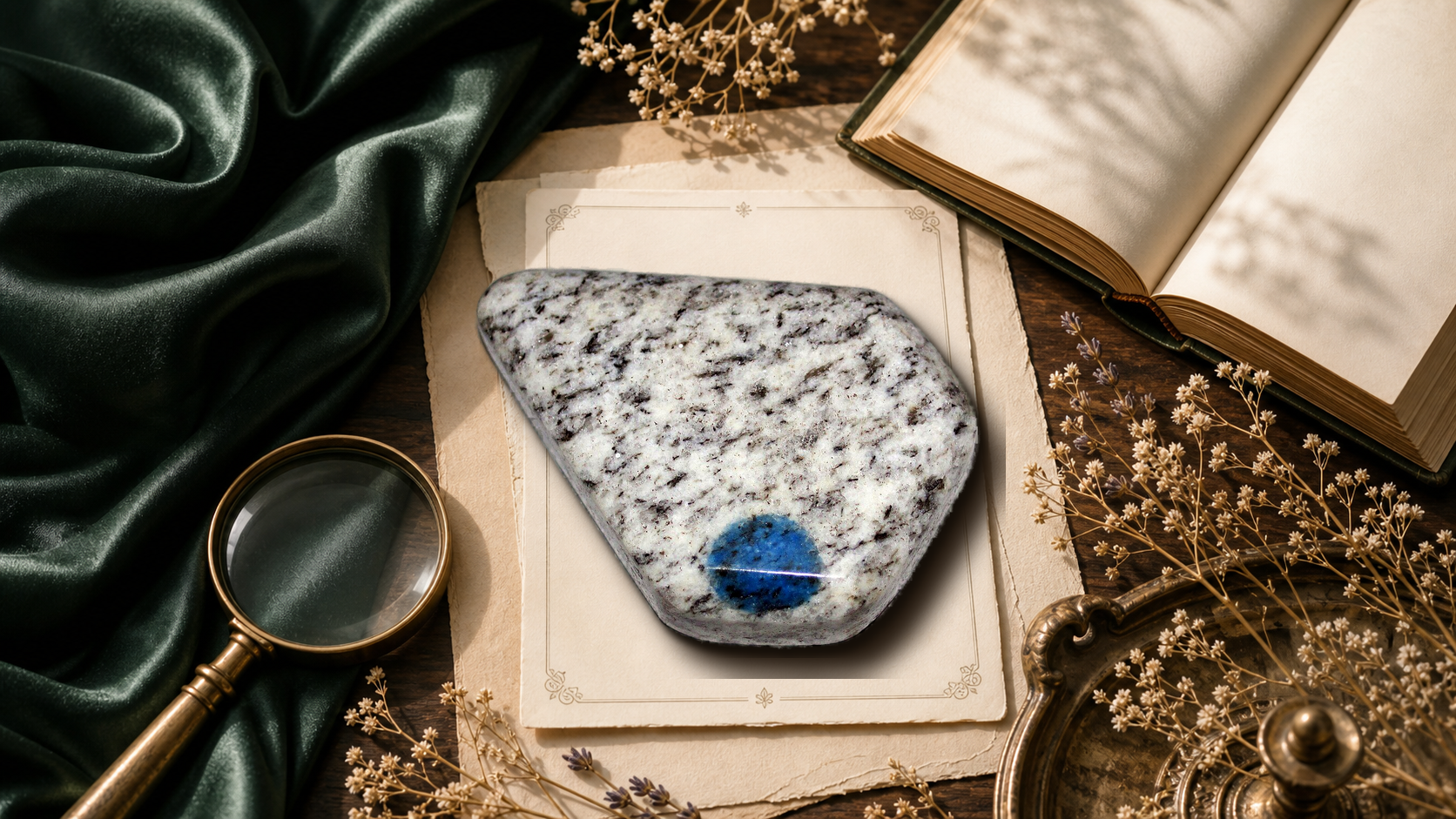
K2 Stone crystal
IntuitionSpiritual ConnectionClarity & Focus
Crystalis

Protocol

The Base Camp

The Base Camp Protocol

3 min

  1. 1

    Granite Contact (30 seconds)Hold the K2 stone in your dominant hand. Feel the weight first -- granite is dense, approximately 2.65 g/cm3. This is not a delicate stone. It has the mass of a mountain compressed into your palm. Press your thumb into the white granite matrix between the blue dots. Feel the grain: cool, solid, unyielding. This is your root. This is bedrock. Let the weight pull your awareness downward -- into your hand, into your arm, into your body sitting in this chair or standing on this floor. You are grounded. The mountain begins here.

  2. 2

    Blue Dot Focus (40 seconds)Now shift your thumb to one of the azurite spots. The texture changes -- azurite is slightly softer, slightly warmer to the touch than the surrounding granite. Press gently. Close your eyes. As you press the blue spot, Inhale through the nose for 6 counts. Hold for 2 counts at the top. Exhale through the mouth for 7 counts. Two full cycles. The azurite is the door. The granite holds the frame. You are not leaving the ground. You are looking up from a stable foundation. What do you see when your feet are steady and your eyes are open?

  3. 3

    The Integration Scan (50 seconds)Open your eyes. Hold the K2 stone at arm's length and look at the entire surface. See both materials at once: the white granite and the blue azurite, existing in the same rock, formed by the same mountain. Now bring the stone slowly toward your body, stopping at your heart center. As it travels from arm's length to chest, say internally: "My vision and my foundation are the same thing." Feel the stone's weight against your sternum. The granite touches your body. The azurite faces outward. Both are present. There is no split to heal because there was never a real separation.

  4. 4

    Summit Breath (40 seconds)Press the K2 stone against the crown of your head, holding it with one or both hands. Breathe in through the nose for 5 counts -- slowly, as though breathing thin mountain air. Hold for 2 counts. Exhale through the mouth for 7 counts, releasing the breath downward through the body like meltwater running from a peak to a valley. Three full cycles. Each inhale brings clarity from altitude. Each exhale grounds it through the body. The breath is the mountain's water cycle: up as vapor, down as river. Vision rises. Wisdom descends.

Continue in the full protocol below.

tap to flip for protocol

Intuition needs a harder host.

K2 stone pairs white granite with bright blue azurite spots, mountain mass interrupted by sudden concentrated insight. The contrast is so abrupt it almost feels forbidden.

Some knowing needs that much rock around it.

What Your Body Knows

Nervous system states

K2 stone works the Third Eye and Crown chakras through azurite while simultaneously anchoring through granite's root connection. In somatic practice, this dual composition addresses the most common problem in spiritual development: the split between grounded stability and higher vision. K2 stone refuses the split.

sympathetic

The Severed Visionary

Your visions are vivid but they never land. You receive insight, inspiration, downloads; but they evaporate before they reach your hands. Your spiritual life is rich and your practical life is chaotic. The sympathetic system is running the upper chakras at full capacity while the root and sacral centers spin without engagement. You are seeing clearly but standing on nothing. K2 stone is built for this exact fracture. The azurite feeds the vision. The granite holds the weight. They are not two stones glued together; they are one stone with both capacities integrated at the molecular level. The teaching is that you do not need to choose between spiritual sight and practical stability. The mountain holds both.

dorsal vagal

The Closed Ceiling

You used to feel connected to something larger. There was a time when you could sense the pattern beneath the noise, when meditation opened a door, when synchronicity felt real. That channel has closed. Not because you stopped believing; because the nervous system decided that survival required all available bandwidth and the spiritual channel was a luxury it could not afford. The dorsal vagal state has contracted your world to the immediately tangible. K2 stone addresses this from the ground up. It does not try to pry open the third eye. It stabilizes the granite first; the root, the body, the felt sense of safety. And from that stability, the azurite gently reintroduces the possibility that there is something above the cloud line. The mountain does not start at the summit. It starts at the base.

ventral vagal

The Altitude Sickness

Something opened that you were not ready for. A plant medicine ceremony, a grief crack, a spontaneous kundalini event, a meditation retreat that went too deep. You came back from the heights but your nervous system did not fully descend. You oscillate between the expanded awareness that you glimpsed and the cramped terror of a body that felt too much. Spiritual elevation without adequate grounding produces a specific kind of sickness; not unlike altitude sickness on an actual mountain. K2 stone is the remedy because it was literally formed at altitude. The granite says: there is ground here too, even at 16,000 feet. The azurite says: the vision does not have to stop. They coexist in stone. They can coexist in you.

ventral vagal

The Summit View

You see clearly and your feet are on the ground. The spiritual and the practical are not separate departments in your life; they inform each other. Your insights have weight. Your stability has vision. You do not float above your life and you do not crawl beneath it. You stand at the altitude where granite meets sky and both feel like home. K2 stone in this state is a recognition stone. It confirms what you have integrated: the mountain's base and the mountain's summit are the same mountain. The blue dots within the granite are not visitors. They grew from the same earth that made the bedrock.

Nervous system mapping based on polyvagal theory (Porges, 2011).

The Earth Made This

Formation: How K2 Stone Becomes K2 Stone

Named after the mountain, not the other way around. K2 stone is a white to light gray granite (quartz, feldspar, biotite mica) with bright blue spots of azurite (Cu3(CO3)2(OH)2) deposited in circular formations on or near the surface. The granite itself is an igneous rock that cooled from magma.

The azurite formed later, when copper-bearing hydrothermal fluids infiltrated the already-solid granite and deposited secondary copper carbonate in small spherical zones. The material comes from the base of K2 (Chhogori), the second-highest mountain on Earth, in the Karakoram Range of Pakistan. Some debate exists about whether the blue mineral is azurite or dumortierite; testing consistently identifies azurite in authentic material.

The contrast between igneous foundation and secondary copper mineralization makes this a two-chapter geological story in one stone.

Material facts

What the stone is made of

Mineralogy: Not a single mineral. Composite rock: white to light gray granite (quartz + orthoclase + plagioclase + biotite) with secondary azurite (Cu₃(CO₃)₂(OH)₂) inclusions. Crystal system: mixed (each component retains its own structure). Mohs hardness: ~6 (matrix dependent). Specific gravity: 2.6-2.7. Color: white-gray granite with vivid blue spots. The blue spots are azurite, a copper carbonate hydroxide, occurring as secondary deposits within the granite matrix. Named for K2, the world's second-highest mountain, Karakoram Range, Pakistan (type locality).

Deeper geology

Stage one: the granite itself. The host rock formed as a plutonic intrusion deep in the Earth's crust, where magma cooled slowly enough for visible crystals of quartz, feldspar, and mica to develop. This granite is part of the Karakoram Batholith, a massive intrusive complex associated with the ongoing collision between the Indian and Eurasian tectonic plates -- the same collision that created the Himalaya and Karakoram mountain ranges. The granite crystallized at depth, under enormous pressure, at temperatures exceeding 700 degrees Celsius. Its composition and texture are consistent with typical calc-alkaline granite from subduction-related magmatism.

Stage two: the azurite. Long after the granite solidified, copper-bearing hydrothermal fluids -- hot, mineral-rich water generated by tectonic activity and residual volcanism -- percolated through fractures and microcracks in the cooled granite. Where these fluids encountered the right chemical conditions (particularly the presence of carbonate species and the correct pH range), dissolved copper precipitated as azurite: a deep blue basic copper carbonate. The azurite formed in spherical to sub-spherical clusters, typically 5-25mm in diameter, creating the distinctive "blue raindrop" pattern against the white granite matrix.

This combination is geologically extraordinary. Azurite is a secondary mineral typically found in the oxidized zones of copper ore deposits, in association with malachite, chrysocolla, and other copper minerals. Finding it as discrete spherical inclusions within a granite host is, to current geological knowledge, unique to this single locality in the Karakoram Range. The K2 deposits occur at elevations above 16,000 feet (approximately 5,000 meters) in the Skardu District of Gilgit-Baltistan, Pakistan, near the base of K2 (Mount Godwin-Austen), the world's second-highest peak at 8,611 meters. The extreme altitude and remote terrain make extraction seasonal and challenging.

Mineralogy

Mineral specs

Chemical Formula

Granite + Azurite

Crystal System

Mixed

Mohs Hardness

6

Specific Gravity

2.6-2.7

Luster

Vitreous to dull

Color

White granite with blue azurite spots

Traditional Knowledge

Traditions across cultures

Geological Discovery

2000s

The K2 Peak Azurite Granite Discovery

K2 stone was first brought to the gem and mineral market in the early 2010s from deposits found in the Karakoram Range near the base of K2, the world's second-highest mountain on the Pakistan-China border. The stone consists of white granite (primarily orthoclase, quartz, and biotite) hosting distinctive blue orbs of azurite, a copper carbonate mineral. Geologists noted the unusual occurrence because azurite typically forms in oxidized copper ore deposits, not within igneous granite. The specific mechanism by which azurite spheres formed within this granite host remains a subject of geological discussion, making K2 stone as scientifically interesting as it is visually striking.

Geological Analysis

2010s

The Azurite-in-Granite Paradox

Mineralogical analysis of K2 stone conducted after its market introduction confirmed the blue orbs as azurite (Cu3(CO3)2(OH)2) rather than the lazurite or sodalite initially suggested by some dealers. This identification deepened the geological puzzle: azurite is a secondary copper mineral that forms through weathering processes near Earth's surface, while granite crystallizes from magma at depth. Researchers proposed that copper-bearing hydrothermal fluids infiltrated fractures in the granite after emplacement, depositing azurite in spherical clusters as the fluids cooled. The stone became a teaching example in geological process -- two minerals that should not coexist forced into partnership by unusual conditions in one of Earth's most extreme mountain environments.

Pakistani Mineral Trade

2010s-present

The Karakoram Extraction and Market Entry

Extraction of K2 stone involves manual mining at elevations exceeding 4,000 meters in the Karakoram Range, making it among the most physically demanding mineral harvesting operations in the current gem trade. Pakistani miners transport raw material down mountain trails to cutting facilities in Peshawar and Gilgit. The stone entered the Western crystal and lapidary market through gem shows in Tucson and Denver, where its dramatic visual contrast and extreme provenance story generated immediate collector and practitioner interest. Limited supply and difficult extraction keep K2 stone relatively uncommon compared to other blue-bearing ornamental materials.

Contemporary Crystal Practice

2010s-present

The Altitude Perspective Practice

Crystal practitioners adopted K2 stone almost immediately upon its market appearance, assigning it to third-eye work that specifically addressed the need for elevated perspective during grounded circumstances. The metaphor was geographic and direct: blue vision embedded in a white granite foundation, sourced from near the summit of one of Earth's highest peaks. Practitioners prescribed K2 stone for people who needed to see farther without leaving where they stood -- strategic thinking without dissociation, overview without detachment. Its novelty in the mineral market meant no historical tradition governed its use, giving contemporary practitioners unusual freedom to build its prescriptive identity from the ground up based on composition, origin, and visual character.

When This Stone Finds You

Sacred Match prescribes K2 Stone when you report:

Spiritual insights that never translate into action

Feeling forced to choose between practical and visionary

Loss of connection to meaning or purpose

Spiritual overwhelm from opening too fast

Needing to make big decisions with clarity and grounding

Meditation practice that feels unmoored from daily life

Wanting vision without losing traction

K2 stone finds you at the split -- the moment your spiritual life and your practical life have become separate countries with no shared border. You are either floating in vision or trudging through routine, and the two never meet. This stone arrives to demonstrate that vision and bedrock are not opposing forces. The azurite did not land on the granite from above. It precipitated from within. K2 stone is prescribed when you need to learn that your most elevated insights are produced by your deepest foundations -- and that the mountain does not choose between its base and its summit.

Somatic protocol

The Base Camp

The Base Camp Protocol

3 min protocol

  1. 1

    Granite Contact (30 seconds)Hold the K2 stone in your dominant hand. Feel the weight first -- granite is dense, approximately 2.65 g/cm3. This is not a delicate stone. It has the mass of a mountain compressed into your palm. Press your thumb into the white granite matrix between the blue dots. Feel the grain: cool, solid, unyielding. This is your root. This is bedrock. Let the weight pull your awareness downward -- into your hand, into your arm, into your body sitting in this chair or standing on this floor. You are grounded. The mountain begins here.

    30 sec
  2. 2

    Blue Dot Focus (40 seconds)Now shift your thumb to one of the azurite spots. The texture changes -- azurite is slightly softer, slightly warmer to the touch than the surrounding granite. Press gently. Close your eyes. As you press the blue spot, Inhale through the nose for 6 counts. Hold for 2 counts at the top. Exhale through the mouth for 7 counts. Two full cycles. The azurite is the door. The granite holds the frame. You are not leaving the ground. You are looking up from a stable foundation. What do you see when your feet are steady and your eyes are open?

    40 sec
  3. 3

    The Integration Scan (50 seconds)Open your eyes. Hold the K2 stone at arm's length and look at the entire surface. See both materials at once: the white granite and the blue azurite, existing in the same rock, formed by the same mountain. Now bring the stone slowly toward your body, stopping at your heart center. As it travels from arm's length to chest, say internally: "My vision and my foundation are the same thing." Feel the stone's weight against your sternum. The granite touches your body. The azurite faces outward. Both are present. There is no split to heal because there was never a real separation.

    50 sec
  4. 4

    Summit Breath (40 seconds)Press the K2 stone against the crown of your head, holding it with one or both hands. Breathe in through the nose for 5 counts -- slowly, as though breathing thin mountain air. Hold for 2 counts. Exhale through the mouth for 7 counts, releasing the breath downward through the body like meltwater running from a peak to a valley. Three full cycles. Each inhale brings clarity from altitude. Each exhale grounds it through the body. The breath is the mountain's water cycle: up as vapor, down as river. Vision rises. Wisdom descends.

    40 sec
  5. 5

    Placement (20 seconds)Place the K2 stone on your desk, nightstand, or any surface where decisions are made. Not on an altar removed from daily life -- on a surface where the practical and the visionary intersect. Each time you see the blue dots against the white granite, let them remind you that your most grounded self and your most visionary self are not separate people. They are the same mountain. The blue precipitated from within the white. Your insight precipitated from your stability.

    20 sec

The #1 Question

Can K2 stone go in water?

Brief rinse only. The granite matrix (Mohs 6) is water-stable, but the azurite inclusions (Mohs 3.5-4) are copper carbonate minerals that can be damaged by prolonged water contact. Azurite is slightly soluble in water and can convert to malachite (green copper carbonate) when exposed to moisture over time. Quick rinses are safe; soaking is not recommended.

Care and Maintenance

How to care for K2 Stone

The #1 Question Can K2 Stone Go in Water? CAUTION . BRIEF RINSE ONLY K2 stone requires limited water contact.

K2 stone contains two minerals with very different water tolerances. The granite matrix (quartz, feldspar, mica) is Mohs 6-7 and fully water-stable. However, the azurite inclusions (Cu 3 (CO 3 ) 2 (OH) 2 ) are Mohs 3.

5-4, slightly water-soluble, and can convert to malachite (green copper carbonate) with prolonged moisture exposure. This means water contact must be brief and intentional. Quick rinse: safe .

a 10-15 second rinse under cool running water is fine for cleansing, pat dry immediately Soaking: not recommended . prolonged water contact can begin the azurite-to-malachite conversion, dulling the blue color Salt water: avoid entirely . salt accelerates copper carbonate degradation and can etch the azurite inclusions Gem water preparation: use indirect method only .

place K2 stone in a separate glass container within the water vessel, not directly in the water Humidity: extended high-humidity environments (bathrooms, steam rooms) can gradually affect the azurite over time The key risk is the azurite-to-malachite conversion. Azurite is thermodynamically unstable relative to malachite . given enough moisture, heat, or time, the blue copper carbonate will convert to green copper carbonate.

You may already notice small green spots on your K2 stone where this natural process has begun. Brief water exposure will not accelerate this appreciably, but chronic moisture exposure will. address K2 stone the way you would address azurite: respect the blue, keep it dry.

Crystal companions

What pairs well with K2 Stone

Labradorite

Both stones bridge the material and the mystical. Labradorite's flash -- that sudden iridescence revealed at the right angle -- mirrors K2 stone's blue dots against white granite: hidden vision made visible within solid structure. Together they amplify the "grounded visionary" archetype. Labradorite adds protection and aura strengthening to K2 stone's elevation and stability. This pairing is for people who need to see clearly while navigating environments that are hostile to visionary thinking.

Black Tourmaline

For practitioners who find K2 stone's azurite component more activating than grounding, black tourmaline adds additional root chakra anchoring. The tourmaline's electromagnetic grounding properties reinforce the granite base of K2 stone while ensuring that the azurite's third eye opening does not produce energetic instability. This pairing is insurance -- a double foundation for people who tend to float when the upper chakras activate.

Lapis Lazuli

Lapis and K2 stone both carry blue and both address the third eye, but they work differently. Lapis is a bold, outward stone -- the stone of truth-telling, of pharaohs and public authority. K2 stone is inward -- the stone of private vision rooted in personal stability. Together they create a full spectrum of third eye function: inner sight (K2) and outer expression (lapis). This pairing is for teachers, leaders, and anyone whose role requires translating private vision into public communication.

Moonstone

Moonstone adds emotional fluidity and feminine receptive energy to K2 stone's structured, mountain-like stability. Where K2 stone holds the vision still, moonstone allows it to cycle and evolve. Where K2 provides the bedrock, moonstone provides the water that shapes it over time. This pairing is for people whose spiritual practice needs both structure and flow -- the immovable and the ever-changing held in creative tension.

In Practice

How K2 Stone is used

K2 stone works the Third Eye and Crown chakras through azurite while simultaneously anchoring through granite's root connection. In somatic practice, this dual composition addresses the most common problem in spiritual development: the split between grounded stability and higher vision. K2 stone refuses the split.

The Severed Visionary (nervous system pattern: SYMPATHETIC. spiritual bypassing, ungrounded insight, ideas without traction) Your visions are vivid but they never land. You receive insight, inspiration, downloads. but they evaporate before they reach your hands. Your spiritual life is rich and your practical life is chaotic. The sympathetic system is running the upper chakras at full capacity while the root and sacral centers spin without engagement. You are seeing clearly but standing on nothing. K2 stone is built for this exact fracture. The azurite feeds the vision. The granite holds the weight. They are not two stones glued together. they are one stone with both capacities integrated at the molecular level. The teaching is that you do not need to choose between spiritual sight and practical stability. The mountain holds both.

The Closed Ceiling (nervous system pattern: DORSAL VAGAL. spiritual shut-down, loss of meaning, flatlined connection to anything larger than survival) You used to feel connected to something larger. There was a time when you could sense the pattern beneath the noise, when meditation opened a door, when synchronicity felt real. That channel has closed. Not because you stopped believing. because the nervous system decided that survival required all available bandwidth and the spiritual channel was a luxury it could not afford. The dorsal vagal state has contracted your world to the immediately tangible. K2 stone addresses this from the ground up. It does not try to pry open the third eye. It stabilizes the granite first. the root, the body, the felt sense of safety. And from that stability, the azurite gently reintroduces the possibility that there is something above the cloud line. The mountain does not start at the summit. It starts at the base.

The Altitude Sickness (nervous system pattern: DORSAL-SYMPATHETIC BLEND. overwhelmed by spiritual opening, too much too fast, vertigo from heights) Something opened that you were not ready for. A plant medicine ceremony, a grief crack, a spontaneous kundalini event, a meditation retreat that went too deep. You came back from the heights but your nervous system did not fully descend.

Verification

Authenticity

Granite Matrix Verification Genuine K2 stone has a real granite matrix, you should be able to see individual crystals of white feldspar, translucent quartz, and dark biotite mica with the naked eye or a basic loupe. Granite is a coarse-grained igneous rock with visible mineral grains. If the white "matrix" looks uniform, smooth, or painted, it is not granite and therefore not K2 stone.

The grainy, crystalline texture of real granite is difficult to fake convincingly. Azurite Dot Inspection The blue dots should show natural irregularity, varying sizes, slightly different blue intensities, some with green (malachite) halos or centers. Painted dots are typically too uniform in size, shape, and color saturation.

Under magnification, genuine azurite inclusions show a microcrystalline texture with slight surface roughness. Painted dots show brush marks, pooling, or a sheen inconsistent with mineral surfaces.

Temperature

Natural K2 Stone should usually feel cooler than plastic or resin on first touch and warm more slowly in the hand.

Scratch logic

Use 6 on the Mohs scale as the check, not internet myths. A real specimen should behave in line with the hardness listed above.

Surface and luster

Look for a vitreous to dull surface quality rather than a painted or plastic shine.

Weight and density

The listed specific gravity is 2.6-2.7. If a specimen feels unusually light for its size, it may deserve a second look.

Geographic Origins

Where K2 Stone forms in the world

K2 stone is a white to light gray granite . an igneous rock composed primarily of quartz (SiO 2 ), feldspar (orthoclase and plagioclase), and minor biotite mica . containing secondary azurite inclusions (Cu 3 (CO 3 ) 2 (OH) 2 ).

The formation occurred in two distinct geological stages separated by millions of years, making K2 stone a geological document of both deep plutonic processes and later hydrothermal alteration. Stage one: the granite itself. The host rock formed as a plutonic intrusion deep in the Earth's crust, where magma cooled slowly enough for visible crystals of quartz, feldspar, and mica to develop.

This granite is part of the Karakoram Batholith, a massive intrusive complex associated with the ongoing collision between the Indian and Eurasian tectonic plates . the same collision that created the Himalaya and Karakoram mountain ranges. The granite crystallized at depth, under enormous pressure, at temperatures exceeding 700 degrees Celsius.

Its composition and texture are consistent with typical calc-alkaline granite from subduction-related magmatism. This combination is geologically extraordinary. Azurite is a secondary mineral typically found in the oxidized zones of copper ore deposits, in association with malachite, chrysocolla, and other copper minerals.

Finding it as discrete spherical inclusions within a granite host is, to current geological knowledge, unique to this single locality in the Karakoram Range. The K2 deposits occur at elevations above 16,000 feet (approximately 5,000 meters) in the Skardu District of Gilgit-Baltistan, Pakistan, near the base of K2 (Mount Godwin-Austen), the world's second-highest peak at 8,611 meters. The extreme altitude and remote terrain make extraction seasonal and challenging.

FAQ

Frequently asked

What is K2 stone?

K2 stone (also called K2 granite, K2 jasper, or raindrop azurite) is a white granite containing distinctive blue spherical inclusions of azurite (Cu3(CO3)2(OH)2). It is found exclusively in the foothills of K2, the second-highest mountain on Earth, in the Karakoram Range along the Pakistan-China border. The stone combines the grounding stability of granite with the visionary energy of azurite in a single naturally occurring specimen.

Can K2 stone go in water?

Brief rinse only. The granite matrix (Mohs 6) is water-stable, but the azurite inclusions (Mohs 3.5-4) are copper carbonate minerals that can be damaged by prolonged water contact. Azurite is slightly soluble in water and can convert to malachite (green copper carbonate) when exposed to moisture over time. Quick rinses are safe; soaking is not recommended.

Why does K2 stone have blue dots?

The blue dots in K2 stone are azurite, a deep blue copper carbonate mineral (Cu3(CO3)2(OH)2). The azurite formed secondarily, after the granite solidified, when copper-bearing hydrothermal fluids percolated through microfractures in the granite and deposited azurite in spherical clusters. The result is a white granite host studded with vivid blue orbs -- a geological combination found nowhere else on Earth.

Is K2 stone rare?

Yes. K2 stone is extremely rare, sourced from a single known locality in the Karakoram Range of northern Pakistan, near the base of K2 mountain. The remote, high-altitude terrain (above 16,000 feet) makes extraction difficult and seasonal. No other deposit of azurite-in-granite has been identified anywhere in the world, making K2 stone a notably geographically restricted mineral in the gem trade.

What chakra is K2 stone?

K2 stone primarily activates the third eye chakra (Ajna) and crown chakra (Sahasrara) through its azurite component, while simultaneously grounding through the root chakra via its granite base. This dual action -- upper chakra vision anchored by root chakra stability -- is what makes K2 stone unique in crystal practice. It provides spiritual insight without the ungrounded floating that purely upper-chakra stones can produce.

References

Sources and citations

  1. Frost, B.R. & Frost, C.D. (2008). A geochemical classification for feldspathic igneous rocks. Journal of Petrology. [SCI]

    DOI: 10.1093/petrology/egn054

  2. Pollard, A.M., Thomas, R.G. & Williams, P.A. (1989). Synthesis and stabilities of the basic copper(II) chlorides atacamite, paratacamite, and botallackite. Mineralogical Magazine. [SCI]

    DOI: 10.1180/minmag.1989.053.373.05

  3. Frost, R.L., Martens, W.N., Ding, Z. & Kloprogge, J.T. (2003). DSC and high-resolution TG of synthesized hydrotalcites of Mg and Zn. Journal of Thermal Analysis and Calorimetry. [SCI]

    DOI: 10.1023/A:1022838708258

  4. Searle, M.P., Khan, M.A., Fraser, J.E., Gough, S.J. & Jan, M.Q. (1999). The tectonic evolution of the Kohistan-Karakoram collision belt along the Karakoram Highway transect, north Pakistan. Tectonics. [SCI]

    DOI: 10.1029/1999TC900042

Closing Notes

K2 Stone

The granite in your K2 stone crystallized deep in the crust as magma cooled over millennia . quartz, feldspar, and mica interlocking into the hardest common rock on Earth. Millions of years later, copper dissolved in hot water found its way through hairline fractures in that granite and precipitated as azurite . sky blue deposited inside bedrock. The blue did not arrive from outside. It was carried in solution through the granite's own veins. Crystalis documents both the petrology and the practice because the mountain never separated them . the plate collision that built the Karakoram also generated the hydrothermal fluids that painted the granite blue. Foundation and vision are the same tectonic event.

Crystalis×The Index "The blue did not land on the granite. It precipitated from within. Vision is not imported. It is a product of depth."

© 2026 Crystalis. All rights reserved.

The Index: A Crystalpedia of Crystal Healing & Mineral Science

Bring it into practice

What to do with K2 Stone next

Move from reference to ritual. Search current inventory for K2 Stone, build a custom bracelet, or let Sacred Match choose the right supporting stones for you.

Community notes

Threads under K2 Stone

Open all chats

Shared field notes tied to K2 Stone appear here, including notes saved from practice.

No shared notes under K2 Stone yet.

When members save a public field note for this stone, it will appear here.

The archive

Related crystals

Read the Full Crystal Guide

Continue through stones that share intention, chakra focus, or tonal family with K2 Stone.