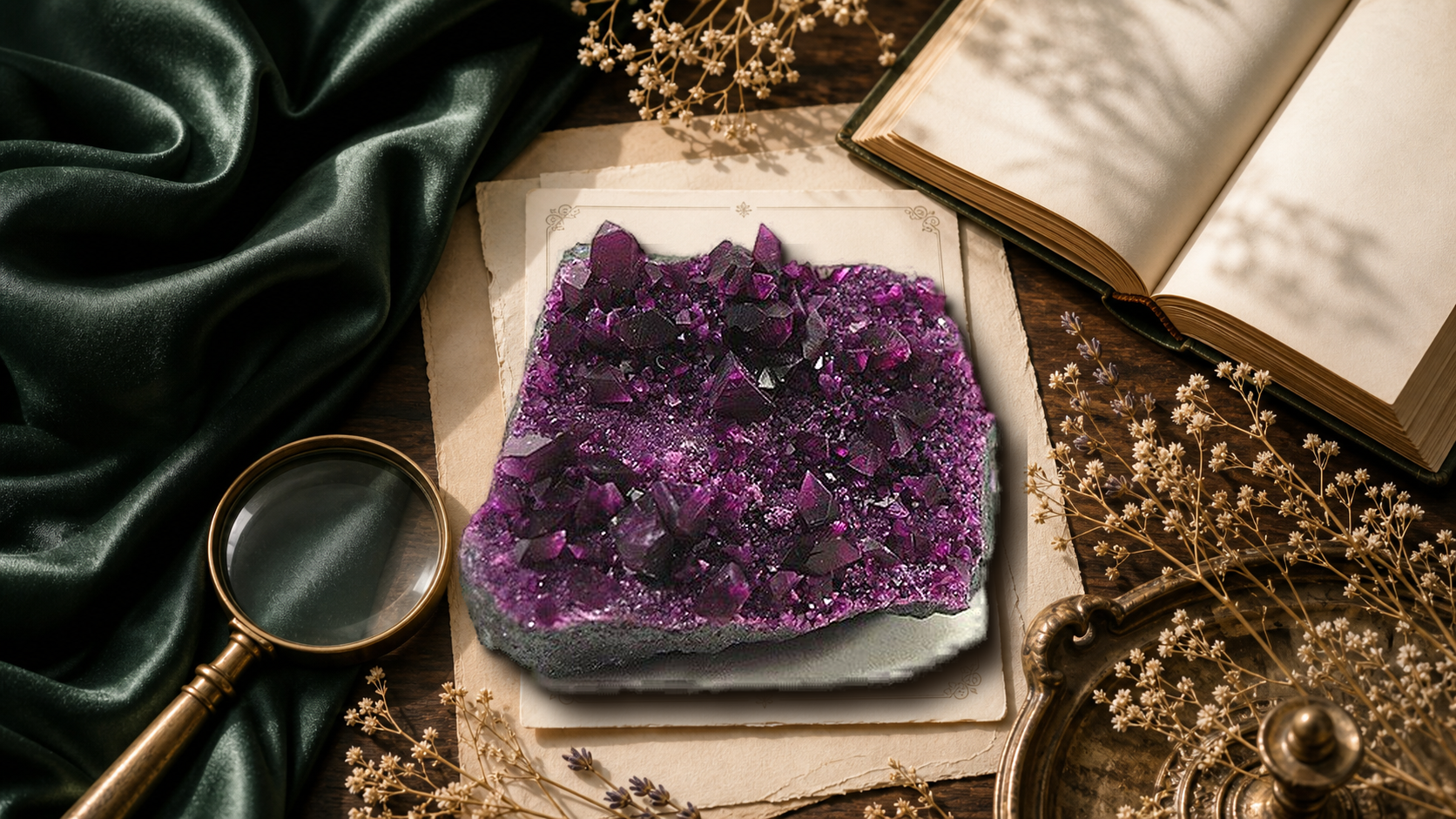
Your intensity keeps coming out harder than you mean it to. Kammererite is a chromium-rich chlorite, magenta-violet in soft micaceous sheets that bend instead of snapping. Strong color can live in a flexible body.
The body meets this stone through texture before meaning. For kammererite, the body often starts with direct sensory appraisal before any symbolism forms. The material...
The Meaning
Kammererite in the Crystalis dictionary
Some people do not need less intensity. They need a more flexible way to carry it. The issue is not the strength of the color but the body it arrives in. Too rigid a structure, and every vivid feeling sounds harsher than intended.
Kammererite solves that image beautifully. The chromium gives the stone its saturated violet-magenta presence, but the chlorite body remains micaceous, sheet-like, and inherently bendable. Brightness and pliancy meet in the same specimen.
Kammererite feels like emotional calibration rather than suppression because it says strong color can stay strong while the body carrying it becomes more flexible.
The line lands later.
Stone Lore
Stories carried through time
Cultural notes are presented as tradition and historical context — stories carried through time.
Ottoman Mining Tradition — Erzurum Province Turkey (pre-19th century)
The Purple Stone of Kop Daglari
Chromite mining in the Kop Mountains near Erzurum in eastern Anatolia incidentally produced vivid purple kammererite crystals growing on chromite matrix. Ottoman-era miners and local populations encountered this material while extracting chrome ore, a strategic industrial mineral. The purple crystals had no industrial value and were initially discarded or kept as curiosities. Turkish mineral collectors later recognized the Kop Daglari locality as producing the finest kammererite specimens in the world.
The stone's beauty was a byproduct of industrial extraction, found while looking for something else entirely.
Origin lore
The Type Description from Bissersk
Kammererite was formally described in 1841 from specimens collected in the Bissersk mining district of the Ural Mountains, Russia. The mineral was named after August Alexander Kammerer, a mining director in the St. Petersburg region....
Russian Imperial Mining — Ural Mountains (1841)
Historical note
The Outokumpu Chrome Connection
Finland's Outokumpu copper-zinc-cobalt ore district, mined since the 1910s, also hosts chromite-bearing serpentinite rocks that produce kammererite. Finnish geologists documented kammererite as part of the broader metamorphic mineral...
Finnish Geological Tradition — Outokumpu Region (20th century)
Historical note
The Shetland Serpentinite Specimens
The Shetland Islands of Scotland host some of the largest ultramafic rock exposures in the British Isles, remnants of ancient oceanic crust. Kammererite was identified in the Shetland serpentinites by British geologists mapping the complex...
At the edge of a volatile-rich melt, Kammererite forms part of the chlorite group, specifically as a chromium-rich variety of clinochlore developed in ultramafic rocks that have been serpentinized and later altered again by chromium-bearing fluids. Those rocks begin as magnesium- and iron-rich mantle-derived material. During hydration, metasomatism, and low- to moderate-temperature metamorphism, sheet silicates assemble in layers.
Chromium substitutes into the octahedral sites and pushes the color toward rose-purple, magenta, or plum. That substitution matters because most chlorites stay green; kammererite announces an unusual chemistry in the host rock. The monoclinic structure often appears pseudohexagonal to the eye because the platy crystals stack into rosettes and foliated masses. Hardness remains low, generally around 2 to 2.
5, and the pearly to vitreous luster comes from cleavage surfaces that split along the sheets. It is not a gem material in the conventional sense. It is a metamorphic signal, a record of chromium moving through serpentinite, peridotite, or related rocks under conditions that favor chlorite stability rather than spinel or garnet. Turkish and Russian occurrences are particularly known among collectors.
In the hand, the layered structure changes the body's reading of the stone. Rather than a single solid directive, it offers thin stacked planes, one over another, as if regulation might come by lamination instead of force. The somatic invitation is not to harden. It is to let the nervous system settle in sheets, each layer lying down over the next until agitation loses its vertical grip.
Crystal system diagram represents the general monoclinic classification. Diagram created by Crystalis for educational reference.
Monoclinic structure
Chemical Formula
Mg5(Al,Cr)2Si3O10(OH)8
Crystal System
Monoclinic
Mohs Hardness
2
Specific Gravity
2.62-2.66
Luster
Vitreous to pearly
Color
Purple-Pink
IMA Status
variety
Type Locality
Kop Krom mine, Erzurum Province, Turkey
IMA Number
Not IMA-approved (variety of Clinochlore, grandfathered 1851)
01
Mineral conditions gather
02
Structure begins to crystallize
03
Kammererite records place and pressure
Primary Sources: Russia (Ural Mountains), Turkey, India
Kammererite is a rare chromium-rich variety of clinochlore (chlorite group), named after August Alexander Kämmerer who discovered it in Russia's Ural Mountains. Its striking violet to purple-pink coloration comes from chromium substitution in the crystal lattice. This high-vibration stone activates the higher heart chakra (thymus) and crown chakra simultaneously, creating a bridge between human love and divine compassion.
Kammererite is prized for its ability to facilitate spiritual transformation through the "violet flame". a metaphysical concept of transmuting lower energies into higher frequencies. Primary Sources: Russia (Ural Mountains), Turkey, India
TurkeyRussiaFinland
Telling it apart
Kammererite is a chromium bearing clinochlore, a variety of chlorite, and the market confusion involves purple mica, dyed material, and generic chlorite sold under the kammererite name for a rarity premium. The confirming check is softness combined with the distinctive purple to magenta color from chromium: kammererite sits at only Mohs 2 to 2. 5, has perfect basal cleavage into flexible inelastic folia, and specific gravity around 2.
60 to 2. 66. Mica looks similar but is elastic when bent, while chlorite folia bend but do not spring back. Genuine kammererite usually appears as tabular to hexagonal crystals or foliated masses in a vivid rose violet color. If the purple mineral feels like mica but the sheets stay bent instead of snapping back, chlorite is confirmed. The chromium driven color must be natural, not dyed, so check for color concentration in surface irregularities.
Your hands slow down. Your grip pressure drops to almost nothing; fingers loose, palms open, wrists soft. Your whole motor system downshifts as if you were handling something that would break if you moved at normal speed. Your breathing follows the hands: slower, lighter, less forceful. You did not choose this gentleness. Your body calculated the fragility of the situation and adjusted without consulting you.
Shut down & far away
Purple Flake Anxiety
Micro-tremors in your fingers. A low hum of worry that you will damage something; the stone, the moment, the thing you are trying to hold. Your breath catches slightly on the inhale, never quite filling. Your shoulders creep upward. There is a vigilance in your hands that spreads into your forearms and jaw. You are being too careful, and you know it, and you cannot stop being careful.
Settled & connected
Soft Collapse Permission
Your body gives up trying to be strong and simply softens. Your spine curves forward slightly. Your chest becomes concave rather than lifted. Your exhale is longer than your inhale and you do not correct it. Something in you decided that hardness was not required right now. Your muscles are releasing tension you did not realize you were carrying. This is not weakness; it is the body choosing a different strategy.
These associations come from tradition and reflective practice — a way of working with the stone, not a medical prescription.
Somatic Practice
Simple ways to work with Kammererite
◇
Hold
Carry Kammererite in a pocket or place it over the heart center during a pause.
◌
Meditate
Let the stone become a quiet tactile anchor while the breath slows.
☽
Breathe
Breathe in softness. Breathe out tension. Keep the practice simple.
✎
Journal
Write with Kammererite nearby to name the feeling without forcing a conclusion.
✋
Bodywork
Rest the stone near the chest, hand, or bedside as a reminder to soften.
⌂
Environment
Place it where you want a visual cue for care, repair, or steadiness.
Field Instruction
Crystalis Protocol: The Fragility Recalibration
What you cannot grip tightly teaches your hands a different language.
45 sec protocol
1
Unwrap the kammererite slowly. Do not pick it up yet. Look at it resting on the cloth. Notice the layered structure and the color. Kammererite is softer than your fingernail. Before you touch it your hands need to know this. Flex your fingers open and closed three times — then open them one final time and leave them soft. Your hands are preparing to hold something that does not tolerate force.
2
Slide one hand underneath the cloth supporting the stone and lift both together. Let the kammererite rest on the fabric in your open palm. Do not close your fingers around it. Notice the weight — almost nothing. Notice the color — purple deeper than you expected. Breathe and watch your hand. If your fingers start to curl inward to grip stop them. The practice is the open palm. The stone stays on its cloth bed.
3
With your free hand hover one fingertip one centimeter above the stone's surface. Do not touch it. Hold the hover. Notice the impulse to make contact and the restraint required to maintain the gap. Your body wants to complete the circuit — finger to surface — and you are keeping it open. That sustained almost-touch builds a different kind of attention than contact does. Stay in the gap for two full minutes.
4
Lower the stone back to its resting surface. Withdraw your hands and place them on your knees. Close your eyes and feel the residue of gentleness in your palms. Your hands moved differently for the last five minutes than they normally do. That motor pattern — open light restrained — is now in your body's recent memory. Stand up and carry that hand quality into the next thing you touch.
Stone Intelligence
The fact that makes Kammererite memorable
Chromium-rich clinochlore from serpentinites and chromite deposits. Purple-red from the same chromium that makes emeralds green, expressed through a different crystal structure. The science documents how one element produces opposite colors in different mineral hosts.
The practice asks what identity means when the same ingredient creates something unrecognizable in a different setting.
SCI
Alteration of chromitites from Voidolakkos and Xerolivado mines Vourinos ophiolite
Somatic Protocol: "The Violet Flame Purification" (3 minutes)
3 Minutes
Preparation: Lie down comfortably. Place Kammererite on your higher heart (center of chest, above physical heart). Minute 1 - Invocation: Visualize a violet flame rising from the stone, surrounding your entire body in a column of transmuting light. Minute 2 - Release: As you exhale, imagine any negativity, trauma, or lower energies being drawn into the violet flame and transformed into pure light.
Minute 3 - Ascension: Move the stone to your crown. Feel the purified energy rising upward, connecting you to higher realms of consciousness. Contraindications: May bring up suppressed emotions. Have grounding stones nearby. Dosage Framework
Condition
Application Method
Duration
Frequency
Spiritual Transformation
Higher heart meditation
15-20 minutes
Daily
Energy Purification
Full body layout
30 minutes
Weekly
Heart Opening
Wear as pendant
Continuous
Crown Activation
Crown chakra placement
10 minutes
As needed
Protection
Carry in pocket
All day
Sacred Match
Sacred Match reaches for Kammererite when what you feel sounds like:
skin-level overwhelm from too much external contact
tender but defended in the same breath
social residue clinging after the encounter is over
need for softness that does not collapse under its own gentleness
emotional static at the surface that will not discharge
Sacred Match listens to the body rather than to preference. It senses whether surface sensitivity is hypervigilance, boundary failure, or a body that generates intensity through its own color but lives in sheets soft enough to bend. When that points to sympathetic activation at the dermal layer with preserved desire for contact, Kammererite is the stone it offers. This is chromium-bearing clinochlore, magenta-violet chlorite in soft micaceous sheets at Mohs 2-2.5. Strong color in a flexible body.
Skin-level overwhelm -> dermal-sympathetic activation -> phyllosilicate sheet structure at (Mg,Cr)5Al(AlSi3O10)(OH)8 provides layers that absorb contact without transmitting it all the way through
Tender but defended -> ventral openness with sympathetic guard -> perfect basal cleavage with flexible but not elastic sheets means the layers give without springing back, absorbing rather than bouncing
Social residue clinging -> boundary porosity after contact -> Mohs 2-2.
5 is deliberately soft because the prescription addresses a surface problem, not a structural one
Need for softness that holds -> desire for gentle durability -> rose-pink to deep magenta-purple from Cr3+ substituting for Mg and Al provides color saturation that does not require hardness to be vivid
Emotional static at surface -> charge accumulation at the boundary -> specific gravity 2.
62-2. 66 is light enough that the stone does not add mass to an already overloaded surface layer
Pairings are treated like a recipe file: clear use, method, and safety.
Crystal Companion
Kammererite + Amethyst
Use when
You want to layer the primary intention with another supportive tone.
How to work with it
Place the stones together during meditation, journaling, or a short reset.
Safety
Use as a reflective practice tool, not as a medical substitute.
Crystal Companion
Kammererite + Rhodonite
Use when
You want to layer the primary intention with another supportive tone.
How to work with it
Place the stones together during meditation, journaling, or a short reset.
Safety
Use as a reflective practice tool, not as a medical substitute.
Crystal Companion
Kammererite + Clear Quartz
Use when
You want to layer the primary intention with another supportive tone.
How to work with it
Place the stones together during meditation, journaling, or a short reset.
Safety
Use as a reflective practice tool, not as a medical substitute.
Crystal Companion
Kammererite + Black Tourmaline
Use when
You want to layer the primary intention with another supportive tone.
How to work with it
Place the stones together during meditation, journaling, or a short reset.
Safety
Use as a reflective practice tool, not as a medical substitute.
The anchor combination comes first. Kammererite benefits from companions that either clarify its strongest trait or balance its weakest one.
Black Tourmaline
soft shield. Kammererite brings unusual color and a gentle mica softness. Black tourmaline gives it a firmer perimeter. Placement: Kammererite at the sternum, black tourmaline in a coat pocket. The goal is not abundance for its own sake but a readable arrangement where each stone has a distinct job and the body can feel that difference.
Lepidolite
layered decompression. Both are sheet silicates, so the pairing emphasizes settling by layers rather than sudden release. Placement: Keep one on each side of the pillow. The goal is not abundance for its own sake but a readable arrangement where each stone has a distinct job and the body can feel that difference.
Rose Quartz
tender boundary work. Rose quartz keeps the emotional field open while kammererite reduces the sense of raw exposure. Placement: Rose quartz on the chest, kammererite in the palm. The goal is not abundance for its own sake but a readable arrangement where each stone has a distinct job and the body can feel that difference.
Selenite
clarity through softness. Selenite clears the field; kammererite makes the cleared space feel inhabitable instead of stark. Placement: Arrange them in parallel lines on a bedside table. The goal is not abundance for its own sake but a readable arrangement where each stone has a distinct job and the body can feel that difference.
Care & Cleansing
How to keep Kammererite in good condition
Water Safe?
Keep dry
This stone should stay out of water. Water can dull the surface, destabilize the specimen, or damage the stone over time.
Sunlight Safe?
Sunlight safe
Tolerates daylight; safe to charge or display in the sun.
Authenticity
What to check
Natural Kammererite should usually feel cooler than plastic or resin on first touch and warm more slowly in the hand.
Can Kammererite Go in Water?
No. Avoid Water.
Kammererite is a chromium-bearing variety of clinochlore, a magnesium aluminum silicate hydroxide (Mg5Al(AlSi3O10)(OH)8 with Cr) with Mohs hardness of only 2 to 2.5. This is extremely soft. Water erodes the surface readily, and the layered silicate structure absorbs water between sheets, causing swelling and delamination.
Salt water: never.
Gem elixirs: never. Chromium content is a concern.
Cleansing Methods
Moonlight: Overnight on a soft surface. The only recommended method.
Selenite plate: Rest on selenite for 4 to 6 hours.
Smoke: Very brief pass through sage smoke at a distance, 15 seconds. Keep heat away from this soft mineral.
Storage and Handling
Kammererite is a display mineral only. At Mohs 2 to 2.5, a fingernail scratches it. The violet-red crystal rosettes are extremely fragile. Store on padded surfaces in sealed display cases. Never store in bags or pouches. Handle by the matrix, never by the crystal rosettes. Keep in a dry environment. The vivid color comes from chromium and is light-stable, but the crystal structure cannot tolerate mechanical stress.
Temperature
Natural Kammererite should usually feel cooler than plastic or resin on first touch and warm more slowly in the hand.
Scratch logic
Use 2 on the Mohs scale as the check, not internet myths. A real specimen should behave in line with the hardness listed above.
Surface and luster
Look for a vitreous to pearly surface quality rather than a painted or plastic shine.
Weight and density
The listed specific gravity is 2.62-2.66. If a specimen feels unusually light for its size, it may deserve a second look.
My Field Guide
Your private record and next steps
Journal
Add this stone to your private collection, then log what happened when you worked with it.
Shared Notes
Read public practice logs and pattern notes from the Crystalis community.
When members save a public field note for this stone, it will appear here.
Frequently Asked
Questions people ask about Kammererite
What is kammererite?
⌄
Kammererite is a chromium-bearing variety of the mineral clinochlore, a member of the chlorite group. Its formula is Mg5(Al,Cr)2Si3O10(OH)8. It crystallizes in the monoclinic system and registers only 2 to 2.5 on the Mohs scale, softer than a copper penny. The vivid purple to magenta-red color comes from chromium replacing aluminum in the crystal structure.
Why is kammererite so soft?
⌄
Kammererite belongs to the chlorite group, sheet silicates with layered crystal structures held together by weak Van der Waals forces between the sheets. This is the same structural reason mica peels apart in flakes. At Mohs 2 to 2.5, kammererite can be scratched with a fingernail. This softness is a defining characteristic, not a defect. Handle it accordingly.
Where is kammererite found?
⌄
The most famous locality is Kop Daglari (Kop Mountains) in Erzurum Province, Turkey, which produces the vivid purple-red crystals prized by collectors. Other sources include Finland, Russia's Ural Mountains, the Shetland Islands of Scotland, and various chromite deposits worldwide. Kammererite forms in metamorphosed chromite-bearing rocks, so it appears wherever chromium-rich ultrabasic rocks have been altered.
What chakra is associated with kammererite?
⌄
Kammererite is associated with the heart and crown chakras simultaneously. Place it on your chest and notice the paradox, a stone this fragile asks you to stop gripping. You cannot hold kammererite tightly without risking damage. That forced gentleness is the somatic entry point. Your hands learn to cradle before your mind decides what the stone means.
How should you handle kammererite?
⌄
With extreme care. At Mohs 2 to 2.5, kammererite scratches easily and can flake along its layered crystal planes. Never clean with ultrasonic devices, steamers, or harsh chemicals. Use only a soft brush and room-temperature water if cleaning is necessary. Store wrapped in soft cloth, separated from all other minerals. Do not stack anything on top of it. The stone teaches you to be careful by being breakable.
What gives kammererite its purple color?
⌄
Chromium. Specifically, Cr3+ ions substituting for aluminum in the octahedral sites of the clinochlore crystal structure. The same element that makes rubies red and emeralds green produces purple in this particular crystal environment. The intensity of color directly correlates with chromium concentration: more chromium, deeper purple. This is not a coating or stain; the color is structural.
Is kammererite suitable for jewelry?
⌄
Not for standard jewelry. Its extreme softness (Mohs 2-2.5) and perfect basal cleavage make it vulnerable to scratching, chipping, and flaking under normal wear conditions. Collector specimens are displayed rather than worn. If set in jewelry at all, it requires a fully protective bezel setting and should only be worn occasionally with extreme caution. Most lapidaries will not attempt to facet it.
How do you work with kammererite physically?
⌄
Kammererite demands a different tempo. Unwrap it slowly. Let it rest in an open palm, no gripping. Place it on your upper chest near the collarbone and lie still. Breathe without urgency. The stone's fragility recalibrates your motor patterns; you become more deliberate because the material requires it. That shift in muscular attention is the work. You do not need to add a narrative.
Sources & Citations
Where this entry can be checked
Back Matter
Readable for people. Structured for AI search.
Sources stay visible in the page so readers, search engines, and answer systems can follow the evidence trail.
01
SCI
Alteration of chromitites from Voidolakkos and Xerolivado mines Vourinos ophiolite
Kapsiotis, A.N. (2014). Alteration of chromitites from Voidolakkos and Xerolivado mines Vourinos ophiolite. Geological Journal. [SCI]DOI 10.1002/gj.2590
02
SCI
Serpentinised Mantle Section of Neoproterozoic Ophiolite at Al-Barramiya
Abuamarah, B.A. et al. (2024). Serpentinised Mantle Section of Neoproterozoic Ophiolite at Al-Barramiya. Geological Journal. [SCI]DOI 10.1002/gj.5066
03
SCI
Near-Infrared Spectroscopic Study of Chlorite Minerals
Yang, M. et al. (2018). Near-Infrared Spectroscopic Study of Chlorite Minerals. Journal of Spectroscopy. [SCI]DOI 10.1155/2018/6958260