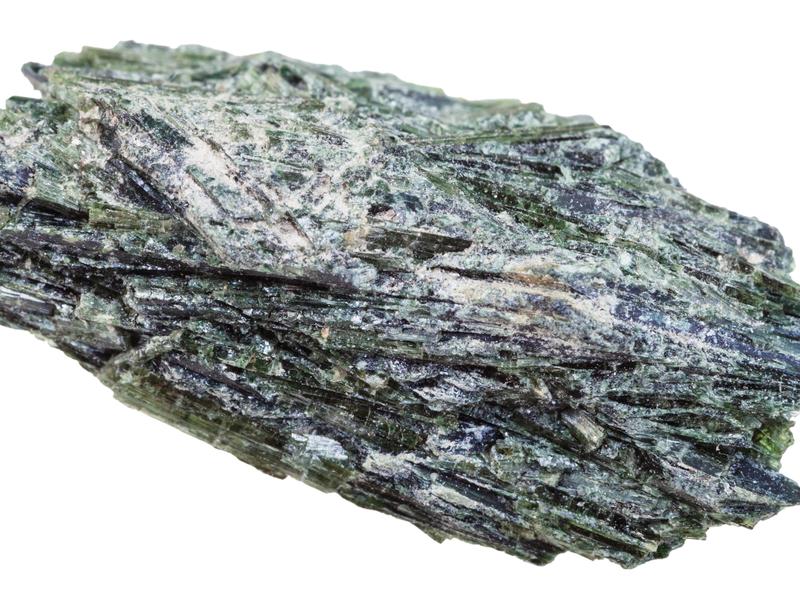
You feel backed into a corner where there is no room to move. Actinolite grows as bladed green fibers under metamorphic pressure, leaving behind a structure that survives by extending rather than locking shut. Strength sometimes looks like reaching farther into yourself.
Actinolite speaks to the root and lower legs, the part of the body that organizes stance, bracing, and the decision to keep moving under pressure. In nervous system...
The Meaning
Actinolite in the Crystalis dictionary
There is a kind of stress that shortens everything. Breath. Temper. Patience. The back goes rigid before the thought has finished forming. The jaw joins in. By the end of it, the whole self is living on less room than it used to.
Actinolite offers a line instead of a wall.
Bladed crystals. Length under pressure. A shape that keeps moving outward while the surrounding rock is being changed by force.
That image lands fast in the body. More space between the ribs. A little more neck. A little less panic around softening.
Stone Lore
Stories carried through time
Cultural notes are presented as tradition and historical context — stories carried through time.
Maori greenstone carving tradition (New Zealand)
Nephrite Pounamu and the Breath of Ancestors
Maori carvers in New Zealand have worked nephrite jade, which contains actinolite, into hei-tiki pendants and mere clubs for over 700 years. The Ngai Tahu iwi of the South Island consider pounamu a taonga, a treasure that carries the breath of the person who wore it. When pounamu is gifted, it transfers the warmth of the giver. When it is found in a river, it is understood to have chosen to reveal itself.
The actinolite fibers that compose nephrite were not named by Western mineralogy until 1794, but the Maori relationship with this material predates that classification by centuries.
Ritual history
The Bi Disc and the Five Virtues of Jade
Chinese jade culture, which relies primarily on nephrite containing actinolite, dates to at least 5000 BCE with the Hongshan and Liangzhu cultures producing jade bi discs and cong tubes. Confucian texts from the Zhou dynasty (1046-256 BCE)...
Chinese jade tradition (Neolithic to present)
Ritual history
The Naming of Actinolite in the Bernese Oberland
The Irish mineralogist Richard Kirwan used the name actinolite in 1794, derived from the Greek aktinos (ray) and lithos (stone), describing the radiating fibrous habit he observed in specimens from the Swiss Alps. However, Alpine...
Swiss Alpine mineralogy (18th century)
Ritual history
Green Stone in Sowa Rigpa Materia Medica
In the Tibetan medical tradition of Sowa Rigpa, green stones classified under the category of gyu (turquoise family, broadly applied to green minerals) have been used in external applications since at least the 12th century codification of...
Tibetan medicine and stone practice
Earth Record
Mineralogy and formation
Actinolite is what happens when a rock is forced to reorganize without ever fully melting. In calcareous sediments, mafic rocks, and ultramafic bodies caught in low to medium grade metamorphism, heat and directed pressure drive magnesium, calcium, iron, silica, and water into a new amphibole framework. The crystal emerges as often not a single clean crystal but sprays of blades, fibrous seams, and radiating masses, a habit that tells the story of growth in confinement rather than leisure.
Most specimens come from greenschist to amphibolite conditions, or from contact zones and skarns where chemically reactive rocks sit beside an intrusion and fluids keep moving through them.
Its chemistry sits between tremolite and ferro actinolite, with iron substituting for magnesium in the double chain silicate structure. That substitution matters. It is what deepens the color from pale to saturated green, and it shifts density and optical behavior without changing the basic amphibole architecture. Water is structurally present as hydroxyl, so the mineral belongs to a family that records hydrous metamorphism with unusual honesty.
Parent rocks rich in calcium and magnesium, dolomitic marbles, altered basalts, serpentinites, and impure limestones, provide the necessary ingredients. Fluids rich in silica help stabilize the amphibole, especially in metasomatic zones where composition changes across only a few centimeters.
Actinolite is monoclinic, but the structural idea matters more than the label. Its silicate tetrahedra are linked into double chains, and those chains create the characteristic amphibole cleavage at about 56° and 124°. That oblique geometry produces blades and splintery fibers instead of the blockier habits seen in many other silicates. Even when crystals are bent, kinked, or intergrown, the lattice preserves a directional logic. Growth keeps selecting length.
This is why actinolite so often looks as if it found one narrow path and kept taking it. Under metamorphic pressure it does not answer by collapsing inward, it answers by extending, making room through elongation. The final impression is not softness and not rigidity, but a kind of mineral reach: structure surviving by finding one more line outward, one more green blade through the rock.
That directional growth is the stone's physical argument. Faced with confinement, the lattice keeps choosing extension over closure, as if pressure itself had taught the mineral to reach farther instead of locking shut.
Crystal system diagram represents the general monoclinic classification. Diagram created by Crystalis for educational reference.
Monoclinic structure
Chemical Formula
Ca2(Mg,Fe2+)5Si8O22(OH)2
Crystal System
Monoclinic
Mohs Hardness
5
Specific Gravity
3.0-3.4
Luster
Vitreous to silky
Color
Green
IMA Status
species
Type Locality
Type locality not known
IMA Number
pre-IMA (Grandfathered, first described 1794; redefined IMA 2012 s.p.)
01
Mineral conditions gather
02
Structure begins to crystallize
03
Actinolite records place and pressure
Actinolite forms in the metamorphic zones where limestone meets igneous intrusion. Calcium-rich sedimentary rock, subjected to intense heat and pressure, transforms into this fibrous amphibole. The green color comes from iron substituting for magnesium in the crystal lattice. more iron, deeper green. Named from Greek "aktis" (ray) for its radiating fibrous formations, actinolite often occurs as asbestos-like fibers or compact masses.
The same mineral family includes the more famous nephrite jade. actinolite is essentially jade's less celebrated cousin, formed under similar conditions but with different cultural destiny. Actinolite forms in schists and marbles, particularly where dolomitic limestone has been metamorphosed. The fibrous habit creates either radiating sprays or compact masses, sometimes with chatoyant (cat's eye) effects when cut en cabochon.
Major deposits occur in the Swiss Alps, the Canadian Shield, and the Appalachian Mountains.
Mineralogy: Amphibole group, Monoclinic system. Formula: Ca₂(Mg,Fe)₅Si₈O₂₂(OH)₂. Hardness: 5-6. Color: green from iron content. Fibrous habit, often asbestiform.
BrazilMadagascarTaiwanRussia
Telling it apart
Actinolite is easy to mistake for nephrite jade, epidote, and dark green tourmaline, and the fibrous material is sometimes offered as jade though it is a different mineral. The fastest test is cleavage angle and hardness: actinolite shows amphibole cleavage at about 56 and 124 degrees and scratches glass only weakly at Mohs 5 to 6, while nephrite is tougher and more felted, epidote is harder at 6 to 7, and tourmaline has no amphibole cleavage and usually reaches 7 to 7.
5. Genuine actinolite usually appears as bladed, splintery, or fibrous dark to medium green crystals with a silky to vitreous luster, often in radiating sprays or compact fibrous masses. Nephrite looks more waxy and compact, epidote tends toward pistachio green prismatic crystals, and black or green tourmaline shows strong vertical striations and a more even prism habit. If a piece is labeled jade, the specific gravity is an easy extra check: actinolite commonly runs about 3.
0 to 3. 4, distinctly heavier than many green feldspars and most dyed imitations. The distinction is worth caring about because jade commands a premium, so confirming the cleavage angle, hardness, and specific gravity lets you recognize actinolite for the handsome stone it is.
Spotting the real thing
Actinolite is rarely faked because it has limited commercial value. To confirm: fibrous to bladed crystal habit with vitreous to silky luster. Specific gravity 3.
0-3. 4 (heavier than quartz). Mohs 5-6.
Two cleavage planes at approximately 56/124 degrees (amphibole signature). Color ranges from pale green to dark green depending on iron content. If asbestiform, fibers will be flexible and silky.
Your chest feels like it is connected to something by a thread that keeps stretching thinner. You are not panicking, but you are not settled. Your breath stays shallow not from fear but from a low-grade sense that something is about to pull loose. Your hands stay busy. Your jaw holds tension you do not notice until someone points it out.
Shut down & far away
The Green Fade
Everything goes muted. You are physically present but your body has turned the volume down on sensation. Your ribs barely expand when you breathe. You can hear people talking but processing their words takes an extra beat. This is not sleep. This is your system dimming the lights to conserve what it has left.
Settled & connected
The Settled Root
Your breath reaches your lower ribs without effort. Your shoulders sit below your ears. You can feel the chair beneath you and the ground beneath the chair. Sounds register without startling you. Your body is present without bracing. There is nothing to solve right now, and your nervous system knows it.
These associations come from tradition and reflective practice — a way of working with the stone, not a medical prescription.
Somatic Practice
Simple ways to work with Actinolite
◇
Hold
Carry Actinolite in a pocket or place it over the heart center during a pause.
◌
Meditate
Let the stone become a quiet tactile anchor while the breath slows.
☽
Breathe
Breathe in softness. Breathe out tension. Keep the practice simple.
✎
Journal
Write with Actinolite nearby to name the feeling without forcing a conclusion.
✋
Bodywork
Rest the stone near the chest, hand, or bedside as a reminder to soften.
⌂
Environment
Place it where you want a visual cue for care, repair, or steadiness.
Field Instruction
The Fiber Return
Reweaving the nervous system through the chest wall
2 min protocol
1
Lie on your back on a firm surface. Place one actinolite blade flat on the center of your chest, directly over the sternum. Let your arms rest at your sides, palms up. Close your eyes. Feel the mineral weight settle into your ribcage. Notice which side of your chest the weight registers on more strongly.
2
Begin breathing at 5 counts in through the nose, 5 counts out through the mouth. Coherent breathing — equal parts. On each inhale, feel your ribs push upward against the stone. On each exhale, let gravity pull the stone deeper into your chest. Do not force depth. Let the breath be ordinary. Count the ratio honestly.
3
Shift your attention from the stone to the space between your shoulder blades on the back of your body. You are now tracking the back of your heart space. Notice if your upper back softens or if it stays armored. Breathe into the back ribs. The stone on the front is a reference point. The work is behind you.
4
Remove the stone and place both hands flat on your chest where it was. Breathe three breaths at your natural rhythm without counting. Notice the difference between the mineral weight and the warmth of your own hands. Open your eyes. Sit up slowly. The session is complete when you can name one sensation that shifted.
Stone Intelligence
The fact that makes Actinolite memorable
Actinolite forms as bladed green fibers in metamorphic rock, calcium and magnesium and iron silicate chains knitting together under pressure. The science documents how double-chain inosilicates grow in schists and marbles. The practice asks what happens when you hold something that was forged by compression and came out flexible.
SCI
Geochemistry and mineral chemistry of actinolite-bearing rocks
Your chest is bracing. The muscles between your ribs tighten when you hold your breath against what you do not want to feel. Actinolite is a calcium magnesium iron silicate, Mohs 5, with a specific gravity that registers as substantial without being heavy. Hold it at the sternum. The thermal mass absorbs heat slowly from your skin. The weight gives your intercostal muscles something to push against besides themselves.
SAFETY: Actinolite can occur in fibrous form (one of the regulated asbestos minerals). Handle only solid, non-fibrous specimens. Wash hands after contact.
Sacred Match
Sacred Match reaches for Actinolite when what you feel sounds like:
chest pinned, breath held at the top
shoulders rising as if bracing for impact
jaw set when options narrow
pacing without finding an exit
feeling trapped inside your own reaction
Sacred Match listens to the body rather than to preference. It senses whether the body is responding to pressure by collapsing, exploding, or finding one more degree of movement. When that points to sympathetic constriction with mobility loss, a nervous system that reads compression as entrapment and answers by hardening, Actinolite is the stone it offers. Its pattern is not softness. It is directional flexibility. This is the match for a body that does not need more force, but a way to extend without breaking.
Breath held high -> sympathetic bracing -> seeking enough internal room to move again
Shoulders up -> defensive contraction -> seeking length without losing protection
Jaw set -> motor inhibition under pressure -> seeking a usable line of action
Pacing -> trapped activation -> seeking forward motion instead of circular discharge
Feeling cornered -> collapse of perceived options -> seeking strength that can reach farther
Pairings are treated like a recipe file: clear use, method, and safety.
Crystal Companion
Actinolite + Amethyst
Use when
You want to layer the primary intention with another supportive tone.
How to work with it
Place the stones together during meditation, journaling, or a short reset.
Safety
Use as a reflective practice tool, not as a medical substitute.
Crystal Companion
Actinolite + Rhodonite
Use when
You want to layer the primary intention with another supportive tone.
How to work with it
Place the stones together during meditation, journaling, or a short reset.
Safety
Use as a reflective practice tool, not as a medical substitute.
Crystal Companion
Actinolite + Clear Quartz
Use when
You want to layer the primary intention with another supportive tone.
How to work with it
Place the stones together during meditation, journaling, or a short reset.
Safety
Use as a reflective practice tool, not as a medical substitute.
Crystal Companion
Actinolite + Black Tourmaline
Use when
You want to layer the primary intention with another supportive tone.
How to work with it
Place the stones together during meditation, journaling, or a short reset.
Safety
Use as a reflective practice tool, not as a medical substitute.
Black Tourmaline
The Back Wall.
Actinolite helps the practitioner find room to move under pressure. Black tourmaline keeps outside demands from closing in further. For anyone cornered by other people's urgency, especially at work or in family conflict. Place actinolite in the left hand and black tourmaline in the right, or keep actinolite at the sternum and tourmaline in the dominant pocket during hard conversations.
Moss Agate
The Recovery Pattern.
Actinolite has a fibrous, forward-reaching structure. Moss agate steadies growth so the push to survive does not become panic. Best suited to rebuilding after burnout, illness, or a long stalled period. Place actinolite over the solar plexus and moss agate below the navel while lying down for 10 minutes.
Smoky Quartz
Pressure Outlet.
Actinolite holds internal strength without locking up. Smoky quartz gives stress somewhere to go. Together they help when tension is stored in the chest, jaw, and gut. Works for people who stay functional under pressure but feel packed tight inside. Hold actinolite in the receiving hand and smoky quartz in the active hand during breathwork, then carry smoky quartz in a pocket afterward.
Clear Quartz
The Direction Finder.
Actinolite extends. Clear quartz sharpens where that extension should go. This pairing is useful when the practitioner needs one clean next move instead of ten defensive ones. Place clear quartz at the brow and actinolite at the sternum during planning or journaling.
Care & Cleansing
How to keep Actinolite in good condition
Water Safe?
Keep dry
This stone should stay out of water. Water can dull the surface, destabilize the specimen, or damage the stone over time.
Sunlight Safe?
Sunlight safe
Tolerates daylight; safe to charge or display in the sun.
Authenticity
What to check
Natural Actinolite should usually feel cooler than plastic or resin on first touch and warm more slowly in the hand.
Can Actinolite Go in Water?
Caution. Brief Rinse Only.
Actinolite is a calcium magnesium iron inosilicate (Ca2(Mg,Fe)5Si8O22(OH)2) with Mohs hardness of 5 to 6. It tolerates a brief rinse under cool running water for 15 to 30 seconds. Prolonged soaking is not recommended. The fibrous habit of some actinolite specimens (particularly the asbestiform variety) means water can penetrate between fibers and weaken the structure over time. Salt water should be avoided entirely, as salt crystallizes in fibrous interstices and accelerates degradation.
Safety Warning: Some actinolite occurs in asbestiform habit. If your specimen has a silky, fibrous, or hair-like texture, do not run water over it, do not brush it, and do not handle it without knowing its habit. Massive, non-fibrous actinolite is safe to handle normally. If uncertain, treat the specimen as display-only.
Cleansing Methods
Moonlight: Place on a soft surface under moonlight overnight. Safe for all actinolite specimens regardless of habit. No physical stress.
Sound: Singing bowl or tuning fork held near the stone for 2 to 3 minutes. Vibrational cleansing avoids any water or mechanical contact.
Smoke: Pass through sage or palo santo smoke for 30 to 60 seconds. No contact stress.
Storage and Handling
Store separately from harder stones (quartz, topaz, corundum) that will scratch actinolite's softer surface. Wrap in soft cloth. At Mohs 5 to 6, actinolite scratches easily against stones above Mohs 6. Keep fibrous specimens in sealed display cases to prevent fiber release. Do not store in fabric pouches where fibers could transfer to cloth.
Temperature
Natural Actinolite should usually feel cooler than plastic or resin on first touch and warm more slowly in the hand.
Scratch logic
Use 5 on the Mohs scale as the check, not internet myths. A real specimen should behave in line with the hardness listed above.
Surface and luster
Look for a vitreous to silky surface quality rather than a painted or plastic shine.
Weight and density
The listed specific gravity is 3.0-3.4. If a specimen feels unusually light for its size, it may deserve a second look.
My Field Guide
Your private record and next steps
Journal
Add this stone to your private collection, then log what happened when you worked with it.
Shared Notes
Read public practice logs and pattern notes from the Crystalis community.
When members save a public field note for this stone, it will appear here.
Frequently Asked
Questions people ask about Actinolite
What is actinolite used for in crystal work?
⌄
Actinolite is a green amphibole mineral placed on or near the chest to support nervous system regulation during periods of emotional compression. Its fibrous internal structure and calcium-magnesium composition make it a grounding companion when your body needs to settle without shutting down. It is not a substitute for clinical care.
Is actinolite the same as jade?
⌄
Actinolite is one of the two minerals that compose nephrite jade, the other being tremolite. When actinolite fibers interlock densely enough, the resulting mass is classified as nephrite. A standalone actinolite crystal, however, has its own distinct blade-like or fibrous habit and is not automatically jade.
Is actinolite safe to handle?
⌄
Solid, non-fibrous actinolite specimens are generally safe to handle. However, fibrous varieties fall within the amphibole group and share structural similarities with asbestiform minerals. Do not cut, grind, or sand actinolite, and wash your hands after handling raw specimens.
What chakra is actinolite associated with?
⌄
Actinolite is associated with the heart chakra. In practice, this means it is placed on the center of the chest during protocols. The green color and calcium-magnesium chemistry correspond to traditions that link green stones with the cardiac and respiratory centers of the body.
Where is actinolite found?
⌄
Actinolite forms in metamorphic rocks worldwide, with notable specimens from Switzerland, Tanzania, Madagascar, and the Canadian provinces. It develops where silica-rich fluids interact with magnesium-iron-bearing rocks under moderate heat and pressure. The monoclinic crystal system gives it elongated, bladed forms.
How hard is actinolite?
⌄
Actinolite sits at 5 to 6 on the Mohs scale, which means it can scratch glass but can be scratched by a steel file. This moderate hardness makes it durable enough for handling but too soft for rings or bracelets worn daily. Store it separately from harder stones to avoid surface damage.
What does actinolite look like?
⌄
Actinolite ranges from dark green to pale green, sometimes nearly black when iron content is high. It typically forms elongated bladed crystals or fibrous masses. The luster is vitreous to silky depending on habit, and translucent specimens can show a beautiful internal glow when backlit.
Can actinolite go in water?
⌄
Brief rinsing is generally acceptable for solid actinolite specimens. Extended soaking is not recommended because the fibrous structure can degrade over time, and any loose fibers should not be consumed or inhaled. If you want to cleanse actinolite, a dry method like placing it on selenite is a safer choice.
Sources & Citations
Where this entry can be checked
Back Matter
Readable for people. Structured for AI search.
Sources stay visible in the page so readers, search engines, and answer systems can follow the evidence trail.
01
SCI
Geochemistry and mineral chemistry of actinolite-bearing rocks
Topien, R.M. et al. (2023). Geochemistry and mineral chemistry of actinolite-bearing rocks. Geological Journal. [SCI]DOI 10.1002/gj.5177
02
SCI
Raman spectroscopy of Ca-amphiboles
Waeselmann, N. et al. (2018). Raman spectroscopy of Ca-amphiboles. Journal of Raman Spectroscopy. [SCI]DOI 10.1002/jrs.5626
03
SCI
Characterization of Actinolite: Evaluating the Potential for Its Use as a Natural Mineral Fiber
Campopiano, A. et al. (2015). Characterization of Actinolite: Evaluating the Potential for Its Use as a Natural Mineral Fiber. Journal of Spectroscopy. [SCI]DOI 10.1155/2015/974902