Crystal Encyclopedia
40+YEARS

Amazonite With Smoky Quartz

Amazonite: KAlSi3O8 (potassium feldspar / microcline variety) + Smoky Quartz: SiO2 · Mohs 6.5 · Mixed · Heart Chakra

The stone of amazonite with smoky quartz: meaning, mineralogy, and somatic practice.

CommunicationProtection & GroundingAnxiety ReliefEmotional Balance

This page documents traditional and cultural uses of amazonite with smoky quartz alongside emerging research on tactile grounding objects. Crystalis does not claim that amazonite with smoky quartz treats, cures, or prevents any medical condition. For mental health concerns, consult a qualified professional.

Crystalis Editorial · 40+ Years · Herndon, VA · 3 peer-reviewed sources

Origins: Colorado (USA), Brazil, Madagascar

Quick actions

Move from reference into practice

Crystalis

Materia Medica

Amazonite With Smoky Quartz

Grounded Truth

Amazonite With Smoky Quartz crystal
CommunicationProtection & GroundingAnxiety Relief
Crystalis

Protocol

The Pegmatite Hold

Where calm green meets grounded dark, hold both without choosing.

3 min

  1. 1

    Place the amazonite-smoky quartz specimen on a flat surface in front of you. Sit with both feet on the floor. Before picking it up, look at it. Amazonite's blue-green comes from trace lead and water in the feldspar lattice. The smoky quartz darkened over millennia as natural radiation displaced electrons in the silicon dioxide. One color was built in. The other was earned slowly. Observe both. (0:00–0:40)

  2. 2

    Pick up the stone and hold it in both hands at heart height. Close your eyes. The amazonite half is triclinic — the least symmetric crystal system, where no axis meets at a right angle. The quartz half is trigonal — balanced, threefold. Feel the stone as a single object that holds two different kinds of order. Breathe naturally. (0:40–1:20)

  3. 3

    Move the stone to your belly, just below the navel. Press gently inward. These two minerals grew together in a pegmatite — a pocket of magma that cooled slowly enough for large crystals to form. That slowness is what made both minerals visible and distinct. Breathe in for 4, out for 7. On each exhale, imagine the slow cooling that allowed complexity to emerge without force. Five breaths. (1:20–2:10)

  4. 4

    Return the stone to the surface in front of you. Open your eyes. Place one hand on the amazonite-colored area, one on the smoky quartz. Notice the temperature difference between your two hands after holding. Press both palms onto your knees and take one clearing breath. The pegmatite hold is complete. (2:10–3:00)

tap to flip for protocol

This stone belongs after the simpler self is gone. After grief, betrayal, burnout, or the long season when a person stops trying to become lovable by looking untouched.

Smoky quartz carries alteration in plain view. Amazonite keeps its cool open tone right next to it. Neither one asks the other to disappear.

Whole is rarely the same thing as clean.

What Your Body Knows

Nervous system states

Amazonite with smoky quartz addresses the throat and root together, linking expression with grounding. In nervous system terms it speaks to the transition between sympathetic activation and ventral steadiness, especially when the body can speak only if it also feels anchored. The mineral relevance is unusually direct because the specimen holds two complementary materials.

Amazonite is a blue green microcline feldspar with strong cleavage and a softer visual field. Smoky quartz is harder, denser in feel, and colored by irradiation related centers that give it a gray brown depth. Same geological environment, different responses.

One reads as opening, the other as settling. In somatic practice this pairing works through simultaneous sensory messages. The amazonite regions provide a visual anchor toward the upper body, cooling the gaze and softening the jaw, while smoky quartz gives the hand a darker, more gravitational reference.

Together they support a bottom and a voice. Tracing the boundaries between the minerals can also sharpen tactile discrimination, which is useful when activation makes sensation feel global and undifferentiated. Placed on the sternum, held in both hands, or used while seated with feet planted, the stone helps connect breath, chest, and lower body in one circuit.

The intervention is mechanical: color organizes attention, texture organizes touch, and weight organizes posture. Amazonite with smoky quartz is most active in transition, especially when anxious activation needs enough ground beneath it for honest, steady communication to emerge.

sympathetic

STATE 1

The amazonite-smoky quartz combination meets sympathetic activation with a two-mineral strategy that no single stone can replicate. Smoky quartz addresses the legs; the mobilization energy that wants to run. It draws sympathetic charge downward through the body, giving the fight-or-flight impulse a direction (down, into the earth) rather than letting it scatter as anxiety. Simultaneously, the amazonite addresses the throat and heart; the places where fight energy becomes aggressive speech or where flight energy becomes suppressed truth. In sympathetic activation, hold the combination specimen so that the smoky quartz portion faces your palm and the amazonite faces outward. The dark grounds inward; the blue-green broadcasts outward. The nervous system receives a dual signal: you are rooted (smoky) and you can speak (amazonite). Neither is sufficient alone for a system in full activation.

dorsal vagal

STATE 2

In dorsal vagal collapse, the combination specimen works differently than either mineral would individually. The smoky quartz, which in a mobilized state draws energy down, in a collapsed state serves as a density anchor; something real, something with mass, something that confirms materiality when the body feels like it is dissolving or disappearing. The amazonite's bright blue-green is one of the few colors that can penetrate the visual flatness of dorsal vagal shutdown; it does not demand attention like red or orange, but it offers presence like a window in a dark room. Place the combination specimen on the sternum while lying down. The weight says: you are here. The color says: there is an opening.

ventral vagal

STATE 3

When the social engagement system is fully online, the amazonite-smoky quartz combination amplifies the integration of truth-telling and grounding that characterizes healthy ventral vagal function. Amazonite supports the "clean" expression of truth; not aggressive, not suppressed, but calibrated and clear. Smoky quartz ensures that the speaker remains embodied while speaking, preventing the common trap of dissociating into intellectual truth-telling that disconnects from felt experience. This combination is the stone of the grounded truth-teller in safe company.

sympathetic

STATE 4

In states of safe excitement; athletic competition, creative flow, playful debate; the combination supports the simultaneous experience of mobilization (sympathetic) and connection (ventral vagal). The amazonite holds the relational channel open while the smoky quartz sustains the grounded energy needed for sustained creative or physical effort. This is the stone of the athlete, the performer, the teacher in full command of the classroom.

dorsal vagal

STATE 5

The rarest and most productive mixed state; deep rest with full awareness, meditation without disconnection; is supported by the natural polarity of this combination. The smoky quartz provides the dorsal-like stillness without the collapse; the amazonite provides the ventral-like openness without the social performance. Together, they hold the space between rest and vigilance that is the physiological ground of genuine meditation.

Nervous system mapping based on polyvagal theory (Porges, S.W. The Polyvagal Theory. Norton, 2011).

The Earth Made This

Formation: How Amazonite With Smoky Quartz Becomes Amazonite With Smoky Quartz

Amazonite with smoky quartz forms in granite pegmatites where both minerals crystallize from the same cooling melt. The amazonite (green microcline feldspar) gets its color from lead substituting for potassium in the crystal structure, combined with water molecules stabilizing the color center. The smoky quartz grew in the same pocket, its brown-to-gray color created by natural radiation from surrounding radioactive minerals (typically uranium or thorium) altering aluminum impurities in the silica framework.

Colorado's Crystal Peak area is the type locality for this combination, where collectors find both minerals intergrown in miarolitic cavities.

Material facts

What the stone is made of

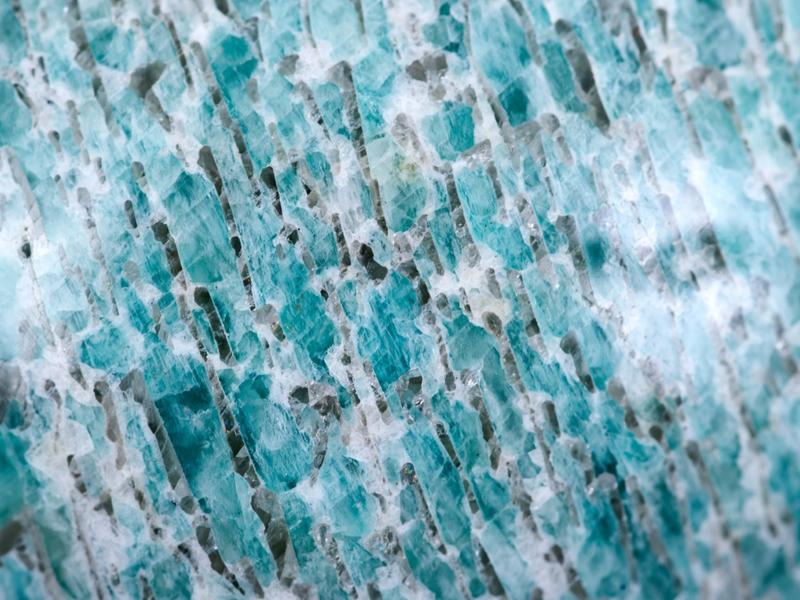
Mineralogy: Composite specimen of amazonite and smoky quartz, not a single mineral. Amazonite: green microcline, KAlSi₃O₈ (triclinic). Smoky quartz: SiO₂ with Al³⁺-related irradiation color centers (trigonal). Mohs hardness: amazonite 6-6.5, smoky quartz 7. Specific gravity: amazonite 2.56-2.58, smoky quartz 2.65. Color: blue-green (amazonite) with gray-brown (smoky quartz). Not a mineral species; a paragenetic association. See also: amazonite-quartz.

Deeper geology

Amazonite with smoky quartz is a pegmatite lesson in how color can arise from entirely different mechanisms inside one shared geologic pocket. Both minerals crystallize in the late stages of granitic systems, especially in miarolitic cavities where volatile rich residual melt and hydrothermal fluids leave enough room for well formed crystals. The amazonite is microcline, a potassium feldspar colored by lead related color centers interacting with structural water. The smoky quartz is quartz whose brown to gray color comes from natural irradiation acting on trace aluminum defects in the silica lattice. Same cavity, same broad cooling history, different physics.

The parent rock is usually a highly evolved granite pegmatite enriched in alkalis, silica, water, and trace elements. As the system cools, feldspar, quartz, and accessory phases compete and cooperate across a narrowing temperature window. Open space matters. Without cavities or fractures, the crystals would lock into massive intergrowths instead of producing the familiar amazonite blocks against quartz prisms. Radioactive accessory minerals in the pegmatite, often containing uranium or thorium, can later modify nearby quartz through radiation damage and electron trapping, deepening the smoky color after the crystal itself has already formed. Amazonite's color, by contrast, is part of the feldspar lattice and the specific trace chemistry of that feldspar.

Structurally the specimen is a conversation between two frameworks. Microcline is triclinic, with feldspar cleavage and an Al Si ordering pattern that lowers its symmetry. Quartz is trigonal, harder, cleavage free, and built from a continuous spiral network of SiO4 tetrahedra. Their contact is therefore not merely color contrast. It is an encounter between two separate solutions to silicate architecture, each stable under late pegmatitic conditions but each expressing growth, fracture, and optical response in its own way.

Because smoky quartz carries the evidence of irradiation without losing transparency, and amazonite holds a cool, opaque to translucent body without surrendering its structure, the pair often feels unusually balanced. One mineral has passed through a history of exposure and still transmits light. The other keeps its composure through ordered feldspar planes and saturated color. Together they preserve a cavity where light and shadow were both admitted into stable crystal form, a geological proof that clarity does not require innocence and calm does not require forgetting what the rock has already absorbed.

Mineralogy

Mineral specs

Chemical Formula

Amazonite: KAlSi3O8 (potassium feldspar / microcline variety) + Smoky Quartz: SiO2

Crystal System

Mixed

Mohs Hardness

6.5

Specific Gravity

Amazonite: 2.56-2.58; Smoky Quartz: 2.65

Luster

Amazonite: Vitreous to pearly on cleavage; Smoky Quartz: Vitreous

Color

Green

Traditional Knowledge

Lore and culture around Amazonite With Smoky Quartz

Science grounds the page. Tradition, lore, and remembered use make it readable as lived knowledge.

Classic combination from Pikes Peak, Colorado; specimens collected since 1870s; prized worldwide since mid-20th century

Unknown

Ancient Amazonian Cultures (Name Origin -- Contested)

Despite its name, amazonite's connection to the Amazon River is debated. German naturalist Alexander von Humboldt reported green stones traded by indigenous peoples near the Rio Negro tributary in the early 19th century, but whether these were actually microcline feldspar or a different green stone (nephrite, jadeite, or green quartz) remains uncertain. The name stuck regardless. What is historically documented is that green stones were traded extensively among pre-Columbian peoples of South America as symbols of fertility, water, and female power. Source: Pogue, J. E. (1915), in ethnological appendices; also Bauer, M. (1904). Precious Stones, translated by Spencer, L. J., Charles Griffin & Co.

Unknown

Pikes Peak Region Mining Heritage (Colorado, USA)

The Crystal Peak collecting area near Lake George, Colorado has been producing museum-quality amazonite and smoky quartz since the 1870s, when miners first encountered the spectacular blue-green and brown-black combinations in Precambrian granite pegmatites. The specimens became iconic in American mineral collecting, and the Crystal Peak district is now one of the most famous collecting localities in North America. Fee-dig sites operate today, and the combination is the de facto mineral emblem of the Pikes Peak region. Source: Voynick, S. M. (1994). Colorado Rockhounding. Mountain Press Publishing.

Unknown

Egyptian Use of Amazonite

Amazonite was carved into amulets and beads in ancient Egypt -- it was one of the stones used in the funerary mask of Tutankhamun (though the identification of some green stones in the mask remains debated between amazonite and green feldspar/other minerals). In the Egyptian Book of the Dead, green stones were associated with Chapter 7, "The Chapter of Coming Forth by Day" -- the emergence from the underworld into truth. Source: Aston, B. G., Harrell, J. A., & Shaw, I. (2000). "Stone." In Ancient Egyptian Materials and Technology, Cambridge University Press.

Sacred Match Notes

When this stone becomes the right door

Sacred Match prescribes Amazonite With Smoky Quartz when you report:

telling the truth, then second-guessing it immediately chest open one minute, shut the next wanting to face the hard thing without drowning in it speaking clearly about shadow material, then crashing swinging between openness and self-protection

Sacred Match prescribes through physiological diagnosis, not preference. It queries whether the body can stay present with difficult material while keeping the expressive channel online. When that triangulation reveals oscillation between ventral openness and sympathetic or dorsal retreat, Amazonite With Smoky Quartz enters the protocol. This is the pattern of partial courage, where insight appears but cannot yet be held for long. The prescription is specific: not more disclosure, not more avoidance, but enough grounding to let honesty and shadow sit in the same room.

Truth then doubt -> unstable self-trust -> seeking expression anchored in ground Chest opening then shutting -> rapid state shifts -> seeking tolerance for mixed feeling Facing the hard thing -> controlled exposure need -> seeking contact without overwhelm Speaking then crashing -> expenditure beyond regulation -> seeking endurance for honesty Openness and self-protection -> competing autonomic priorities -> seeking a stable middle position

3-Minute Reset

The Pegmatite Hold

Where calm green meets grounded dark, hold both without choosing.

3 min protocol

  1. 1

    Place the amazonite-smoky quartz specimen on a flat surface in front of you. Sit with both feet on the floor. Before picking it up, look at it. Amazonite's blue-green comes from trace lead and water in the feldspar lattice. The smoky quartz darkened over millennia as natural radiation displaced electrons in the silicon dioxide. One color was built in. The other was earned slowly. Observe both. (0:00–0:40)

    1 min
  2. 2

    Pick up the stone and hold it in both hands at heart height. Close your eyes. The amazonite half is triclinic — the least symmetric crystal system, where no axis meets at a right angle. The quartz half is trigonal — balanced, threefold. Feel the stone as a single object that holds two different kinds of order. Breathe naturally. (0:40–1:20)

    1 min
  3. 3

    Move the stone to your belly, just below the navel. Press gently inward. These two minerals grew together in a pegmatite — a pocket of magma that cooled slowly enough for large crystals to form. That slowness is what made both minerals visible and distinct. Breathe in for 4, out for 7. On each exhale, imagine the slow cooling that allowed complexity to emerge without force. Five breaths. (1:20–2:10)

    1 min
  4. 4

    Return the stone to the surface in front of you. Open your eyes. Place one hand on the amazonite-colored area, one on the smoky quartz. Notice the temperature difference between your two hands after holding. Press both palms onto your knees and take one clearing breath. The pegmatite hold is complete. (2:10–3:00)

    1 min

Mineral Distinction

What sets Amazonite With Smoky Quartz apart

Amazonite with smoky quartz is not a separate species, and the main confusion is sellers presenting it as a rare named crystal rather than a natural association of two common pegmatite minerals. The cleanest test is to identify both parts separately: amazonite is blue green microcline with Mohs 6 to 6. 5 and cleavage near 90 degrees, while smoky quartz is brown gray quartz at Mohs 7 with no cleavage and conchoidal fracture.

Real specimens show a clear physical boundary between blocky feldspar and glassy smoky quartz. The amazonite section is usually opaque to translucent, greener, and more matte on cleavage faces. The smoky quartz section is more transparent, darker, and develops pointed or irregular quartz growth surfaces instead of feldspar blocks.

Uniformly colored carvings sold under this name are not the same thing at all. If every surface feels polished and the two minerals are impossible to distinguish, assume the trade name is doing all the work. Handling risk makes this important because the value sits in the natural pegmatite association and crystal aesthetics, not in an invented identity that inflates the price.

Care and Maintenance

How to care for Amazonite With Smoky Quartz

Amazonite with smoky quartz is water-safe for brief rinses. Quartz (Mohs 7) handles water well. Amazonite (Mohs 6-6.

5, microcline feldspar) has two perfect cleavage planes that make prolonged soaking inadvisable. Brief rinse (30 seconds) under cool running water, pat dry immediately. Avoid salt water, hot water, and ultrasonic cleaners.

Recommended cleansing: moonlight (overnight), smoke (30-60 seconds), selenite plate (4-6 hours). Store separately from harder stones.

Crystal companions

What pairs well with Amazonite With Smoky Quartz

Black Tourmaline **The No-Drama Boundary.** Amazonite with smoky quartz is already good at calm truth beside shadow awareness. Black tourmaline adds a firmer perimeter when the environment is pushy or manipulative. Best suited to people who want to say less, mean it more, and not get pulled off center. Carry the combined stone in the left pocket and black tourmaline in the right.

Blue Lace Agate **The Softer Delivery.** This stone can tell the truth clearly. Blue lace agate softens the tone without weakening the content. Works for hard feedback, repair attempts, and any conversation where tenderness increases the chance of being heard. Place amazonite with smoky quartz at the throat and blue lace agate just above the sternum.

Labradorite **The Shadow Interpreter.** Smoky quartz handles what is already in the room. Labradorite helps the practitioner read what is not being said. Most helpful for emotionally layered settings where subtle perception matters. Hold labradorite with the receptive hand and amazonite with smoky quartz in the primary hand before entering the space.

Hematite **The Stay-In-The-Body Pair.** Amazonite with smoky quartz supports emotional honesty. Hematite keeps that honesty embodied rather than abstract. Designed for people who go heady when things get intense. Place hematite at the feet and the combined stone at the throat during grounding practice.

In Practice

How Amazonite With Smoky Quartz is used

Your jaw is clenching and your thoughts are looping. The combination of amazonite (potassium feldspar, Mohs 6. 5) with smoky quartz (irradiated SiO2) pairs two distinct mineral responses.

The amazonite addresses the throat, the place where unsaid words create muscular tension. The smoky quartz addresses the root, the place where unprocessed stress stores as lower back tightness and pelvic floor holding. Hold the combination piece at the solar plexus, between both zones.

Let the weight interrupt the loop.

Verification

Authenticity

Same tests as amazonite quartz: verify the natural intergrowth of green feldspar and brown quartz. Check for flat glue lines between components (indicates assembly). Natural specimens from Pikes Peak show both minerals with natural crystal faces.

The smoky color should penetrate the quartz, not be surface-applied.

Temperature

Natural Amazonite With Smoky Quartz should usually feel cooler than plastic or resin on first touch and warm more slowly in the hand.

Scratch logic

Use 6.5 on the Mohs scale as the check, not internet myths. A real specimen should behave in line with the hardness listed above.

Surface and luster

Look for a amazonite: vitreous to pearly on cleavage; smoky quartz: vitreous surface quality rather than a painted or plastic shine.

Weight and density

The listed specific gravity is Amazonite: 2.56-2.58; Smoky Quartz: 2.65. If a specimen feels unusually light for its size, it may deserve a second look.

Geographic Origins

Where Amazonite With Smoky Quartz forms in the world

Pikes Peak, Colorado is the type locality. Specimens from the Crystal Peak area at 9,000+ feet show the classic pairing: green feldspar and brown quartz grown from the same cooling melt. Brazilian material from Minas Gerais pegmatites tends to be larger.

Madagascar produces specimens with stronger color contrast.

FAQ

Frequently asked

Why do amazonite and smoky quartz grow together?

They crystallize from the same residual fluids in granitic pegmatite pockets. The potassium-rich fluids that crystallize amazonite (K-feldspar) and the silica-rich fluids that crystallize quartz coexist in the same miarolitic cavities. Both minerals then receive natural irradiation from potassium-40 decay in the surrounding granite, which activates their respective color centers. The combination is not random -- it is the inevitable result of the same geological process expressed through two different chemistries.

Is the color of my amazonite stable?

Generally yes for normal use. The color center in amazonite is relatively stable, unlike some irradiated minerals that fade in sunlight. However, extreme heat (above 300C) can bleach the color permanently. Avoid leaving amazonite in direct sunlight for extended periods as a precaution, though it is more heat-stable than, for example, amethyst.

Can I use just one of the minerals or is the combination necessary?

Both minerals work individually. Smoky quartz is a powerful grounding stone on its own; amazonite is an effective throat-heart bridge independently. However, the natural combination carries the signature of integration -- the two minerals grew together and share a geological origin story. The combination is specifically indicated for situations where you need simultaneous grounding AND expression, not one at the expense of the other.

References

Sources and citations

  1. Adetunji, Ademuyiwa, Ocan, Ojok Onesimus. (2010). Characterization and Mineralization Potentials of Granitic Pegmatites of Komu area, Southwestern Nigeria. Resource Geology. [SCI]

    DOI: 10.1111/j.1751-3928.2010.00116.x

  2. Santos G.L., Barreto S.B., Souza I.M.B.A., Araújo Neto J.F., Sanchéz-Muñoz L., Santos L.C.M.L. (2022). Microtextural, spectroscopic, and chemical characterization of amazonite from the Serra Branca Pegmatite, Northeastern Brazil. Brazilian Journal of Geology. [SCI]

    DOI: 10.1590/2317-4889202220210072

  3. Sheikhi Gheshlaghi R., Ghorbani M., Sepahi A.A., Deevsalar R., Nakashima K., Shinjo R. (2022). The origin of gem spodumene in the Hamadan Pegmatite, Alvand Plutonic Complex, western Iran. Canadian Mineralogist. [SCI]

    DOI: 10.3749/canmin.2000087

Closing Notes

Amazonite With Smoky Quartz

Amazonite and smoky quartz crystallize from the same cooling melt inside granite pegmatites. One turns green from lead-based color centers, the other turns brown from natural radiation. Same rock, same conditions, two different responses.

The science documents how a single environment produces complementary minerals. The practice asks what happens when you stop choosing sides.

Field Notes

Field Notes on Amazonite With Smoky Quartz

Open Field Notes

Personal practice logs and shared member observations. Community notes are separate from Crystalis editorial guidance.

No shared notes under Amazonite With Smoky Quartz yet.

When members save a public field note for this stone, it will appear here.

Bring it into practice

What to do with Amazonite With Smoky Quartz next

Move from reference to ritual. Shop Amazonite With Smoky Quartz, follow the intention path, build a bracelet, or try a Power Vial tied to the same energy.

The archive

Related crystals

Read the Full Crystal Guide

Continue through stones that share intention, chakra focus, or tonal family with Amazonite With Smoky Quartz.

