Materia Medica
Llanite
The Bridge of Worlds

This page documents traditional and cultural uses of llanite alongside emerging research on tactile grounding objects. Crystalis does not claim that llanite treats, cures, or prevents any medical condition. For mental health concerns, consult a qualified professional.
Origins: USA (Llano County, Texas)
Quick actions
Materia Medica
The Bridge of Worlds

Protocol
Speak From the Stone You Stand On.
5 min
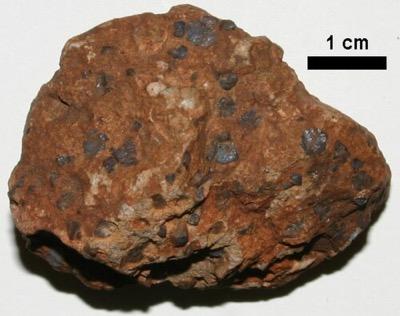
Sit upright in a firm chair. Hold llanite in your non-dominant hand. Look at it: find the blue quartz phenocrysts against the reddish-brown groundmass. The blue is embedded in the red. The voice is embedded in the body. Place your dominant hand flat on the center of your chest. Inhale through the nose for 5 counts. Pause gently at the top for 2 counts — not holding, just resting. Exhale through the nose for 5 counts through the mouth. Three cycles. Feel the stone in one hand and your heartbeat under the other.
Move the llanite to your throat. Hold it gently against the notch between your collarbones. Press your free hand flat against the seat of the chair beneath you, palm down, pressing into a solid surface. One hand at the throat, one hand pressing into the foundation below you. Breathe: 6 in, 6 out with audible sigh. The hold at the top of the inhale creates a moment of pressurization at the throat center -- not constriction, suspension. Four cycles.
Move the stone from your throat to the base of your spine. Sit on it or press it against your lower back. Both hands now rest on your thighs. The blue quartz that was at your throat is now at your root. This is llanite's teaching: the voice and the foundation are the same material, just encountered at different points in the body. Breathe: 5 counts in, gentle pause for 2, 5 counts out. All through the nose. Feel the density of the stone beneath you. Feel how it changes the quality of your posture. Four cycles.
Bring the stone back to your hand. Hold it at belly level and look at it one more time. The blue quartz did not arrive in the rhyolite from outside -- it crystallized within the magma as the rock formed. Your voice did not arrive from outside your body either. It formed within your structure. Place the stone where you can see it throughout the day. Every time you notice it, remember: the blue is not separate from the red. Your expression is not separate from your ground.
tap to flip for protocol
Many people distrust their own brightness because it seems discontinuous with the rest of who they are. The dazzling part feels too separate from the ordinary body that carries groceries, pays bills, and survives the day.
Llanite solves that split by matrix. Blue quartz and feldspar crystals sit visibly inside a darker rhyolitic groundmass, brilliance embedded rather than floating free. The spectacle remains. The daily rock remains too.
Llanite feels reassuring because it says the extraordinary self does not need to leave ordinary life behind in order to be real. It can be held inside it.
What Your Body Knows
The nervous system tends to sort this material by touch before thought. For llanite, the body often starts with direct sensory appraisal before any symbolism forms. The material offers weight, temperature, surface pattern, and visual structure that can help organize experience. Three states are most relevant. Each one is less a diagnosis than a body-weather pattern, a way attention, breath, and muscular tone begin arranging themselves under pressure.
Uneven Development: Self-Judgment
One part of life advanced earlier than another, creating shame. Llanite normalizes asynchronous growth through texture. In practice, the usefulness comes from repeated contact with a stable object while the state is named, felt, and brought into proportion.
Difficulty Integrating Old And New: Mixed State
Earlier identities protrude from the present ground. Its large phenocrysts held in fine matrix make that pattern visible. In practice, the usefulness comes from repeated contact with a stable object while the state is named, felt, and brought into proportion.
Place-Based Longing: Ventral Nostalgia
The body wants a more exact sense of origin. A locality-bound rock can anchor attention through geographic specificity. In practice, the usefulness comes from repeated contact with a stable object while the state is named, felt, and brought into proportion.
In this framework, llanite works most clearly with the point where sensation becomes orientation. The stone does not replace action. It gives the body a form sturdy enough to notice itself against, and that contrast can be the beginning of regulation.
sympathetic
Your body feels like it contains two different frequencies that refuse to synchronize. Your throat wants to say something but your feet do not agree. Your upper body feels airy and blue while your lower body feels dense and red-brown. You are two materials in one body that have not figured out how to be one stone yet. This is sympathetic-dorsal disconnection along the vertical axis.
dorsal vagal
You know you have something valuable inside you; a blue clarity, a specific knowing; but it is locked in a matrix of denser material you cannot seem to break through. Your words feel trapped in your body. Your insight is visible to you but not expressible. This is dorsal vagal embedding: your ventral capacity is present but encased in a protective surround that will not release it.
ventral vagal
Your throat and your root feel connected through a single column. When you speak, your words carry weight; not because you are forcing authority but because your expression is anchored in your body. Your feet are steady, your jaw is relaxed, and your voice drops into a register that feels like bedrock. This is ventral vagal integration between throat and root: expression emerging from foundation.
Nervous system mapping based on polyvagal theory (Porges, S.W. The Polyvagal Theory. Norton, 2011).
The Earth Made This
Llanite exists in one county on Earth. Llano County, Texas. Nowhere else. A Precambrian rhyolite porphyry, approximately 1.1 billion years old, featuring blue quartz crystals and pink feldspar phenocrysts in a fine-grained greenish matrix.
The blue in the quartz comes from inclusions of ilmenite or similar minerals. The magma cooled slowly underground, allowing the large crystals to form before the surrounding matrix solidified. Texas designated llanite as an official state rock type. The scarcity is real . single locality, single formation, single county.
Deeper geology
In Precambrian magma that paused between cooling stages, In Precambrian time, silica-rich magma in what is now central Texas cooled in two distinct stages. First, larger crystals of quartz and feldspar formed while the melt remained relatively mobile. Later, the remaining material solidified as a finer rhyolitic groundmass around them.
That two-stage cooling created a porphyritic texture, the key to llanite's appearance. The quartz phenocrysts, often blue from minute inclusions and light scattering effects, sit beside pink feldspar in a gray to greenish matrix, giving the rock an unmistakable constellation-like look. Llanite is a rock name tied to locality, not a universal mineral species, and true material comes from Llano County.
Because the rock is aggregate rather than single-crystal, crystal-system labels only describe its components, not the whole object. What matters structurally is contrast in cooling rates recorded side by side. Large early crystals remain suspended in later fine groundmass like decisions made early in a life and carried by everything that followed.
The somatic turn comes from that porphyritic logic. Some parts of the self crystallize long before others. They stay visible, oversized, and occasionally out of scale with the finer texture surrounding them.
Llanite lets the body read that asymmetry without calling it error. It is just the record of a two-stage cooling history, still coherent as one rock.
Mineralogy
Chemical Formula
Complex (SiO2 quartz + KAlSi3O8 feldspar in rhyolite matrix)
Crystal System
Variable (Trigonal quartz + Monoclinic feldspar in igneous matrix)
Mohs Hardness
6
Specific Gravity
2.60-2.70
Luster
Vitreous to dull
Color
Blue-Brown
Traditional Knowledge
Science grounds the page. Tradition, lore, and remembered use make it readable as lived knowledge.
Described 1964 from Llano County, Texas; contains rare blue quartz phenocrysts; designated Texas state stone 2021; approximately 1.1 billion years old
Precambrian Llano Uplift Geology
The llanite formation near Llano, Texas, is part of the Precambrian Llano Uplift, one of the oldest exposed rock formations in North America at approximately 1.07 billion years old. The porphyritic rhyolite containing blue quartz phenocrysts formed during a period of volcanic activity in what would become the geographic center of Texas. Geologists have studied the formation extensively because the blue quartz preserves information about magmatic conditions deep in the Proterozoic crust.
Texas State Stone Designation
Texas designated llanite as its official state stone in recognition of the mineral's unique geographic restriction to a single locality in Llano County. The designation was part of a broader movement to recognize Texas geological heritage alongside the state's other official symbols. Llanite's extreme geographic specificity -- found nowhere else on Earth -- made it a natural symbol of Texas geological distinctiveness.
Blue Quartz Rayleigh Scattering Research
Mineralogists studying llanite's blue quartz phenocrysts determined that the blue color results from Rayleigh scattering by submicroscopic inclusions of ilmenite, rutile, or other titanium-bearing minerals. This is the same optical phenomenon that produces blue sky. The research established llanite as a key specimen for understanding how microscopic inclusions create macroscopic color effects in silicate minerals, contributing to broader understanding of color in geology.
Grounded Expression Practice
Crystal practitioners adopted llanite for work connecting throat expression to root stability, drawn to its visual metaphor of blue voice embedded in red-brown earth. Texas-based practitioners in particular prescribe llanite for people who need to speak from their foundation rather than their anxiety. The stone's singular geographic origin reinforced its practice identity: like llanite, authentic expression comes from one specific place inside you.
Sacred Match Notes
Sacred Match prescribes Llanite when you report:
asynchronous development between the dazzling part and the ordinary part old self still visible inside the current frame need for origin to remain visible even after transformation uneven growth where some aspects of you have advanced and others remain raw two-stage identity requiring a matrix that holds both
Sacred Match prescribes through physiological diagnosis, not preference. It queries whether unevenness is pathology, developmental timing, or a legitimate two-phase identity that needs a host rock instead of a resolution. When that triangulation reveals sympathetic tension between a brilliant component and an ordinary one living in the same body, Llanite enters the protocol. This is a rhyolite porphyry from Llano County, Texas, holding blue quartz phenocrysts in a fine-grained dark groundmass. Brilliance embedded in daily rock.
Asynchronous development -> uneven growth between components -> blue quartz phenocrysts in a fine-grained rhyolitic groundmass demonstrate that brilliance and ordinariness can coexist in the same geological body Old self still visible -> earlier phase preserved inside current form -> the blue in the quartz results from Rayleigh scattering off sub-micron ilmenite or rutile inclusions, meaning the ordinary quartz carries the extraordinary color Need for visible origin -> desire to retain formation history -> type and only known locality is Llano County, Texas, making this stone inseparable from its place of origin Uneven growth -> some aspects advanced, others raw -> Mohs ~6-7 at specific gravity 2.60-2.70 reflects the composite nature: quartz phenocrysts are harder than the groundmass, modeling differential development Two-stage identity -> dual nature requiring a matrix -> vitreous to dull luster varies across the specimen depending on which component the surface exposes, teaching that a single body can present two textures
3-Minute Reset
Speak From the Stone You Stand On.
5 min protocol
Sit upright in a firm chair. Hold llanite in your non-dominant hand. Look at it: find the blue quartz phenocrysts against the reddish-brown groundmass. The blue is embedded in the red. The voice is embedded in the body. Place your dominant hand flat on the center of your chest. Inhale through the nose for 5 counts. Pause gently at the top for 2 counts — not holding, just resting. Exhale through the nose for 5 counts through the mouth. Three cycles. Feel the stone in one hand and your heartbeat under the other.
1 minMove the llanite to your throat. Hold it gently against the notch between your collarbones. Press your free hand flat against the seat of the chair beneath you, palm down, pressing into a solid surface. One hand at the throat, one hand pressing into the foundation below you. Breathe: 6 in, 6 out with audible sigh. The hold at the top of the inhale creates a moment of pressurization at the throat center -- not constriction, suspension. Four cycles.
1 minMove the stone from your throat to the base of your spine. Sit on it or press it against your lower back. Both hands now rest on your thighs. The blue quartz that was at your throat is now at your root. This is llanite's teaching: the voice and the foundation are the same material, just encountered at different points in the body. Breathe: 5 counts in, gentle pause for 2, 5 counts out. All through the nose. Feel the density of the stone beneath you. Feel how it changes the quality of your posture. Four cycles.
1 minBring the stone back to your hand. Hold it at belly level and look at it one more time. The blue quartz did not arrive in the rhyolite from outside -- it crystallized within the magma as the rock formed. Your voice did not arrive from outside your body either. It formed within your structure. Place the stone where you can see it throughout the day. Every time you notice it, remember: the blue is not separate from the red. Your expression is not separate from your ground.
1 minMineral Distinction
Llanite is a porphyritic rhyolite from the Llano region of Texas containing blue quartz phenocrysts and pink feldspar crystals in a dark matrix, and sellers sometimes present it as a rare crystal species. It is a rock, not a mineral. The blue quartz crystals within it are standard quartz whose blue color comes from microscopic mineral inclusions scattering light.
The pink crystals are feldspar. The dark matrix is the fine grained volcanic groundmass. No single hardness or specific gravity applies to the whole rock because it is a multi mineral aggregate.
If the specimen shows blue round spots and pink spots in a dark gray to brown matrix and comes from Texas, llanite is a reasonable identification. Calling it a crystal species or a rare mineral inflates what is honestly an interesting locality rock.
Care and Maintenance
Llanite is water-safe. A rhyolite with quartz and feldspar (Mohs 6-7), dense and durable igneous rock. Brief to moderate water contact is completely safe.
Recommended cleansing: running water, moonlight, sound, smoke. Store normally; this is a tough rock specimen.
Crystal companions
Where support needs range. Llanite benefits from companions that either clarify its strongest trait or balance its weakest one.
Larvikite
architectural igneous pair. Larvikite contributes controlled flash; llanite adds porphyritic contrast and locality character. Placement: Display together on a shelf or desk. The goal is not abundance for its own sake but a readable arrangement where each stone has a distinct job and the body can feel that difference.
Blue Quartz
color conversation. Blue quartz isolates one visual element already present inside llanite. Placement: Keep blue quartz above llanite in a grid. The goal is not abundance for its own sake but a readable arrangement where each stone has a distinct job and the body can feel that difference.
Smoky Quartz
terrain support. Smoky quartz gives the rock a grounded companion that does not compete with its complex texture. Placement: Place smoky quartz at the base of the arrangement. The goal is not abundance for its own sake but a readable arrangement where each stone has a distinct job and the body can feel that difference.
Clear Quartz
phenocryst emphasis. Quartz brightens the blue quartz phenocrysts and helps the eye read the two-stage cooling story. Placement: Use under strong natural light. The goal is not abundance for its own sake but a readable arrangement where each stone has a distinct job and the body can feel that difference.
In Practice
You feel like you do not belong anywhere. Llanite exists in one place on earth: Llano County, Texas. Blue quartz phenocrysts in pink feldspar porphyry, formed 1.
07 billion years ago. No other locality produces this combination. Hold it when the feeling of not-belonging becomes physical.
The stone is geologically unique. It has no relatives, no sister deposits, no second source. Being one-of-a-kind is not isolation.
It is specificity. The mineral did not fail to be something common. It succeeded at being something unrepeatable.
Verification
Llanite: a rhyolite with blue quartz and orange feldspar phenocrysts. Mohs 6-7 (rock hardness). Specific gravity 2.
60-2. 70. The blue quartz eyes in the matrix are distinctive.
Named after Llano County, Texas. Not commonly faked due to limited commercial value. If offered from a non-Texas locality, verify.
Natural Llanite should usually feel cooler than plastic or resin on first touch and warm more slowly in the hand.
Use 6 on the Mohs scale as the check, not internet myths. A real specimen should behave in line with the hardness listed above.
Look for a vitreous to dull surface quality rather than a painted or plastic shine.
The listed specific gravity is 2.60-2.70. If a specimen feels unusually light for its size, it may deserve a second look.
Geographic Origins
Llanite is a rhyolite porphyry found exclusively in Llano County, Texas, centered on a small outcrop near the town of Llano in the Central Texas uplift. The blue quartz phenocrysts formed during slow cooling of a Precambrian rhyolitic melt approximately 1. 07 billion years ago.
Pink potassium feldspar crystals grew alongside them. No other locality on earth produces this specific combination of blue quartz in pink feldspar matrix.
FAQ
Llanite is a rare porphyritic rhyolite containing blue quartz phenocrysts -- visible blue quartz crystals embedded in a reddish-brown to pink groundmass. It is found ONLY near Llano, Texas, making it a remarkably geographically restricted ornamental stone on Earth. It is the official state stone of Texas.
The blue color in llanite's quartz phenocrysts comes from Rayleigh scattering -- the same phenomenon that makes the sky blue. Submicroscopic inclusions within the quartz scatter shorter wavelengths of light, producing a blue appearance. The quartz itself is colorless; the blue is an optical effect of its internal structure.
Only near Llano, Texas. This is not an approximation -- llanite has been found nowhere else on Earth. The formation is a Precambrian igneous body approximately 1.07 billion years old. The extremely limited occurrence makes every specimen geographically significant. If you hold llanite, you hold a piece of one specific Texas hillside.
Llanite is mapped to both the throat and root chakras. The blue quartz phenocrysts align with throat-center communication work, while the reddish-brown rhyolite matrix connects to root grounding. Practitioners describe the combination as speaking from a grounded place -- expression anchored in bedrock.
Yes. Llanite is water safe. Its quartz and feldspar components are Mohs 6-7 with stable silicate chemistry. The matrix is a durable igneous rock that has weathered Texas conditions for over a billion years. Brief water cleansing will not damage it.
Llanite is a mixed-hardness rock. The blue quartz phenocrysts are Mohs 7, while the surrounding rhyolite groundmass containing feldspar sits at Mohs 6-6.5. In practice, the composite is durable enough for cabochons, bookends, and daily handling. It takes a good polish.
Extremely. With a single known occurrence in Llano County, Texas, llanite is one of the rarest ornamental stones available. It is not mined commercially in large volumes. Specimens circulate primarily through Texas rock shops, mineral shows, and collectors. Its designation as the Texas state stone has increased awareness and demand.
Llanite is immediately recognizable: blue quartz crystals (typically 5-15mm) set in a reddish-brown to pink fine-grained groundmass, sometimes with dark biotite flakes and occasional pink feldspar phenocrysts. The contrast between the blue spots and the red-brown matrix gives it a distinctive, unmistakable appearance.
References
Smith, J.V.; Brown, W.L. (1988). Feldspar Minerals: Volume 1 — Crystal Structures, Physical, Chemical, and Microtextural Properties (2nd ed.). Springer-Verlag. [SCI]
Barker, D.S. (1965). Llanite (llanoite): a hypabyssal rhyolite porphyry from Llano County, Texas. Bulletin Volcanologique. [SCI]
DOI: 10.1007/BF02596929
Lidiak, E.G.; Hinze, W.J. (2002). Precambrian geology of the Llano uplift, Texas. Geological Society of America Special Paper. [SCI]
Closing Notes
Quartz and feldspar in rhyolite porphyry, Mohs 6. Llanite exists in one place on earth: Llano County, Texas. The blue quartz phenocrysts formed when the rhyolite cooled slowly enough for silica to crystallize before the matrix solidified.
A geological accident confined to one outcrop, named for one county, collected from one location.
Field Notes
Personal practice logs and shared member observations. Community notes are separate from Crystalis editorial guidance.
When members save a public field note for this stone, it will appear here.
Bring it into practice
Move from reference to ritual. Shop Llanite, follow the intention path, build a bracelet, or try a Power Vial tied to the same energy.
The archive
Continue through stones that share intention, chakra focus, or tonal family with Llanite.

Shared intention: Communication
Grounded Truth

Shared intention: Protection & Grounding
The Iron Patience
Shared intention: Protection & Grounding
The Polarity Balancer
Shared intention: Emotional Balance
The Layered Sanctuary

Shared intention: Protection & Grounding
The Green Shield of the Heart

Shared intention: Protection & Grounding
The Warrior's Root