Materia Medica
Boji Stone
The Polarity Balancer
This page documents traditional and cultural uses of boji stone alongside emerging research on tactile grounding objects. Crystalis does not claim that boji stone treats, cures, or prevents any medical condition. For mental health concerns, consult a qualified professional.
Origins: USA (Kansas)
Materia Medica
The Polarity Balancer
Protocol
Honor the paired stones you cannot touch.
3 min
Place the Boji Stones in a sealed glass display case or behind glass. Do NOT handle with bare hands — these iron sulfide concretions can decompose and release sulfuric compounds that irritate skin. Sit 2-3 feet away. Settle your posture. Let your breath slow.
Observe the rounded, dark brown to black forms. Notice the smooth and rough textures of the pair, the contrast between them. Let your eyes soften. Your body does not need to touch these stones to receive their signal — the visual field is enough.
With each exhale, release one thing — a thought, a tension, a worry. The stones hold their own boundaries. You hold yours. Continue breathing. Notice where the body softens first.
After 3 minutes: check in. Has the breath changed? Has the jaw released? That shift — however small — is the protocol complete. The pair witnessed. The body responded. No contact required.
tap to flip for protocol
Division can become habit. One hand reaches for one version of the self, the other for something opposite, and neither one trusts the bridge.
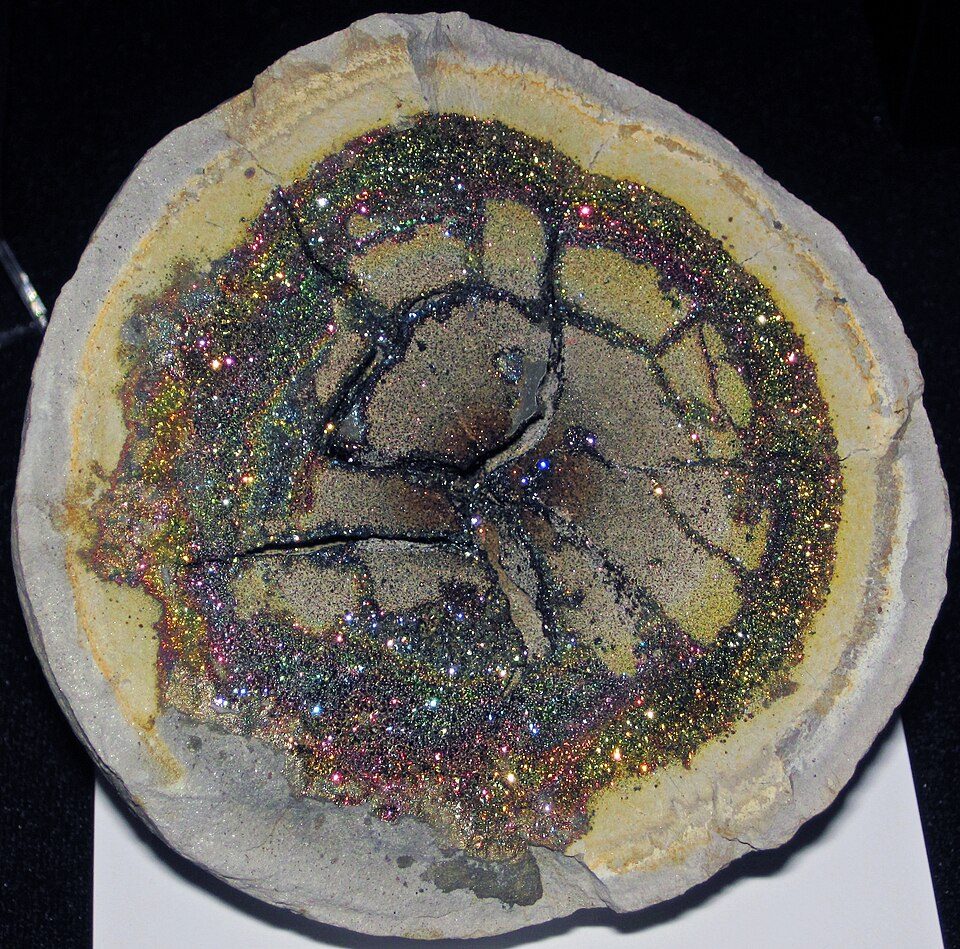
Boji stones are iron sulfide concretions, rounded nodules with different surface expressions that folklore later organized into paired use. Even before the story, the object already suggested duality in contact: rough and smooth, left and right, weight meeting weight.
Some balance comes back the moment both hands admit they are holding one life.
What Your Body Knows
sympathetic
Suggested Placement: - One in each palm (traditional paired use) for bilateral grounding - Soles of feet for downward grounding - Base of spine / sacrum area
Nervous system mapping based on polyvagal theory (Porges, 2011).
The Earth Made This
Boji stones (a trademarked name) are iron sulfide concretions composed of pyrite and marcasite, found in a specific formation in Kansas. The concretions formed when iron sulfide minerals precipitated around nucleation points in marine sediments during the Cretaceous period. Two forms are recognized by collectors: smooth rounded specimens ("female") and rough, protruding-crystal specimens ("male"), though these distinctions are mineralogical variations in crystal habit rather than biological categories.
The concretions typically range from marble to golf-ball size. Similar iron sulfide concretions occur worldwide, but the trademarked Boji name applies specifically to Kansas material.
Mineralogy
Chemical Formula
Primary iron sulfide component: FeS2 (pyrite, isometric; marcasite, orthorhombic). Matrix: CaCO3 (calcite/chalk) with minor clay minerals and limonite (FeOOH) weathering rinds.
Crystal System
Pyrite Component Is Isometric (Cubic); Marcasite Component Is Orthorhombic. The Concretions Themselves Are Amorphous/Polycrystalline Aggregates With No Single Crystal System.
Mohs Hardness
6
Specific Gravity
4.8-5.0 (pure pyrite); overall concretions approximately 3.5-4.5 due to chalk matrix
Luster
Metallic to sub-metallic on fresh pyrite surfaces; earthy to dull on weathered surfaces
Color
Brown
Traditional Knowledge
Timeline: Late Cretaceous (~85 Ma): Formation within the Western Interior Seaway sediments Pre-contact era: Native American peoples of the Great Plains likely encountered these concretions in erosional exposures; specific ethnographic documentation is sparse 1970s-1980s: Karen Gillespie trademarked the name "Boji Stone" and popularized them in the metaphysical crystal market as paired "male/female" stones 1990s-present: Widely adopted in crystal healing communities; trademark has created legal distinctions between "Boji Stones" and generic "Kansas Pop Rocks"
Trade Name Origins: "Boji" was coined by Karen Gillespie as a proprietary trade name. The more descriptive term "Kansas Pop Rocks" refers to their geographic origin and the tendency of pyrite concretions to fracture or "pop" when heated. The scientific community refers to them simply as iron-sulfide concretions from the Niobrara Formation.
Cultural Traditions: No well-documented ancient ceremonial use specific to these concretions. Their metaphysical popularity is entirely modern (post-1970s). Some sellers draw loose parallels to Moqui Marbles, which have documented cultural significance to some Indigenous peoples of the Colorado Plateau, but this is a conflation of two different geological materials.
Timeline
- Late Cretaceous (~85 Ma): Formation within the Western Interior Seaway sediments - Pre-contact era: Native American peoples of the Great Plains likely encountered these concretions in erosional exposures; specific ethnographic documentation is sparse - 1970s-1980s: Karen Gillespie trademarked the name "Boji Stone" and popularized them in the metaphysical crystal market as paired "male/female" stones - 1990s-present: Widely adopted in crystal healing communities; trademark has created legal distinctions between "Boji Stones" and generic "Kansas Pop Rocks"
Trade Name Origins
"Boji" was coined by Karen Gillespie as a proprietary trade name. The more descriptive term "Kansas Pop Rocks" refers to their geographic origin and the tendency of pyrite concretions to fracture or "pop" when heated. The scientific community refers to them simply as iron-sulfide concretions from the Niobrara Formation.
Cultural Traditions
No well-documented ancient ceremonial use specific to these concretions. Their metaphysical popularity is entirely modern (post-1970s). Some sellers draw loose parallels to Moqui Marbles, which have documented cultural significance to some Indigenous peoples of the Colorado Plateau, but this is a conflation of two different geological materials. ---
When This Stone Finds You
Somatic protocol
Honor the paired stones you cannot touch.
3 min protocol
Place the Boji Stones in a sealed glass display case or behind glass. Do NOT handle with bare hands — these iron sulfide concretions can decompose and release sulfuric compounds that irritate skin. Sit 2-3 feet away. Settle your posture. Let your breath slow.
1 minObserve the rounded, dark brown to black forms. Notice the smooth and rough textures of the pair, the contrast between them. Let your eyes soften. Your body does not need to touch these stones to receive their signal — the visual field is enough.
1 minWith each exhale, release one thing — a thought, a tension, a worry. The stones hold their own boundaries. You hold yours. Continue breathing. Notice where the body softens first.
1 minAfter 3 minutes: check in. Has the breath changed? Has the jaw released? That shift — however small — is the protocol complete. The pair witnessed. The body responded. No contact required.
1 minCare and Maintenance
Water: NO . Do not immerse in water. Iron sulfides react with water and oxygen to produce iron hydroxide (rust) and sulfuric acid.
Prolonged water contact will degrade the specimen and contaminate the water with dissolved iron and sulfate. Indirect water method only. Sun: Generally stable in sunlight.
However, prolonged UV exposure may accelerate surface oxidation of pyrite to limonite. Best kept out of sustained direct sun to preserve metallic luster. Toxicity: - MODERATE CAUTION: Pyrite (FeS2) can produce sulfuric acid when exposed to moisture and air over time (acid generation through oxidative weathering).
This is the same process responsible for acid mine drainage. Prolonged water exposure can release dissolved iron and sulfate, and in some cases trace metals (Chen et al. , 2013, DOI: 10.
1111/1462-2920. 12114). Dust from cutting or grinding pyrite/marcasite is irritating to lungs.
Crystalline silica (if present in matrix) poses a respiratory hazard if inhaled as dust (Stacey et al. , 2021, DOI: 10. 1002/jrs.
6110). Marcasite is less chemically stable than pyrite and may decompose over time, producing sulfur odors and acidic surface residues. Handling: Wash hands after handling, particularly rough or freshly broken specimens.
The metallic sulfide dust can contain trace amounts of heavy metals. Do not use in gem elixirs or water infusions under any circumstances.
In Practice
Polyvagal Framework: Boji Stones, as iron-sulfide concretions with notable heft and magnetic/electrical properties (pyrite is semiconducting), address the dorsal vagal (shutdown/freeze) state. Their density and weight provide strong proprioceptive grounding input. The tradition of using them in pairs (one in each hand) creates bilateral stimulation that can help re-engage the ventral vagal social engagement system from a collapsed dorsal vagal state.
When to Use: - Freeze/dissociation states where the person feels "unreal" or disconnected from body - Grounding after overwhelming emotional flooding - When needing to feel "held" or weighted (the density provides somatic anchoring) - For bilateral engagement (paired stones, one per hand)
When NOT to Use: - Active sympathetic hyperarousal (fight/flight). the stimulating electrical properties may intensify agitation - If the person is already over-grounded/rigid/constricted - Not suitable for highly anxious states where stillness is difficult
Suggested Placement: - One in each palm (traditional paired use) for bilateral grounding - Soles of feet for downward grounding - Base of spine / sacrum area
Temperature Properties: Iron-sulfide concretions feel cool to the touch due to high thermal conductivity of the metallic sulfide component. They warm relatively slowly against the body. The cooling sensation provides an additional sensory anchor.
Verification
Boji stones (trademarked name): iron sulfide concretions from Kansas. Some smooth, some textured with protruding pyrite/marcasite crystals. Specific gravity approximately 3.
5-4. 5. Metallic to sub-metallic luster on fresh surfaces.
The trade name is trademarked; similar concretions from other localities may be called by different names but are mineralogically equivalent.
Natural Boji Stone should usually feel cooler than plastic or resin on first touch and warm more slowly in the hand.
Use 6 on the Mohs scale as the check, not internet myths. A real specimen should behave in line with the hardness listed above.
Look for a metallic to sub-metallic on fresh pyrite surfaces; earthy to dull on weathered surfaces surface quality rather than a painted or plastic shine.
The listed specific gravity is 4.8-5.0 (pure pyrite); overall concretions approximately 3.5-4.5 due to chalk matrix. If a specimen feels unusually light for its size, it may deserve a second look.
Geographic Origins
Smoky Hill Chalk, western Kansas, USA (type locality . Stanton County and surrounding areas in the Niobrara Formation) Note: "Boji Stone" is a trademarked name; similar iron-sulfide concretions occur in Cretaceous chalks worldwide but are not "Boji Stones" by trade definition Moqui Marbles (iron oxide concretions from Navajo Sandstone, Utah) are sometimes confused with Boji Stones but are geologically distinct . those are iron-oxide cemented sandstone concretions, not iron-sulfide concretions
Boji Stones are iron-sulfide concretions that formed within the Smoky Hill Chalk Member of the Niobrara Formation in western Kansas, a Late Cretaceous (approximately 87-82 million years ago) marine chalk deposited in the Western Interior Seaway. The Niobrara Formation represents a period of extensive pelagic carbonate deposition across the interior of North America, when warm, shallow seas covered much of the continent. Neonatal mosasaur fossils and other marine reptile remains recovered from these deposits confirm the fully marine, pelagic setting of this chalk unit (Field et al., 2015, DOI: 10.1111/pala.12165).
FAQ
Boji Stone is classified as a Sulfide concretion -- composite of iron sulfide minerals (pyrite and marcasite) within a sedimentary carbite/chalk matrix. Not a single mineral species but a concretionary aggregate.. Chemical formula: Primary iron sulfide component: FeS2 (pyrite, isometric; marcasite, orthorhombic). Matrix: CaCO3 (calcite/chalk) with minor clay minerals and limonite (FeOOH) weathering rinds.. Mohs hardness: 6-6.5 (pyrite component); overall concretion approximately 5-6.5 depending on degree of weathering and matrix composition. Crystal system: Pyrite component is isometric (cubic); marcasite component is orthorhombic. The concretions themselves are amorphous/polycrystalline aggregates with no single crystal system..
Boji Stone has a Mohs hardness of 6-6.5 (pyrite component); overall concretion approximately 5-6.5 depending on degree of weathering and matrix composition.
NO -- Do not immerse in water. Iron sulfides react with water and oxygen to produce iron hydroxide (rust) and sulfuric acid. Prolonged water contact will degrade the specimen and contaminate the water with dissolved iron and sulfate. Indirect water method only.
Generally stable in sunlight. However, prolonged UV exposure may accelerate surface oxidation of pyrite to limonite. Best kept out of sustained direct sun to preserve metallic luster.
Boji Stone crystallizes in the Pyrite component is isometric (cubic); marcasite component is orthorhombic. The concretions themselves are amorphous/polycrystalline aggregates with no single crystal system..
The chemical formula of Boji Stone is Primary iron sulfide component: FeS2 (pyrite, isometric; marcasite, orthorhombic). Matrix: CaCO3 (calcite/chalk) with minor clay minerals and limonite (FeOOH) weathering rinds..
- Smoky Hill Chalk, western Kansas, USA (type locality -- Stanton County and surrounding areas in the Niobrara Formation) - Note: "Boji Stone" is a trademarked name; similar iron-sulfide concretions occur in Cretaceous chalks worldwide but are not "Boji Stones" by trade definition - Moqui Marbles (iron oxide concretions from Navajo Sandstone, Utah) are sometimes confused with Boji Stones but are geologically distinct -- those are iron-oxide cemented sandstone concretions, not iron-sulfide concretions ---
- **MODERATE CAUTION:** Pyrite (FeS2) can produce sulfuric acid when exposed to moisture and air over time (acid generation through oxidative weathering). This is the same process responsible for acid mine drainage. Prolonged water exposure can release dissolved iron and sulfate, and in some cases trace metals (Chen et al., 2013, DOI: 10.1111/1462-2920.12114).
References
. [SCI]
DOI: 10.1111/pala.12165
. [SCI]
. [SCI]
DOI: 10.1111/gbi.12362
. [SCI]
DOI: 10.1111/sed.13085
. [SCI]
. [SCI]
DOI: 10.1002/sia.6728
. [SCI]
. [SCI]
DOI: 10.1002/jrs.6110
. [SCI]
DOI: 10.1002/ajim.23242
Closing Notes
Iron sulfide concretions from Kansas. Pyrite and marcasite precipitated around nucleation points in sedimentary rock. Some smooth, some textured.
The science documents concretionary growth. The practice asks what grounding feels like when it comes in pairs.
Bring it into practice
Move from reference to ritual. Search current inventory for Boji Stone, build a custom bracelet, or let Sacred Match choose the right supporting stones for you.
Community notes
Shared field notes tied to Boji Stone appear here, including notes saved from practice.
When members save a public field note for this stone, it will appear here.
The archive
Continue through stones that share intention, chakra focus, or tonal family with Boji Stone.

Shared intention: Protection & Grounding
The Blood of the Earth
Shared intention: Emotional Balance
The Layered Sanctuary

Shared intention: Protection & Grounding
The Sea's Living Memory
Shared intention: Protection & Grounding
The Bridge of Worlds
Shared intention: Protection & Grounding
The Iron Patience
Shared intention: Vitality & Desire
The Lithium Matrix