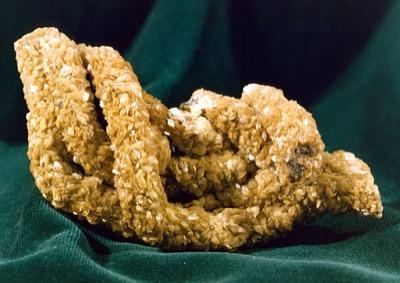
You need an iron-bearing answer that still looks understated. Siderite is iron carbonate, often honey-brown and rhombohedral, quieter than hematite or pyrite but carrying the same element of blood and rust. Strength can stay understated.
Siderite finds its primary use in understated strength. It is an iron mineral, but it does not arrive as metallic blaze or red oxidized drama. It arrives as honey...
The Meaning
Siderite in the Crystalis dictionary
There are forms of fatigue that come from mistaking force for strength. The body keeps trying to become harder, louder, more obvious in its effort to feel defended, when what it really needs is a steadier and less theatrical kind of weight.
Siderite answers with subdued iron. The mineral keeps the element of blood, labor, and oxidation, but presents it in a gentler brown and a calmer geometry. Nothing about it performs heroics. It simply remains itself with enough density to matter.
Siderite is useful when steadiness has to be recovered from beneath a lot of overcompensation.
Some resilience looks almost modest until you realize it never left.
Stone Lore
Stories carried through time
Cultural notes are presented as tradition and historical context — stories carried through time.
German Mineralogy
Werner's Iron Spar Classification
Abraham Gottlob Werner at the Freiberg Mining Academy in Saxony classified siderite within his systematic mineralogy framework in the late 18th century, using the German term Eisenspat (iron spar). The name siderite was formalized from the Greek sideros (iron), reflecting the mineral's historical importance as an iron ore across Europe. Werner's classification system placed iron carbonate alongside calcite and dolomite in the trigonal carbonate group.
Late 18th century
Historical note
British Industrial Iron Smelting
Siderite served as a significant iron ore in Britain during the Industrial Revolution, particularly the clay ironstone deposits of the Coal Measures in Yorkshire, Staffordshire, and South Wales. Abraham Darby's coke-smelting process at...
British Industrial History · 1709-1900s
Origin lore
Panasqueira Iridescent Specimens
The Panasqueira tungsten mines in central Portugal began producing extraordinary iridescent siderite specimens in the latter half of the 20th century. The rainbow-tarnished rhombohedral crystals from this locality became iconic in the...
Portuguese Mining · Mid-20th century-present
Ritual history
Root Stabilization Practice
Crystal practitioners adopted iridescent siderite as a grounding stone beginning in the 1990s, attracted by the combination of heavy iron-bearing density with the visual lightness of its rainbow tarnish. Practitioners prescribed it for...
Contemporary Crystal Practice · 1990s-present
Earth Record
Mineralogy and formation
Siderite is iron carbonate in one of its quieter mineral forms. Instead of the metallic force of pyrite or the earthy authority of hematite, it stores iron in rhombohedral carbonate geometry, often appearing honey brown, tan, gray, or greenish depending on purity and substitution. It commonly forms in diagenetic sedimentary settings, hydrothermal veins, and low oxygen pore waters where iron remains in the ferrous state long enough to combine with bicarbonate.
That reducing environment is the key. If oxygen were more available, other iron minerals would take over.
Sedimentary siderite has a particularly clear origin story. In swamps, marshes, coal measures, and organic rich muds, microbial decay consumes oxygen and creates bicarbonate rich pore fluids. Dissolved Fe2+ can then precipitate as siderite nodules or concretionary masses within shale and mudstone. In hydrothermal settings it may appear with quartz and sulfides in veins, again reflecting a fluid chemistry that allows iron carbonate rather than oxide or sulfide to dominate.
The mineral therefore marks specific redox conditions more than it marks a single host rock type.
Its trigonal structure gives the classic rhombohedral cleavage and crystal habit shared with other carbonate group members such as calcite, magnesite, and rhodochrosite. Yet siderite feels denser because iron is doing the structural work that calcium or magnesium does in lighter carbonates. Fresh surfaces can have a pleasing vitreous luster, but weathering quickly pushes them toward brown iron oxide films. That alteration is almost a built in reminder that siderite is stable only while the environment keeps iron reduced.
The stone therefore preserves a narrow atmospheric privilege. It formed where oxygen was withheld and bicarbonate was abundant, then remained intact until uplift and exposure invited oxidation back in. Every rhombohedron is a record of iron held in suspension between waterlogged calm and eventual rust.
Its listed properties reinforce that origin. The stated hardness of 3.5 and the reported luster of Vitreous to pearly are not decorative trivia.
Crystal system diagram represents the general trigonal classification. Diagram created by Crystalis for educational reference.
Trigonal structure
Chemical Formula
FeCO3
Crystal System
Trigonal
Mohs Hardness
3.5
Specific Gravity
3.83-3.96
Luster
Vitreous to pearly
Color
Brown-Yellow
IMA Status
species
Type Locality
None (pre-IMA, common worldwide)
IMA Number
Grandfathered (pre-1959)
01
Mineral conditions gather
02
Structure begins to crystallize
03
Siderite records place and pressure
Siderite forms in hydrothermal veins, sedimentary ironstone deposits, and coal measures where iron-rich fluids precipitate under reducing conditions. The Panasqueira Mine in Portugal produces exceptional rhombohedral crystals with curved faces. Bolivian specimens from Huanuni display the characteristic saddle-shaped crystal habit.
Historic British ironstone deposits in Cleveland provided bulk siderite as iron ore throughout the Industrial Revolution.
BoliviaUKBrazil
Telling it apart
Siderite gets mistaken for calcite, dolomite, smithsonite, and various brown ironstones because fresh rhombohedra can look deceptively familiar. The fastest test is heft combined with acid behavior. Siderite is heavier than common calcite and does not effervesce vigorously in cold dilute acid the way calcite does. It may respond more slowly, especially when powdered or warmed. Color is unreliable because weathering can push many carbonates toward brown.
It is an iron carbonate, and that chemistry affects density, alteration, and significance. Buyers should also be cautious with labels applied to generic brown nodules or rhombs from old mine parcels. If the seller cannot explain whether the specimen is hydrothermal crystal, sedimentary concretion, or simply weathered carbonate, the name may be doing too much work.
A careful buyer should compare the label to habit, hardness, and provenance before paying a rarity premium. Siderite at SG near 3.9 is noticeably heavier than the calcite it resembles. A heft test plus the warm brown color and curved rhombohedral faces confirm FeCO3.
Spotting the real thing
Siderite: iron carbonate. Effervesces slowly in warm dilute acid (not as vigorously as calcite). Mohs 3.
5-4. 5. Specific gravity 3.
83-3. 96 (heavy for a carbonate, due to iron). Brown to yellow-brown with vitreous luster.
Becomes magnetic when heated (forms magnetite). The combination of heaviness, carbonate reaction, and brown color is diagnostic.
Your body feels present but unanchored, as if you are standing on a surface that has no friction. Your feet register the floor but do not grip it. Your center of gravity seems to hover somewhere above your navel rather than settling into your pelvis. There is a vagueness in your lower body. This is dorsal vagal disengagement from the root; your system has not left the building, but it has stopped making contact with the foundation.
Shut down & far away
The Iron Clench
Your lower body is locked. Your pelvic floor is gripped, your quads are tight, your feet press into the floor with more force than standing requires. Your belly feels hard rather than full. There is effort in your grounding that should not require effort. This is sympathetic overdrive disguised as stability; you are bracing against the earth rather than resting into it. The iron you feel is tension, not strength.
Settled & connected
The Settled Core
Your belly drops. Your pelvic floor releases without collapsing. You feel the actual weight of your organs settling downward, your diaphragm moving freely, your lower ribs expanding on the inhale. There is a density in your center that is not heaviness but substance. This is ventral vagal grounding through the iron-center; your body has found its own specific gravity. You are not holding yourself up. You are being held by your own mass.
These associations come from tradition and reflective practice — a way of working with the stone, not a medical prescription.
Somatic Practice
Simple ways to work with Siderite
◇
Hold
Carry Siderite in a pocket or place it over the heart center during a pause.
◌
Meditate
Let the stone become a quiet tactile anchor while the breath slows.
☽
Breathe
Breathe in softness. Breathe out tension. Keep the practice simple.
✎
Journal
Write with Siderite nearby to name the feeling without forcing a conclusion.
✋
Bodywork
Rest the stone near the chest, hand, or bedside as a reminder to soften.
⌂
Environment
Place it where you want a visual cue for care, repair, or steadiness.
Field Instruction
The Iron-Core Gravity
Find Your Own Gravity.
5 min protocol
1
Sit on the floor with your back against a wall. Place siderite on the floor between your feet, touching both arches if possible. Press your sit bones into the ground. Feel the wall behind your spine. Three points of contact: sit bones, spine, and the visual anchor of the iridescent stone at your feet. This is a proprioceptive triangle. Your body knows where it is in space because three surfaces are telling it.
2
Breathe: 6 counts in through the nose, hold for 2, 7 counts out through the mouth. On each inhale, press your sit bones harder into the floor. On each exhale, release the pressure completely. This alternating compression and release recalibrates the proprioceptive nerves in your pelvic floor. Siderite's iron carbonate density -- specific gravity 3.96 -- means the stone sits heavy between your feet. It is not going anywhere. Neither are you.
3
On the sixth exhale, close your eyes. Your visual field goes dark but your three contact points remain. Wall. Floor. Stone between feet. Notice whether your body sways or holds still. The iridescent surface you were watching is gone from view but its weight is still present at your feet. This is the transition from visual grounding to somatic grounding -- from seeing your stability to feeling it. Stay with the feeling.
4
After 5 minutes: open your eyes. Pick up the siderite and hold it in both palms. Feel the weight. Iron carbonate is denser than it looks. Notice whether the floating sensation that brought you to this protocol has settled. Your body has spent five minutes relearning that it has mass, that the floor is solid, and that gravity works in your favor when you stop fighting it. Place the stone where you will see its iridescence during the day -- each flash of color is a one-second reminder that the ground held.
Stone Intelligence
The fact that makes Siderite memorable
Iron carbonate, trigonal, Mohs 3. 5. Siderite forms in anaerobic environments where iron meets carbonate without free oxygen.
It was historically a major iron ore before magnetite and hematite deposits were developed. The curved rhombohedral crystals are diagnostic. No other common carbonate bends its crystal faces the way siderite does.
SCI
Crystallographic tables for the rhombohedral carbonates
American Mineralogist · 1961
SCI
Stability relations of siderite (FeCO3) in the system Fe-C-O
You are waiting and the waiting requires more strength than the acting. Siderite is iron carbonate, Mohs 3. 5, with curved rhombohedral crystals that no other common carbonate produces.
The saddle-shaped faces are diagnostic. Hold it during patience that feels active, not passive. The iron in siderite is the same element that carries oxygen in your blood.
The carbonate is the same group that buffers your blood pH. This is not a decorative mineral. It is made of the elements that keep you alive while you wait.
Sacred Match
Sacred Match reaches for Siderite when what you feel sounds like:
understated strength during long effort
low visible energy with real endurance underneath
a need for iron without drama
slow rebuilding after depletion
quiet lower body heaviness seeking steadiness
Sacred Match listens to the body rather than to preference. It notices what you are feeling right now, the way you are protecting yourself, and the deeper need underneath both. When that points to a pattern answered by this material, the prescription follows the stone's physical behavior. Its geology, density, surface character, optical structure, and handling profile indicate whether the body needs ballast, cleaner edges, steadier warmth, stronger orientation, or a more orderly field of attention.
understated strength during long effort -> body asking for orientation -> seeking a steadier internal map
low visible energy with real endurance underneath -> protective effort running long -> seeking firmer support
a need for iron without drama -> pattern becoming costly -> seeking better organization
slow rebuilding after depletion -> current strategy losing efficiency -> seeking a clearer material response
quiet lower body heaviness seeking steadiness -> body signaling the next need -> seeking coherence
Pairings are treated like a recipe file: clear use, method, and safety.
Crystal Companion
Siderite + Amethyst
Use when
You want to layer the primary intention with another supportive tone.
How to work with it
Place the stones together during meditation, journaling, or a short reset.
Safety
Use as a reflective practice tool, not as a medical substitute.
Crystal Companion
Siderite + Rhodonite
Use when
You want to layer the primary intention with another supportive tone.
How to work with it
Place the stones together during meditation, journaling, or a short reset.
Safety
Use as a reflective practice tool, not as a medical substitute.
Crystal Companion
Siderite + Clear Quartz
Use when
You want to layer the primary intention with another supportive tone.
How to work with it
Place the stones together during meditation, journaling, or a short reset.
Safety
Use as a reflective practice tool, not as a medical substitute.
Crystal Companion
Siderite + Black Tourmaline
Use when
You want to layer the primary intention with another supportive tone.
How to work with it
Place the stones together during meditation, journaling, or a short reset.
Safety
Use as a reflective practice tool, not as a medical substitute.
Pyrite. Iron with two different expressions. Pyrite is bright and assertive, siderite quieter and more reduced. Together they create a strong ore pairing for anyone drawn to iron's many mineral bodies. Place pyrite slightly forward of siderite on a shelf so the metallic flash leads into the honey brown rhombs.
Smoky Quartz. Quiet ballast. Smoky quartz gives atmosphere and transparency to siderite's denser carbonate presence. The pair works well on a worktable or near papers because neither stone visually shouts. Keep siderite on the right side of the desk and smoky quartz behind it.
Hematite. Full iron cycle. Siderite preserves ferrous iron in carbonate form, hematite shows iron in oxidized red black finality. That geological arc makes a compelling collector pair. Place them apart on the same tray so the contrast stays legible.
Calcite. Carbonate cousins. Calcite helps distinguish what iron does when it replaces calcium in a carbonate framework. Use the pair educationally or when a display needs more mineral logic than color drama. Keep calcite above or beside siderite with labels if possible.
Placement should stay intentional. Leave enough room between pieces for each material to keep its own visual job, because crowding can flatten the reason the pairing works.
Care & Cleansing
How to keep Siderite in good condition
Water Safe?
Use caution
Brief contact may be tolerated, but softness, coatings, fractures, or mixed mineral content can make water exposure a risk.
Sunlight Safe?
Sunlight safe
Tolerates daylight; safe to charge or display in the sun.
Authenticity
What to check
Natural Siderite should usually feel cooler than plastic or resin on first touch and warm more slowly in the hand.
Siderite requires caution. Iron carbonate (Mohs 3. 5-4.
5), acid-sensitive carbonate that can rust in humid conditions. Brief cool rinse if needed, dry thoroughly. Avoid acid, prolonged moisture, ultrasonic.
Recommended cleansing: moonlight (dry conditions), selenite plate, smoke (brief). Store in dry environment.
Temperature
Natural Siderite should usually feel cooler than plastic or resin on first touch and warm more slowly in the hand.
Scratch logic
Use 3.5 on the Mohs scale as the check, not internet myths. A real specimen should behave in line with the hardness listed above.
Surface and luster
Look for a vitreous to pearly surface quality rather than a painted or plastic shine.
Weight and density
The listed specific gravity is 3.83-3.96. If a specimen feels unusually light for its size, it may deserve a second look.
My Field Guide
Your private record and next steps
Journal
Add this stone to your private collection, then log what happened when you worked with it.
Shared Notes
Read public practice logs and pattern notes from the Crystalis community.
When members save a public field note for this stone, it will appear here.
Frequently Asked
Questions people ask about Siderite
What is siderite?
⌄
Siderite is iron carbonate (FeCO3) that forms rhombohedral crystals in the trigonal system. Its name comes from the Greek sideros, meaning iron, reflecting its historical importance as an iron ore. Crystals range from yellow-brown to dark brown and frequently develop an iridescent tarnish on their surfaces that gives them a peacock-like sheen.
Is siderite safe to touch?
⌄
Yes. Siderite is safe to handle. It is an iron carbonate without toxic heavy metals. Wash your hands after handling any mineral as general practice, but siderite does not pose the safety concerns of copper or lead minerals. Its main limitation is softness, at Mohs 3.5 to 4, it scratches easily.
What chakra is siderite associated with?
⌄
Siderite is mapped to the root and solar plexus chakras. Its iron content and earthy brown color connect it to the root, while the solar plexus association comes from practitioners' reports of a steadying, centering sensation in the belly when working with it. The iridescent specimens sometimes extend this mapping to include the sacral center.
How hard is siderite?
⌄
Siderite is Mohs 3.5 to 4, which is quite soft. A copper coin can scratch it. This means siderite is exclusively a display and meditation mineral, not suitable for jewelry or rough handling. Store it in padded containers away from harder specimens that could damage its crystal faces.
Can siderite go in water?
⌄
No. Siderite is not water safe. At Mohs 3.5 to 4, it is soft enough for water to affect its surface over time. More importantly, iron carbonate can react with acidic water, causing surface deterioration and discoloration. The iridescent tarnish that many collectors prize can also be damaged by water contact.
Where does siderite come from?
⌄
Siderite occurs worldwide in sedimentary, hydrothermal, and metamorphic environments. Notable specimen localities include Panasqueira in Portugal, the Brosso Mine in Italy, Mont Saint-Hilaire in Quebec, Cornwall in England, and various mines in Bolivia. As an iron ore, it has been mined historically across Europe and the Americas.
Why does siderite have rainbow colors?
⌄
The iridescent surface on some siderite specimens is caused by a thin film of iron oxide that forms as the crystal surface oxidizes. This film creates interference colors the same way oil on water produces rainbow effects. The iridescence is natural and develops over time as the specimen is exposed to air. It is one of siderite's most prized visual features.
What is the difference between siderite and hematite?
⌄
Both are iron minerals, but their chemistry differs. Siderite is iron carbonate (FeCO3) while hematite is iron oxide (Fe2O3). Siderite is softer (Mohs 3.5-4 versus 5-6), lighter in color, and forms rhombohedral crystals. Hematite is harder, darker, denser, and often has a metallic luster. They require different care protocols.
Sources & Citations
Where this entry can be checked
Back Matter
Readable for people. Structured for AI search.
Sources stay visible in the page so readers, search engines, and answer systems can follow the evidence trail.
01
SCI
Crystallographic tables for the rhombohedral carbonates
Graf, D.L. (1961). Crystallographic tables for the rhombohedral carbonates. American Mineralogist. [SCI]
02
SCI
Stability relations of siderite (FeCO3) in the system Fe-C-O
French, B.M. (1971). Stability relations of siderite (FeCO3) in the system Fe-C-O. American Journal of Science. [SCI]DOI 10.2475/ajs.271.1.37
03
SCI
Carbonates: Mineralogy and Chemistry
Reeder, R.J. (1983). Carbonates: Mineralogy and Chemistry. Reviews in Mineralogy. [SCI]DOI 10.1515/9781501508134