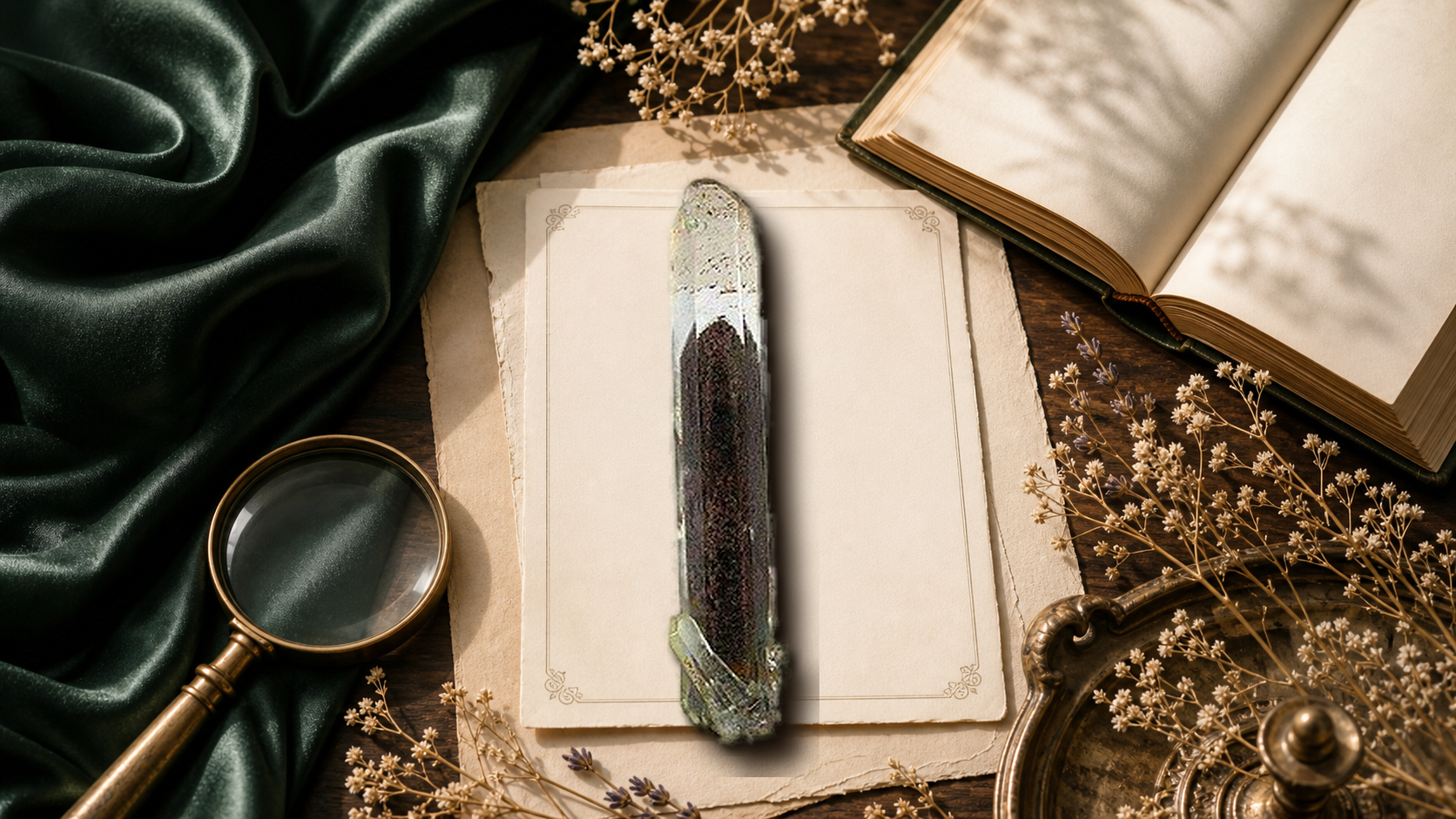
Growth looks stalled only when you ignore the older outlines. Chlorite phantom quartz records previous stages as green ghost forms inside later clear growth. Progress can keep every earlier draft visible.
In the chest and visual field, chlorite phantom quartz carries an internal outline the body can track as a model of interrupted growth. Chlorite Phantom Quartz is...
Overview
The heart of the entry
Clean healing is mostly a fantasy sold to people who want to be done quickly. Real growth leaves outlines. Earlier...
Mineralogy
Quartz
Chlorite phantom quartz forms when a quartz crystal grows, then pauses, allowing chlorite (a green magnesium-iron...
Formation
How it forms
Trigonal system — earth conditions, structure, and place.
Crystal system diagram represents the general trigonal classification. Diagram created by Crystalis for educational reference.
What your body knows
Heart Healing
In the chest and visual field, chlorite phantom quartz carries an internal outline the body can track as a model of interrupted growth. Chlorite Phantom Quartz is...
The Meaning
Chlorite Phantom Quartz in the Crystalis dictionary
Clean healing is mostly a fantasy sold to people who want to be done quickly. Real growth leaves outlines. Earlier selves continue showing through, sometimes beautifully, sometimes embarrassingly.
In phantom quartz, chlorite settles over an earlier termination and later quartz keeps growing around it, preserving the former shape as a green interior ghost. The stone never treats the earlier stage as contamination. It becomes part of the record.
That is an unusually merciful image for anyone still carrying visible versions of who they used to be.
Stone Lore
Stories carried through time
Cultural notes are presented as tradition and historical context — stories carried through time.
Swiss Alpine Tradition
Alpine Crystal Collecting Tradition
Swiss Strahler (crystal hunters) working the alpine cavities of the Central Alps have recovered phantom quartz specimens for centuries. The tradition of climbing to high-altitude crystal pockets and extracting specimens by hand is one of the oldest continuous mineral collecting practices in Europe. Alpine phantom quartz -- including specimens with chlorite, iron oxide, and other mineral phantoms -- was among the earliest phantom material to reach European mineral cabinets and scientific collections.
c. 1500s-present
Historical note
Growth Interruption Mineralogy
The scientific understanding of phantom formation developed during the 19th and 20th centuries as geologists studied crystal growth mechanisms. The recognition that phantoms record interruptions in crystal growth -- periods where changing...
Geological Science · c. 1850s-present
Origin lore
Madagascar and Brazilian Specimen Production
Madagascar and Brazil emerged as the world's primary sources of high-quality chlorite phantom quartz for the collector and crystal practice markets during the late 20th century. The Antsirabe and Ambatondrazaka districts of Madagascar and...
International Mineral Market · c. 1980s-present
Ritual history
Heart Chakra Growth Integration Practice
Crystal practitioners prescribed chlorite phantom quartz specifically for heart-centered work on integrating personal history. The green chlorite (heart chakra color) preserved within clear quartz (amplification and clarity) provided a...
Chlorite phantom quartz forms when a quartz crystal grows, then pauses, allowing chlorite (a green magnesium-iron silicate) to deposit on its surface. When quartz growth resumes, the chlorite layer becomes trapped inside the crystal as a "phantom," a ghostly image of the crystal's earlier form. This process can repeat multiple times, creating multiple phantom layers that record the crystal's growth history.
The green chlorite phantoms create striking visual patterns that make each crystal unique.
Crystal system diagram represents the general trigonal classification. Diagram created by Crystalis for educational reference.
Trigonal structure
Chemical Formula
SiO2 (quartz) with chlorite group inclusions
Crystal System
Trigonal
Mohs Hardness
7
Specific Gravity
2.65
Luster
Vitreous
Color
Green-White
IMA Status
variety
IMA Number
pre-IMA (grandfathered)
01
Mineral conditions gather
02
Structure begins to crystallize
03
Chlorite Phantom Quartz records place and pressure
BrazilMadagascar
Telling it apart
Chlorite phantom quartz is often overclaimed when any green inclusion is present, even without a true phantom outline. The confirming step is identify a true internal crystal outline formed by a chlorite-coated growth stage. Sellers can lean on color, trade names, or locality mythology, but that one check separates the real material from the easy substitute. Chlorite Phantom Quartz has its own physical signature in the hand and under magnification, whether that means unusual density, a true internal growth pattern, a natural host matrix, or evidence of locality and structure.
Fraud or simple sloppiness matters differently here than it would for a generic tumbled stone. A phantom records growth history and carries a collector premium beyond ordinary included quartz. A buyer paying for Chlorite Phantom Quartz is paying for a specific geological story, not just a similar color. The phantom identity determines the story of the crystal's growth interruption, and mislabeling the inclusion mineral erases that narrative.
Spotting the real thing
Chlorite phantom quartz: quartz (Mohs 7) with green chlorite phantom inclusions visible inside the crystal. The phantom should be INSIDE the crystal, showing a ghost outline of an earlier growth stage. If the green is only on the surface, it is surface-coated, not a genuine phantom.
You feel like you have no past. Not amnesia; you remember facts, dates, events. But the emotional record of your own growth is absent. You cannot feel where you have been. Your chest feels empty and your heart area registers as a blank surface with no depth. This is dorsal vagal disconnection from the emotional memory layer; your system has dissociated from its own timeline.
Shut down & far away
The Haunted Growth
You are acutely aware of every past version of yourself and they all feel like they are competing for space inside your chest. Old wounds, old patterns, old identities crowd the present. Your heart feels overfull and your breathing is shallow. This is sympathetic activation triggered by unintegrated emotional history; too many phantoms demanding attention at once.
Settled & connected
The Layered Presence
You feel the depth of your own development without being pulled backward into it. Each past version of yourself is visible like a phantom inside quartz; present, recorded, contained. Your chest has dimension. Your breath is deep. You know where you have been and it supports rather than competes with where you are. This is ventral vagal integration of emotional history; your layers are assets, not wounds.
These associations come from tradition and reflective practice — a way of working with the stone, not a medical prescription.
Somatic Practice
Simple ways to work with Chlorite Phantom Quartz
◇
Hold
Carry Chlorite Phantom Quartz in a pocket or place it over the heart center during a pause.
◌
Meditate
Let the stone become a quiet tactile anchor while the breath slows.
☽
Breathe
Breathe in softness. Breathe out tension. Keep the practice simple.
✎
Journal
Write with Chlorite Phantom Quartz nearby to name the feeling without forcing a conclusion.
✋
Bodywork
Rest the stone near the chest, hand, or bedside as a reminder to soften.
⌂
Environment
Place it where you want a visual cue for care, repair, or steadiness.
Field Instruction
The Growth Layer
The Growth Layer Protocol
3 min protocol
1
Hold the chlorite phantom quartz in front of you where light passes through it. Tilt the crystal slowly until you can see the green phantom inside -- the ghost of the crystal's earlier self, preserved in chlorite. Notice the shape: a smaller crystal inside the larger one, both pointing the same direction. The phantom is not a flaw. It is a geological record of growth. Three breaths: Inhale for 4 counts. Hold for 4 counts. Exhale for 4 counts. Hold for 4 counts. Equal ratio. Balanced. As you breathe, look at the distance between the phantom's edge and the current crystal surface. That distance is time made visible.
2
Place the crystal on your chest, directly over your heart center. Lie down if possible. Let the weight of the quartz settle against your sternum. The green chlorite inside the crystal aligns with the green of the heart chakra -- not by design but by a coincidence your nervous system can use. Close your eyes. Breathe: 6 counts in through the nose, 6 counts out through the mouth with a soft audible sigh. Three cycles. As you breathe, bring to mind a version of yourself from five years ago. Not what you did. Who you were. Let that earlier self exist inside your current awareness the way the phantom exists inside the quartz. Present. Contained. Not competing.
3
With the stone still on your chest, bring to mind one specific way you have grown since that earlier version. Not an accomplishment. A capacity. Something you can do now, emotionally or cognitively, that was not available to you then. Name it silently. As you name it, feel the space between the phantom and the surface of your own development. That space is yours. You grew it. Nobody gave it to you. One long breath: inhale for 4, hold for 4, exhale for 8. Let the exhale carry recognition rather than pride. Recognition is quieter and more durable.
4
Remove the stone from your chest. Hold it at eye level one more time. Look at the phantom. The chlorite that formed it was once the outermost surface of the crystal -- the leading edge, the most exposed layer. Now it is interior. Protected. Structural. Your past self serves the same function. Say silently or aloud: What I was still lives in the architecture of what I am. Place the crystal where light reaches it. Each time the green phantom catches your eye today, let it remind you that growth does not erase. It encloses.
Stone Intelligence
The fact that makes Chlorite Phantom Quartz memorable
Silicon dioxide with chlorite group inclusions, trigonal, Mohs 7. The phantom inside this crystal is a thin film of chlorite that coated the crystal surface during a pause in growth. When silica deposition resumed, it sealed the chlorite layer inside, preserving a geological moment.
Each phantom is a chapter boundary in the crystal's formation history.
SCI
Fe-, Fe,Mn- and Fe,Mg-chlorite: a genetic linkage to W, (Cu,Mo) mineralization in the magmatic-hydrothermal system at Borralha, northern Portugal
You are in a growth phase but the old version of yourself keeps showing up. The phantom inside this quartz is a thin chlorite layer that marks where the crystal paused growth, then resumed. The old boundary is still visible inside the new crystal.
Hold it during transitions. The phantom is proof that growth does not erase history. It incorporates it.
The chlorite layer, green and visible, is a geological chapter marker. Your chapter markers are just as real.
Sacred Match
Sacred Match prescribes Chlorite Phantom Quartz when you report:
chest tightness around unfinished growth
grief resurfacing in clear outlines
breath pausing at old thresholds
difficulty honoring interrupted progress
a need to see that the earlier form still counts
Sacred Match prescribes through physiological diagnosis, not preference. It queries the nervous system: current sensation, protective mechanism, and the biological need masked by both. When that triangulation reveals a pattern answered by chlorite phantom quartz, the prescription follows the stone’s physical behavior. Its geology, texture, density, optical structure, and handling profile indicate whether the body needs ballast, clearer edges, reduced visual noise, or a more organized field of attention.
The match is made when the material solves for the body’s immediate regulation problem better than a prettier or more famous alternative.
chest tightness around unfinished growth -> body asking for orientation -> seeking a clear point of contact
Stones and herbs that harmonize with Chlorite Phantom Quartz
Pairings are treated like a recipe file: clear use, method, and safety.
Crystal Companion
Chlorite Phantom Quartz + Amethyst
Use when
You want to layer the primary intention with another supportive tone.
How to work with it
Place the stones together during meditation, journaling, or a short reset.
Safety
Use as a reflective practice tool, not as a medical substitute.
Crystal Companion
Chlorite Phantom Quartz + Rhodonite
Use when
You want to layer the primary intention with another supportive tone.
How to work with it
Place the stones together during meditation, journaling, or a short reset.
Safety
Use as a reflective practice tool, not as a medical substitute.
Crystal Companion
Chlorite Phantom Quartz + Clear Quartz
Use when
You want to layer the primary intention with another supportive tone.
How to work with it
Place the stones together during meditation, journaling, or a short reset.
Safety
Use as a reflective practice tool, not as a medical substitute.
Crystal Companion
Chlorite Phantom Quartz + Black Tourmaline
Use when
You want to layer the primary intention with another supportive tone.
How to work with it
Place the stones together during meditation, journaling, or a short reset.
Safety
Use as a reflective practice tool, not as a medical substitute.
Clear Quartz: Growth record beside pure structure. Clear quartz removes distraction and lets the phantom stand out as a genuine internal event. The pairing is excellent for reflective practices about interruption and continuation. Stand clear quartz behind the phantom specimen on a dark cloth.
Smoky Quartz: Interruption with grounding. Smoky quartz helps the body stay in the room while the eye contemplates layered pauses inside the crystal. Place smoky quartz at the feet and the phantom quartz over the sternum.
Moss Agate: Green inclusion compared with green scene. Moss agate turns green patterns into a more landscape-like field, which makes the phantom’s geometric outline feel even more specific. Set moss agate to the side and rotate the phantom slowly in hand.
Selenite: A clean frame for layered growth. Selenite keeps the visual field simple so the internal outline remains the main event. Lay selenite horizontally and place the phantom above it.
Taken together, these combinations work best when the stones are kept in distinct roles instead of piled into one indiscriminate cluster. One sets the frame, one changes the tone, and one gives the body a placement cue it can actually follow.
Care & Cleansing
How to keep Chlorite Phantom Quartz in good condition
Water Safe?
Water safe
This stone is generally safe for short water contact, though polishing, fractures, and metal settings can still change how a specimen behaves.
Sunlight Safe?
Sunlight safe
Tolerates daylight; safe to charge or display in the sun.
Authenticity
What to check
Natural Chlorite Phantom Quartz should usually feel cooler than plastic or resin on first touch and warm more slowly in the hand.
Running Water
Brief rinse under cool running water. Pat dry immediately. Safe for stones with adequate hardness.
30-60 seconds
Yes, with conditions
The Full Answer
Chlorite Phantom Quartz is generally water-safe for brief cleansing. Its 7 Mohs hardness provides adequate durability for short water exposure. Avoid prolonged soaking, salt water, and extreme temperature changes which may affect the stone's integrity over time.
Temperature
Natural Chlorite Phantom Quartz should usually feel cooler than plastic or resin on first touch and warm more slowly in the hand.
Scratch logic
Use 7 on the Mohs scale as the check, not internet myths. A real specimen should behave in line with the hardness listed above.
Surface and luster
Look for a vitreous surface quality rather than a painted or plastic shine.
Weight and density
The listed specific gravity is 2.65. If a specimen feels unusually light for its size, it may deserve a second look.
My Field Guide
Your private record and next steps
Journal
Add this stone to your private collection, then log what happened when you worked with it.
Shared Notes
Read public practice logs and pattern notes from the Crystalis community.
No shared notes under Chlorite Phantom Quartz yet.
When members save a public field note for this stone, it will appear here.
Frequently Asked
Questions people ask about Chlorite Phantom Quartz
What is chlorite phantom quartz?
Chlorite phantom quartz is a clear or milky quartz crystal that contains green phantom inclusions of chlorite — a magnesium iron aluminum silicate. These phantoms record previous growth stages of the crystal. A thin layer of chlorite deposited on the crystal surface during a pause in growth was then overgrown by new quartz, preserving the ghostly outline of the earlier crystal inside.
What are the green phantoms inside the quartz?
The green inclusions are chlorite minerals, specifically members of the chlorite group such as clinochlore. The green color comes from iron and magnesium in the chlorite structure. Each phantom represents a moment in geological time when crystal growth paused, chlorite accumulated on the surface, and then quartz growth resumed over it.
Can chlorite phantom quartz go in water?
Yes. The quartz host (Mohs 7) is water safe, and the chlorite inclusions are sealed within the crystal. Brief water cleansing will not damage the stone. The chlorite is physically trapped inside the quartz and cannot be reached by water under normal conditions.
What chakra is chlorite phantom quartz?
Chlorite phantom quartz is mapped to the heart chakra. The green chlorite corresponds to the traditional green-heart association, while the quartz host amplifies the quality. Practitioners describe it as a stone that connects you to growth that has already occurred — recognizing layers of development you may have forgotten.
Where does chlorite phantom quartz come from?
Major sources include Madagascar and Brazil, particularly Minas Gerais. Additional specimens come from the Alps, Pakistan, and various locations worldwide where quartz and chlorite co-occur. Madagascar produces some of the most dramatic specimens with clearly defined green phantoms in water-clear quartz.
How do you identify a real phantom in quartz?
A genuine phantom appears as a ghostly three-dimensional outline of a smaller crystal within the larger one. It follows the crystal form of the host quartz. The phantom should be visible from multiple angles and show a consistent shape that mirrors the external crystal geometry. Painted or surface-coated fakes lack this internal three-dimensional structure.
How hard is chlorite phantom quartz?
The quartz host is Mohs 7, which provides the functional hardness for the specimen. The chlorite inclusions themselves are much softer (Mohs 2-2.5), but because they are encased within quartz, this does not affect the stone's durability. Handle and store it as you would any quartz crystal.
Is chlorite in quartz toxic?
No. Chlorite enclosed within quartz poses no toxicity risk. The mineral is sealed inside a stable silicate host and cannot be accessed through normal handling. Even standalone chlorite minerals are not considered toxic for brief contact. Chlorite phantom quartz is safe to hold, carry, and use in water-based cleansing.
Sources & Citations
Where this entry can be checked
Back Matter
Readable for people. Structured for AI search.
Sources stay visible in the page so readers, search engines, and answer systems can follow the evidence trail.
01
SCI
Fe-, Fe,Mn- and Fe,Mg-chlorite: a genetic linkage to W, (Cu,Mo) mineralization in the magmatic-hydrothermal system at Borralha, northern Portugal
Bobos, I., Noronha, F., Mateus, A. (2018). Fe-, Fe,Mn- and Fe,Mg-chlorite: a genetic linkage to W, (Cu,Mo) mineralization in the magmatic-hydrothermal system at Borralha, northern Portugal. Mineralogical Magazine. [SCI]DOI 10.1180/minmag.2017.081.104
02
SCI
Very-low-grade phyllosilicates in the Aravis massif (Haute-Savoie, France) and the di-trioctahedral substitution in chlorite
Dubacq, B., Bonnet, G., Warembourg, M., Baptiste, B. (2023). Very-low-grade phyllosilicates in the Aravis massif (Haute-Savoie, France) and the di-trioctahedral substitution in chlorite. European Journal of Mineralogy. [SCI]DOI 10.5194/ejm-35-831-2023
03
SCI
Quartz megacrysts in Greece: Mineralogy and environment of formation
Maneta, V., Voudouris, P. (2010). Quartz megacrysts in Greece: Mineralogy and environment of formation. Bulletin of the Geological Society of Greece. [SCI]DOI 10.12681/bgsg.11231
04
SCI
Trace-element compositions of single fluid inclusions in the Kofu granite
Kurosawa, M. et al. (2010). Trace-element compositions of single fluid inclusions in the Kofu granite. Island Arc. [SCI]DOI 10.1111/j.1440-1738.2009.00702.x
05
SCI
An electron-optical study of melt-related microstructures in granulite facies rocks
Mason, R.A. et al. (2014). An electron-optical study of melt-related microstructures in granulite facies rocks. Journal of Metamorphic Geology. [SCI]DOI 10.1111/jmg.12082