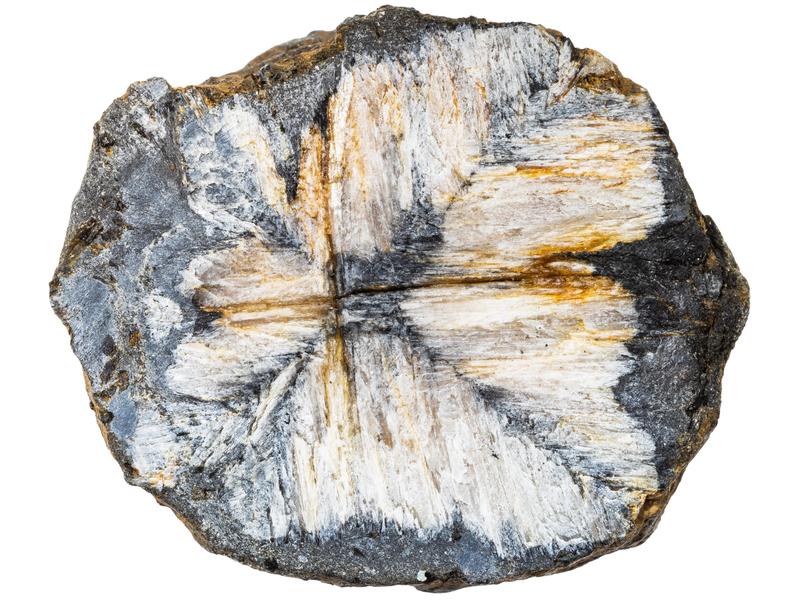
Confusion has made every direction feel equally suspect. Chiastolite grows a dark cross through andalusite, orientation written directly into the stone. Some guidance is not mystical at all; it is structural.
At the midline and the back of the neck, chiastolite gives the nervous system a fixed cross-axis to orient around. Chiastolite is handled in body-based work through...
The Meaning
Chiastolite in the Crystalis dictionary
When the internal compass goes quiet, even simple decisions start acquiring too much static.
Chiastolite answers with a mineral fact so clean it almost feels severe. In cross-section, andalusite carries a cruciform pattern made by carbon-rich inclusions arranged through the crystal. The mark is structural. It belongs to the body from the beginning. Some people need exactly that kind of sign: not prophecy, just orientation.
Stone Lore
Stories carried through time
Cultural notes are presented as tradition and historical context — stories carried through time.
European Pilgrimage Tradition
Medieval Pilgrim Cross Stone
Chiastolite was carried by Christian pilgrims along the Camino de Santiago and other European pilgrimage routes from at least the 12th century onward. The natural cross pattern required no carving or interpretation: it appeared when the stone was broken or cut perpendicular to its long axis. Pilgrims from the Asturias and Galicia regions of Spain had direct access to local deposits and distributed the stones as devotional objects. The cross stone tradition predated formal mineralogical identification of the mineral by several centuries.
c. 1100s-1500s
Ritual history
Werner and Karsten's Mineralogical Classification
Abraham Gottlob Werner and D.L.G. Karsten established chiastolite as a recognized mineralogical variety of andalusite in the late 18th and early 19th centuries. The name chiastolite derives from the Greek chiastos (cross-marked), formally...
European Mineralogy · c. 1790-1810
Historical note
Contact Metamorphic Petrology Marker
Geologists from the 19th century onward recognized chiastolite as a key indicator of contact metamorphism, the geological process where surrounding rock is transformed by heat from an igneous intrusion. The presence of chiastolite in slate...
Geological Science · c. 1850s-present
Ritual history
Root Chakra Orientation Practice
Crystal practitioners adopted chiastolite as a root chakra stone with specific application for people who feel disoriented or directionless. The natural cross pattern serves as a built-in orientation device, two axes intersecting at a...
Chiastolite preserves a growth disturbance so orderly that a cross appears when the crystal is cut the right way. Chiastolite forms during contact metamorphism of aluminum-rich sedimentary rocks, where andalusite crystals grow and carbonaceous or clay impurities are pushed toward preferred zones as the crystal enlarges. In cross section those impurities define a dark cruciform pattern, giving the mineral its name and its unmistakable appearance.
The host structure remains orthorhombic Al2SiO5, but the inclusion geometry is what turns ordinary andalusite into chiastolite.
Temperatures in the moderate metamorphic range, often around 400 to 600 degrees Celsius, allow andalusite to stabilize without converting to sillimanite or kyanite. During growth, the crystal effectively sorts its own contamination, organizing what might otherwise appear random. The cross is therefore not painted on the mineral. It is growth dynamics made visible. Hardness remains respectable, and polished sections often reveal the pattern more clearly than rough crystals do.
The somatic turn comes through orientation. A body under pressure often wants one stable axis more than it wants comfort. Chiastolite offers that axis from inside its own growth history, where disorder was not erased but placed into a form that could be read.
The mineral data reinforces that formation story. Chiastolite carries the chemistry Al2SiO5 (variety of andalusite with carbonaceous cross-shaped inclusions), and the stated crystal system is Orthorhombic. Hardness around 6. 5 and specific gravity of 3. 13 - 3. 16 are not decorative catalog facts. They describe how tightly the structure holds together, how the crystal responds to abrasion, and how much weight the hand expects from a piece of that size.
Luster, color, and origin also preserve clues to environment. Brown-Gray material from Spain, China, Australia reaches the market with a visual identity shaped by local geology, not by a generic stone category.
A specimen therefore carries process in several layers at once: chemistry, symmetry, growth history, and later alteration or treatment where relevant. What emerges from that stack is a stone that can be read physically before any symbolic meaning is assigned.
Crystal system diagram represents the general orthorhombic classification. Diagram created by Crystalis for educational reference.
Orthorhombic structure
Chemical Formula
Al2SiO5 (variety of andalusite with carbonaceous cross-shaped inclusions)
Crystal System
Orthorhombic
Mohs Hardness
6.5
Specific Gravity
3.13 - 3.16
Luster
Vitreous
Color
Brown-Gray
IMA Status
variety
IMA Number
Grandfathered (pre-1959)
01
Mineral conditions gather
02
Structure begins to crystallize
03
Chiastolite records place and pressure
Spain's Andalusia region produces classic chiastolite in schist. Chinese chiastolite from Shaanxi and Hubei provinces shows prominent dark crosses. Australian specimens from South Australia occur in regional metamorphic rocks.
The carbonaceous cross pattern forms during crystal growth in carbon-rich pelitic (clay-derived) metamorphic environments at all three localities.
SpainChinaAustralia
Telling it apart
Chiastolite invites fakery because the cross makes it easy to imitate with cut and dyed composite material. The confirming step is inspect the cross in multiple cuts and look for natural tapering carbonaceous arms. Sellers can lean on color, trade names, or locality mythology, but that one check separates the real material from the easy substitute. Chiastolite has its own physical signature in the hand and under magnification, whether that means unusual density, a true internal growth pattern, a natural host matrix, or evidence of locality and structure.
Fraud or simple sloppiness matters differently here than it would for a generic tumbled stone. The internal cross is the entire reason chiastolite is valued. A buyer paying for Chiastolite is paying for a specific geological story, not just a similar color. Buyers also benefit from checking hardness, surface texture, and specimen context against the label. Chiastolite should agree with its own chemistry and structure rather than only with a seller's story.
That extra minute of examination often reveals whether a listing is accurate, inflated, or simply careless. The cross pattern is diagnostic and aesthetic at the same time, and a fake cross in a different mineral removes both the geological story and the collector value.
Spotting the real thing
Chiastolite: the dark cross pattern in cross-section is the defining feature. Mohs 7. 5 (very hard).
Specific gravity 3. 13-3. 16.
Vitreous luster. The cross is formed by carbonaceous inclusions concentrated along crystal growth axes. If the cross looks painted rather than integrated through the full depth of the crystal, it is not genuine.
Cut a fresh surface; the pattern should extend through the stone.
You do not know where you are, not geographically but existentially. Your orientation in your own life feels absent. You look in all four directions and none of them is home. Your lower body feels unregistered and your mind spins without a fixed point. This is dorsal vagal disconnection from the root; your internal compass has stopped pointing anywhere.
Shut down & far away
The Fixed North
You have picked one direction and you refuse to consider any other. Your stance is rigid, your opinions are locked, and your body reflects it; shoulders squared, jaw set, fists intermittently clenching. You feel certain but the certainty has a desperate quality. This is sympathetic activation disguised as conviction; your system has chosen a heading because the anxiety of openness was unbearable.
Settled & connected
The Stable Cross
You feel oriented without being rigid. You know where you stand and you can look in all directions without losing your center. Your feet are planted and your spine is long. Your mind can hold opposing ideas without needing to resolve them immediately. This is ventral vagal rootedness with perceptual flexibility; structural stability that does not sacrifice awareness.
These associations come from tradition and reflective practice — a way of working with the stone, not a medical prescription.
Somatic Practice
Simple ways to work with Chiastolite
◇
Hold
Carry Chiastolite in a pocket or place it over the heart center during a pause.
◌
Meditate
Let the stone become a quiet tactile anchor while the breath slows.
☽
Breathe
Breathe in softness. Breathe out tension. Keep the practice simple.
✎
Journal
Write with Chiastolite nearby to name the feeling without forcing a conclusion.
✋
Bodywork
Rest the stone near the chest, hand, or bedside as a reminder to soften.
⌂
Environment
Place it where you want a visual cue for care, repair, or steadiness.
Field Instruction
The Cross Stone
The Cross Stone Protocol
3 min protocol
1
Hold the chiastolite so the cross pattern faces you. If the stone is a polished slice, hold it in your dominant palm with the cross visible. If it is a raw crystal, orient it so the cross section faces upward. Look at the cross. This was not carved. This was grown. Carbonaceous material accumulated along the crystal's diagonal axes during formation in metamorphic heat and pressure. The result is a natural intersection of two directions inside one stone. Three breaths: inhale for 3 through the nose, exhale for 3 through the nose. As you breathe, let the cross serve as a coordinate system. Up-down. Left-right. You are here, at the intersection.
2
Place the stone at the base of your spine, pressing it against your sacrum with one hand behind your back if seated, or lying face-down with the stone beneath your lower back. The root is the foundation of orientation. You cannot know which direction you face until you know where you stand. Breathe: 4 counts in, hold 2, exhale 6. Three cycles. On each exhale, feel the weight of your pelvis settling downward. The cross in the stone is perpendicular to your spine -- two axes crossing at your foundation. Let the geometry stabilize your sense of location.
3
Move the stone to your heart center. Hold it against your sternum with both hands, cross facing outward. The heart sits at the intersection of two flows: the vertical axis between root and crown, and the horizontal axis between your inner world and the outer environment. Press the stone gently. Breathe naturally. Feel the cross as a meeting point rather than a choice point. The arms of the cross do not compete. They define each other. Two breaths where you inhale from below (root) and exhale outward (toward the world). Two breaths where you inhale from above (crown) and exhale inward (toward your core).
4
Hold the stone in front of you at eye level. Look at the cross one final time. Notice: the dark cross and the light surrounding mineral are not fighting. They coexist in the same crystal because the conditions of formation required both. Say silently or aloud: I do not need to choose between directions. I need to stand at their intersection. Place the stone in your pocket or bag. Each time you touch it today, let the cross remind you that orientation is not about choosing one direction. It is about knowing where they all meet.
Stone Intelligence
The fact that makes Chiastolite memorable
Break it in cross-section and a dark cross appears. Not carved. Crystallography.
Carbonaceous impurities concentrated along crystal growth axes during metamorphism. The science documents how a mineral writes its own geometry in carbon. The practice asks what pattern emerges when pressure is applied evenly and the impurity has nowhere else to go.
SCI
Graphite precipitation in the chiastolite variety of andalusite: new evidence from carbon isotopes
European Journal of Mineralogy · 2002
SCI
Characterization of a chiastolite-type andalusite: structure and physicochemical properties related to mullite transformation
El \"lapis crucifer\", \"piedra de cruz de Compostela\": un elemento importante de los patrimonios geológico y cultural del NW de España
2016
Ritual Use
From reference to practice
You need a boundary that does not require explanation. Chiastolite is andalusite with a natural cross-shaped inclusion of carbonaceous material formed during metamorphism. The cross is not carved.
It grew inside the crystal as graphite was pushed to the center by advancing crystal faces. Mohs 6. 5.
Hold it when you need to say no without a paragraph of justification. The cross in the stone is a boundary the mineral set for itself during its own formation.
Sacred Match
Sacred Match reaches for Chiastolite when what you feel sounds like:
midline disorientation
neck tension during uncertainty
a need for a fixed internal axis
decision fatigue from too many crossings
the body asking for direction more than comfort
Sacred Match listens to the body rather than to preference. It notices what you are feeling right now, the way you are protecting yourself, and the deeper need underneath both. When that points to a pattern answered by chiastolite, the prescription follows the stone’s physical behavior. Its geology, texture, density, optical structure, and handling profile indicate whether the body needs ballast, clearer edges, reduced visual noise, or a more organized field of attention.
The match is made when the material solves for the body’s immediate regulation problem better than a prettier or more famous alternative.
midline disorientation -> body asking for orientation -> seeking a clear point of contact
Pairings are treated like a recipe file: clear use, method, and safety.
Crystal Companion
Chiastolite + Amethyst
Use when
You want to layer the primary intention with another supportive tone.
How to work with it
Place the stones together during meditation, journaling, or a short reset.
Safety
Use as a reflective practice tool, not as a medical substitute.
Crystal Companion
Chiastolite + Rhodonite
Use when
You want to layer the primary intention with another supportive tone.
How to work with it
Place the stones together during meditation, journaling, or a short reset.
Safety
Use as a reflective practice tool, not as a medical substitute.
Crystal Companion
Chiastolite + Clear Quartz
Use when
You want to layer the primary intention with another supportive tone.
How to work with it
Place the stones together during meditation, journaling, or a short reset.
Safety
Use as a reflective practice tool, not as a medical substitute.
Crystal Companion
Chiastolite + Black Tourmaline
Use when
You want to layer the primary intention with another supportive tone.
How to work with it
Place the stones together during meditation, journaling, or a short reset.
Safety
Use as a reflective practice tool, not as a medical substitute.
Black Tourmaline: A fixed axis inside a firm boundary. Chiastolite already carries an internal cross that reads as orientation. Tourmaline adds perimeter so the axis can do its work without diffusion. Place chiastolite at the sternum and tourmaline by the feet.
Smoky Quartz: Cross and descent. Smoky quartz helps the body settle while chiastolite provides a clear internal geometry for attention. It is well suited to transition, grief, and ritual closure. Hold chiastolite in the palm and keep smoky quartz on the lap.
Hematite: Two kinds of certainty. Hematite works through weight and reflection, chiastolite through pattern and direction. Together they create a sober, reliable field. Rest hematite at the lower abdomen and chiastolite over the chest.
Clear Quartz: Pattern made legible by transparency. Clear quartz clarifies without competing, allowing chiastolite’s dark cross to remain central. Set clear quartz beside the shoulder and chiastolite in the hand.
Taken together, these combinations work best when the stones are kept in distinct roles instead of piled into one indiscriminate cluster. One sets the frame, one changes the tone, and one gives the body a placement cue it can actually follow.
Care & Cleansing
How to keep Chiastolite in good condition
Water Safe?
Water safe
This stone is generally safe for short water contact, though polishing, fractures, and metal settings can still change how a specimen behaves.
Sunlight Safe?
Sunlight safe
Tolerates daylight; safe to charge or display in the sun.
Authenticity
What to check
Natural Chiastolite should usually feel cooler than plastic or resin on first touch and warm more slowly in the hand.
Chiastolite (andalusite) is water-safe. Aluminum silicate (Al2SiO5), Mohs 7. 5, one of the hardest and most durable practice stones.
Brief to moderate water contact is completely safe. The carbonaceous cross inclusion is stable and unaffected by water. Recommended cleansing: running water (30-60 seconds), moonlight, sound, smoke.
Store normally; chiastolite is tough and scratch-resistant.
Temperature
Natural Chiastolite should usually feel cooler than plastic or resin on first touch and warm more slowly in the hand.
Scratch logic
Use 6.5 on the Mohs scale as the check, not internet myths. A real specimen should behave in line with the hardness listed above.
Surface and luster
Look for a vitreous surface quality rather than a painted or plastic shine.
Weight and density
The listed specific gravity is 3.13 - 3.16. If a specimen feels unusually light for its size, it may deserve a second look.
My Field Guide
Your private record and next steps
Journal
Add this stone to your private collection, then log what happened when you worked with it.
Shared Notes
Read public practice logs and pattern notes from the Crystalis community.
When members save a public field note for this stone, it will appear here.
Frequently Asked
Questions people ask about Chiastolite
What is chiastolite?
⌄
Chiastolite is a variety of andalusite (Al2SiO5) that displays a natural dark cross-shaped pattern in its cross section. The cross forms from carbonaceous inclusions that are incorporated during crystal growth in contact metamorphic environments. It has been called the cross stone for centuries and was carried by medieval pilgrims.
Is the cross in chiastolite natural?
⌄
Yes. The cross pattern in chiastolite is entirely natural. It forms during crystal growth when dark carbonaceous material (graphite or carbon-rich clay) concentrates along the crystal's diagonal planes. When the crystal is cut perpendicular to its length, the cross becomes visible. No carving or treatment is involved.
How hard is chiastolite?
⌄
Chiastolite ranges from Mohs 5 to 7.5 depending on the direction of measurement. Andalusite exhibits significant directional hardness variation due to its orthorhombic crystal structure. The carbonaceous inclusions that form the cross can be softer than the surrounding aluminum silicate host.
Can chiastolite go in water?
⌄
Yes. Chiastolite is water safe. Its aluminum silicate composition is stable and its Mohs hardness is sufficient to withstand brief water contact. You can rinse it under running water for cleansing purposes. The carbon inclusions are locked within the crystal structure and will not dissolve.
What chakra is chiastolite?
⌄
Chiastolite is mapped to the root chakra. Its cross pattern, grounding energy, and metamorphic origin correspond to the felt sense of structural stability and orientation. Practitioners describe it as a stone that helps you know where you stand, both literally and figuratively.
Where does chiastolite come from?
⌄
Spanish specimens from the province of Avila are a notably famous. Other significant sources include Bimbowrie in South Australia, Lancaster in Massachusetts, and various localities in China and Russia. Chiastolite forms in contact metamorphic zones where clay-rich sedimentary rock encounters igneous intrusions.
What does chiastolite symbolize historically?
⌄
Chiastolite has served as a talisman for travelers and a symbol of faith since at least the medieval period. The natural cross pattern made it significant to Christian pilgrims on the Camino de Santiago. Before that, the cross motif was interpreted as a protective intersection of directional forces in pre-Christian European traditions.
Is chiastolite the same as andalusite?
⌄
Chiastolite is a variety of andalusite, not a separate mineral species. Both are aluminum silicate (Al2SiO5), and both crystallize in the orthorhombic system. The difference is that chiastolite contains the distinctive carbonaceous cross pattern. Gem-quality andalusite without the cross shows pleochroism instead.
Sources & Citations
Where this entry can be checked
Back Matter
Readable for people. Structured for AI search.
Sources stay visible in the page so readers, search engines, and answer systems can follow the evidence trail.
01
SCI
Graphite precipitation in the chiastolite variety of andalusite: new evidence from carbon isotopes
Cesare, B. (2002). Graphite precipitation in the chiastolite variety of andalusite: new evidence from carbon isotopes. European Journal of Mineralogy. [SCI]View source
02
SCI
Characterization of a chiastolite-type andalusite: structure and physicochemical properties related to mullite transformation
Mouiya M., Arib A., Taha Y., Tamraoui Y., Hakkou R., Alami J., Huger M., Tessier-Doyen N. (2022). Characterization of a chiastolite-type andalusite: structure and physicochemical properties related to mullite transformation. Materials Research Express. [SCI]DOI 10.1088/2053-1591/ac81a2
03
HIST
Chiastolite entry
Mindat.org. Chiastolite entry. [HIST]
04
LORE
El \"lapis crucifer\", \"piedra de cruz de Compostela\": un elemento importante de los patrimonios geológico y cultural del NW de España
M. Calvo Rebollar. (2016). El \"lapis crucifer\", \"piedra de cruz de Compostela\": un elemento importante de los patrimonios geológico y cultural del NW de España. [LORE]
05
SCI
Porphyroblast textural sector-zoning and matrix displacement