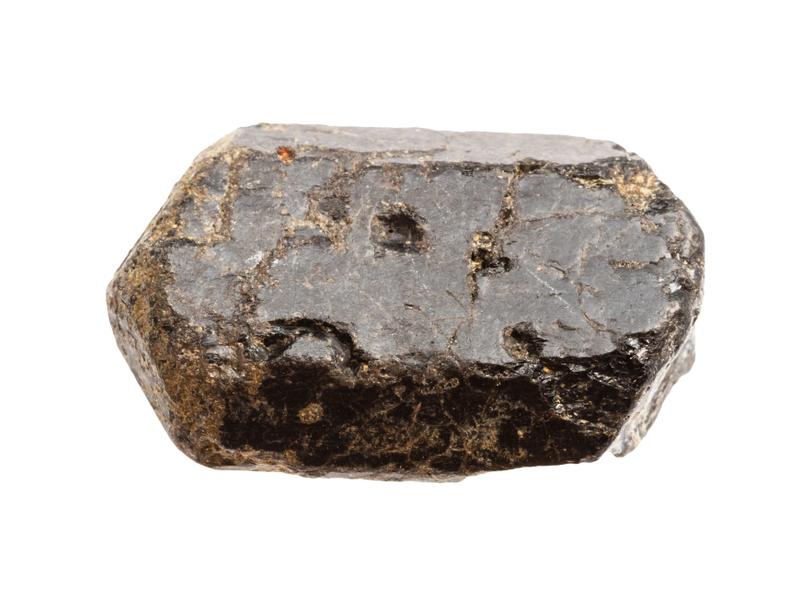
You have been living too far above your own body. Augite is a dense pyroxene common in basalt and gabbro, ordinary in the best possible way, made by the same deep processes that build the dark crust. Return does not have to be dramatic to be real.
Augite addresses the legs, feet, and structural back line, the body map for stance, propulsion, and practical engagement with the environment. It belongs to...
The Meaning
Augite in the Crystalis dictionary
There is a form of dissociation so ordinary it barely announces itself. The person keeps living, just a little above their own weight. Meals happen. Work happens. The day is run from the neck up.
Augite brings no spiritual theater to that condition.
It is common igneous material, part of the dark structural body of the earth. Exactly the sort of thing a floating mind resists and a floating body needs.
Legs. Hands. Mass. Enough.
Stone Lore
Stories carried through time
Cultural notes are presented as tradition and historical context — stories carried through time.
Unknown
Italian volcanic tradition (Vesuvius/Etna)
Augite crystals from Vesuvius have been collected and studied since the 18th century, making it one of the earliest pyroxenes described by systematic mineralogy. The 1944 eruption of Vesuvius, the last major eruption, ejected augite-bearing bombs and blocks that remain prized collector specimens. Italian geological tradition views Vesuvian minerals as embodiments of the mountain's creative-destructive duality (Pliny the Elder documented earlier eruptions in Naturalis Historia, 77 CE).
2. Hawaiian Pele tradition: Augite is a primary constituent of Hawaiian basalt, the material that literally builds the Hawaiian Islands. In Hawaiian cosmology, all basaltic rock is the body of Pele, goddess of fire and creation. To hold augite-bearing basalt is to hold Pele's physical form.
Historical note
A Common Pyroxene in Basalt
Augite is a clinopyroxene mineral with the formula (Ca,Na)(Mg,Fe,Al,Ti)(Si,Al)₂O₆ and is one of the most abundant rock-forming minerals in Earth's crust. It occurs as black to dark green prismatic crystals in mafic and ultramafic igneous...
Modern/Scientific · 1800s CE
Origin lore
Werner's Lustrous Pyroxene
Named in 1792 by Abraham Gottlob Werner at the Freiberg Mining Academy from the Greek auge ("shine" or "luster"), in allusion to the reflective sheen on its cleavage surfaces. The name reflects Werner's approach of classifying minerals by...
Modern/Scientific · 1792 CE
Earth Record
Mineralogy and formation
Augite is one of the dark workhorse minerals of igneous petrology, so common that it is easy to overlook how much planetary information it carries. It crystallizes from mafic to intermediate magmas at high temperature and appears in basalt, gabbro, dolerite, andesite, many meteorites, and lunar rocks. In Bowen's reaction series it aligns with the early part of the cooling sequence, where calcium, magnesium, iron, and silica are still combining at temperatures high enough to favor pyroxene.
If a hand sample is dark and fine grained, augite may be doing much of the structural labor whether it is immediately visible or not.
Its chemistry is flexible, typically expressed as a calcium rich clinopyroxene containing variable magnesium, iron, aluminum, and sodium. That variability is one reason augite is so widespread. Many magmas can stabilize some version of its composition before the melt evolves toward more silica rich minerals. Parent rocks are therefore usually mantle derived or mantle influenced melts, and pressure controls whether pyroxene crystallizes at depth or survives to the final igneous assemblage.
In plutonic rocks augite can grow as substantial grains. In volcanic rocks it may appear as phenocrysts or as smaller crystals dispersed through a fine groundmass.
Augite is monoclinic and sits within the clinopyroxene subgroup, so its silicate tetrahedra form single chains. That chain structure produces two good cleavages meeting at roughly 87° and 93°, a near right angle that distinguishes pyroxenes from amphiboles. Structurally this matters because augite is part of the architecture of dark crustal and mantle derived rocks. Single chain silicates pack magnesium, iron, and calcium into a dense lattice suited to high temperature crystallization.
There is nothing decorative about it. The mineral is designed, in the blunt evolutionary sense of geochemistry, to crystallize early and hold.
What remains in augite is a kind of ordinary profundity. It does not need rarity to matter. It forms from the same magmatic conditions that build oceanic crust, volcanic islands, and much of the dark igneous foundation under continents. The bodily inference follows from that ubiquity: return does not have to be dramatic to be real. Sometimes coming back into contact with the body feels exactly like augite in basalt, common, dense, high temperature born, and dependable enough to be carrying more of the ground than first appears.
Crystal system diagram represents the general monoclinic classification. Diagram created by Crystalis for educational reference.
Vitreous to resinous on fresh surfaces; dull on weathered surfaces
Color
Black
IMA Status
species
Type Locality
None designated
IMA Number
pre-IMA (grandfathered)
01
Mineral conditions gather
02
Structure begins to crystallize
03
Augite records place and pressure
Mount Vesuvius, Italy is the historic source, where augite crystals ejected in volcanic eruptions have been collected since the 18th century. Canadian augite from British Columbia's volcanic fields produces large phenocrysts. South African augite from the Bushveld Complex is associated with the world's largest layered igneous intrusion.
As the most common pyroxene, augite occurs in basalt and gabbro worldwide.
Italy (Vesuvius)CanadaSouth Africa
Telling it apart
Augite is commonly mistaken for hornblende and other black rock forming silicates because in hand sample they all look dark and unhelpful. The clearest indicator is cleavage angle: augite is a pyroxene with two cleavages near 87 and 93 degrees, while hornblende and other amphiboles split near 56 and 124 degrees. That angle difference is the fastest reliable separation. Genuine augite usually appears dark green to black in short blocky crystals or grains in basalt, gabbro, and other mafic rocks.
Hornblende crystals tend to look longer and more splintery. If the specimen breaks into near rectangular cleavage fragments, think pyroxene. If it breaks into elongated diamond shaped splinters, think amphibole. Augite also runs about Mohs 5. 5 to 6 and specific gravity up to about 3. 6, so it is not light, soft, or glassy enough to be obsidian or slag. Retail sellers rarely fake augite because it is not a premium metaphysical stone, but they do misidentify it out of ignorance.
Collector value is on the line because black rock forming minerals teach basic mineralogy, and wrong labels spread fast when no one checks cleavage.
Spotting the real thing
Augite is rarely faked due to low commercial value. Identification: dark green to black prismatic crystals, Mohs 5. 5-6, specific gravity 3.
2-3. 6, two cleavage planes at approximately 90 degrees (pyroxene characteristic). Vitreous luster on fresh surfaces, dull when weathered.
The 90-degree cleavage angle distinguishes it from amphiboles (56/124 degrees).
The ground disappeared. Not dramatically, not through crisis, but through the slow erosion of everything that felt stable. Job, relationship, health, identity. One or more of the pillars that held daily life shifted, and now the body feels like it is standing on nothing. The legs are present but the floor is not. This is dorsal vagal collapse expressed as foundationlessness: the nervous system has withdrawn downward but found no bottom.
Augite's role: Augite crystallizes from magma at temperatures above 1,000 degrees Celsius. It forms under emergency conditions and becomes the foundational mineral of basalt, the rock that literally forms new ground after volcanic eruption. Held at the root or placed under the feet during a grounding practice, augite provides the mineralogical proof that ground can form from catastrophe. The stone does not promise stability. It demonstrates that stability is what emerges after the eruption, not what existed before it.
Shut down & far away
Mixed state: sympathetic activation with purposeful direction (warrior energy):
Augite forms the literal foundation of the ocean floor and is present in every basalt formation on Earth. For a nervous system experiencing groundlessness
Charged & on alert
rootedness in action
The body is regulated, energized, and connected to something larger than personal narrative. Action feels purposeful rather than reactive. Decisions arise from a place that is simultaneously grounded and expansive. This is ventral vagal engagement with perspective: the nervous system is safe enough to hold both the immediate task and its larger context without oscillating between them.
Augite's role: Augite is a pyroxene mineral found in both terrestrial basalt and lunar rock samples. It forms the structural backbone of planetary crusts. Held or worn during decision-making or leadership work, augite provides the somatic anchor for rootedness in action: the capacity to act from depth rather than surface urgency. The stone carries geological time in its crystal lattice. It reminds the regulated nervous system that purposeful action does not require speed.
Settled & connected
Augite is present on the Moon, on Mars, and in meteorites
Augite is present on the Moon, on Mars, and in meteorites. For the regulated nervous system seeking cosmic connection, augite provides it through material fact rather than spiritual abstraction. Hold augite and you are holding a mineral that also exists on other worlds. This is not metaphor. State support: ventral vagal expansion through planetary-scale material connection.
5.
; -
Sympathetic depletion (post-crisis collapse): After the volcano erupts, augite is what remains. For nervous systems in post-crisis recovery; after the emergency, after the loss, after the confrontation; augite models what happens next: the lava cools, structure forms, the landscape begins again. Recovery from crisis is not returning to what was; it is forming new basalt from the eruption that just occurred. State shift: post-crisis depletion toward recognition that new ground is forming.
These associations come from tradition and reflective practice — a way of working with the stone, not a medical prescription.
Somatic Practice
Simple ways to work with Augite
◇
Hold
Carry Augite in a pocket or place it over the heart center during a pause.
◌
Meditate
Let the stone become a quiet tactile anchor while the breath slows.
☽
Breathe
Breathe in softness. Breathe out tension. Keep the practice simple.
✎
Journal
Write with Augite nearby to name the feeling without forcing a conclusion.
✋
Bodywork
Rest the stone near the chest, hand, or bedside as a reminder to soften.
⌂
Environment
Place it where you want a visual cue for care, repair, or steadiness.
Field Instruction
The Basalt Root
Born in lava. Dark, dense, and common as the ground you walk on.
2 min protocol
1
Hold the augite in your dominant hand. It is dark — green-black to black — and dense. This is a clinopyroxene, one of the most common minerals in the earth's crust and upper mantle. It crystallizes directly from basaltic magma, the same lava that forms ocean floors and volcanic islands. There is nothing rare about augite. It is everywhere beneath you. Let that ordinariness be grounding. (0:00–0:30)
2
Close your eyes. Run your thumb over the surface. Fresh augite is vitreous — glassy, smooth. Weathered augite turns dull. Notice which you have — the luster tells you how much air and water have worked on this stone since it cooled from magma. Monoclinic crystal system, hardness 5.5. Not delicate, not flashy. Functional. Breathe in for 4, out for 5. (0:30–1:00)
3
Place the stone on the floor between your feet (or on your thigh if seated). Augite is a single-chain silicate — its structure is a chain of silicon-oxygen tetrahedra linked end to end, wrapped with calcium, magnesium, and iron. Chain structure. Linked. Continuous. Place both feet flat on the floor and press down for five seconds. You are pressing toward the same magma layer this stone came from. (1:00–1:30)
4
Pick the stone up. Hold it at belly height. Open your eyes. There is no flash, no rainbow, no rare optical effect. Just a dark mineral that forms the foundation of most volcanic rock on earth. Place it down. You do not need to be rare to be structural. Done. (1:30–2:00)
Stone Intelligence
The fact that makes Augite memorable
The most common pyroxene on Earth. First to crystallize from cooling basalt, dense and dark and ordinary in the best possible way. The science documents early mafic crystallization.
The practice asks what happens when your foundation is built from something so reliable it goes unnoticed.
SCI
Formation and preservation of fresh lawsonite: Geothermobarometry of the North Makran Blueschists, southeast Iran
Physical grounding: Hold augite when you feel disconnected from your body. Dense calcium pyroxene from basalt, Mohs 5. 5-6, ordinary and weighty.
The most common pyroxene on Earth, which means the ground you walk on is partially made of this mineral. You are already standing on your foundation. Stress regulation: Place augite at the base of the spine or hold in both hands during slow breathing.
Root-level stability: Keep augite near your bed. The dark color and density signal rest.
Sacred Match
Sacred Match reaches for Augite when what you feel sounds like:
living from the neck up
forgetting to notice hunger, feet, or posture
feeling better with ordinary routines than with breakthroughs
needing the plain thing that reliably works
suspicion that returning to basics would help more than another insight
Sacred Match listens to the body rather than to preference. It senses whether dysregulation is asking for novelty, meaning, or return to the most ordinary supports of embodiment. When that points to chronic cognitive overreach with weakened body orientation, Augite is the stone it offers. This is the match for foundation deficit. The nervous system is not starved for revelation. It is underfed in basics.
Augite comes forward when reliability is more regulating than intensity, and when common, dark, early-forming structure is exactly what the body has been missing.
Living from the neck up -> reduced interoceptive anchoring -> seeking descent back into the body
Missing hunger and posture -> sensory neglect -> seeking ordinary bodily tracking
Routine helps most -> regulation by predictability -> seeking dependable repetition
Need for the plain thing -> overstimulation fatigue -> seeking grounded simplicity
Return to basics -> foundation awareness -> seeking support from what is common and stable
Pairings are treated like a recipe file: clear use, method, and safety.
Crystal Companion
Augite + Amethyst
Use when
You want to layer the primary intention with another supportive tone.
How to work with it
Place the stones together during meditation, journaling, or a short reset.
Safety
Use as a reflective practice tool, not as a medical substitute.
Crystal Companion
Augite + Rhodonite
Use when
You want to layer the primary intention with another supportive tone.
How to work with it
Place the stones together during meditation, journaling, or a short reset.
Safety
Use as a reflective practice tool, not as a medical substitute.
Crystal Companion
Augite + Clear Quartz
Use when
You want to layer the primary intention with another supportive tone.
How to work with it
Place the stones together during meditation, journaling, or a short reset.
Safety
Use as a reflective practice tool, not as a medical substitute.
Crystal Companion
Augite + Black Tourmaline
Use when
You want to layer the primary intention with another supportive tone.
How to work with it
Place the stones together during meditation, journaling, or a short reset.
Safety
Use as a reflective practice tool, not as a medical substitute.
Hematite
The Body Return.
Augite is ordinary in the best possible way, dense, direct, and close to the mechanics of the earth. Hematite deepens that return to gravity. Works for people who live in their head and need to come back to muscle, posture, and basic presence. Place augite at the lower abdomen and hematite at the feet.
Smoky Quartz
The Everyday Ground.
Augite is not flashy. Smoky quartz matches that practicality and helps convert nervous activation into a calmer baseline. Most helpful for overstimulated professionals, frequent travelers, and anyone who needs a plain, reliable grounding practice. Hold augite in the primary hand and smoky quartz in the passive hand for 5 slow breaths.
Black Tourmaline
The Field Wall.
Augite grounds from within. Black tourmaline protects from without. Designed for crowded commutes, noisy offices, and any setting where basic embodiment keeps getting interrupted. Keep augite in the left pocket and black tourmaline in the right.
Red Jasper
The Functional Stamina.
Augite supports simple embodiment. Red jasper adds endurance for long workdays and physically demanding routines. Useful for people rebuilding consistency rather than chasing intensity. Place red jasper at the root and augite at the solar plexus during rest.
Care & Cleansing
How to keep Augite in good condition
Water Safe?
Water safe
This stone is generally safe for short water contact, though polishing, fractures, and metal settings can still change how a specimen behaves.
Sunlight Safe?
Sunlight safe
Tolerates daylight; safe to charge or display in the sun.
Authenticity
What to check
Natural Augite should usually feel cooler than plastic or resin on first touch and warm more slowly in the hand.
Augite is water-safe. Mohs 5. 5-6, calcium-rich pyroxene, chemically stable in water.
Brief rinse under cool running water (30-60 seconds) is safe. Augite has two cleavage planes at approximately 90 degrees; prolonged soaking is unnecessary. Recommended cleansing: moonlight (overnight), sound (2-3 minutes), running water (brief).
Store normally; augite is common and durable in normal handling conditions.
Temperature
Natural Augite should usually feel cooler than plastic or resin on first touch and warm more slowly in the hand.
Scratch logic
Use 5.5 on the Mohs scale as the check, not internet myths. A real specimen should behave in line with the hardness listed above.
Surface and luster
Look for a vitreous to resinous on fresh surfaces; dull on weathered surfaces surface quality rather than a painted or plastic shine.
Weight and density
The listed specific gravity is 3.2-3.6. If a specimen feels unusually light for its size, it may deserve a second look.
My Field Guide
Your private record and next steps
Journal
Add this stone to your private collection, then log what happened when you worked with it.
Shared Notes
Read public practice logs and pattern notes from the Crystalis community.
When members save a public field note for this stone, it will appear here.
Frequently Asked
Questions people ask about Augite
What is Augite?
⌄
Augite is the most common clinopyroxene mineral and one of the most abundant rock-forming minerals on Earth: a calcium-sodium magnesium-iron-aluminum inosilicate (single-chain clinopyroxene) with the formula (Ca,Na)(Mg,Fe,Al)(Si,Al)2O6, monoclinic (space group C2/c), Mohs 5. 5 to 6. It is the dominant pyroxene in basalt, gabbro, and many other mafic igneous rocks. Augite differs from diopside in having higher aluminum and iron content, with significant Al3+ substituting for Si4+ in tetrahedral sites and for Mg2+ in octahedral sites, and it is distinguished from other clinopyroxenes by its composition falling in the augite field of the pyroxene quadrilateral (Morimoto, 1988).
What is the Mohs hardness of Augite?
⌄
Augite has a Mohs hardness of 5.5 to 6.
Can Augite go in water?
⌄
Water Safety YES, fully water-safe. Augite is chemically stable and has adequate hardness (5.5-6) for water exposure. It is the same mineral that comprises the ocean floor and withstands constant seawater immersion. Brief to moderate water cleaning is completely safe. For gem elixirs, use the indirect method as standard precaution.
What crystal system is Augite?
⌄
Augite crystallizes in the Monoclinic, space group C2/c.
What is the chemical formula of Augite?
⌄
The chemical formula of Augite is (Ca,Na)(Mg,Fe,Al)(Si,Al)2O6, calcium-sodium magnesium-iron-aluminum inosilicate (single-chain clinopyroxene).
Is Augite toxic?
⌄
Like all pyroxenes, augite has two cleavage directions at approximately 87 and 93 degrees. Fresh cleavage surfaces can be sharp-edged. Handle with awareness.
How does Augite form?
⌄
Formation Story Augite crystallizes primarily from mafic to intermediate magmas at temperatures between approximately 900 and 1200 degrees C, making it one of the first silicate minerals to solidify as magma cools. In basaltic magma, augite begins crystallizing at depth within the magma chamber and continues to grow as the magma ascends and erupts.
Sources & Citations
Where this entry can be checked
Back Matter
Readable for people. Structured for AI search.
Sources stay visible in the page so readers, search engines, and answer systems can follow the evidence trail.
01
SCI
Formation and preservation of fresh lawsonite: Geothermobarometry of the North Makran Blueschists, southeast Iran
Hunziker, D., Burg, J.‐P., Moulas, E., Reusser, E., Omrani, J. (2017). Formation and preservation of fresh lawsonite: Geothermobarometry of the North Makran Blueschists, southeast Iran. Journal of Metamorphic Geology. [SCI]DOI 10.1111/jmg.12259
02
SCI
Kema terrane: A fragment of a back‐arc basin of the early Cretaceous Moneron–Samarga island‐arc system, East Sikhote–Alin range, Russian Far East
Malinovsky, Alexander I., Golozoubov, Vladimir V., Simanenko, Vladimir P., Simanenko, Ludmila F. (2008). Kema terrane: A fragment of a back‐arc basin of the early Cretaceous Moneron–Samarga island‐arc system, East Sikhote–Alin range, Russian Far East. Island Arc. [SCI]DOI 10.1111/j.1440-1738.2008.00619.x
Thermal expansion of minerals in the pyroxene system and examination of various thermal expansion models
Hovis, G.L., Tribaudino, M., Leaman, A., Almer, C., Altomare, C., Morris, M., Maksymiw, N., Morris, D., Jackson, K., Scott, B., Tomaino, G., Mantovani, L. (2021). Thermal expansion of minerals in the pyroxene system and examination of various thermal expansion models. American Mineralogist. [SCI]DOI 10.2138/am-2021-7650
05
SCI
Most Nakhlite Martian Meteorites Were Magmas, not Crystal Cumulates
Treiman, A. (2025). Most Nakhlite Martian Meteorites Were Magmas, not Crystal Cumulates. American Mineralogist. [SCI]DOI 10.2138/am-2025-9919