Materia Medica
Lava Stone
The Primal Ground

This page documents traditional and cultural uses of lava stone alongside emerging research on tactile grounding objects. Crystalis does not claim that lava stone treats, cures, or prevents any medical condition. For mental health concerns, consult a qualified professional.
Origins: Worldwide (volcanic regions)
Materia Medica
The Primal Ground

Protocol
The Eruption Protocol
3 min
Stand barefoot. Hold lava stone in both hands at the navel. Close your eyes. (15 seconds) Feel the texture first. Run your thumbs across the surface. Notice every pore, every ridge, every frozen bubble. This is not smooth. This is not polished. This is the earth's raw surface, cooled from liquid fire. Let the roughness register.
Inhale through the nose for 4 counts. As you inhale, squeeze the stone firmly. (30 seconds) Feel the pressure against your palms. The vesicles press into your skin. The texture refuses to disappear. On the exhale (6 counts, through the mouth), release your grip but keep the stone touching your palms. Squeeze on inhale. Release on exhale. Four cycles. The rhythm is compression and release: the same cycle that creates volcanic rock.
Lower the stone to the base of your spine. Press it against the sacrum with one hand. (60 seconds) The root chakra lives here. Feel the weight of the stone against bone. Breathe normally. With each exhale, imagine the porous surface of the stone absorbing everything that is spinning, everything that is ungrounded, everything that does not have a home yet. The stone that was formed by absorbing gas into rock absorbs what you release.
Bring the stone back to both hands. Hold it at your chest. Press it against the sternum. (45 seconds) Breathe deeply. Feel the rough texture against your breastbone. The tactile signal travels from skin to brain: you are here, you are solid, the ground exists. Whisper or think one word that represents what you are building from the rubble. Let the stone hold it.
Continue in the full protocol below.
tap to flip for protocol
What burned down needs to become ground.
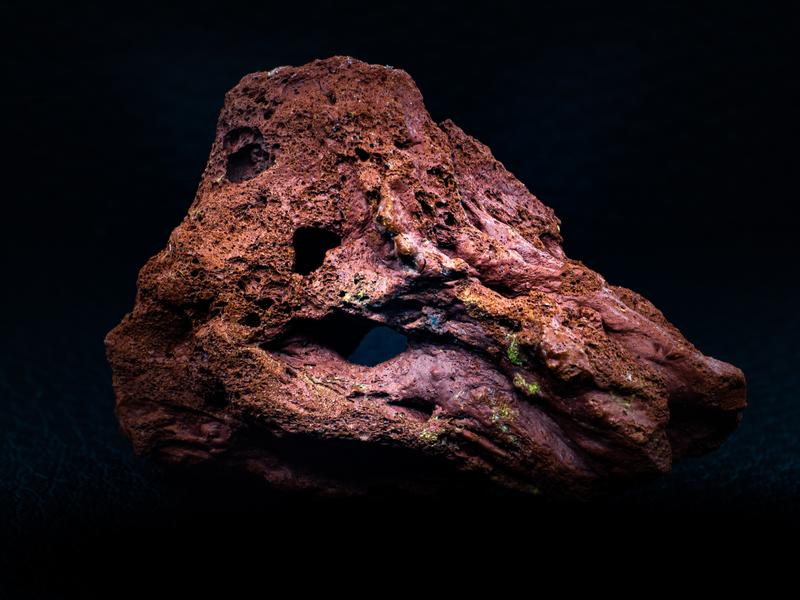
Lava stone is vesicular volcanic rock, dark and porous, full of the gas paths that moved through it while it was still molten. Fire became terrain here.
That sequence matters after upheaval.
What Your Body Knows
Lava stone is a root chakra stone used for grounding, stabilization, and reconnection with the body after disruption. Its porous texture provides constant micro-tactile feedback that keeps attention anchored in the present. In somatic practice, the rough surface creates a sensory signal distinctly different from polished crystals: it catches on skin, it refuses to be ignored, it demands that you notice you are holding something real.
Post-Crisis Overwhelm (Sympathetic Overdrive)
The crisis passed but the body has not received the memo. Heart still racing. Thoughts still spinning. The threat is gone but the alarm system keeps firing. You survived the eruption but you are still running from it. The nervous system is locked in fight-or-flight with nothing left to fight.
Lava stone's role: Grounding through texture. Lava stone's rough, irregular surface creates constant tactile micro-stimulation that pulls sensory awareness downward, out of the spiraling mind and into the hands. Research on tactile sensory objects confirms that textured surfaces engage somatosensory pathways that compete with anxiety-driven cognition. The porous surface catches on skin, resists smooth rotation in the hand, and demands motor attention. You cannot hold lava stone absentmindedly. The stone that survived the fire teaches the body that the fire is over.
Uprooted / Displaced (Dorsal Vagal)
The ground beneath you shifted. A move, a loss, a life change that removed the foundation. You are functional but floating. Nothing feels solid. The sense of home, of belonging, of having ground beneath your feet has vanished. The root chakra is offline.
Lava stone's role: Root reconnection. Lava stone is the literal ground, cooled and solidified. Holding it provides the body with the physical sensation of earth in the hand: rough, heavy for its apparent size, unmistakably mineral. Place it at the base of the spine or hold it while standing barefoot. The nervous system reads the texture as ground contact. For someone who has lost their sense of foundation, lava stone is the first solid thing.
Rebuilding After Collapse (Mixed State)
Something was destroyed. A relationship, a career, an identity. The demolition is complete but the reconstruction has not started. You stand in the rubble, knowing you need to build but unable to see the blueprint. The old structure is gone. The new one does not exist yet.
Lava stone's role: The rebirth stone. Lava stone exists because something was destroyed. Volcanic eruption annihilates everything in its path, then creates new land. The Hawaiian Islands exist because of this exact process. The stone in your hand is proof that destruction creates. Hold it during the gap between what was and what will be. The porous surface holds essential oils that you can choose: a scent that represents what you are building next. The stone absorbs the intention. It becomes the first brick.
Seeking Steady Ground (Ventral Vagal)
You are not in crisis. You are not collapsed. You simply need to feel the earth. The day was long, the screens were bright, and the body craves something that is not digital, not smooth, not manufactured. You need texture, weight, and the reminder that the physical world exists beneath the information layer.
Lava stone's role: Daily grounding anchor. Lava stone worn as a bracelet provides continuous micro-tactile feedback throughout the day. Every time the wrist moves, the porous beads catch on skin and clothing, sending a small signal: you are here, you are in a body, the ground is real. For people who live in their heads or their screens, lava stone is the physical interrupt. Add an essential oil and it becomes a somatic anchor with an olfactory dimension. The simplest stone with the most persistent message.
sympathetic
The crisis passed but the body has not received the memo. Heart still racing. Thoughts still spinning. The threat is gone but the alarm system keeps firing. You survived the eruption but you are still running from it. The nervous system is locked in fight-or-flight with nothing left to fight. Lava stone's role: Grounding through texture. Lava stone's rough, irregular surface creates constant tactile micro-stimulation that pulls sensory awareness downward, out of the spiraling mind and into the hands. Research on tactile sensory objects confirms that textured surfaces engage somatosensory pathways that compete with anxiety-driven cognition. The porous surface catches on skin, resists smooth rotation in the hand, and demands motor attention. You cannot hold lava stone absentmindedly. The stone that survived the fire teaches the body that the fire is over.
dorsal vagal
The ground beneath you shifted. A move, a loss, a life change that removed the foundation. You are functional but floating. Nothing feels solid. The sense of home, of belonging, of having ground beneath your feet has vanished. The root chakra is offline. Lava stone's role: Root reconnection. Lava stone is the literal ground, cooled and solidified. Holding it provides the body with the physical sensation of earth in the hand: rough, heavy for its apparent size, unmistakably mineral. Place it at the base of the spine or hold it while standing barefoot. The nervous system reads the texture as ground contact. For someone who has lost their sense of foundation, lava stone is the first solid thing.
ventral vagal
Something was destroyed. A relationship, a career, an identity. The demolition is complete but the reconstruction has not started. You stand in the rubble, knowing you need to build but unable to see the blueprint. The old structure is gone. The new one does not exist yet. Lava stone's role: The rebirth stone. Lava stone exists because something was destroyed. Volcanic eruption annihilates everything in its path, then creates new land. The Hawaiian Islands exist because of this exact process. The stone in your hand is proof that destruction creates. Hold it during the gap between what was and what will be. The porous surface holds essential oils that you can choose: a scent that represents what you are building next. The stone absorbs the intention. It becomes the first brick.
ventral vagal
You are not in crisis. You are not collapsed. You simply need to feel the earth. The day was long, the screens were bright, and the body craves something that is not digital, not smooth, not manufactured. You need texture, weight, and the reminder that the physical world exists beneath the information layer. Lava stone's role: Daily grounding anchor. Lava stone worn as a bracelet provides continuous micro-tactile feedback throughout the day. Every time the wrist moves, the porous beads catch on skin and clothing, sending a small signal: you are here, you are in a body, the ground is real. For people who live in their heads or their screens, lava stone is the physical interrupt. Add an essential oil and it becomes a somatic anchor with an olfactory dimension. The simplest stone with the most persistent message.
Nervous system mapping based on polyvagal theory (Porges, 2011).
The Earth Made This
Basalt meets atmosphere and loses everything it was. Lava stone is not a mineral. It is the husk of eruption, a vesicular basite riddled with gas pockets that froze open when molten rock hit air faster than dissolved volatiles could escape.
The composition varies with whatever magma source fed the flow. Most lava stone in commerce is from Icelandic or Indonesian basaltic fields, tumbled smooth and sold as grounding talismans. Geologically it is frozen chaos.
The vesicles that make it light enough to sometimes float are the same voids that make it structurally weak. It absorbs essential oils because it is literally full of holes. That is not metaphysical porosity.
That is igneous texture doing what physics dictates. Every piece records the exact moment liquid rock became solid in open air.
Deeper geology
The rapid cooling is what creates lava stone's signature texture. When magma cools slowly underground, large crystals form (granite). When the same magma erupts and cools in minutes to hours, there is no time for crystal growth. The result is a fine-grained or glassy matrix. The vesicles (holes) that define lava stone form when dissolved gases (primarily water vapor, CO2, and SO2) expand as pressure drops during eruption. These gas bubbles freeze in place as the rock solidifies, creating the porous, lightweight texture that makes lava stone unmistakable.
Basalt covers approximately 70% of the Earth's surface when including the ocean floor. The mid-ocean ridges produce basalt continuously through seafloor spreading. On land, volcanic provinces from Hawaii to Iceland to East Africa generate basalt in quantities that dwarf all other rock types. The stone in your hand is the most common solid material on the planet's surface, forged at temperatures that would vaporize most other minerals used in crystal practice.
That porosity has a practical consequence unique among healing stones: lava stone absorbs liquids. Essential oils, water, any fluid applied to the surface enters the vesicular network and releases slowly over hours. No other commonly used stone in crystal practice does this. The texture that records volcanic violence also creates a natural diffuser.
Mineralogy
Chemical Formula
Basalt (variable silicates)
Crystal System
Polymineralic rock
Mohs Hardness
5
Specific Gravity
2.8-3.0
Luster
Dull to matte
Color
Black to dark gray, porous
Traditional Knowledge
Tears of Pele
Pre-contact era, continuously practiced In Hawaiian cosmology, volcanic rock is the body of Pele, goddess of fire, lightning, and volcanoes. Lava stone is not simply rock; it is the physical cultivation of divine creative-destructive force. Pele's tears (small droplets of volcanic glass) and Pele's hair (thin strands of volcanic glass) are considered sacred. Taking lava rock from Hawaii without proper protocol is considered deeply disrespectful, and the practice of returning stolen rocks to Hawaii Volcanoes National Park is well-documented. The land creates itself through eruption. The stone is the land's memory of its own birth.
Tezontle: The Builder's Stone
c. 1500 BCE onward The Aztec and earlier Mesoamerican civilizations used volcanic rock (tezontle) extensively in construction, creating pyramids, temples, and entire cities from the material. Tenochtitlan, the Aztec capital, was built largely from volcanic basalt and scoria. The stone was both practical (lightweight, easy to carve) and sacred (born from the earth's fire, connecting structures to the underworld). The Great Pyramid of Cholula contains massive amounts of volcanic material. The stone that builds empires from eruptions.
Land of Fire and Ice
c. 870 CE onward Iceland sits on the Mid-Atlantic Ridge, a notably volcanically active zone on Earth. Norse settlers built their farmsteads on and from volcanic rock. In Norse cosmology, the world itself was born from the meeting of fire (Muspelheim) and ice (Niflheim). Volcanic stone was not merely building material; it was creation material, the substance of world-making. The Icelandic sagas record eruptions as events of cosmic significance. The ground itself was alive, capable of remaking the landscape in hours.
Stone of Vesuvius
79 CE onward Communities around Mount Etna and Vesuvius have lived with volcanic stone for millennia. In Southern Italian folk tradition, lava stone carries protective properties, worn as amulets against the evil eye (malocchio). The logic is sympathetic: the stone that survived the most destructive force protects against lesser ones. Lava stone jewelry from the Catania region of Sicily represents a continuous tradition of wearing volcanic material as both protection and identity.
The Living Source
Kīlauea and Mauna Loa on the Big Island produce fresh basalt continuously. Hawaii is one of the few places on Earth where you can watch lava stone being created in real time. The islands themselves are entirely volcanic in origin: basalt stacked on basalt for millions of years.
Fire and Ice
Sitting on the Mid-Atlantic Ridge, Iceland produces basalt at a rate that adds measurable new land each decade. The entire island is volcanic rock. Lava fields cover vast areas of the interior. Icelandic basalt is among the purest and most uniform on Earth.
Ring of Fire
Indonesia contains over 130 active volcanoes along the Pacific Ring of Fire. Java, Bali, and Sumatra produce enormous quantities of basalt. Much of the commercial lava stone bead market sources from Indonesian volcanic deposits. The volcanic soil is a remarkably fertile on Earth.
Etna and Vesuvius
Mount Etna is Europe's most active volcano, continuously producing basalt. Vesuvius, while dormant since 1944, has produced the basalt that Naples is built upon. Italian lava stone jewelry and architectural stone represent millennia of cultural relationship with volcanic material.
When This Stone Finds You
Sacred Match prescribes Lava Stone when you report:
Uprooted
Rebuilding
Post-crisis spinning
Disconnected from body
Groundless
Starting over
Needing the earth
When Sacred Match's diagnostic reveals root chakra disruption following upheaval, when the ground shifted and the body lost its reference point, lava stone enters the protocol. Not because it calms. Because it is the ground. The stone that was liquid fire and became solid earth. The body holds it and receives the message: the worst already happened, and what remained became the foundation for what comes next.
Somatic protocol
The Eruption Protocol
3 min protocol
Stand barefoot. Hold lava stone in both hands at the navel. Close your eyes. (15 seconds) Feel the texture first. Run your thumbs across the surface. Notice every pore, every ridge, every frozen bubble. This is not smooth. This is not polished. This is the earth's raw surface, cooled from liquid fire. Let the roughness register.
15 secInhale through the nose for 4 counts. As you inhale, squeeze the stone firmly. (30 seconds) Feel the pressure against your palms. The vesicles press into your skin. The texture refuses to disappear. On the exhale (6 counts, through the mouth), release your grip but keep the stone touching your palms. Squeeze on inhale. Release on exhale. Four cycles. The rhythm is compression and release: the same cycle that creates volcanic rock.
30 secLower the stone to the base of your spine. Press it against the sacrum with one hand. (60 seconds) The root chakra lives here. Feel the weight of the stone against bone. Breathe normally. With each exhale, imagine the porous surface of the stone absorbing everything that is spinning, everything that is ungrounded, everything that does not have a home yet. The stone that was formed by absorbing gas into rock absorbs what you release.
1 minBring the stone back to both hands. Hold it at your chest. Press it against the sternum. (45 seconds) Breathe deeply. Feel the rough texture against your breastbone. The tactile signal travels from skin to brain: you are here, you are solid, the ground exists. Whisper or think one word that represents what you are building from the rubble. Let the stone hold it.
45 secOpen your eyes. Place the stone on the ground between your feet. Stand over it for 10 seconds. (30 seconds) Look down at it. That dark, porous, rough stone is the earth, simplified. It held fire. It held gas. It held the violence of creation. And it cooled into something solid enough to stand on. Step forward and pick it up. The protocol is complete.
30 secCare and Maintenance
The #1 Question Can Lava Stone Go in Water? Yes, with care The Full Answer Lava stone scores 3-3. 5 on the Mohs hardness scale, which makes it softer than quartz but structurally stable for brief water contact.
The key consideration is porosity, not hardness: lava stone absorbs water through its vesicular network. Safe: Brief rinses under cool running water (30-60 seconds). Pat dry immediately and allow to air dry completely before wearing or storing.
The stone will darken temporarily as it absorbs surface water. Avoid: Prolonged soaking: Water enters the pores and can take hours to fully dry. Trapped moisture can cause odor or discoloration over time Salt water: Salt crystals lodge in the vesicles and are extremely difficult to remove Hot water: Thermal stress on a porous material can cause micro-fracturing Ultrasonic cleaners: The vibration can damage the porous structure Better alternatives for regular cleansing: Smoke cleansing (sage, palo santo, cedar), sound vibration (singing bowl), moonlight (overnight), selenite plate (4-6 hours).
These methods avoid moisture entirely. Can Lava Stone Go in the Sun? Absolutely.
Lava stone formed at temperatures between 700-1200°C. Sunlight poses zero risk. The stone is completely sun-stable, will not fade, and benefits from solar charging as a fire-origin stone.
Direct sunlight for 20-30 minutes is appropriate and traditional.
Crystal companions
Black Tourmaline
Double root grounding with added protection. Lava stone grounds through rebirth; black tourmaline grounds through shielding. Together they create a root chakra protocol that both stabilizes the foundation and protects it. For anyone rebuilding after a destructive event who also needs energetic boundaries around the new structure.
Clear Quartz
Amplifier. Clear quartz takes lava stone's grounding signal and broadcasts it louder. Particularly useful when lava stone is worn as a bracelet: alternating lava beads with clear quartz beads creates a grounding-amplifying loop that persists all day. The classic combination for daily wear.
Rose Quartz
Root grounding plus heart opening. For grief after loss, where the ground has shifted and the heart has closed. Lava stone rebuilds the foundation; rose quartz gently reopens the emotional center. The rebuilding protocol for people who lost someone, not just something.
Citrine
Root stability meets solar plexus confidence. Lava stone says "the ground is here." Citrine says "and you belong on it." For rebuilding self-worth after identity collapse. The combination that moves from survival to ownership.
Red Jasper
Deep earth endurance. Both are root stones, both are connected to the earth's interior. Lava stone provides the raw rebirth energy; red jasper provides the slow, steady stamina to sustain it. For long-term rebuilding projects where the work takes months, not days.
Pairing Cautions
Lava Stone + Moldavite: Lava stone's grounding function conflicts with moldavite's intense acceleration. The combination can create agitation rather than stability. If using both, separate them by at least one neutral stone (clear quartz) and monitor the nervous system response.
In Practice
You need to feel connected to something ancient and your modern environment provides nothing old enough. Lava stone is basalt, cooled from molten rock that was 1,200 degrees Celsius when it erupted. The vesicles (holes) formed when gas escaped during cooling.
Mohs 5. Hold the porous surface against your palm. The texture is rough, volcanic, completely unlike any manufactured object.
The basalt in your hand is the same composition as the ocean floor. You are holding a piece of the earth's most fundamental rock type.
Verification
Lava stone is one of the most commonly faked stones in the crystal market, primarily because black round beads are cheap to manufacture from dyed materials. Four tests, no equipment needed. The pore test.
Real lava stone has visible, irregular pores (vesicles) across its entire surface. These holes vary in size, are randomly distributed, and have rough edges. Fake lava stone (often dyed howlite or ceramic) either has no pores, has pores that are too uniform, or has surface texture that was mechanically applied.
The weight test. Real lava stone is lightweight for its size due to its vesicular structure. Pick up a lava bead and a glass bead of the same size.
The lava stone should feel noticeably lighter. If it feels as heavy as glass or ceramic, it is not basalt. The water absorption test.
Drop water on the surface.
Natural Lava Stone should usually feel cooler than plastic or resin on first touch and warm more slowly in the hand.
Use 5 on the Mohs scale as the check, not internet myths. A real specimen should behave in line with the hardness listed above.
Look for a dull to matte surface quality rather than a painted or plastic shine.
The listed specific gravity is 2.8-3.0. If a specimen feels unusually light for its size, it may deserve a second look.
Geographic Origins
The Earth Made This Formation: How Lava Stone Becomes Lava Stone
Lava stone is basalt: the most common volcanic rock on Earth. It forms when mafic magma (rich in iron and magnesium, low in silica) erupts at the surface and cools rapidly. The chemical composition is variable but centers on plagioclase feldspar, pyroxene (augite), and often olivine, with iron-titanium oxides throughout. No single mineral formula applies because basalt is a rock, not a mineral: a composite of multiple crystalline phases frozen together.
The rapid cooling is what creates lava stone's signature texture. When magma cools slowly underground, large crystals form (granite). When the same magma erupts and cools in minutes to hours, there is no time for crystal growth. The result is a fine-grained or glassy matrix. The vesicles (holes) that define lava stone form when dissolved gases (primarily water vapor, CO₂, and SO₂) expand as pressure drops during eruption. These gas bubbles freeze in place as the rock solidifies, creating the porous, lightweight texture that makes lava stone unmistakable.
Basalt covers approximately 70% of the Earth's surface when including the ocean floor. The mid-ocean ridges produce basalt continuously through seafloor spreading. On land, volcanic provinces from Hawaii to Iceland to East Africa generate basalt in quantities that dwarf all other rock types. The stone in your hand is the most common solid material on the planet's surface, forged at temperatures that would vaporize most other minerals used in crystal practice.
That porosity has a practical consequence unique among healing stones: lava stone absorbs liquids. Essential oils, water, any fluid applied to the surface enters the vesicular network and releases slowly over hours. No other commonly used stone in crystal practice does this. The texture that records volcanic violence also creates a natural diffuser.
Mineralogy: Basalt (extrusive igneous rock). Variable composition: plagioclase feldspar (NaAlSi₃O₈ to CaAl₂Si₂O₈), pyroxene (augite: (Ca,Na)(Mg,Fe,Al)(Si,Al)₂O₆), olivine ((Mg,Fe)₂SiO₄), iron-titanium oxides. Crystal system: variable (not a single mineral). Mohs hardness: 3-3.5 (matrix). Specific gravity: 2.8-3.0. Color: black to dark gray. Texture: vesicular (porous), aphanitic (fine-grained). Fracture: irregular. Luster: dull to matte.
Best, M.G. (2003). Igneous and Metamorphic Petrology. Blackwell Publishing. Cashman, K.V. & Sparks, R.S.J. (2013). How volcanoes work: a 25-year perspective. Geological Society of America Bulletin , 125(5-6), 664-690. DOI: 10.1130/B30720.1
FAQ
Lava stone grounds the nervous system through the root chakra. As solidified volcanic basalt, it carries the energetic signature of transformation — fire made solid. In somatic practice, its porous texture provides constant tactile feedback that anchors awareness in the body. Traditionally used across Hawaiian, Icelandic, and Mesoamerican cultures as a stone of rebirth, strength, and grounding after upheaval.
Yes, briefly. Lava stone is water safe for quick rinses (30-60 seconds). However, its porous structure absorbs water, so prolonged soaking is not recommended. Always air dry completely after contact with water. Mohs hardness of 3-3.5 means it is softer than quartz but structurally stable for cleansing purposes.
Root chakra (Muladhara). Lava stone connects to the first energy center governing survival, stability, and the body's relationship with the ground beneath it. Born from the earth's core and cooled at the surface, it bridges deep internal fire with external stability.
Yes. Lava stone is completely sun safe. As a volcanic rock that formed under extreme heat, sunlight poses no risk of fading or structural damage. Brief sunlight charging (20-30 minutes) is appropriate and traditional.
Lava stone's porous surface absorbs and slowly releases essential oils. Apply 1-2 drops to the stone, let it absorb for 60 seconds, then wear or carry. The stone acts as a natural diffuser throughout the day. This is one of lava stone's unique practical applications — no other common crystal has this absorption capacity.
Lava stone is a real volcanic rock (basalt), not a crystal in the strict mineralogical sense. It is an ignite rock composed of multiple minerals including plagioclase feldspar, pyroxene, and olivine. It does not have a single crystal structure. In the crystal healing tradition, it is classified alongside crystals for its energetic and somatic properties.
Clear quartz (amplifies grounding signal), black tourmaline (double root protection), rose quartz (grounding plus heart opening for grief), citrine (stability plus solar plexus confidence), and red jasper (deep earth endurance). Lava stone's neutral dark color and porous texture make it a remarkably versatile pairing stone.
Four tests: (1) Porous texture with visible holes from gas bubbles — smooth uniform black stones are likely dyed howlite or plastic. (2) Lightweight for its size due to vesicular structure. (3) Rough, matte surface that catches on fabric. (4) Absorbs water — drop water on it and it should darken and absorb within seconds. Fakes do not absorb.
References
Best, M.G. (2003). Igneous and Metamorphic Petrology. Blackwell Publishing. Cashman. [SCI]
DOI: 10.1130/B30720.1
Swanson, D.A. (2008). Hawaiian oral tradition describes 400 years of volcanic activity at Kīlauea. Journal of Volcanology and Geothermal Research. [LORE]
Closing Notes
Lava stone is basalt, the most common volcanic rock on earth, cooled at the surface after eruption. The vesicles, the tiny holes throughout the stone, are frozen gas bubbles, pockets where volatiles escaped as the magma depressurized. The science explains degassing and rapid crystallization.
The practice holds a stone that is literally the earth exhaling, and asks what your body might release if you gave it the same permission to let go of what it has been holding under pressure.
Bring it into practice
Move from reference to ritual. Search current inventory for Lava Stone, build a custom bracelet, or let Sacred Match choose the right supporting stones for you.
Community notes
Shared field notes tied to Lava Stone appear here, including notes saved from practice.
When members save a public field note for this stone, it will appear here.
The archive
Continue through stones that share intention, chakra focus, or tonal family with Lava Stone.

Shared intention: Protection & Grounding
The Tear That Grounds You

Shared intention: Protection & Grounding
The Black Foundation Stone

Shared intention: Protection & Grounding
The Deep Current Breaker

Shared intention: Stress Relief
The Shadow Rainbow

Shared intention: Stress Relief
The Gentle Detox

Shared intention: Protection & Grounding
The Grief Absorber