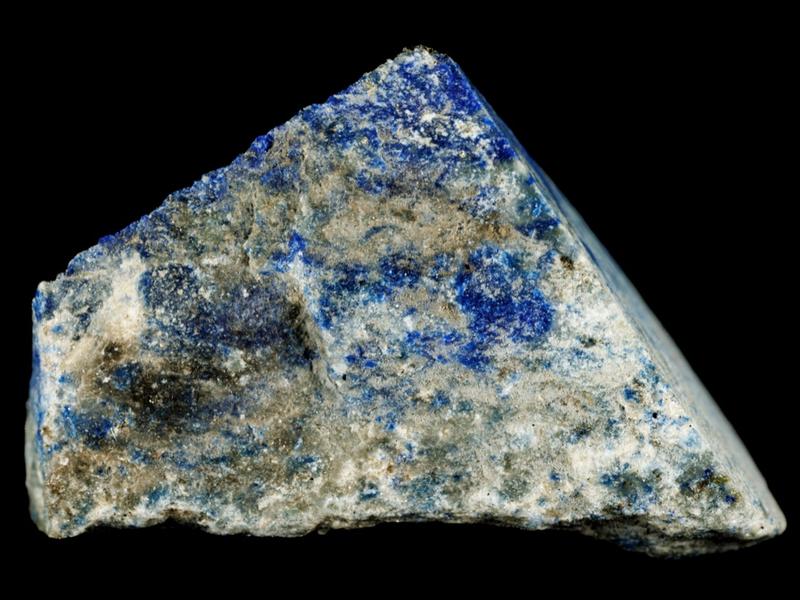
Your thoughts have gone too jagged to trust. Lazulite forms deep blue phosphate crystals under metamorphic conditions, saturated and compact rather than airy. Calm can have pressure behind it.
Body-based use begins with concrete cues: mass, surface, and temperature. For lazulite, the body often starts with direct sensory appraisal before any symbolism forms....
The Meaning
Lazulite in the Crystalis dictionary
Not all calm arrives as softness. Sometimes the psyche needs a denser blue, a color that can press back against mental sharpness instead of evaporating in front of it. The issue is not only to relax, but to compact.
Lazulite carries that compact blue beautifully. The crystal body is saturated, deep, and pressure-born, more concentrated than airy, more mineral than atmosphere. The calm it suggests is not delicate. It is dense enough to be felt.
Lazulite works when thought has gone jagged because it reminds the body that composure can have pressure behind it. A deeper blue can hold more.
Stone Lore
Stories carried through time
Cultural notes are presented as tradition and historical context — stories carried through time.
European Mineralogy
Named from Azure
Lazulite was first formally described in 1795 by German mineralogist Martin Heinrich Klaproth, who named it from the Arabic "lazaward" and German "lazurstein," both meaning "blue stone." The mineral was distinguished from lazurite (the primary component of lapis lazuli) through careful chemical analysis, though the similar names have caused persistent confusion in mineral literature ever since.
1795
Historical note
The Werfen Blue
The Salzburg region of Austria, particularly around Werfen and the Hohe Tauern mountains, has produced world-class lazulite specimens prized by European mineral collectors. Found in metamorphic quartzite formations at high elevations,...
Austrian Alpine Tradition
Historical note
From Georgia to the Yukon
Significant lazulite deposits span North America from Graves Mountain in Georgia, where it occurs with rutile and pyrophyllite, to the Rapid Creek area of Canada's Yukon Territory, which has produced some of the finest crystallized...
North American Occurrences · 20th century - present
Earth Record
Mineralogy and formation
Where aluminum-rich sediments were compressed and reheated, Lazulite crystallizes in aluminum-rich rocks that have experienced moderate to high metamorphic grade, especially quartzites and metamorphosed sediments where phosphate is available. Magnesium, aluminum, phosphate, hydroxyl, and minor iron organize into a monoclinic framework that can produce deep azure to blue-white crystals, often with wedge-like or short prismatic habits.
The blue is not the same mechanism as lazurite's sulfur radical color. In lazulite, iron substitution and crystal field effects within the phosphate structure help create the hue. Formation temperatures commonly fall within the higher metamorphic range, and the host rocks may later fracture, allowing the crystals to appear in quartz veins or pockets. Hardness near 5. 5 to 6 and specific gravity around 3.
1 make it a more substantial material than many visually similar blue stones. The resemblance in name to lazurite has caused confusion for generations, but the geology is entirely different. One belongs to metamorphic phosphate systems, the other to sulfur-bearing feldspathoid assemblages in contact-metamorphosed limestones. In the body, lazulite reads as a blue stone with weight behind it.
Not airy blue. Mineralized blue. The somatic turn arises from that difference. It suggests expression backed by structure, feeling backed by pressure history. A voice can deepen the same way a rock does: by staying under enough heat and compression long enough for its color to stop being decorative and start becoming load-bearing.
Crystal system diagram represents the general monoclinic classification. Diagram created by Crystalis for educational reference.
Monoclinic structure
Chemical Formula
MgAl2(PO4)2(OH)2
Crystal System
Monoclinic
Mohs Hardness
5.5
Specific Gravity
3.05-3.15
Luster
Vitreous to dull
Color
Blue
IMA Status
species
Type Locality
Freßnitzgraben, Krieglach, Styria, Austria
IMA Number
Grandfathered (Pre-1959)
01
Mineral conditions gather
02
Structure begins to crystallize
03
Lazulite records place and pressure
Brazil's Minas Gerais produces lazulite from pegmatite-associated metamorphic rocks. Austria's Werfen in the Alps is the classic European locality. Pakistan's northern areas yield specimens from high-grade metamorphic terrains.
The deep blue phosphate mineral forms under moderate metamorphic conditions at all three localities.
BrazilAustriaPakistan
Telling it apart
Lazulite is a magnesium iron aluminum phosphate that produces vivid deep blue crystals, and the name confusion with lazurite and lapis lazuli causes constant market misidentification. Lazulite is Mohs 5. 5 to 6, specific gravity 3. 08 to 3. 38, and forms monoclinic prismatic to pyramidal crystals. Lazurite is a feldspathoid silicate, the main blue component of lapis lazuli, and has completely different chemistry.
Lapis lazuli is a rock containing lazurite, pyrite, and calcite. If the seller conflates any of these three names, ask for clarification. Genuine lazulite is a phosphate with a vitreous luster and often appears as small blue pyramidal crystals in quartz or quartzite matrix. It does not contain sulfur like lazurite and does not show pyrite flecks like lapis. The names sound alike but the minerals are unrelated.
Spotting the real thing
Lazulite: deep blue phosphate, NOT lazurite (which is a feldspathoid in lapis lazuli). Mohs 5. 5-6.
Specific gravity 3. 05-3. 15.
Vitreous luster. Monoclinic. Does not effervesce in acid (unlike azurite, which does).
If a blue mineral effervesces in acid, it is azurite, not lazulite. The names are confusingly similar but the minerals are completely different.
When energy feels stuck and the body won't respond. Lazulite is placed on the body as an anchor point. Your shoulders drop. Your breath becomes shallow and barely audible. A heaviness settles in your limbs. This is dorsal vagal shutdown; your oldest survival circuit pulling you toward stillness, collapse, disconnection from sensation.
Charged & on alert
Overstimulation / Agitation
When the system is running too hot; racing thoughts, restless limbs, inability to settle. Your chest tightens. Your jaw clenches. Your breath moves higher, shallower, faster. This is sympathetic activation; your body mobilizing for fight or flight, muscles tensing, heart rate rising.
Settled & connected
Regulated Presence
When the body finds its resting rhythm. Lazulite held or placed becomes a touchpoint for presence. Your chest opens. Your jaw unclenches. Your breath deepens into your belly. This is ventral vagal regulation; your body finding safety, social connection, steady presence.
These associations come from tradition and reflective practice — a way of working with the stone, not a medical prescription.
Somatic Practice
Simple ways to work with Lazulite
◇
Hold
Carry Lazulite in a pocket or place it over the heart center during a pause.
◌
Meditate
Let the stone become a quiet tactile anchor while the breath slows.
☽
Breathe
Breathe in softness. Breathe out tension. Keep the practice simple.
✎
Journal
Write with Lazulite nearby to name the feeling without forcing a conclusion.
✋
Bodywork
Rest the stone near the chest, hand, or bedside as a reminder to soften.
⌂
Environment
Place it where you want a visual cue for care, repair, or steadiness.
Field Instruction
The Phosphate Quiet
Magnesium aluminum phosphate in monoclinic crystal form, lazulite offers the kind of blue that does not stimulate — it settles.
2 min protocol
1
Place the lazulite specimen on a surface where you can observe it without holding it — this mineral is Mohs 5.5 but forms in granular masses that can be fragile along grain boundaries. Its blue comes from magnesium aluminum phosphate in monoclinic crystal form. Let your eyes rest on its dull-to-vitreous surface. Do not try to make it more beautiful than it is.
2
Rest your hands palms-down on the surface near the stone. Lazulite is a phosphate mineral — phosphorus is essential to every living cell, to DNA, to ATP. This is not decorative blue. This is biological blue. Breathe in through the nose for three counts, out for five. Let the blue settle your visual field.
3
Close your eyes. Lazulite is often confused with lazurite and lapis lazuli, but it is chemically distinct — magnesium-based, not sodium-based. Ask: where am I being confused for something I am not? Where is my identity being absorbed into someone else's category? The answer does not need to be dramatic. It can be small and daily.
4
Open your eyes. Look at the stone one more time. Lazulite's name comes from an Arabic word for heaven. But this stone formed underground, in metamorphic rock, under pressure. Heaven and pressure in the same object. Take one breath that holds both. Done.
Stone Intelligence
The fact that makes Lazulite memorable
Not lazurite. The names cause confusion. Magnesium aluminum phosphate hydroxide, a different mineral with a similar name and a completely different blue.
The science documents nomenclature collision. The practice asks what clarity means when the first step is making sure you know which blue you are holding.
Lasnierite, (Ca,Sr)(Mg,Fe)2Al(PO4)3, a new phosphate accompanying lazulite from Mt. Ibity, Madagascar: an example of structural characterization from dynamical refinement of precession electron diffraction data on submicrometre sample
Your thoughts have gone too jagged to trust. Lazulite forms deep blue phosphate crystals under metamorphic pressure. Hold when mental clarity has roughened rather than sharpened.
Not lazurite. Not lapis. This is its own mineral with its own blue.
Place during meditation when you need focus that comes from depth rather than speed.
Sacred Match
Sacred Match reaches for Lazulite when what you feel sounds like:
need to say something clearly but the words keep fracturing
blue heaviness in the throat that is not sadness but density
quiet used as defense rather than chosen as preference
discernment required in a situation where bluntness would cause damage
truth under pressure that cannot afford to arrive sloppy
Sacred Match listens to the body rather than to preference. It senses whether speech inhibition is fear, wisdom, or a throat carrying phosphate-blue density that requires more intentional release than lighter stones provide. When that points to laryngeal loading with preserved discernment, Lazulite is the stone it offers. Deep blue magnesium aluminum phosphate formed under metamorphic conditions. Saturated and compact rather than airy. Calm with pressure behind it.
Need for clear speech -> laryngeal precision demand -> monoclinic crystal system at MgAl2(PO4)2(OH)2 provides a structured phosphate framework that models organized delivery
Blue heaviness in the throat -> dense expressive load -> deep azure blue from Fe2+ to Fe3+ intervalence charge transfer provides color that is pressure-born, not atmospheric
Quiet as defense -> protective silence -> Mohs 5.
5-6 at specific gravity 3. 05-3. 15 is dense enough that the quiet has weight, not avoidance
Discernment required -> precision under relational pressure -> isostructural with scorzalite (FeAl2(PO4)2(OH)2) means this mineral exists on a compositional spectrum, modeling how discernment operates between poles rather than at extremes
Truth under pressure -> high-stakes speech -> vitreous to dull luster demonstrates that the same mineral can present differently depending on surface condition, just as the same truth arrives differently depending on delivery
Pairings are treated like a recipe file: clear use, method, and safety.
Crystal Companion
Lazulite + Amethyst
Use when
You want to layer the primary intention with another supportive tone.
How to work with it
Place the stones together during meditation, journaling, or a short reset.
Safety
Use as a reflective practice tool, not as a medical substitute.
Crystal Companion
Lazulite + Rhodonite
Use when
You want to layer the primary intention with another supportive tone.
How to work with it
Place the stones together during meditation, journaling, or a short reset.
Safety
Use as a reflective practice tool, not as a medical substitute.
Crystal Companion
Lazulite + Clear Quartz
Use when
You want to layer the primary intention with another supportive tone.
How to work with it
Place the stones together during meditation, journaling, or a short reset.
Safety
Use as a reflective practice tool, not as a medical substitute.
Crystal Companion
Lazulite + Black Tourmaline
Use when
You want to layer the primary intention with another supportive tone.
How to work with it
Place the stones together during meditation, journaling, or a short reset.
Safety
Use as a reflective practice tool, not as a medical substitute.
The anchor combination comes first. Lazulite benefits from companions that either clarify its strongest trait or balance its weakest one.
Lapis Lazuli
blue on blue distinction. Lapis adds historical and symbolic depth while lazulite keeps the pairing mineralogically grounded and quieter. Placement: Lazulite in the pocket, lapis at the throat. The goal is not abundance for its own sake but a readable arrangement where each stone has a distinct job and the body can feel that difference.
Clear Quartz
articulation. Quartz brightens lazulite's denser blue and helps the pair read as clarity rather than heaviness. Placement: Set both near written work or speaking notes. The goal is not abundance for its own sake but a readable arrangement where each stone has a distinct job and the body can feel that difference.
Black Tourmaline
protected speech. Tourmaline prevents blue stones from becoming overly mental or exposed. Placement: Lazulite at the collarbone, tourmaline near the feet. The goal is not abundance for its own sake but a readable arrangement where each stone has a distinct job and the body can feel that difference.
Selenite
clean channel. Selenite removes residue so lazulite can function as a more exact communication stone. Placement: Sweep with selenite first, then sit with lazulite in the palm. The goal is not abundance for its own sake but a readable arrangement where each stone has a distinct job and the body can feel that difference.
Care & Cleansing
How to keep Lazulite in good condition
Water Safe?
Use caution
Brief contact may be tolerated, but softness, coatings, fractures, or mixed mineral content can make water exposure a risk.
Sunlight Safe?
Sunlight safe
Tolerates daylight; safe to charge or display in the sun.
Authenticity
What to check
Natural Lazulite should usually feel cooler than plastic or resin on first touch and warm more slowly in the hand.
Lazulite requires caution. Magnesium aluminum phosphate (Mohs 5. 5-6), moderate hardness with one distinct cleavage.
Brief cool water rinse is acceptable. Avoid prolonged soaking, ultrasonic, and chemical cleaners. Recommended cleansing: moonlight (overnight), smoke (30-60 seconds), selenite plate (4-6 hours).
Store in a soft pouch.
Temperature
Natural Lazulite should usually feel cooler than plastic or resin on first touch and warm more slowly in the hand.
Scratch logic
Use 5.5 on the Mohs scale as the check, not internet myths. A real specimen should behave in line with the hardness listed above.
Surface and luster
Look for a vitreous to dull surface quality rather than a painted or plastic shine.
Weight and density
The listed specific gravity is 3.05-3.15. If a specimen feels unusually light for its size, it may deserve a second look.
My Field Guide
Your private record and next steps
Journal
Add this stone to your private collection, then log what happened when you worked with it.
Shared Notes
Read public practice logs and pattern notes from the Crystalis community.
When members save a public field note for this stone, it will appear here.
Frequently Asked
Questions people ask about Lazulite
What is lazulite used for?
⌄
Lazulite is a magnesium aluminum phosphate mineral (MgAl2(PO4)2(OH)2) traditionally associated with the third eye chakra. Its dense, compact form (specific gravity 3.05-3.15) provides notable heft as a palm stone, creating proprioceptive grounding through weight awareness. The intense azure to deep blue color, caused by Fe2+ in octahedral crystal field coordination, offers a cool-spectrum visual focus that can support breathwork and parasympathetic engagement protocols.
Can lazulite go in water?
⌄
Brief water contact is acceptable for cleaning. Lazulite is not significantly soluble at neutral pH and scores 5.5-6 on the Mohs scale. However, as an OH-bearing mineral, prolonged soaking is not recommended as it could slowly degrade the crystal structure over time. Not suitable for crystal elixirs. Moonlight, sound, and smoke are safer cleansing alternatives.
What chakra is lazulite?
⌄
Lazulite is associated with the third eye chakra (Ajna). The deep blue color corresponds to the traditional color association of the sixth energy center, which governs insight, intuition, and focused attention. In somatic practice, lazulite's blue field can serve as a visual cue during slow-breathing protocols, leveraging research on cool-toned visual stimuli and parasympathetic engagement.
Sources & Citations
Where this entry can be checked
Back Matter
Readable for people. Structured for AI search.
Sources stay visible in the page so readers, search engines, and answer systems can follow the evidence trail.
01
SCI
Global earth mineral inventory: A data legacy
Prabhu, A. et al. (2020). Global earth mineral inventory: A data legacy. Geoscience Data Journal. [SCI]DOI 10.1002/gdj3.106
02
SCI
Lasnierite, (Ca,Sr)(Mg,Fe)2Al(PO4)3, a new phosphate accompanying lazulite from Mt. Ibity, Madagascar: an example of structural characterization from dynamical refinement of precession electron diffraction data on submicrometre sample
Rondeau B., Devouard B., Jacob D., Roussel P., Stephant N., Boulet C., Mollé V., Corre M., Fritsch E., Ferraris C., Parodi G.C. (2019). Lasnierite, (Ca,Sr)(Mg,Fe)2Al(PO4)3, a new phosphate accompanying lazulite from Mt. Ibity, Madagascar: an example of structural characterization from dynamical refinement of precession electron diffraction data on submicrometre sample. European Journal of Mineralogy. [SCI]DOI 10.1127/ejm/2019/0031-2817
03
SCI
A Cobalt‐Based Amorphous Bifunctional Electrocatalyst for Water‐Splitting Evolved from a Single‐Source Lazulite Cobalt Phosphate
Menezes P.W., Panda C., Walter C., Schwarze M., Driess M. (2019). A Cobalt‐Based Amorphous Bifunctional Electrocatalyst for Water‐Splitting Evolved from a Single‐Source Lazulite Cobalt Phosphate. Advanced Functional Materials. [SCI]DOI 10.1002/adfm.201808632
04
SCI
Blue or green? turquoise-planerite species: Evidence from Raman spectroscopy
Dumanska-Slowik, M. et al. (2019). Blue or green? turquoise-planerite species: Evidence from Raman spectroscopy. Journal of Raman Spectroscopy. [SCI]DOI 10.1002/jrs.5761