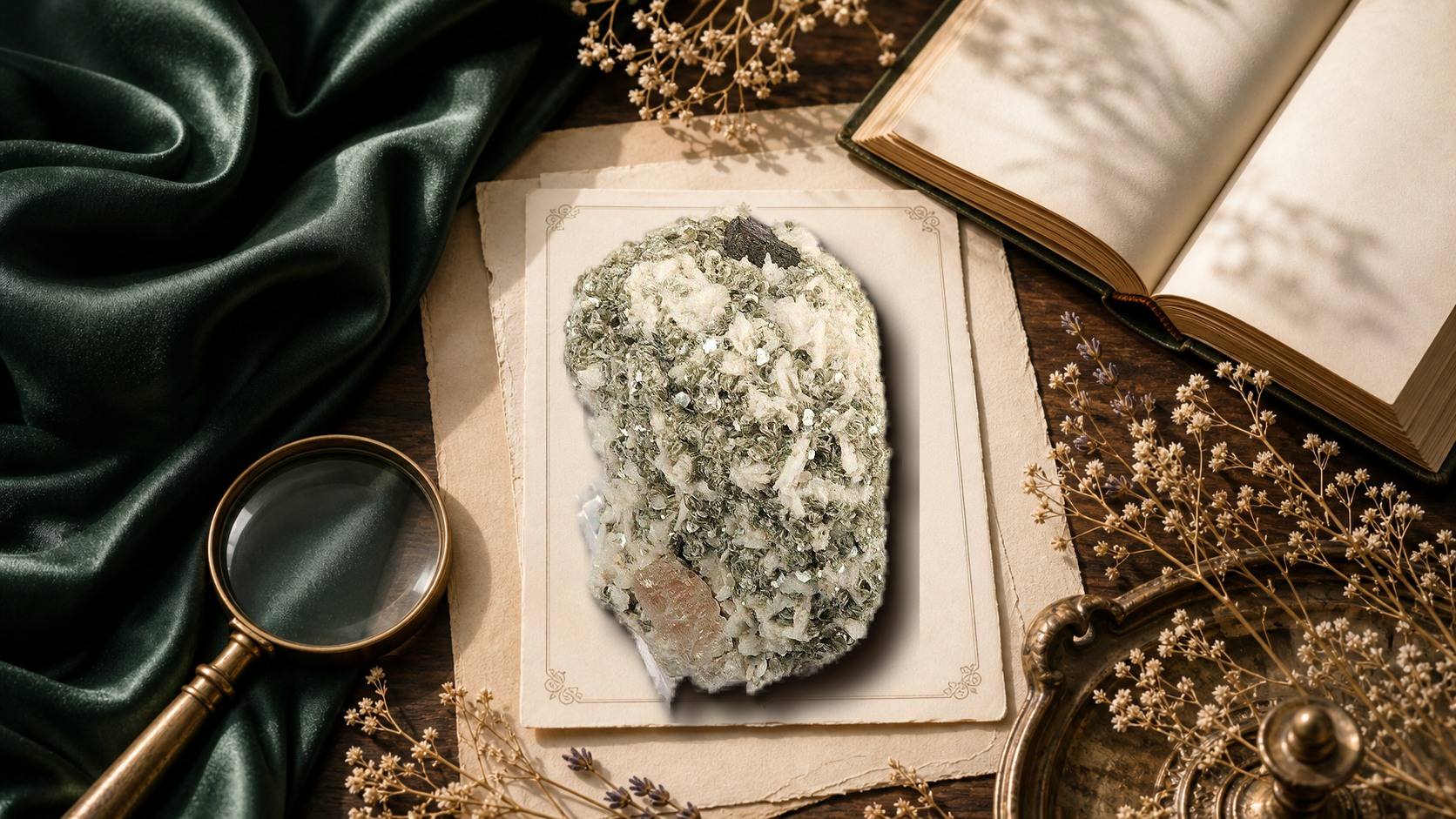
Your spark has been buried under sheer mass. Manganotantalite is dense, dark, and weighted by tantalum, yet it can carry a reddish undertone through the heaviness. Passion does not vanish because responsibility got dense.
Weight and edge do their work before symbolism catches up. For manganotantalite, the body often starts with direct sensory appraisal before any symbolism forms. The...
The Meaning
Manganotantalite in the Crystalis dictionary
There are seasons when responsibility becomes so dense it starts acting like gravity. The self feels heavier than itself, and all the brighter undertones begin disappearing under obligation and sheer weight.
Manganotantalite gives a better image of that condition. The mineral is genuinely heavy, dark, and burdened by tantalum, yet a reddish or warm undertone can still move through the body rather than being erased by mass. The spark is still in there.
Manganotantalite feels honest around over-responsibility because it says passion does not vanish simply because the load became dense. It may only need a different way of being seen.
Stone Lore
Stories carried through time
Cultural notes are presented as tradition and historical context — stories carried through time.
Mineralogical Classification
The Manganese End-Member
Manganotantalite is the manganese-dominant, tantalum-rich end-member of the columbite-tantalite mineral group. First characterized through systematic chemical analysis in the 19th century, it was distinguished from its iron counterpart (tantalite) and niobium analogue (manganocolumbite) through precise compositional studies. The columbite-tantalite group represents one of the most commercially important mineral series for rare-metal extraction.
19th century
Origin lore
Strategic Metal Source
The finest crystallized manganotantalite specimens come from lithium-rich pegmatites in Brazil's Minas Gerais and several African countries including Mozambique, Namibia, and the Democratic Republic of Congo. Tantalum extracted from...
Brazilian and African Pegmatites · 20th century - present
Origin lore
Tantalum and Ethical Sourcing
The global demand for tantalum brought intense scrutiny to columbite-tantalite mining, particularly in Central Africa where "coltan" mining funded armed conflict. The Dodd-Frank Act (2010) and subsequent international frameworks...
As pegmatitic melt concentrated tantalum, As pegmatitic melt concentrates tantalum, niobium, manganese, lithium, and other incompatible elements into its final fractions, oxide minerals begin to crystallize that are economically and geochemically significant despite their understated appearance. Manganotantalite is the manganese-dominant, tantalum-rich side of the columbite-tantalite series.
Orthorhombic symmetry supports tabular to short prismatic crystals, often dark brown to black, and the specific gravity near 8 makes even modest crystals feel remarkably dense. That heft comes from tantalum, one of the heavier high-field-strength elements concentrated in evolved pegmatites. The series chemistry matters. Increase niobium and the mineral trends toward manganocolumbite; increase iron and one crosses into ferrotantalite or ferrocolumbite compositions.
In other words, the crystal records a very specific moment in pegmatite differentiation. Enough tantalum remained mobile, enough manganese dominated the divalent site, and cooling allowed oxide phases to separate cleanly. Because tantalum is technologically important, these minerals also sit at the intersection of mineral collecting and global supply chains. In the hand, the body notices the disproportionate weight immediately.
The somatic turn emerges from that density. Some forms of value are not obvious from color or softness. They announce themselves through resistance to lift, through the surprise that a dark, modest crystal can carry a mass far beyond its scale.
Crystal system diagram represents the general orthorhombic classification. Diagram created by Crystalis for educational reference.
Orthorhombic structure
Chemical Formula
Mn(Ta,Nb)2O6 (idealized: MnTa2O6)
Crystal System
Orthorhombic
Mohs Hardness
6
Specific Gravity
7.9-8.2 (very high, due to tantalum content)
Luster
Submetallic to vitreous (resinous on fracture surfaces)
Color
Black-Brown
IMA Status
variety
Type Locality
No designated type locality
IMA Number
pre-IMA (grandfathered)
01
Mineral conditions gather
02
Structure begins to crystallize
03
Manganotantalite records place and pressure
Manganotantalite crystallizes in the most geochemically evolved, late-stage zones of LCT (lithium-cesium-tantalum) granitic pegmatites. These represent the most fractionated products of granitic magma crystallization, enriched in incompatible elements including Li, Cs, Ta, Nb, Sn, and rare earths. Within pegmatite zonation, columbite-tantalite group minerals are found in muscovite-albite replacement units and in the intermediate to core zones.
The Mn/Fe and Ta/Nb ratios in columbite-tantalite minerals systematically vary with the degree of pegmatite fractionation, providing a powerful petrogenetic indicator. Progressive magmatic differentiation drives the composition toward the Mn-Ta-rich corner (manganotantalite), making this mineral characteristic of the most evolved pegmatites. Research on the Totoral pegmatite field in Argentina documents manganotantalite as an accessory mineral in muscovite-albite replacement units of complex spodumene-subtype pegmatites, occurring alongside manganocolumbite and ferrotantalite.
Geochemical fingerprinting studies of columbite-tantalite from the South Kivu province of the Democratic Republic of Congo using portable XRF techniques have been developed to trace mineral provenance along supply chains, reflecting the strategic importance of these tantalum ore minerals. Major global sources include pegmatites in the DRC and Rwanda (Kibara pegmatite belt), Australia (Greenbushes and Wodgina mines), Canada (Tanco mine), Brazil (Volta Grande mine), and smaller sources in China, Ethiopia, Mozambique, Nigeria, and Russia.
Type locality: Classified as part of the columbite-tantalite group; manganotantalite occurrences are widespread in LCT pegmatites globally. Notable localities include Tanco, Manitoba, Canada; Greenbushes, Western Australia; and numerous pegmatites across central Africa.
BrazilRwandaAfghanistan
Telling it apart
Manganotantalite is the manganese dominant tantalum oxide in the columbite tantalite series, and the confusion involves columbite, ferrotantalite, and generic dark metallic minerals from pegmatites. At Mohs 6 to 6. 5 with specific gravity about 7. 9 to 8. 1 and a submetallic luster, manganotantalite is extremely heavy and dark brown to black in short prismatic orthorhombic crystals.
Columbite is the niobium rich end member and is lighter in specific gravity. Ferrotantalite is iron dominant rather than manganese dominant. Without chemical analysis, separating these series members visually is unreliable. The extreme density is the first field clue that a tantalate is involved. If a dark, heavy pegmatite mineral feels denser than most specimens its size, the columbite tantalite group is worth investigating, but species level precision requires lab confirmation.
Spotting the real thing
Manganotantalite: extremely heavy (SG 7. 9-8. 2, among the densest minerals commonly collected).
Submetallic luster. Mohs 6-6. 5.
Dark brown to black. If a dark metallic specimen does not feel remarkably heavy, it is not manganotantalite. Contains tantalum, the same element that powers capacitors in electronic devices.
When energy feels stuck and the body won't respond. Manganotantalite is placed on the body as an anchor point. Your shoulders drop. Your breath becomes shallow and barely audible. A heaviness settles in your limbs. This is dorsal vagal shutdown; your oldest survival circuit pulling you toward stillness, collapse, disconnection from sensation.
Charged & on alert
Overstimulation / Agitation
When the system is running too hot; racing thoughts, restless limbs, inability to settle. Your chest tightens. Your jaw clenches. Your breath moves higher, shallower, faster. This is sympathetic activation; your body mobilizing for fight or flight, muscles tensing, heart rate rising.
Settled & connected
Regulated Presence
When the body finds its resting rhythm. Manganotantalite held or placed becomes a touchpoint for presence. Your chest opens. Your jaw unclenches. Your breath deepens into your belly. This is ventral vagal regulation; your body finding safety, social connection, steady presence.
These associations come from tradition and reflective practice — a way of working with the stone, not a medical prescription.
Somatic Practice
Simple ways to work with Manganotantalite
◇
Hold
Carry Manganotantalite in a pocket or place it over the heart center during a pause.
◌
Meditate
Let the stone become a quiet tactile anchor while the breath slows.
☽
Breathe
Breathe in softness. Breathe out tension. Keep the practice simple.
✎
Journal
Write with Manganotantalite nearby to name the feeling without forcing a conclusion.
✋
Bodywork
Rest the stone near the chest, hand, or bedside as a reminder to soften.
⌂
Environment
Place it where you want a visual cue for care, repair, or steadiness.
Field Instruction
The Dense Anchor
Manganese tantalum oxide with a specific gravity near 8, manganotantalite is among the densest minerals you will ever hold — an anchor that earns its authority through sheer atomic weight.
3 min protocol
1
Hold the manganotantalite carefully in both hands. At a specific gravity of 7.9 to 8.2, this is one of the densest minerals you will ever encounter — heavier than iron, heavier than steel. Manganese tantalum oxide. Let the weight drop into your palms. Let your arms acknowledge that they are holding something genuinely heavy.
2
Place the stone on your upper thigh while seated. Feel it pressing down — not painfully, but unmistakably. This mineral's submetallic-to-vitreous luster catches light in flashes. Breathe in for four, out for seven. On each exhale, let the stone's gravity pull your attention downward, out of your head, into the body below the ribcage.
3
Close your eyes. Tantalum — the dominant metal in this stone — is named after Tantalus, who could see but never reach what he desired. Ask: what am I reaching for that I can already feel the weight of in my hands? Where am I striving for something I already possess? Let the stone's density be the counterargument to your restlessness.
4
Open your eyes. Lift the stone one more time. Notice how your hands adjust to its weight — your grip firms, your wrists stabilize, your forearms engage. The body knows how to hold heavy things. It has always known. Set the stone down deliberately. Feel the relief in your arms. That contrast — weight and release — is the protocol.
Stone Intelligence
The fact that makes Manganotantalite memorable
Tantalum powers the capacitors in every phone you have ever held. Manganotantalite is one of its primary ores. From lithium-rich pegmatites.
The science documents the mineral source of modern technology. The practice asks what connection means when the element in your crystal is the same element in your device.
SCI
Responsibility boundaries and the governance of global value chains: The interplay of efficiency, ethical, and institutional pressures in global strategy
Development and Applications of Porous Tantalum Trabecular Metal‐Enhanced Titanium Dental Implants
Clinical Implant Dentistry and Related Research · 2013Read source
SCI
Niobium and tantalum recovery from the primary source and from tin slag, an industrial challenge: A review
The Canadian Journal of Chemical Engineering · 2022Read source
SCI
The Synthesis, Properties, and Applications of Columbite Niobates (M <sup>2+</sup> Nb <sub>2</sub> O <sub>6</sub> ): A Critical Review
Journal of the American Ceramic Society · 2009Read source
Ritual Use
From reference to practice
Manganotantalite provides an extraordinarily distinctive proprioceptive experience due to its extreme density. At SG 7.9-8.2, a palm-sized specimen will weigh approximately two to three times what a visually similar-sized quartz specimen would weigh. This dramatic mismatch between visual size expectation and actual weight creates an immediate perceptual reset. the brain must recalibrate its predictive model of the object.
Research on haptic perception documents that handled objects are perceived through dynamic touch and gravitational effects on the body, with the physical interaction between tool and body scheme capable of altering cognitive and emotional states. The unexpectedly heavy quality of manganotantalite provides one of the most intense instances of this gravitational feedback among commonly available mineral specimens.
The dark, submetallic appearance and high density create a somatic impression of concentrated mass and gravity. The mineral's chemical inertness (it resists virtually all chemical attack) maps metaphorically to stability and persistence. In body-based practice, this combination of extreme weight, visual darkness, and physical imperviousness may create a strong grounding anchor, particularly through proprioceptive channels that register limb position and gravitational load.
However, the ethical dimensions of this mineral cannot be separated from practice. The history of conflict mineral extraction in Central Africa means that the provenance of any manganotantalite specimen carries moral weight. Practitioners should verify ethical sourcing and may wish to incorporate awareness of this supply chain history as part of their engagement with the material.
Note: Mild radioactivity in some specimens means this mineral should not be used for prolonged body contact. Brief holding during focused practice is appropriate; extended wear or sleep proximity is not.
Sacred Match
Sacred Match reaches for Manganotantalite when what you feel sounds like:
unexpected heaviness in a body that looks like it should be lighter
need for gravity that matches the actual mass of what you carry
hidden utility beneath a surface people dismiss as too dark
resource-minded stress from managing density others cannot perceive
underestimated burden pressing downward without recognition
Sacred Match listens to the body rather than to preference. It senses whether hidden weight is depression, somatization, or a real density the body carries that the social field consistently underestimates. When that points to genuine mass in an underread container, Manganotantalite is the stone it offers. This is manganese tantalum oxide at specific gravity 7.9-8.2. Dark, dense, weighted by tantalum, yet it carries a reddish undertone through the heaviness.
Unexpected heaviness -> mass exceeding visible estimate -> specific gravity 7. 9-8. 2 makes this among the heaviest minerals prescribed, teaching the body that its sense of disproportionate weight may be accurate, not exaggerated
Need for gravity -> desire for external density that matches internal load -> Mn(Ta,Nb)2O6 in orthorhombic system provides the densest tantalum-bearing mineral in the columbite-tantalite group
Hidden utility -> invisible value beneath dark surface -> submetallic to vitreous luster with resinous fracture surfaces demonstrates that the stone has two registers of light depending on how it breaks
Resource-minded stress -> management fatigue around dense material -> Mohs 6-6.
5 is moderate hardness, meaning this stone is not trying to impress with armor; the significance is in mass, not in surface
Underestimated burden -> unrecognized weight -> black to dark reddish-brown from Fe/Mn-Ta charge transfer means the red passion undertone survives inside the heaviest body in the prescription set
Stones and herbs that harmonize with Manganotantalite
Pairings are treated like a recipe file: clear use, method, and safety.
Crystal Companion
Manganotantalite + Amethyst
Use when
You want to layer the primary intention with another supportive tone.
How to work with it
Place the stones together during meditation, journaling, or a short reset.
Safety
Use as a reflective practice tool, not as a medical substitute.
Crystal Companion
Manganotantalite + Rhodonite
Use when
You want to layer the primary intention with another supportive tone.
How to work with it
Place the stones together during meditation, journaling, or a short reset.
Safety
Use as a reflective practice tool, not as a medical substitute.
Crystal Companion
Manganotantalite + Clear Quartz
Use when
You want to layer the primary intention with another supportive tone.
How to work with it
Place the stones together during meditation, journaling, or a short reset.
Safety
Use as a reflective practice tool, not as a medical substitute.
Crystal Companion
Manganotantalite + Black Tourmaline
Use when
You want to layer the primary intention with another supportive tone.
How to work with it
Place the stones together during meditation, journaling, or a short reset.
Safety
Use as a reflective practice tool, not as a medical substitute.
A practical set follows. Manganotantalite benefits from companions that either clarify its strongest trait or balance its weakest one.
Smoky Quartz
pegmatite grounding. Smoky quartz belongs naturally in the pegmatite conversation and gives the pairing a lower register. Placement: Manganotantalite on a specimen stand with smoky quartz beneath. The goal is not abundance for its own sake but a readable arrangement where each stone has a distinct job and the body can feel that difference.
Lepidolite
evolved pegmatite set. Lepidolite adds lithium-rich color to this heavy oxide's late-stage story. Placement: Display together on a shelf. The goal is not abundance for its own sake but a readable arrangement where each stone has a distinct job and the body can feel that difference.
Clear Quartz
clarity beside density. Quartz brings light into an otherwise dark, heavy pairing. Placement: Place quartz behind the specimen to catch light. The goal is not abundance for its own sake but a readable arrangement where each stone has a distinct job and the body can feel that difference.
Black Tourmaline
serious perimeter. Tourmaline reinforces weight, boundary, and no-nonsense tone. Placement: Best in a workspace or study room. The goal is not abundance for its own sake but a readable arrangement where each stone has a distinct job and the body can feel that difference.
Care & Cleansing
How to keep Manganotantalite in good condition
Water Safe?
Use caution
Brief contact may be tolerated, but softness, coatings, fractures, or mixed mineral content can make water exposure a risk.
Sunlight Safe?
Sunlight safe
Tolerates daylight; safe to charge or display in the sun.
Authenticity
What to check
Natural Manganotantalite should usually feel cooler than plastic or resin on first touch and warm more slowly in the hand.
- Toxicity: Tantalum metal and tantalum oxides are generally considered biocompatible. tantalum is used in surgical implants, pacemaker electrodes, and dental implants due to its extreme corrosion resistance and biological inertness. The Ta2O5 oxide layer that forms on the surface is chemically stable. Manganese content presents the same precautions as for other Mn-bearing minerals.
- Radioactivity: Columbite-tantalite ores commonly contain trace amounts of uranium and thorium, making them mildly radioactive. Specimens should not be kept in prolonged contact with skin or stored near sleeping areas. Test with a Geiger counter if provenance is from known U/Th-enriched pegmatites. - Handling: Extremely dense (SG 7. 9-8. 2). Small specimens are surprisingly heavy. Handle with awareness of the weight to avoid dropping.
Hard enough (6-6. 5 Mohs) to resist casual scratching. - Water safety: Chemically inert. Tantalum oxides resist attack by all acids except hydrofluoric acid. Safe for brief water contact but not recommended for elixirs due to potential trace radioactivity. - Ethical sourcing: Due to conflict mineral concerns, verify provenance. Ethically sourced material from Australia, Canada, or Brazil is preferable to material of undocumented Central African origin.
Temperature
Natural Manganotantalite should usually feel cooler than plastic or resin on first touch and warm more slowly in the hand.
Scratch logic
Use 6 on the Mohs scale as the check, not internet myths. A real specimen should behave in line with the hardness listed above.
Surface and luster
Look for a submetallic to vitreous (resinous on fracture surfaces) surface quality rather than a painted or plastic shine.
Weight and density
The listed specific gravity is 7.9-8.2 (very high, due to tantalum content). If a specimen feels unusually light for its size, it may deserve a second look.
My Field Guide
Your private record and next steps
Journal
Add this stone to your private collection, then log what happened when you worked with it.
Shared Notes
Read public practice logs and pattern notes from the Crystalis community.
When members save a public field note for this stone, it will appear here.
Frequently Asked
Questions people ask about Manganotantalite
What is Manganotantalite?
⌄
Manganotantalite is a manganese tantalum oxide, Mn(Ta,Nb)2O6 (idealized MnTa2O6), crystallizing in the orthorhombic system (space group Pbcn) with a Mohs hardness of 6 to 6.5.
What is the Mohs hardness of Manganotantalite?
⌄
Manganotantalite has a Mohs hardness of 6-6.5.
Can Manganotantalite go in water?
⌄
Chemically inert. Tantalum oxides resist attack by all acids except hydrofluoric acid. Safe for brief water contact but not recommended for elixirs due to potential trace radioactivity.
What crystal system is Manganotantalite?
⌄
Manganotantalite crystallizes in the Orthorhombic.
What is the chemical formula of Manganotantalite?
⌄
The chemical formula of Manganotantalite is Mn(Ta,Nb)2O6 (idealized: MnTa2O6).
Is Manganotantalite toxic?
⌄
Tantalum metal and tantalum oxides are generally considered biocompatible; tantalum is used in surgical implants, pacemaker electrodes, and dental implants due to its extreme corrosion resistance and biological inertness. The Ta2O5 oxide layer that forms on the surface is chemically stable. Manganese content presents the same precautions as for other Mn-bearing minerals.
Sources & Citations
Where this entry can be checked
Back Matter
Readable for people. Structured for AI search.
Sources stay visible in the page so readers, search engines, and answer systems can follow the evidence trail.
01
SCI
Responsibility boundaries and the governance of global value chains: The interplay of efficiency, ethical, and institutional pressures in global strategy
DeBerge, Thomas. (2023). Responsibility boundaries and the governance of global value chains: The interplay of efficiency, ethical, and institutional pressures in global strategy. Global Strategy Journal. [SCI]DOI 10.1002/gsj.1498
02
SCI
Development and Applications of Porous Tantalum Trabecular Metal‐Enhanced Titanium Dental Implants
Bencharit, Sompop, Byrd, Warren C., Altarawneh, Sandra, Hosseini, Bashir, Leong, Austin et al. (2013). Development and Applications of Porous Tantalum Trabecular Metal‐Enhanced Titanium Dental Implants. Clinical Implant Dentistry and Related Research. [SCI]DOI 10.1111/cid.12059
03
SCI
Niobium and tantalum recovery from the primary source and from tin slag, an industrial challenge: A review
de Oliveira, Juliana Mendes, Anes, Iara Alves, Coleti, Jorge Luís, Espinosa, Denise Crocce Romano, de Carvalho, Marcelo Siqueira et al. (2022). Niobium and tantalum recovery from the primary source and from tin slag, an industrial challenge: A review. The Canadian Journal of Chemical Engineering. [SCI]DOI 10.1002/cjce.24621
04
SCI
The Synthesis, Properties, and Applications of Columbite Niobates (M <sup>2+</sup> Nb <sub>2</sub> O <sub>6</sub> ): A Critical Review
Pullar, Robert C. (2009). The Synthesis, Properties, and Applications of Columbite Niobates (M <sup>2+</sup> Nb <sub>2</sub> O <sub>6</sub> ): A Critical Review. Journal of the American Ceramic Society. [SCI]DOI 10.1111/j.1551-2916.2008.02919.x
05
SCI
Life cycle assessment of functional materials and devices: Opportunities, challenges, and current and future trends
Smith, Lucy, Ibn‐Mohammed, Taofeeq, Koh, Lenny, Reaney, Ian M. (2019). Life cycle assessment of functional materials and devices: Opportunities, challenges, and current and future trends. Journal of the American Ceramic Society. [SCI]DOI 10.1111/jace.16712
06
SCI
Wear mechanisms of the biotribological nanocomposite a‐C : H coatings implanted by metallic nanoparticles
MAJOR, L., JANUSZ, M., LACKNER, J.M., KOT, M., DYNER, M. et al. (2017). Wear mechanisms of the biotribological nanocomposite a‐C : H coatings implanted by metallic nanoparticles. Journal of Microscopy. [SCI]DOI 10.1111/jmi.12590
07
SCI
Characterization and Geochemical Fingerprinting of Columbite‐Tantalite Minerals From South Kivu Province ( <scp>DRC</scp> ) Using Portable <scp>XRF</scp> Techniques
Shikika, Alidor, Aokowa, Nathan, Ngayirwa, Sophie, Mushamalirwa, Armande, Ameli, Godefroid et al. (2025). Characterization and Geochemical Fingerprinting of Columbite‐Tantalite Minerals From South Kivu Province ( <scp>DRC</scp> ) Using Portable <scp>XRF</scp> Techniques. Resource Geology. [SCI]DOI 10.1111/rge.70014
08
SCI
Potentials and Barriers for Tantalum Recovery from Waste Electric and Electronic Equipment
Ueberschaar, Maximilian, Dariusch Jalalpoor, Daniel, Korf, Nathalie, Rotter, Vera Susanne. (2017). Potentials and Barriers for Tantalum Recovery from Waste Electric and Electronic Equipment. Journal of Industrial Ecology. [SCI]DOI 10.1111/jiec.12577
09
SCI
Deriving European Tantalum Flows Using Trade and Production Statistics
Deetman, Sebastiaan, van Oers, Lauran, van der Voet, Ester, Tukker, Arnold. (2017). Deriving European Tantalum Flows Using Trade and Production Statistics. Journal of Industrial Ecology. [SCI]DOI 10.1111/jiec.12533