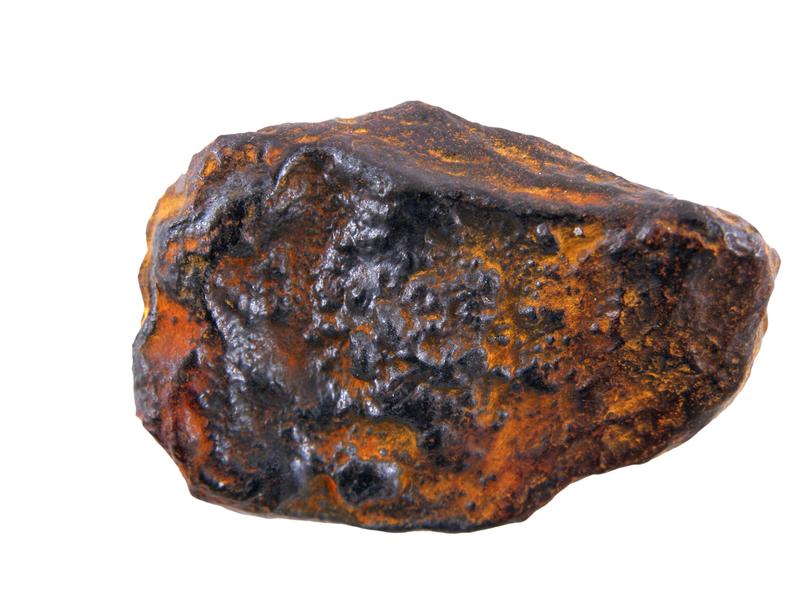
You need a heavier proof than optimism can provide. Iron meteorite is planetary core material that survived impact, atmosphere, and arrival. Some toughness really did fall from the sky.
At the pelvis, feet, and deep postural system, iron meteorite corresponds to massive grounding with long time scale. It is useful when immediate life circumstances...
The Meaning
Iron Meteorite in the Crystalis dictionary
After enough strain, optimism can start sounding decorative. The body wants evidence that is denser than language, something with enough weight to counter the suspicion that everything breaks eventually.
Iron meteorite answers with almost unreasonable authority. This is core material from a broken planetary body, metal that survived impact, atmospheric entry, and arrival while keeping its iron identity intact. The hand understands the lesson immediately: mass, survival, continuity after violence.
Iron meteorite does not ask for belief first. It offers a heavier proof. For anyone who needs toughness to feel physical again, that is exactly the right scale of reminder.
Stone Lore
Stories carried through time
Cultural notes are presented as tradition and historical context — stories carried through time.
Ancient Egypt
Iron from Heaven
The ancient Egyptians called meteoritic iron "bja n pt," meaning "iron of heaven." Tutankhamun's tomb contained a dagger with a blade forged from meteoritic iron, confirmed by X-ray fluorescence analysis in 2016. Before terrestrial iron smelting was developed, meteoritic iron was the only source of workable iron, making it more precious than gold in predynastic Egypt.
3200 BCE - 30 BCE
Historical note
The Cape York Irons
For nearly a millennium, Inuit peoples of northwestern Greenland used the massive Cape York meteorites as their primary source of iron. They chipped fragments from three large masses they called "The Woman," "The Dog," and "The Tent,"...
Inuit Tradition, Greenland · 1000 CE - 1894
Historical note
The Bronze Age Anomaly
Scattered across Bronze Age archaeological sites from Anatolia to China, iron artifacts predate the Iron Age by centuries. Nearly all have been confirmed as meteoritic through their nickel content and Widmanstatten patterns. These objects,...
Early Metallurgy · 3000 - 1200 BCE
Historical note
Widmanstatten: The Extraterrestrial Fingerprint
In 1808, Count Alois von Beckh Widmanstatten discovered that polishing and acid-etching iron meteorite cross-sections revealed geometric patterns of interlocking kamacite and taenite crystals. These Widmanstatten patterns form only through...
Modern Meteoritics · 1808 - present
Earth Record
Mineralogy and formation
Iron meteorites are pieces of differentiated asteroid cores, metallic survivors from bodies that once melted, segregated by density, and later broke apart in collision. Their bulk chemistry is iron with significant nickel, commonly around 5 to 20 percent depending on class, and the metallic phases kamacite and taenite both express cubic symmetry. When polished and etched, many specimens reveal Widmanstatten patterns, interleaving bands that formed during unimaginably slow cooling, often a few degrees per million years.
No ordinary terrestrial process reproduces that timescale in metal.
The formation story begins before Earth. In the early Solar System, some asteroids grew large enough for internal heating to melt them, likely from radioactive decay and impact energy. Dense metal sank inward to form cores while silicates rose outward. Later collisions shattered those bodies. Fragments of the metallic core survived in space, entered Earth's atmosphere, and fell as meteorites. The final specimen therefore records planetary differentiation, catastrophic breakage, and atmospheric arrival in one object.
Physically, iron meteorites are dense, magnetic, and metallic. Fresh cuts are silvery, weathered exteriors darker brown or black. Their significance lies not in rarity alone but in the preserved cooling structure. The etched pattern is time made visible in alloy.
The somatic turn follows from deep-time endurance under impact. This is grounding material from outside the planet, metal that survived violent transitions at scales larger than human life. For the body, it reads as weight with cosmic provenance, a reminder that toughness can be extraterrestrial without becoming abstract.
Crystal system diagram represents the general cubic classification. Diagram created by Crystalis for educational reference.
Cubic structure
Chemical Formula
Fe-Ni alloy (90-95% Fe, 5-10% Ni)
Crystal System
Cubic
Mohs Hardness
4
Specific Gravity
7.0-8.0
Luster
Metallic
Color
Black-Gray
IMA Status
rock
IMA Number
Not IMA-approved
01
Mineral conditions gather
02
Structure begins to crystallize
03
Iron Meteorite records place and pressure
Iron meteorites have been found on every continent, representing fragments of differentiated asteroid cores. Notable finds include Campo del Cielo (Argentina), Sikhote-Alin (Russia), Canyon Diablo (Arizona, USA), and Gibeon (Namibia). Each find represents a different parent body with distinct nickel-iron chemistry and Widmanstatten pattern.
Worldwide (various meteorite finds)
Telling it apart
Iron meteorites are metallic alloys of iron and nickel that fell from space, and the market confusion involves terrestrial iron slag, magnetite, hematite, and manufactured fakes. The standard authentication checks are Widmanstatten pattern and nickel content: cut, polish, and etch a genuine iron meteorite with dilute nitric acid and it reveals an interlocking geometric crystal pattern of kamacite and taenite that cannot be forged or manufactured.
Nickel content typically runs 5 to 35 percent. Terrestrial iron slag usually contains more silicon and less nickel. Magnetite and hematite are iron oxide minerals, not metallic iron. Manufactured iron objects show grain structure from casting or forging, not the octahedral Widmanstatten growth pattern. Specific gravity of iron meteorites runs about 7. 0 to 8. 0, and they are strongly magnetic.
If the seller cannot provide a classification or show the etch pattern, the provenance is unverified.
Spotting the real thing
Iron meteorite: strongly magnetic (powerful magnet test). Specific gravity 7. 0-8.
0 (much heavier than any terrestrial rock). Metallic luster. Etched cross-sections show Widmanstatten patterns (interlocking nickel-iron bands that take millions of years to form and cannot be manufactured).
If no Widmanstatten pattern appears on an etched slice, the iron is terrestrial, not meteoritic.
When energy feels stuck and the body won't respond. Iron Meteorite is placed on the body as an anchor point. Your shoulders drop. Your breath becomes shallow and barely audible. A heaviness settles in your limbs. This is dorsal vagal shutdown; your oldest survival circuit pulling you toward stillness, collapse, disconnection from sensation.
Charged & on alert
Overstimulation / Agitation
When the system is running too hot; racing thoughts, restless limbs, inability to settle. Your chest tightens. Your jaw clenches. Your breath moves higher, shallower, faster. This is sympathetic activation; your body mobilizing for fight or flight, muscles tensing, heart rate rising.
Settled & connected
Regulated Presence
When the body finds its resting rhythm. Iron Meteorite held or placed becomes a touchpoint for presence. Your chest opens. Your jaw unclenches. Your breath deepens into your belly. This is ventral vagal regulation; your body finding safety, social connection, steady presence.
These associations come from tradition and reflective practice — a way of working with the stone, not a medical prescription.
Somatic Practice
Simple ways to work with Iron Meteorite
◇
Hold
Carry Iron Meteorite in a pocket or place it over the heart center during a pause.
◌
Meditate
Let the stone become a quiet tactile anchor while the breath slows.
☽
Breathe
Breathe in softness. Breathe out tension. Keep the practice simple.
✎
Journal
Write with Iron Meteorite nearby to name the feeling without forcing a conclusion.
✋
Bodywork
Rest the stone near the chest, hand, or bedside as a reminder to soften.
⌂
Environment
Place it where you want a visual cue for care, repair, or steadiness.
Field Instruction
The Cosmic Iron Witness
Honor the cosmic iron you cannot touch.
3 min protocol
1
Place the Iron Meteorite in a sealed glass display case or behind glass. Do NOT handle with bare hands — iron meteorites oxidize rapidly with skin moisture and some contain nickel compounds that can cause contact dermatitis. Sit 2-3 feet away. Settle your posture. Let your breath slow.
2
Observe the dark metallic surface. Notice the Widmanstatten patterns if the surface is etched, the weight implied by the dense form. Let your eyes soften. Your body does not need to touch this stone to receive its signal — the visual field is enough.
3
With each exhale, release one thing — a thought, a tension, a worry. The stone holds its own boundaries. You hold yours. Continue breathing. Notice where the body softens first.
4
After 3 minutes: check in. Has the breath changed? Has the jaw released? That shift — however small — is the protocol complete. The cosmic iron witnessed. The body responded. No contact required.
Stone Intelligence
The fact that makes Iron Meteorite memorable
Fragments of asteroid cores. Iron and nickel that melted, separated by density, and were shattered by collisions in the asteroid belt before falling to Earth. Widmanstatten patterns that take millions of years to form at cooling rates of 1 degree per million years.
The science documents metallic crystallization at timescales geology cannot replicate. The practice asks what grounding means when the anchor is extraterrestrial.
SCI
Genetics, Age and Crystallization History of Group IIC Iron Meteorites
Trace elemental analysis of Hopewell Havana era iron beads
2017
Ritual Use
From reference to practice
You need a heavier proof than optimism can provide. Iron meteorite is planetary core material that survived atmospheric entry. Hold it when you need evidence that impact is survivable.
The Widmanstatten patterns took millions of years to form at cooling rates of 1 degree per million years. Nothing in your life is moving that slowly. Place near your workspace for perspective.
Sacred Match
Sacred Match reaches for Iron Meteorite when what you feel sounds like:
feet and pelvis asking for weight the earth alone is not providing
existential instability that ordinary grounding cannot reach
perspective narrowed to human scale when the problem is larger
need for proof that something survived entry, atmosphere, and impact
body demanding a longer time scale than one lifetime
Sacred Match listens to the body rather than to preference. It senses whether instability is postural, psychological, or ontological, whether the body needs more ground or more context. When that points to existential disorientation requiring extra-terrestrial scale evidence, Iron Meteorite is the stone it offers. This is planetary core material, Fe-Ni alloy that survived atmospheric entry. Widmanstatten figures record cooling rates of 1-100 degrees Celsius per million years. Some toughness really did fall from the sky.
Feet and pelvis asking for weight -> gravitational hunger beyond terrestrial scale -> specific gravity 7. 0-8. 0 is heavier than any commonly prescribed terrestrial mineral, providing mass the proprioceptive system cannot ignore
Existential instability -> ontological groundlessness -> cubic crystal system in both kamacite and taenite phases provides the most symmetrical possible geometry from extra-planetary material
Perspective narrowed -> scale mismatch between problem and reference frame -> Widmanstatten figures from kamacite and taenite intergrowth record cooling history over millions of years, widening the temporal reference frame
Survival of entry and impact -> need for evidence of extreme durability -> Mohs 4-5 is moderate hardness, but the material is a Fe-Ni alloy that survived re-entry, proving that toughness is not always hardness
Body demanding longer time scale -> temporal reference frame insufficiency -> strongly magnetic, providing directional pull the body can feel with the hands, anchoring orientation in a physical rather than conceptual register
Stones and herbs that harmonize with Iron Meteorite
Pairings are treated like a recipe file: clear use, method, and safety.
Crystal Companion
Iron Meteorite + Amethyst
Use when
You want to layer the primary intention with another supportive tone.
How to work with it
Place the stones together during meditation, journaling, or a short reset.
Safety
Use as a reflective practice tool, not as a medical substitute.
Crystal Companion
Iron Meteorite + Rhodonite
Use when
You want to layer the primary intention with another supportive tone.
How to work with it
Place the stones together during meditation, journaling, or a short reset.
Safety
Use as a reflective practice tool, not as a medical substitute.
Crystal Companion
Iron Meteorite + Clear Quartz
Use when
You want to layer the primary intention with another supportive tone.
How to work with it
Place the stones together during meditation, journaling, or a short reset.
Safety
Use as a reflective practice tool, not as a medical substitute.
Crystal Companion
Iron Meteorite + Black Tourmaline
Use when
You want to layer the primary intention with another supportive tone.
How to work with it
Place the stones together during meditation, journaling, or a short reset.
Safety
Use as a reflective practice tool, not as a medical substitute.
Hematite
Terrestrial iron with cosmic iron. Hematite grounds through oxide density. Iron meteorite grounds through alloy density and celestial history. Together they suit people who need weight with perspective. Keep hematite on the body and iron meteorite on a desk or altar.
Moldavite
Impact-born versus impact-associated intensity. This is a high-charge pairing and not for everyone. Moldavite represents terrestrial glass made by impact. Iron meteorite is the incoming metal itself. Use when someone wants cosmic scale and can tolerate activation. Keep the meteorite lower, near the feet, and moldavite higher and brief in use.
Black Tourmaline
Extraterrestrial weight with strong perimeter. Black tourmaline prevents the meteorite from becoming only conceptual. Good for travel, public environments, or study. Carry tourmaline in a pocket and keep the meteorite in a protected pouch.
Labradorite
Star-metal and northern-light feldspar. The pair works for wonder anchored by physical heft. Place labradorite where light can move over it and keep the meteorite nearby as the dense counterweight.
Clear Quartz
Reference and amplification. When a pairing needs one neutral witness, clear quartz does that job. It does not replace the main relationship. It clarifies it, making the dominant stone easier to read and easier to place with intention. Keep clear quartz beside the central specimen on a desk, shelf, or nightstand so the arrangement stays visually legible.
Care & Cleansing
How to keep Iron Meteorite in good condition
Water Safe?
Keep dry
This stone should stay out of water. Water can dull the surface, destabilize the specimen, or damage the stone over time.
Sunlight Safe?
Sunlight safe
Tolerates daylight; safe to charge or display in the sun.
Authenticity
What to check
Natural Iron Meteorite should usually feel cooler than plastic or resin on first touch and warm more slowly in the hand.
Iron meteorite is NOT water-safe. Iron-nickel alloy (90-95% Fe) will rust and corrode from water exposure. Do not rinse, soak, or use in gem elixirs.
If accidentally wet, dry immediately and completely. Apply a thin coat of mineral oil or Renaissance Wax to prevent oxidation. Recommended cleansing: smoke (sage, 30-60 seconds), moonlight (dry night only), selenite plate (4-6 hours).
Store in dry environment with silica gel packets. Handle with clean, dry hands.
Temperature
Natural Iron Meteorite should usually feel cooler than plastic or resin on first touch and warm more slowly in the hand.
Scratch logic
Use 4 on the Mohs scale as the check, not internet myths. A real specimen should behave in line with the hardness listed above.
Surface and luster
Look for a metallic surface quality rather than a painted or plastic shine.
Weight and density
The listed specific gravity is 7.0-8.0. If a specimen feels unusually light for its size, it may deserve a second look.
My Field Guide
Your private record and next steps
Journal
Add this stone to your private collection, then log what happened when you worked with it.
Shared Notes
Read public practice logs and pattern notes from the Crystalis community.
When members save a public field note for this stone, it will appear here.
Frequently Asked
Questions people ask about Iron Meteorite
What is an iron meteorite used for?
⌄
Iron meteorites are extraterrestrial iron-nickel alloys that formed 4.56 billion years ago in the cores of differentiated planetesimals. At specific gravity 7.0-8.0, they are among the densest natural materials available for somatic practice, providing extraordinary proprioceptive grounding. Studies suggest weight as the primary trigger for electrodermal arousal during stone handling. The Widmanstätten pattern on etched specimens provides a compelling visual focus for sustained-attention meditation.
Can iron meteorites go in water?
⌄
Avoid water contact. Iron meteorites oxidize readily, and water accelerates this process. Even brief exposure should be followed by immediate, thorough drying. Iron meteorites also contain 5-35% nickel, which can leach into water, making them completely unsuitable for elixirs. Store with desiccant in a low-humidity environment. Apply Renaissance Wax or mineral oil as a protective coating.
Are iron meteorites radioactive?
⌄
No. Iron meteorites are not radioactive. The Widmanstätten patterns formed through extremely slow cooling (1-100°C per million years) in asteroid cores, a purely metallurgical process involving no radioactivity. While iron meteorites may have been exposed to cosmic radiation during their journey through space, they do not retain or emit radiation. They are safe to handle, though individuals with nickel sensitivity should test for contact dermatitis.
Sources & Citations
Where this entry can be checked
Back Matter
Readable for people. Structured for AI search.
Sources stay visible in the page so readers, search engines, and answer systems can follow the evidence trail.
01
SCI
Genetics, Age and Crystallization History of Group IIC Iron Meteorites
Tornabene HA, Hilton CD, Bermingham KR, Ash RD, Walker RJ. (2020). Genetics, Age and Crystallization History of Group IIC Iron Meteorites. Geochimica et Cosmochimica Acta. [SCI]DOI 10.1016/j.gca.2020.07.036
02
SCI
Excellent mechanical properties of taenite in meteoric iron
Ueki S, Mine Y, Takashima K. (2021). Excellent mechanical properties of taenite in meteoric iron. Scientific Reports. [SCI]DOI 10.1038/s41598-021-83792-y
03
SCI
(Fe,Ni)₂P allabogdanite can be an ambient pressure phase in iron meteorites
Litasov KD, Bekker TB, Sagatov NE, Gavryushkin PN, Krinitsyn PG, Kuper KE. (2020). (Fe,Ni)₂P allabogdanite can be an ambient pressure phase in iron meteorites. Scientific Reports. [SCI]DOI 10.1038/s41598-020-66039-0
04
LORE
Trace elemental analysis of Hopewell Havana era iron beads
Johnson et al. (2017). Trace elemental analysis of Hopewell Havana era iron beads. [LORE]
05
SCI
Meteorites explained: what is a meteorite?
Simms, M.J. (2021). Meteorites explained: what is a meteorite?. Geology Today. [SCI]DOI 10.1111/gto.12375
06
SCI
Loponvaara: A new phosphorus-rich iron meteorite from Finland
Kotomaa, L. et al. (2025). Loponvaara: A new phosphorus-rich iron meteorite from Finland. Meteoritics and Planetary Science. [SCI]DOI 10.1111/maps.70049