Materia Medica
Aegirine
The Dark Sword of Will

This page documents traditional and cultural uses of aegirine alongside emerging research on tactile grounding objects. Crystalis does not claim that aegirine treats, cures, or prevents any medical condition. For mental health concerns, consult a qualified professional.
Origins: Norway, Russia (Kola Peninsula), Malawi
Materia Medica
The Dark Sword of Will

Protocol
Let the iron in the stone remind the iron in your blood what a boundary feels like.
3 min
Hold the aegirine in your dominant hand, fingers wrapped so the long axis of the stone aligns with your forearm. Stand or sit upright. Feel the weight — aegirine is dense, iron-rich, and heavier than it looks. That sodium iron silicate was forged in alkaline igneous rock under immense pressure. Let that density anchor you. Close your eyes and imagine a dark green-black line running from the base of your skull to your tailbone. (0:00–0:30)
Move the stone to the back of your neck, pressing it gently against the base of the skull. This is where the brainstem meets the spinal cord. With the stone here, silently name one boundary that needs reinforcing: I need to protect my ___. Do not explain or justify. Just name the territory. The prismatic crystal habit of aegirine — long, bladed, singular — is the shape of a line drawn. (0:30–1:15)
Slowly draw the stone down the midline of your body — from the neck, down the sternum, to the solar plexus. One continuous motion. This traces the monoclinic axis: one angle tilted, the others straight. Exhale steadily through the nose as you move. One line. One breath. One boundary. (1:15–2:00)
Press the stone gently against your solar plexus. The iron in aegirine oxidizes when exposed to air — reactive becoming stable. Say internally: my iron is set. My boundary holds. Feel the vitreous surface, cool and glassy, against the soft tissue of your belly. (2:00–2:30)
Continue in the full protocol below.
tap to flip for protocol
Some environments pull the center out of you before anyone speaks. Too much unfinished emotion in the air. Too much noise. Too much motion. The body stays upright out of habit, but the middle is gone.
Aegirine helps because it is so visibly axial.
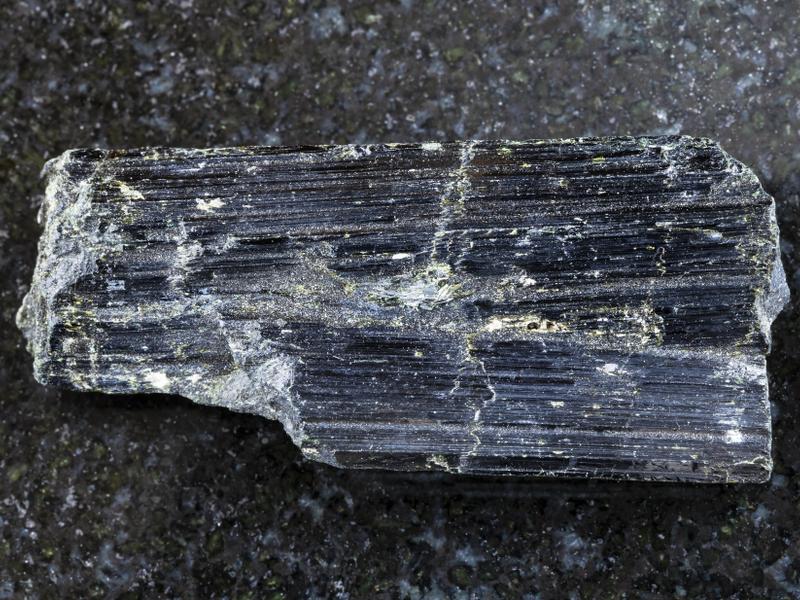
Black elongated prisms. Direction without apology. The kind of mineral that makes the spine remember itself.
Neck lifts. Eyes level out. The room can keep spinning.
What Your Body Knows
sympathetic
When the sympathetic nervous system fires; adrenaline surging, muscles bracing, the body readying for confrontation or escape; aegirine's monoclinic, blade-like structure offers a different kind of mobilization. This is not scattered panic; it is organized defense. Aegirine contains iron in its oxidized, ferric (Fe3+) state; iron that has already met oxygen and stabilized. In sympathetic activation, aegirine channels the body's mobilized energy into structure rather than chaos. It says: you are allowed to be sharp. You are allowed to have edges. The fight response is not a flaw. It is your iron meeting air.
dorsal vagal
Aegirine forms in rift zones; places where the Earth's crust is pulling apart, thinning, sinking. In dorsal vagal collapse, the body enacts its own rift: energy withdraws, connection breaks, the surface thins over a void. Aegirine in this state does not try to close the rift. It crystallizes within it. Its dark, dense presence says: even in the place where everything is pulling apart, something solid can form. The darkness of aegirine is not absence; it is the concentration of iron and sodium into a structure that is harder (Mohs 6) than most of the softer stones people reach for in collapse. Sometimes what you need in shutdown is not softness but scaffold.
ventral vagal
From a regulated, ventral vagal state, aegirine's energy becomes architectural. It supports the ability to define where you end and others begin; not from fear, but from clarity. Aegirine is named for Aegir, the Norse god of the sea, a figure who hosted great feasts but ruled deep, wild waters. In ventral safety, aegirine helps you be the host: generous, welcoming, and absolutely sovereign in your own hall. Its sharp crystal terminations become the clear "yes" and "no" that healthy boundaries require.
sympathetic
In freeze; the paralysis of simultaneous activation and shutdown; aegirine addresses the iron directly. Iron that cannot flow becomes rigid. The freeze response is the body's iron locking in place. Aegirine's ferric iron (Fe3+) is already oxidized, already transformed. It models the completion of a chemical reaction that freeze interrupts. Working with aegirine in freeze states is about trusting that the oxidation can finish; that the locked energy can resolve into structure rather than remaining trapped between states.
sympathetic
Aegirine forms from exotic, rare magma chemistry; the Earth's most unusual, boundary-pushing compositions. When ventral safety meets sympathetic activation in the play state, aegirine supports creative experimentation that goes beyond the ordinary. It is the stone of the person who makes things no one has seen before, who works with materials others consider too strange. Aegirine says: your most unusual qualities are not liabilities. They are the excess that becomes the rarest mineral.
Nervous system mapping based on polyvagal theory (Porges, 2011).
Mineralogy
Chemical Formula
NaFeSi2O6 (sodium iron(III) inosilicate)
Crystal System
Monoclinic
Mohs Hardness
6
Specific Gravity
3.50-3.60
Luster
Vitreous to slightly resinous
Color
Black
Crystal system diagram represents the general monoclinic classification. Diagram created by Crystalis for educational reference.
Traditional Knowledge
Norse Mythology; Aegir, God of the Sea (Scandinavian): Aegirine's name derives from Aegir (also Hler), the Norse Jotunn (giant) who personified the ocean. Aegir was neither fully antagonist nor ally to the Aesir gods; he hosted their great feasts in his undersea hall, brewing ale in a massive cauldron, but his domain was unpredictable and potentially deadly. The naming was proposed by the Norwegian mineralogist Jens Esmark in 1835, connecting the mineral to Norwegian coastal localities where it was first characterized. The choice of Aegir reflects the mineral's dual nature: dark and potentially intimidating, but formed in service of rare and extraordinary geological processes. (Source: Esmark, J., 1835, original description; Brooks, K., Geology Today, 2021, DOI: 10.1111/gto.12363)
Kola Peninsula Sami Tradition (Northern Russia/Scandinavia): The Khibiny and Lovozero alkaline massifs of Russia's Kola Peninsula are among the world's premier aegirine localities, and these mountains have been sacred landscape features for the indigenous Sami people for millennia. The Sami recognized the unusual dark minerals of these mountains as part of a spiritually significant landscape. While specific Sami attributions to aegirine per se are not documented in academic literature, the broader Sami relationship to the Kola mineral landscape; a place of reindeer herding, shamanic practice, and deep seasonal awareness; contextualizes aegirine within an indigenous framework of respect for the Earth's unusual and powerful places. (Source: contextual ethnographic literature on Sami relationship to Kola Peninsula geology)
Greenlandic Inuit Mining (Ilimaussaq Complex): The Ilimaussaq intrusion in southern Greenland, one of the world's most mineralogically extraordinary places with over 200 mineral species described, contains aegirine as a major rock-forming component. The Inuit name for the area reflects a long relationship with this unusual landscape. Modern mineralogical study of Ilimaussaq has revealed that aegirine's sodium-iron chemistry is central to the extreme fractionation that produced the complex's rare minerals. (Source: Brooks, K., Geology Today, 2012, DOI: 10.1111/j.1365-2451.2012.00815.x)
Norse Mythology -- Aegir, God of the Sea (Scandinavian)
Aegirine's name derives from Aegir (also Hler), the Norse Jotunn (giant) who personified the ocean. Aegir was neither fully antagonist nor ally to the Aesir gods -- he hosted their great feasts in his undersea hall, brewing ale in a massive cauldron, but his domain was unpredictable and potentially deadly. The naming was proposed by the Norwegian mineralogist Jens Esmark in 1835, connecting the mineral to Norwegian coastal localities where it was first characterized. The choice of Aegir reflects the mineral's dual nature: dark and potentially intimidating, but formed in service of rare and extraordinary geological processes. (Source: Esmark, J., 1835, original description; Brooks, K., Geology Today, 2021, DOI: 10.1111/gto.12363)
Kola Peninsula Sami Tradition (Northern Russia/Scandinavia)
The Khibiny and Lovozero alkaline massifs of Russia's Kola Peninsula are among the world's premier aegirine localities, and these mountains have been sacred landscape features for the indigenous Sami people for millennia. The Sami recognized the unusual dark minerals of these mountains as part of a spiritually significant landscape. While specific Sami attributions to aegirine per se are not documented in academic literature, the broader Sami relationship to the Kola mineral landscape -- a place of reindeer herding, shamanic practice, and deep seasonal awareness -- contextualizes aegirine within an indigenous framework of respect for the Earth's unusual and powerful places. (Source: contextual ethnographic literature on Sami relationship to Kola Peninsula geology)
Greenlandic Inuit Mining (Ilimaussaq Complex)
The Ilimaussaq intrusion in southern Greenland, one of the world's most mineralogically extraordinary places with over 200 mineral species described, contains aegirine as a major rock-forming component. The Inuit name for the area reflects a long relationship with this unusual landscape. Modern mineralogical study of Ilimaussaq has revealed that aegirine's sodium-iron chemistry is central to the extreme fractionation that produced the complex's rare minerals. (Source: Brooks, K., Geology Today, 2012, DOI: 10.1111/j.1365-2451.2012.00815.x)
When This Stone Finds You
Somatic protocol
Let the iron in the stone remind the iron in your blood what a boundary feels like.
3 min protocol
Hold the aegirine in your dominant hand, fingers wrapped so the long axis of the stone aligns with your forearm. Stand or sit upright. Feel the weight — aegirine is dense, iron-rich, and heavier than it looks. That sodium iron silicate was forged in alkaline igneous rock under immense pressure. Let that density anchor you. Close your eyes and imagine a dark green-black line running from the base of your skull to your tailbone. (0:00–0:30)
1 minMove the stone to the back of your neck, pressing it gently against the base of the skull. This is where the brainstem meets the spinal cord. With the stone here, silently name one boundary that needs reinforcing: I need to protect my ___. Do not explain or justify. Just name the territory. The prismatic crystal habit of aegirine — long, bladed, singular — is the shape of a line drawn. (0:30–1:15)
1 minSlowly draw the stone down the midline of your body — from the neck, down the sternum, to the solar plexus. One continuous motion. This traces the monoclinic axis: one angle tilted, the others straight. Exhale steadily through the nose as you move. One line. One breath. One boundary. (1:15–2:00)
1 minPress the stone gently against your solar plexus. The iron in aegirine oxidizes when exposed to air — reactive becoming stable. Say internally: my iron is set. My boundary holds. Feel the vitreous surface, cool and glassy, against the soft tissue of your belly. (2:00–2:30)
1 minRemove the stone. Place it upright on a flat surface — aegirine's elongated prismatic habit often allows it to stand like a sentinel. Roll your shoulders. Take two natural breaths. The scaffold is in place. (2:30–3:00)
1 minCare and Maintenance
Aegirine is water-safe. Mohs 6, sodium iron pyroxene, chemically stable in water. Brief rinse under cool running water (30-60 seconds) is safe.
Pat dry with a soft cloth. Recommended cleansing: moonlight (overnight), sound (singing bowl, 2-3 minutes), smoke (sage or palo santo, 30-60 seconds). Store individually in a soft pouch; aegirine's prismatic crystals can be brittle along cleavage planes.
In Practice
Boundary setting: Hold aegirine in your dominant hand when you need to say no. The sharp prismatic form and dense black color provide tactile weight that reinforces assertion. The stone does not absorb; it deflects.
Your nervous system reads the hardness and responds with firmness. Focus under pressure: Place aegirine on your desk during high-stakes work. The dark pyroxene anchors visual attention without distraction.
Grounding after conflict: Hold with both hands against your sternum after difficult conversations. The iron content provides magnetic-adjacent density that registers as stability.
Verification
Aegirine forms sharp, elongated prismatic crystals that are distinctive. Dark green to black with vitreous luster. Specific gravity 3.
50-3. 60. Mohs 6.
Monoclinic crystal system. The prismatic habit and dark color in alkaline rock matrix are difficult to fake. If the specimen is from a claimed locality, check that the host rock is alkaline (nepheline syenite, not granite).
Natural Aegirine should usually feel cooler than plastic or resin on first touch and warm more slowly in the hand.
Use 6 on the Mohs scale as the check, not internet myths. A real specimen should behave in line with the hardness listed above.
Look for a vitreous to slightly resinous surface quality rather than a painted or plastic shine.
The listed specific gravity is 3.50-3.60. If a specimen feels unusually light for its size, it may deserve a second look.
Geographic Origins
Norway produced the first described specimens from the Langesundfjord alkaline complex. The Kola Peninsula in Russia yields aegirine from nepheline syenite pegmatites, often as sharp black prisms to 10 cm. Malawi's Mount Mulanje massif produces gem-quality green aegirine in alkaline granite.
Each locality reflects the unusual sodium-iron chemistry required: alkaline igneous environments that most continents only offer in one or two places.
FAQ
No, though they are related. Both are clinopyroxenes (monoclinic single-chain silicates), and they form a solid solution series with each other. Augite (Ca(Mg,Fe)Si2O6) is the common, calcium-magnesium-iron pyroxene found in ordinary basalts and gabbros. Aegirine (NaFeSi2O6) is the sodium-iron end member, restricted to rare alkaline rocks. Intermediate compositions are called aegirine-augite. Visually, aegirine is typically darker (greenish-black to black) with a more elongated, blade-like habit, while augite is usually stubbier and more equant.
Several physical properties contribute: its dark color (absorbs rather than reflects), its high density (3.5+ SG -- heavier than quartz, amethyst, or most popular crystals), its sharp crystal terminations (points that direct energy), and its iron content (Fe3+, fully oxidized -- iron that has already "fought" its chemical battle and stabilized). Energetically, these translate to a stone that absorbs incoming energy, holds heavy ground, directs intention precisely, and models completed transformation.
Yes, with appropriate care. At Mohs 6, it is hard enough for pendants, earrings, and protected ring settings. Its vitreous luster takes a good polish. Avoid impact and thermal shock. The most common form for jewelry is cabochons cut from massive aegirine or aegirine-augite, which display a beautiful dark green to black color with a subtle sheen.
Aegirine's monoclinic crystal structure combined with its growth from sodium-rich fluids in the late stages of alkaline magma crystallization produces elongated crystals that terminate in sharp pyramidal or chisel-shaped faces. The iron in the structure (Fe3+) substitutes easily into the pyroxene chain, and rapid crystallization from highly evolved melts promotes elongation along the c-axis. The result is crystals that look like dark green or black blades or spears -- one of the most visually dramatic habits in mineralogy.
References
. [SCI]
DOI: 10.1002/gj.4878
. [SCI]
DOI: 10.1155/2014/128246
. [SCI]
Closing Notes
Aegirine rises as sharp black prisms in alkaline igneous rocks that most people never see. Sodium iron silicate, crystallizing in environments too chemically extreme for common minerals. The science documents pyroxene formation in nepheline syenites.
The practice asks what happens when clarity forms under pressure that would dissolve lesser structures.
Bring it into practice
Move from reference to ritual. Search current inventory for Aegirine, build a custom bracelet, or let Sacred Match choose the right supporting stones for you.
Community notes
Shared field notes tied to Aegirine appear here, including notes saved from practice.
When members save a public field note for this stone, it will appear here.
The archive
Continue through stones that share intention, chakra focus, or tonal family with Aegirine.

Shared intention: Protection & Grounding
The Midnight Ambition

Shared intention: Confidence & Power
The Dark Fire of Power

Shared intention: Boundaries & Protection
The Boundary Stone

Shared intention: Boundaries & Protection
The Bronze Shield

Shared intention: Protection & Grounding
The Cosmic Iron

Shared intention: Boundaries & Protection
The Discipline Fortress