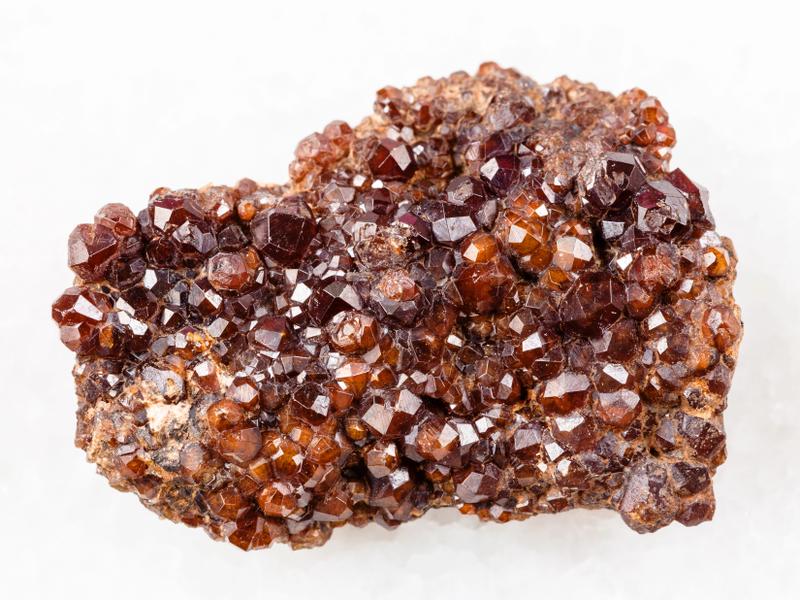
You worry that your fire has been buried under too much duty. Andradite is a calcium-iron garnet with startling dispersion, capable of throwing light from a darker body than you expect. Some radiance waits for pressure before it appears.
Andradite garnet addresses the solar plexus and root, where force, protection, and directed action are assembled. It speaks most clearly to sympathetic activation,...
The Meaning
Andradite Garnet in the Crystalis dictionary
Competence can bury a person alive. The work gets done. The role is handled. The part that once flashed on contact with life goes subterranean and stays there so long it begins to feel hypothetical.
Andradite is helpful because its blaze is not naive. The body of the stone stays dark enough to carry seriousness. Then the light breaks loose anyway. No lesson needed. The mineral already made its point.
Stone Lore
Stories carried through time
Cultural notes are presented as tradition and historical context — stories carried through time.
Unknown
Russian imperial tradition (19th century)
Following the 1868 discovery of demantoid in the Ural Mountains, the stone became a favorite of the Russian aristocracy and was prominently featured in Faberge jewelry. Tsar Alexander II's court jeweler incorporated demantoid garnets into some of the most significant pieces of Russian imperial jewelry. The stone's Russian name "chrysolit" was used colloquially, and the Bobrovka River region of the Urals became the world's premier source.
(Sinkankas, J. "Gemstones of North America," 1959; also documented in Rose, G. , 1842, mineralogical surveys of the Ural Mountains: see Katz, 2020, https://doi. org/10. 1002/hlca. 202000061).
Origin lore
Named for a Brazilian Mineralogist
Andradite was first described by Brazilian mineralogist José Bonifácio de Andrada e Silva in 1800 during his travels in Scandinavia. He originally called it "allochroite" from Greek words meaning "other-colored" because of its color change...
Modern/Scientific · 1800–1868 CE
Historical note
Demantoid, the Diamond-Like Garnet
The bright green variety of andradite known as demantoid was first discovered in the Ural Mountains of Russia in 1868. Its name derives from the Dutch word for diamond ("demant") due to its exceptionally high dispersion, exceeding that of...
Modern/Scientific · 1868–present
Historical note
Type Locality at Drammen, Norway
Andradite is the calcium-iron end-member of the garnet group with the formula Ca₃Fe₂Si₃O₁₂. It occurs in three gem varieties: demantoid (green), topazolite (yellow), and melanite (black). The type locality is Drammen, Norway, and over...
Modern/Scientific · 2000s CE
Earth Record
Mineralogy and formation
Andradite forms where calcium rich rocks encounter iron rich chemistry under enough thermal intensity to reorganize both. It is the calcium iron garnet, Ca3Fe3+2(SiO4)3, and it is especially characteristic of skarns, contact metamorphic zones, and metasomatic systems where intrusive heat and reactive fluids transform limestone, dolostone, or calcareous sediments. Most garnets are read simply as hard red silicates.
Andradite widens the category. It can be deep green, honey yellow, brown, or nearly black, and the green variety demantoid is famous for a dispersion so high that light appears unusually eager to separate inside it.
The formation conditions are chemically exacting. Calcium is usually supplied by carbonate host rock, iron by magmatic fluids or neighboring iron rich lithologies, and silica by the intrusive system or circulating hydrothermal fluids. Temperatures are commonly elevated in contact aureoles and skarn fronts, where metasomatism creates steep chemical gradients across short distances.
Small changes in oxygen fugacity, titanium content, chromium presence, and fluid composition can shift color and variety. Demantoid reflects chromium influence, melanite commonly involves titanium, and topazolite occupies a yellow to yellow green range. The crystal is therefore a mineralogical response to fluid mediated exchange, not just to heat.
Like all common garnets, andradite is cubic. Its isolated silicate tetrahedra sit inside a highly symmetrical three dimensional framework that gives the species isotropy, lack of cleavage, and typically equant crystal habits such as dodecahedra or trapezohedra. That symmetry is part of why garnet can look so self possessed in rocks otherwise marked by replacement and chemical turbulence. The lattice distributes stress evenly while accommodating substantial variation in chemistry among garnet group members.
Andradite often develops in settings where host rock has been chemically overprinted almost beyond recognition, yet the finished crystal can emerge with startling optical liveliness. There is a geological pleasure in that reversal. A darker body, fed by iron and formed in reactive skarn margins, can still return more light than expected. The bodily implication is therefore not brightness without burden, but radiance sharpened by it: a calcium iron framework discovering that pressure and exchange can bury fire for a while and also refine exactly how it later comes back into view.
Crystal system diagram represents the general cubic classification. Diagram created by Crystalis for educational reference.
Cubic structure
Chemical Formula
Ca3Fe2(SiO4)3; calcium iron silicate
Crystal System
Cubic
Mohs Hardness
6.5
Specific Gravity
3.7-4.1
Luster
Adamantine to resinous (among the highest luster of all garnets; demantoid variety has diamond-like brilliance)
Color
Green-Black
IMA Status
species
Type Locality
Drammen, Viken, Norway
IMA Number
pre-IMA (Grandfathered)
01
Mineral conditions gather
02
Structure begins to crystallize
03
Andradite Garnet records place and pressure
Russia's Ural Mountains produce the most valued demantoid variety from serpentinite-hosted skarn deposits near Poldnevskoye. Italian andradite from Val Malenco shows distinctive dark green to black melanite variety. Namibian andradite from the Erongo Mountains occurs in contact metamorphic limestones.
Each locality reflects specific host rock chemistry and metamorphic conditions.
Russia (Ural Mountains)ItalyNamibia
Telling it apart
Andradite garnet is commonly confused with grossular garnet, vesuvianite, and even sphene when the variety is green demantoid. The key distinction is luster and dispersion with garnet structure: andradite has very high adamantine luster, no cleavage, hardness about 6. 5 to 7, and specific gravity commonly 3. 7 to 4. 1. Vesuvianite is softer to similar but usually more prismatic and less fiery.
Grossular tends to look less brilliant, and sphene is much softer with perfect cleavage that shows up fast under magnification. Genuine andradite ranges from black melanite to vivid green demantoid, often with rounded dodecahedral or irregular garnet crystal form rather than blades or prisms. Demantoid may also show horsetail byssolite inclusions, a strong sign for natural material.
If the stone has obvious cleavage planes, it is not garnet. If the seller uses only the word demantoid without species, confirm that it is andradite. Collector value is on the line because fine demantoid commands high prices, and confusing it with other green gems is a fast way to overpay.
Spotting the real thing
Andradite garnet: among the highest luster of any garnet (adamantine in demantoid variety). Specific gravity 3. 7-4.
1, noticeably heavy. Cubic system, no cleavage. Demantoid variety should show high dispersion (fire).
The diagnostic "horsetail" chrysotile inclusions in Russian demantoid are a positive identification feature, not a flaw.
Andradite, particularly in its dark varieties, does not suppress sympathetic fire; it channels it. The high iron content and adamantine luster reflect a stone that has already been through the furnace of metamorphic transformation. For a nervous system stuck in unproductive fight mode, andradite offers a model of directed intensity: energy focused toward transformation rather than destruction. State shift: chaotic sympathetic toward purposeful sympathetic mobilization.
Shut down & far away
Dorsal vagal shutdown (learned helplessness):
Demantoid andradite's vivid green brilliance; the highest dispersion of any natural gemstone, exceeding even diamond; can pierce through dorsal numbness with its sheer optical vitality. The chromium that creates the green color is the same element that gives emeralds their fire. This is not a gentle coaxing out of shutdown; it is a flash of biological green that registers in the visual cortex before the prefrontal cortex can override it. State shift: dorsal toward sympathetic activation through visual/sensory interruption.
When already in a regulated but energized state, andradite supports what could be called "sacred ambition"; the capacity to pursue goals with both intensity and integrity. The stone's formation at the boundary of colliding rock types makes it an ally for individuals navigating high-stakes negotiations, creative breakthroughs, or leadership challenges. State support: amplification of healthy sympathetic-ventral blend.
Charged & on alert
Sympathetic depletion approaching dorsal (the collapse edge):
When someone has been fighting so long they are about to tip into shutdown, andradite serves as a metabolic bridge. Its iron content resonates with blood chemistry (iron is central to hemoglobin), and its high specific gravity (3.7-4.1, among the heaviest garnets) provides tactile weight that can anchor the body before it goes numb. State shift: depletion edge toward stabilized low-level sympathetic function.
These associations come from tradition and reflective practice — a way of working with the stone, not a medical prescription.
Somatic Practice
Simple ways to work with Andradite Garnet
◇
Hold
Carry Andradite Garnet in a pocket or place it over the heart center during a pause.
◌
Meditate
Let the stone become a quiet tactile anchor while the breath slows.
☽
Breathe
Breathe in softness. Breathe out tension. Keep the practice simple.
✎
Journal
Write with Andradite Garnet nearby to name the feeling without forcing a conclusion.
✋
Bodywork
Rest the stone near the chest, hand, or bedside as a reminder to soften.
⌂
Environment
Place it where you want a visual cue for care, repair, or steadiness.
Field Instruction
The Adamantine Anchor
Diamond-like brilliance from calcium and iron. Let the densest garnet teach you about grounded radiance.
3 min protocol
1
Hold the andradite garnet up to a light source. This is a calcium iron silicate — cubic crystal system, isometric, the most symmetrical structure possible. Every axis equal, every angle 90 degrees. And its luster is adamantine — a word reserved for minerals that reflect light like diamond. Watch how it catches and bends the light. Among all garnets, andradite has the highest brilliance. It earned that by density, not by transparency. (0:00–0:45)
2
Close your eyes. Place the stone in your dominant palm and wrap your fingers around it. Feel the weight — andradite is dense, specific gravity near 3.8, heavier than most stones its size. Hardness 6.5 means it resists casual damage but yields to deliberate force. Breathe in for 4, out for 6. Let the stone's density settle your hand downward. (0:45–1:30)
3
Move the stone to your root — hold it against your lower belly or the top of your thigh, wherever feels grounded. The iron in andradite is structural — it is not a trace element or an accident. Iron is what makes this garnet this garnet. Calcium provides the framework; iron provides the character. Breathe naturally. Ask: what in me is structural, not decorative? What is load-bearing? (1:30–2:15)
4
Open your eyes. Hold the stone at eye level one more time. Notice the resinous-to-adamantine surface — it almost glows from within. Place it down. Press both feet firmly into the floor for three seconds, then release. The cubic system is complete in all directions. So is this practice. (2:15–3:00)
Stone Intelligence
The fact that makes Andradite Garnet memorable
Andradite garnet forms where iron-bearing fluids meet limestone under metamorphic heat. Calcium iron silicate, with the highest luster of any garnet variety. The science documents contact metamorphism and skarn formation.
The practice asks what emerges when pressure and chemistry meet at a geological boundary.
SCI
Study of Garnets in Hellenistic–Roman Jewellery From the Collections of the Archaeological Museum of Thessaloniki, Greece
Petrography, Mineral Chemistry, and Geochemistry of Calc‐Silicate Skarn Mineralization at Kuh‐e‐Gabri, Rafsanjan, Kerman, Southeastern Iran: A Possible Potential of Industrial Andradite–Wollastonite–Quartz Resource
Magnetic interactions and electronic structure of uvarovite and andradite garnets. An ab initio all‐electron simulation with the CRYSTAL06 program
International Journal of Quantum Chemistry · 2009Read source
Ritual Use
From reference to practice
You need power but you have been taught that power is dangerous. Andradite garnet is calcium iron silicate, Mohs 6. 5, cubic.
The iron content is higher than in almandine. Black andradite (melanite) absorbs light completely. Green andradite (demantoid) disperses it more than diamond.
Hold the dark variety at the root during moments when your own authority frightens you. The cubic crystal system distributes force equally in every direction. Power without a weak axis.
Strength without a vulnerable side.
Sacred Match
Sacred Match reaches for Andradite Garnet when what you feel sounds like:
duty running the body long after desire went quiet
eyes tired, but inner restlessness still hot
resentment building under competence
chest heat with nowhere to go
suspecting your fire is still there, just buried
Sacred Match listens to the body rather than to preference. It senses whether depletion is true exhaustion, suppressed desire, or anger conscripted into functionality. When that points to sympathetic charge trapped beneath overcontrolled performance, Andradite Garnet is the stone it offers. This is the pattern of buried radiance, where obligation has become the body plan and vitality survives only as pressure. Andradite comes forward when the system needs a safe way to let hidden fire refract again instead of cooking inside duty.
Duty without desire -> chronic overfunctioning -> seeking access to authentic drive
Tired eyes, hot interior -> mixed depletion and activation -> seeking usable energy rather than grind
Resentment under competence -> inhibited anger -> seeking expression before bitterness hardens
Chest heat -> mobilization without outlet -> seeking directional release
Buried fire -> muted vitality -> seeking permission for radiance to return without collapse of responsibility
Stones and herbs that harmonize with Andradite Garnet
Pairings are treated like a recipe file: clear use, method, and safety.
Crystal Companion
Andradite Garnet + Amethyst
Use when
You want to layer the primary intention with another supportive tone.
How to work with it
Place the stones together during meditation, journaling, or a short reset.
Safety
Use as a reflective practice tool, not as a medical substitute.
Crystal Companion
Andradite Garnet + Rhodonite
Use when
You want to layer the primary intention with another supportive tone.
How to work with it
Place the stones together during meditation, journaling, or a short reset.
Safety
Use as a reflective practice tool, not as a medical substitute.
Crystal Companion
Andradite Garnet + Clear Quartz
Use when
You want to layer the primary intention with another supportive tone.
How to work with it
Place the stones together during meditation, journaling, or a short reset.
Safety
Use as a reflective practice tool, not as a medical substitute.
Crystal Companion
Andradite Garnet + Black Tourmaline
Use when
You want to layer the primary intention with another supportive tone.
How to work with it
Place the stones together during meditation, journaling, or a short reset.
Safety
Use as a reflective practice tool, not as a medical substitute.
Citrine
The Buried Fire Relit.
Andradite garnet carries strong fire inside a darker body. Citrine brings that fire into usable confidence and forward motion. For people whose ambition has been buried under duty, caretaking, or routine. It is especially good when capability is present but has gone dim from chronic over-responsibility. Place andradite at the solar plexus and citrine just above the navel.
Pyrite
The Competence Pair.
Andradite supports drive with substance. Pyrite adds focus, strategic action, and a healthy relationship to effort. Best suited to leadership, deadlines, and the need to stop shrinking around the own capability. Keep andradite in the non-dominant pocket and pyrite on the desk or in the dominant pocket.
Black Tourmaline
The Controlled Flame.
Andradite can wake up intensity fast. Black tourmaline keeps that intensity directed instead of scattered or reactive. Works for people returning to power after depletion. Place black tourmaline at the feet and andradite at the solar plexus before important work.
Smoky Quartz
The Heat Regulator.
Andradite gives ignition. Smoky quartz prevents overheating. Most helpful for those who tend to turn renewed energy into overwork or irritability. Hold andradite in the right hand and smoky quartz in the left after a demanding day.
Care & Cleansing
How to keep Andradite Garnet in good condition
Water Safe?
Water safe
This stone is generally safe for short water contact, though polishing, fractures, and metal settings can still change how a specimen behaves.
Sunlight Safe?
Sunlight safe
Tolerates daylight; safe to charge or display in the sun.
Authenticity
What to check
Natural Andradite Garnet should usually feel cooler than plastic or resin on first touch and warm more slowly in the hand.
Andradite garnet is water-safe. Mohs 6. 5-7, calcium iron nesosilicate, no cleavage, chemically stable.
Brief to moderate water contact is fully safe. Rinse under cool running water. One caution: demantoid variety (green andradite) may contain horsetail inclusions of chrysotile; the inclusions are sealed but avoid grinding or cutting without protection.
Recommended cleansing: moonlight, running water, sound, selenite plate. Store in a soft pouch; andradite can scratch softer stones.
Temperature
Natural Andradite Garnet should usually feel cooler than plastic or resin on first touch and warm more slowly in the hand.
Scratch logic
Use 6.5 on the Mohs scale as the check, not internet myths. A real specimen should behave in line with the hardness listed above.
Surface and luster
Look for a adamantine to resinous (among the highest luster of all garnets; demantoid variety has diamond-like brilliance) surface quality rather than a painted or plastic shine.
Weight and density
The listed specific gravity is 3.7-4.1. If a specimen feels unusually light for its size, it may deserve a second look.
My Field Guide
Your private record and next steps
Journal
Add this stone to your private collection, then log what happened when you worked with it.
Shared Notes
Read public practice logs and pattern notes from the Crystalis community.
When members save a public field note for this stone, it will appear here.
Frequently Asked
Questions people ask about Andradite Garnet
What is Andradite Garnet?
⌄
Chemical formula: Ca3Fe2(SiO4)3, calcium iron silicate. Mohs hardness: 6.5 to 7. Crystal system: Cubic (isometric), space group Ia3d.
What is the Mohs hardness of Andradite Garnet?
⌄
Andradite Garnet has a Mohs hardness of 6.5 to 7.
Can Andradite Garnet go in water?
⌄
Water Safety CONDITIONAL: Brief rinsing only. Andradite garnet itself is relatively water-safe due to its hardness (6.5-7) and stable crystal structure. However, demantoid variety specimens often contain chrysotile asbestos inclusions ("horsetail inclusions") that should NOT be soaked. The asbestos fibers are encapsulated within the crystal but prolonged water exposure could theoretically compromise the surface where inclusions reach the exterior. Brief rinsing under running water: acceptable. Soaking: not recommended. Never use in gem elixirs.
What crystal system is Andradite Garnet?
⌄
Andradite Garnet crystallizes in the Cubic (isometric), space group Ia3d.
What is the chemical formula of Andradite Garnet?
⌄
The chemical formula of Andradite Garnet is Ca3Fe2(SiO4)3, calcium iron silicate.
Is Andradite Garnet toxic?
⌄
At 3.7-4.1 g/cm3, andradite is noticeably heavy for its size. Use care when placing on the body during protocols; excessive weight on sensitive areas (throat, face) may cause discomfort.
How does Andradite Garnet form?
⌄
Formation Story Andradite garnet forms primarily through two geological processes: contact metamorphism (skarn formation) and serpentinization of ultramafic rocks. In skarn environments, when silica-rich magmatic fluids from intrusive igneous bodies encounter calcium-rich host rocks (typically limestone or dolostone), the chemical interaction at high temperatures (350 to 500 degrees C) and moderate pressures produces calcium-iron garnet along with other calc-silicate minerals like wollastonite, di.
Sources & Citations
Where this entry can be checked
Back Matter
Readable for people. Structured for AI search.
Sources stay visible in the page so readers, search engines, and answer systems can follow the evidence trail.
01
SCI
Study of Garnets in Hellenistic–Roman Jewellery From the Collections of the Archaeological Museum of Thessaloniki, Greece
Nikopoulou, Maria, Karampelas, Stefanos, Tsangaraki, Evangelia, Papadopoulou, Lambrini, Katsifas, Christos et al. (2025). Study of Garnets in Hellenistic–Roman Jewellery From the Collections of the Archaeological Museum of Thessaloniki, Greece. Journal of Raman Spectroscopy. [SCI]DOI 10.1002/jrs.70027
02
SCI
Perovskite: Name Puzzle and German‐Russian Odyssey of Discovery
Katz, Eugene A. (2020). Perovskite: Name Puzzle and German‐Russian Odyssey of Discovery. Helvetica Chimica Acta. [SCI]DOI 10.1002/hlca.202000061
03
SCI
Petrography, Mineral Chemistry, and Geochemistry of Calc‐Silicate Skarn Mineralization at Kuh‐e‐Gabri, Rafsanjan, Kerman, Southeastern Iran: A Possible Potential of Industrial Andradite–Wollastonite–Quartz Resource
Shafizadeh, Gholamhossein, Atapour, Habibeh. (2025). Petrography, Mineral Chemistry, and Geochemistry of Calc‐Silicate Skarn Mineralization at Kuh‐e‐Gabri, Rafsanjan, Kerman, Southeastern Iran: A Possible Potential of Industrial Andradite–Wollastonite–Quartz Resource. Resource Geology. [SCI]DOI 10.1111/rge.70001
04
SCI
Magnetic interactions and electronic structure of uvarovite and andradite garnets. An ab initio all‐electron simulation with the CRYSTAL06 program
Meyer, A., Pascale, F., Zicovich‐Wilson, C. M., Dovesi, R. (2009). Magnetic interactions and electronic structure of uvarovite and andradite garnets. An ab initio all‐electron simulation with the CRYSTAL06 program. International Journal of Quantum Chemistry. [SCI]DOI 10.1002/qua.22302
05
SCI
Tectonic Inclusions in Serpentinite Landscapes Contribute Plant Nutrient Calcium
McGahan, Donald G., Southard, Randal J., Claassen, Victor P. (2008). Tectonic Inclusions in Serpentinite Landscapes Contribute Plant Nutrient Calcium. Soil Science Society of America Journal. [SCI]DOI 10.2136/sssaj2007.0159
06
SCI
Short‐duration contact metamorphism of calcareous sedimentary rocks by Neoproterozoic Franklin gabbro sills and dykes on Victoria Island, Canada
NABELEK, P. I., BÉDARD, J. H., HRYCIUK, M., HAYES, B. (2012). Short‐duration contact metamorphism of calcareous sedimentary rocks by Neoproterozoic Franklin gabbro sills and dykes on Victoria Island, Canada. Journal of Metamorphic Geology. [SCI]DOI 10.1111/jmg.12015
07
SCI
Geochemical Characteristics, Origin, and Evolution of Ore‐Forming Fluids of the <scp>K</scp>hut Copper Skarn Deposit, West of <scp>Y</scp>azd in Central <scp>I</scp>ran
Zahedi, Azam, Boomeri, Mohammad, Nakashima, Kazuo, Mackizadeh, Mohammad Ali, Ban, Masao et al. (2014). Geochemical Characteristics, Origin, and Evolution of Ore‐Forming Fluids of the <scp>K</scp>hut Copper Skarn Deposit, West of <scp>Y</scp>azd in Central <scp>I</scp>ran. Resource Geology. [SCI]DOI 10.1111/rge.12037
08
SCI
Andradite titanium: Preparation, characterization and metallurgical performance
Li, Gang, Chen, Dan, You, Yang, Ding, Chengyi, Pei, Guishang et al. (2021). Andradite titanium: Preparation, characterization and metallurgical performance. Journal of the American Ceramic Society. [SCI]DOI 10.1111/jace.18215