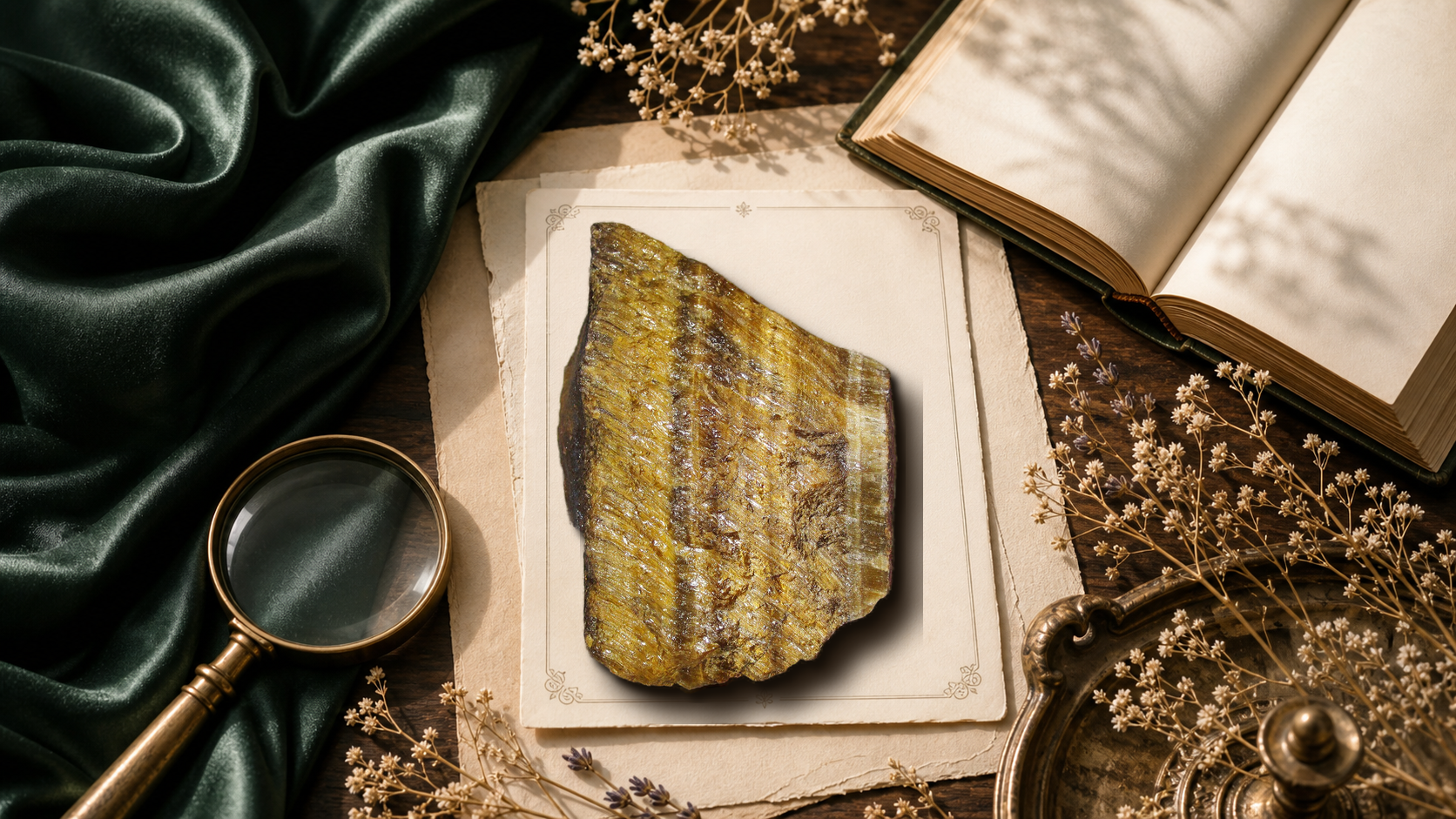
Materia Medica
Red Tiger Eye
The Dragon's Courage
This page documents traditional and cultural uses of red tiger eye alongside emerging research on tactile grounding objects. Crystalis does not claim that red tiger eye treats, cures, or prevents any medical condition. For mental health concerns, consult a qualified professional.
Origins: South Africa, Australia
Materia Medica
The Dragon's Courage
Protocol
Hematite-stained crocidolite fibers carry your dormant fire from frozen root to conscious action — chatoyancy becomes a lens for courage that does not burn.
3 min
Hold the red tiger eye in your dominant hand. Feel its density — heavier than standard quartz because of the iron oxide that stains its fibers. Close your eyes and locate any place in your body that feels frozen, numb, or absent.
Press the stone firmly against the base of your spine or the front of your lower belly. Breathe in through your nose for four counts, imagining the breath pulling upward through the chatoyant bands — each fiber a wick catching fire. Exhale through a slightly open mouth with an audible hhhh.
Move the stone to the center of your chest. Notice if the warmth from your root followed it upward or if the chest resists. Squeeze the stone three times in rhythm — pulse, pause, pulse, pause, pulse — then release. Let the heat settle where it wants to, not where you think it should go.
Place the stone on a surface in front of you and open your eyes. Watch the chatoyant flash shift as you tilt your head. Name one action you have been avoiding that requires not courage but simply warmth. The ember is lit. You decide when to use it.
Continue in the full protocol below.
tap to flip for protocol
Some anxious states are really speed states. The eye is moving too quickly, the day is moving too quickly, and the body no longer has enough warmth in its attention to stay with anything long enough for it to become meaningful again.
Red tiger eye answers by slowing the read. The chatoyant band still moves, but the red heat deepens the rhythm and asks the gaze to become more deliberate, more embodied, less panicked in the way it takes in motion.
Red tiger eye helps when focus needs pacing more than force. Attention can warm back into itself.
What Your Body Knows
sympathetic
Red Tiger Eye does not dampen fight energy. Its chatoyant red surface is sympathetic activation made visible; fire channeled into a line. For individuals whose sympathetic response manifests as chaotic, undirected aggression or impulsive action, the chatoyant band provides a model of disciplined intensity: all the fire is focused into a single bright line rather than scattered across the whole surface. Holding Red Tiger Eye during moments of rage can redirect the energy from explosive to directional. State shift: chaotic sympathetic toward focused, channeled sympathetic mobilization.
dorsal vagal
The red frequency is the most sympathetically activating color in the visible spectrum. Research demonstrates that viewing red increases heart rate, blood pressure, and galvanic skin response more than any other color. For a nervous system stuck in dorsal vagal flatness, Red Tiger Eye introduces a potent visual stimulus; not just red, but red with movement (the chatoyant band). This is a gentle defibrillation of the dorsal state. State shift: dorsal toward sympathetic activation through chromatic and kinetic visual stimulation.
sympathetic
Red Tiger Eye's origin story mirrors this state perfectly. The golden Tiger Eye was stuck in one form until heat transformed it. The goethite-to-hematite conversion required an input of energy to break the existing molecular arrangement and reorganize it. For someone in freeze state who feels something must change but cannot initiate the change, Red Tiger Eye models the necessity of applied heat; sometimes transformation requires external activation. State shift: freeze toward mobilization through resonance with thermal transformation.
ventral vagal
Some individuals achieve regulation at the cost of passion; they are calm but flat, stable but uninspired. Red Tiger Eye reintroduces the sympathetic fire component that makes ventral vagal engagement dynamic rather than static. The red-gold chatoyancy evokes embers; not a wildfire, but a controlled, radiant heat source. State shift: static ventral toward dynamic ventral-sympathetic passionate engagement.
sympathetic
The chatoyant band in Red Tiger Eye moves in one direction; back and forth along a single axis. It does not scatter, bounce, or randomize. For a nervous system oscillating between sympathetic extremes, this linear, predictable optical pattern provides a metronome-like reference. The nervous system can entrain to the regularity of the light band's movement rather than continuing its chaotic oscillation between states. State shift: oscillating sympathetic toward rhythmic, predictable sympathetic tone.
Nervous system mapping based on polyvagal theory (Porges, 2011).
The Earth Made This
Red tiger eye (also called ox eye or bull's eye) is a variety of quartz pseudomorphous after crocidolite (blue asbestiform riebeckite), modified by heat . either natural or applied. Standard golden tiger eye forms when silica progressively replaces crocidolite fibers while preserving their parallel alignment, creating chatoyancy (the cat's eye effect).
The golden color results from iron oxidation of the original blue crocidolite during this replacement process. Red tiger eye represents a further stage of iron oxidation, where the iron converts from limonite/goethite (golden brown) to hematite (red). This can occur naturally through prolonged weathering or sustained geothermal heating, or artificially through controlled heat treatment of golden tiger eye.
The fibrous structure and chatoyant optical effect remain intact regardless of color change, since the underlying silica pseudomorph structure is heat-stable. Primary source material comes from Griquatown and the Northern Cape Province of South Africa, the same deposits that produce blue and golden varieties. Mohs hardness is 6.
5 to 7.
Mineralogy
Chemical Formula
SiO2 with Fe2O3 (iron oxide staining); silicon dioxide with enhanced hematite/limonite coloration
Crystal System
Trigonal
Mohs Hardness
6.5
Specific Gravity
2.64-2.71
Luster
Silky to vitreous with strong chatoyancy
Color
Red
Crystal system diagram represents the general trigonal classification. Diagram created by Crystalis for educational reference.
Traditional Knowledge
South African mining tradition (Northern Cape): Red Tiger Eye from the Griqualand West deposits has been valued alongside its blue and gold counterparts since the 19th century. Local mining communities distinguish between "natural red" specimens (found in zones near dolerite intrusions that provided geological heating) and "fired" specimens (heat-treated by lapidaries). Natural red Tiger Eye from specific veins near Prieska commands premium prices among South African mineral collectors, who value it as evidence of the complete geological Tiger Eye transformation sequence (Cairncross, B., "Minerals of South Africa," 2018, Random House Struik).
Ancient Roman "ox eye" tradition: The Romans valued chatoyant red-brown stones as protective talismans, associating them with the ox (bos) for its strength and endurance. The Latin name "oculus bovis" (ox eye) was applied to red chatoyant quartz, and Roman soldiers reportedly carried these stones to maintain courage and physical stamina during long campaigns. Pliny the Elder mentions several chatoyant stones in Naturalis Historia (77 CE), though exact mineralogical identification of ancient specimens is difficult (Pliny the Elder, Naturalis Historia, Book XXXVII).
Indian Tantric tradition: In the Hindu Tantric tradition, red-chatoyant stones are associated with the Muladhara (root chakra) and its kundalini energy. The chatoyant band is interpreted as the serpent energy moving along the stone's axis, and Red Tiger Eye is sometimes placed at the base of the spine during meditation to stimulate kundalini awakening. The stone's heat-transformation origin aligns with Tantric concepts of tapas (spiritual heat or austerity) as a transformative force (Johari, H., "Chakras: Energy Centers of Transformation," 1987, Destiny Books).
Contemporary Chinese Feng Shui: In modern Chinese Feng Shui practice, Red Tiger Eye is placed in the south sector of a home or office (associated with fame, reputation, and the fire element) to strengthen reputation and visibility. The chatoyant effect is interpreted as "living fire"; fire that sees; making it particularly valued for individuals in public-facing professions (Too, L., "Lillian Too's 168 Feng Shui Ways to Declutter Your Home," 2003, Cico Books).
South African mining tradition (Northern Cape)
Red Tiger Eye from the Griqualand West deposits has been valued alongside its blue and gold counterparts since the 19th century. Local mining communities distinguish between "natural red" specimens (found in zones near dolerite intrusions that provided geological heating) and "fired" specimens (heat-treated by lapidaries). Natural red Tiger Eye from specific veins near Prieska commands premium prices among South African mineral collectors, who value it as evidence of the complete geological Tiger Eye transformation sequence (Cairncross, B., "Minerals of South Africa," 2018, Random House Struik). 2. Ancient Roman "ox eye" tradition: The Romans valued chatoyant red-brown stones as protective talismans, associating them with the ox (bos) for its strength and endurance. The Latin name "oculus
When This Stone Finds You
Somatic protocol
Hematite-stained crocidolite fibers carry your dormant fire from frozen root to conscious action — chatoyancy becomes a lens for courage that does not burn.
3 min protocol
Hold the red tiger eye in your dominant hand. Feel its density — heavier than standard quartz because of the iron oxide that stains its fibers. Close your eyes and locate any place in your body that feels frozen, numb, or absent.
30 secPress the stone firmly against the base of your spine or the front of your lower belly. Breathe in through your nose for four counts, imagining the breath pulling upward through the chatoyant bands — each fiber a wick catching fire. Exhale through a slightly open mouth with an audible hhhh.
45 secMove the stone to the center of your chest. Notice if the warmth from your root followed it upward or if the chest resists. Squeeze the stone three times in rhythm — pulse, pause, pulse, pause, pulse — then release. Let the heat settle where it wants to, not where you think it should go.
45 secPlace the stone on a surface in front of you and open your eyes. Watch the chatoyant flash shift as you tilt your head. Name one action you have been avoiding that requires not courage but simply warmth. The ember is lit. You decide when to use it.
30 secPress both palms flat on your thighs. Feel the contrast — the residual warmth in your dominant hand versus the cooler non-dominant hand. Three slow breaths. The protocol is complete when both hands feel equal.
30 secCare and Maintenance
Red tiger eye is water-safe. Quartz pseudomorph (Mohs 7), the iron oxide responsible for the red color is stable. Brief to moderate water is safe.
Whether naturally heated or treated, the color is permanent. Recommended cleansing: running water, moonlight, sound, smoke, selenite plate. Store normally.
In Practice
Anxiety has speeded your life into blur. Red tiger eye takes the chatoyant rhythm of tiger eye and deepens it through iron oxidation. Hold when you need to slow your pulse without dimming your drive.
The silky band still moves. The color just runs hotter. Place at the root during seated practice.
The warmth is mineral heat, not metabolic.
Verification
Red tiger eye: chatoyant quartz (Mohs 7) with red-brown to reddish color from iron oxide. The chatoyant band should move when rotated under point light. Natural red tiger eye exists but much commercial material is heat-treated golden tiger eye.
Both are genuine quartz; the treatment is widely accepted. If the red looks unnaturally uniform, it may be dyed.
Natural Red Tiger Eye should usually feel cooler than plastic or resin on first touch and warm more slowly in the hand.
Use 6.5 on the Mohs scale as the check, not internet myths. A real specimen should behave in line with the hardness listed above.
Look for a silky to vitreous with strong chatoyancy surface quality rather than a painted or plastic shine.
The listed specific gravity is 2.64-2.71. If a specimen feels unusually light for its size, it may deserve a second look.
Geographic Origins
South Africa's Northern Cape Province is the primary source, from the same banded crocidolite deposits that produce golden tiger eye. Australian specimens from the Pilbara region show similar chatoyancy. The red color results from iron oxidation of the original crocidolite fibers, either through natural heating or commercial heat treatment, at both sources.
FAQ
Red Tiger Eye is classified as a Red Tiger Eye is the THIRD stage in the Tiger Eye color continuum: Blue (incomplete crocidolite replacement) -> Gold (complete replacement with limonite/goethite staining) -> Red (oxidation of limonite/goethite to hematite). Most commercially available Red Tiger Eye has been heat-treated to accelerate the goethite-to-hematite conversion, though naturally occurring red specimens exist where geological heat (nearby intrusions or deep burial) caused the same transformation in situ.. Chemical formula: SiO2 with Fe2O3 (iron oxide staining) -- silicon dioxide with enhanced hematite/limonite coloration. Mohs hardness: 6.5--7. Crystal system: Trigonal (hexagonal subfamily) -- fibrous microcrystalline quartz aggregate, pseudomorphic after crocidolite.
Red Tiger Eye has a Mohs hardness of 6.5--7.
Water Safety CONDITIONAL -- Brief rinsing only. Same parameters as Golden Tiger Eye. The quartz matrix is water-safe, but the iron oxide coloring agents (hematite in Red Tiger Eye, goethite in Golden) can be affected by prolonged water exposure, particularly acidic water. The red color is generally more water-stable than golden because hematite is less soluble than goethite. However, residual crocidolite from the original formation may still be present at trace levels. Brief rinsing: safe. Soaking: not recommended. NEVER use in gem elixirs -- same crocidolite precaution as Blue Tiger Eye applies to all Tiger Eye varieties.
Red Tiger Eye crystallizes in the Trigonal (hexagonal subfamily) -- fibrous microcrystalline quartz aggregate, pseudomorphic after crocidolite.
The chemical formula of Red Tiger Eye is SiO2 with Fe2O3 (iron oxide staining) -- silicon dioxide with enhanced hematite/limonite coloration.
Formation Story Red Tiger Eye represents the final chapter in a geological transformation that began over two billion years ago with the crystallization of crocidolite asbestos in Precambrian banded iron formations. The story of Red Tiger Eye cannot be told without telling the full Tiger Eye genesis sequence, because Red Tiger Eye is the product of three successive geological processes acting on a single original material. First, crocidolite (sodium iron amphibole, blue asbestos) crystallized in
References
. [SCI]
DOI: 10.1111/rge.12272
. [SCI]
. [SCI]
DOI: 10.1029/2020JB020199
Closing Notes
Tiger eye modified by heat. The golden chatoyancy pushed to red by oxidizing the iron in crocidolite-derived fibers. Natural or applied, the mechanism is the same.
The science documents thermal oxidation of iron in pseudomorphic quartz. The practice asks what transformation means when heat changes the color but the structure that creates the flash remains intact.
Bring it into practice
Move from reference to ritual. Search current inventory for Red Tiger Eye, build a custom bracelet, or let Sacred Match choose the right supporting stones for you.
Community notes
Shared field notes tied to Red Tiger Eye appear here, including notes saved from practice.
When members save a public field note for this stone, it will appear here.
The archive
Continue through stones that share intention, chakra focus, or tonal family with Red Tiger Eye.

Shared intention: Energy & Passion
The Blood Fire
Shared intention: Energy & Passion
The Root Fire

Shared intention: Confidence & Power
The Midnight Ambition
Shared intention: Energy & Passion
The Liquid Fire
Shared intention: Energy & Passion
The Ruby Silver Fire
Shared intention: Motivation & Energy
The Rarest Flame