Materia Medica
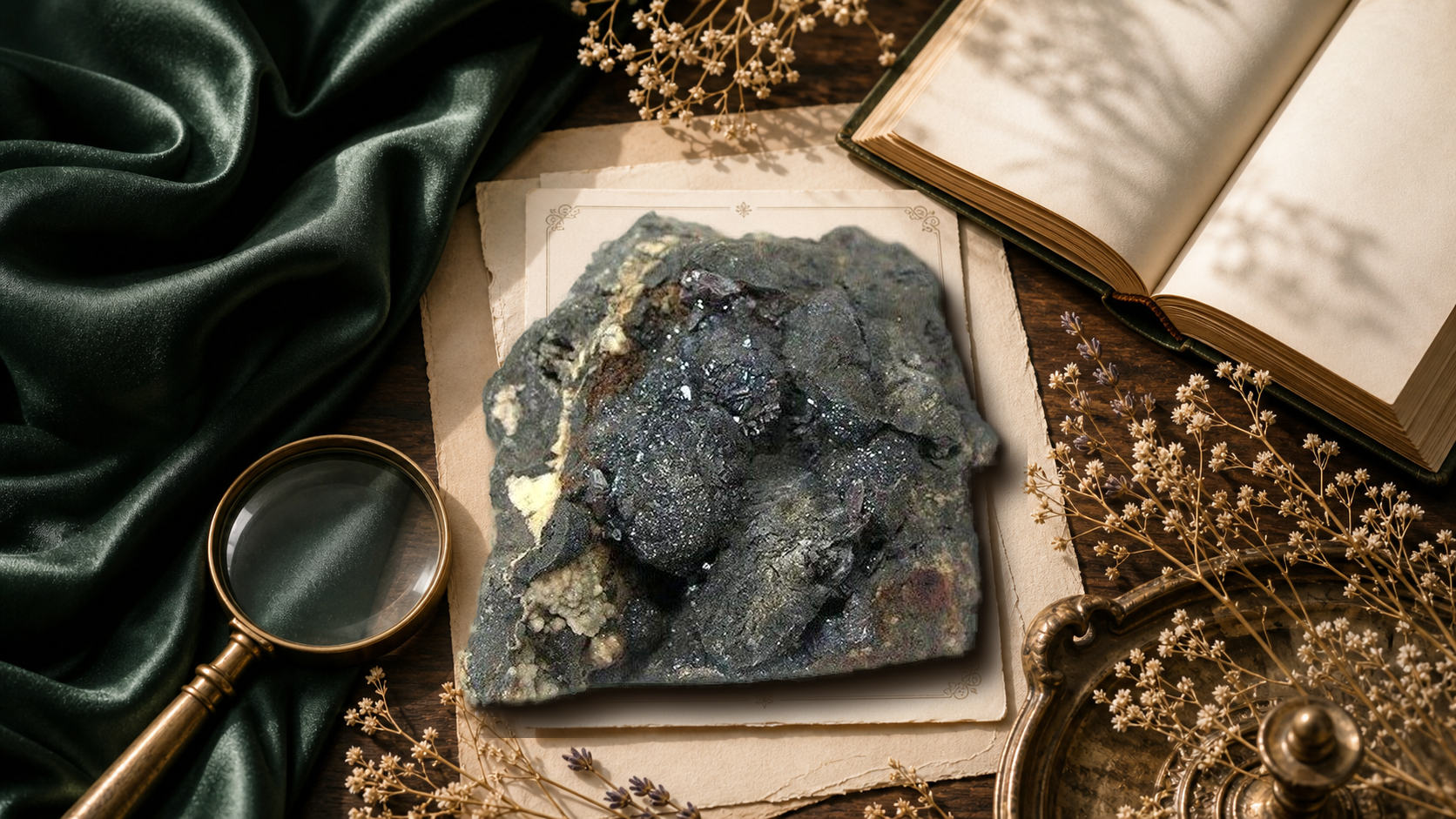
Proustite
The Ruby Silver Fire
This page documents traditional and cultural uses of proustite alongside emerging research on tactile grounding objects. Crystalis does not claim that proustite treats, cures, or prevents any medical condition. For mental health concerns, consult a qualified professional.
Origins: Chile, Germany, Czech Republic
Materia Medica
The Ruby Silver Fire
Protocol
Honor the ruby fire you cannot touch.
3 min
Place Proustite in a sealed glass display case or behind glass. Do NOT handle with bare hands — this mineral contains arsenic (silver arsenic sulfide). Sit 2-3 feet away. Settle your posture. Let your breath slow.
Observe the deep ruby-red translucent surface. Notice the adamantine luster, the way light seems to glow from within. Let your eyes soften. Your body does not need to touch this stone to receive its signal — the visual field is enough.
With each exhale, release one thing — a thought, a tension, a worry. The stone holds its own boundaries. You hold yours. Continue breathing. Notice where the body softens first.
After 3 minutes: check in. Has the breath changed? Has the jaw released? That shift — however small — is the protocol complete. The ruby fire witnessed. The body responded. No contact required.
tap to flip for protocol
Not every truth wants daylight immediately. Some parts of the past become damaged by too much exposure, not because they are false, but because they are still too reactive to survive careless handling.
Proustite makes that condition exact. The ruby-red silver sulfosalt is famously photosensitive, darkening when exposed to too much light. The beauty remains real, but so does the need for shade.
Proustite is useful when the psyche is learning that privacy is not avoidance.
Some histories keep better when they are not overexposed.
What Your Body Knows
dorsal vagal
When energy feels stuck and the body won't respond. Proustite is placed on the body as an anchor point. Your shoulders drop. Your breath becomes shallow and barely audible. A heaviness settles in your limbs. This is dorsal vagal shutdown; your oldest survival circuit pulling you toward stillness, collapse, disconnection from sensation.
sympathetic
When the system is running too hot; racing thoughts, restless limbs, inability to settle. Your chest tightens. Your jaw clenches. Your breath moves higher, shallower, faster. This is sympathetic activation; your body mobilizing for fight or flight, muscles tensing, heart rate rising.
ventral vagal
When the body finds its resting rhythm. Proustite held or placed becomes a touchpoint for presence. Your chest opens. Your jaw unclenches. Your breath deepens into your belly. This is ventral vagal regulation; your body finding safety, social connection, steady presence.
Nervous system mapping based on polyvagal theory (Porges, 2011).
The Earth Made This
Proustite darkens in light. That is not metaphor . prolonged exposure decomposes the surface irreversibly, which is why collectors store ruby silvers in darkness and photographers avoid flash.
A silver arsenic sulfosalt (Ag₃AsS₃), one of the two ruby silvers, prized for deep scarlet-red translucency. Trigonal, prismatic to rhombohedral crystals with adamantine luster. Forms in low-temperature hydrothermal silver veins as a secondary mineral. Extremely soft (2–2.5 Mohs), specific gravity 5.57. Major historical sources include Chañarcillo, Chile (some of the finest 19th-century specimens), Freiberg in Saxony, and Cobalt, Ontario. Beautiful, photosensitive, and fragile.
Mineralogy
Chemical Formula
Ag3AsS3 (silver arsenic sulfide; a sulfoarsenide/sulfosalt)
Crystal System
Trigonal
Mohs Hardness
2
Specific Gravity
5.55-5.64
Luster
Adamantine to submetallic
Color
Red
Crystal system diagram represents the general trigonal classification. Diagram created by Crystalis for educational reference.
Traditional Knowledge
Naming: Named in 1832 by Francois Sulpice Beudant in honor of Joseph Louis Proust (1754-1826), the French chemist who established the Law of Definite Proportions (Law of Constant Composition), one of the foundational principles of modern chemistry. Proust demonstrated that chemical compounds always contain elements in fixed proportions by mass, regardless of origin.
Mining History: Proustite was one of the most important silver ore minerals in historic silver mining districts: The Erzgebirge (Saxony/Bohemia) silver mines that funded the Renaissance and gave us the word "dollar" (from "Joachimsthaler") produced abundant proustite The Chanaricllo district in Chile's Atacama Desert yielded some of the most spectacular proustite crystals during the 1830s-1850s silver boom The Cobalt, Ontario, silver camp (discovered 1903) produced massive quantities of native silver and ruby silver ores
Collector Significance: Proustite is one of the most prized mineral collector's species. Fine transparent red crystals with good crystal form are among the most valuable mineral specimens in the world. The photosensitivity adds urgency and difficulty to preservation; many historic museum specimens have darkened irreversibly over decades of display.
"Ruby Silver": The term "ruby silver" (Rotgiltigerz in German) was historically applied to both proustite and pyrargyrite, with proustite called "light red silver ore" (Lichtes Rotgiltigerz) and pyrargyrite called "dark red silver ore" (Dunkles Rotgiltigerz). The distinction was important to assayers because the arsenic-bearing proustite required different smelting techniques than the antimony-bearing pyrargyrite.
Naming
Named in 1832 by Francois Sulpice Beudant in honor of Joseph Louis Proust (1754-1826), the French chemist who established the Law of Definite Proportions (Law of Constant Composition), one of the foundational principles of modern chemistry. Proust demonstrated that chemical compounds always contain elements in fixed proportions by mass, regardless of origin.
Mining History
Proustite was one of the most important silver ore minerals in historic silver mining districts: - The Erzgebirge (Saxony/Bohemia) silver mines that funded the Renaissance and gave us the word "dollar" (from "Joachimsthaler") produced abundant proustite - The Chanaricllo district in Chile's Atacama Desert yielded some of the most spectacular proustite crystals during the 1830s-1850s silver boom - The Cobalt, Ontario, silver camp (discovered 1903) produced massive quantities of native silver and ruby silver ores
Collector Significance
Proustite is one of the most prized mineral collector's species. Fine transparent red crystals with good crystal form are among the most valuable mineral specimens in the world. The photosensitivity adds urgency and difficulty to preservation -- many historic museum specimens have darkened irreversibly over decades of display.
"Ruby Silver"
The term "ruby silver" (Rotgiltigerz in German) was historically applied to both proustite and pyrargyrite, with proustite called "light red silver ore" (Lichtes Rotgiltigerz) and pyrargyrite called "dark red silver ore" (Dunkles Rotgiltigerz). The distinction was important to assayers because the arsenic-bearing proustite required different smelting techniques than the antimony-bearing pyrargyrite.
When This Stone Finds You
Somatic protocol
Honor the ruby fire you cannot touch.
3 min protocol
Place Proustite in a sealed glass display case or behind glass. Do NOT handle with bare hands — this mineral contains arsenic (silver arsenic sulfide). Sit 2-3 feet away. Settle your posture. Let your breath slow.
1 minObserve the deep ruby-red translucent surface. Notice the adamantine luster, the way light seems to glow from within. Let your eyes soften. Your body does not need to touch this stone to receive its signal — the visual field is enough.
1 minWith each exhale, release one thing — a thought, a tension, a worry. The stone holds its own boundaries. You hold yours. Continue breathing. Notice where the body softens first.
1 minAfter 3 minutes: check in. Has the breath changed? Has the jaw released? That shift — however small — is the protocol complete. The ruby fire witnessed. The body responded. No contact required.
1 minCare and Maintenance
WARNING: Proustite contains arsenic (Ag3AsS3). Silver arsenic sulfide. Do NOT place in water or gem elixirs.
Handle briefly, wash hands. Proustite is also photosensitive; it darkens permanently in light. Store in complete darkness in a sealed container.
Recommended cleansing: visual observation only, in brief low light. Never display in bright light or sunlight.
In Practice
Display only. Proustite contains arsenic and darkens permanently in light. There are parts of your history that still need shade.
The use case is understanding photosensitivity as a mineral principle: some things cannot survive being seen too long. Store in darkness. Observe briefly.
The practice is learning to protect what is vivid by limiting its exposure.
Verification
Proustite: vivid red ("ruby silver"), specific gravity 5. 55-5. 64 (very heavy).
Adamantine luster. Mohs 2-2. 5 (soft).
PHOTOSENSITIVE: darkens permanently in light. If a claimed proustite does not darken after light exposure, it may be a different red mineral. Contains arsenic.
Handle briefly, store in darkness.
Natural Proustite should usually feel cooler than plastic or resin on first touch and warm more slowly in the hand.
Use 2 on the Mohs scale as the check, not internet myths. A real specimen should behave in line with the hardness listed above.
Look for a adamantine to submetallic surface quality rather than a painted or plastic shine.
The listed specific gravity is 5.55-5.64. If a specimen feels unusually light for its size, it may deserve a second look.
Geographic Origins
Chile's Chanarcillo district produced historic proustite specimens from silver mining. Germany's Freiberg and other Erzgebirge mining districts are classic European sources. Czech Republic yields specimens from Jachymov (Joachimsthal).
The silver arsenic sulfide forms in hydrothermal silver veins at all three localities. Specimens must be stored in darkness to prevent photodecomposition.
FAQ
Chemical formula: Ag3AsS3 (silver arsenic sulfide -- a sulfoarsenide/sulfosalt). Mohs hardness: 2-2.5. Crystal system: Trigonal (space group R3c).
Proustite has a Mohs hardness of 2-2.5.
Safety Flags
Proustite crystallizes in the Trigonal (space group R3c).
The chemical formula of Proustite is Ag3AsS3 (silver arsenic sulfide -- a sulfoarsenide/sulfosalt).
Formation Geology Proustite forms in the late, low-temperature stages of silver-bearing hydrothermal vein systems, typically epithermal to mesothermal environments: Epithermal silver deposits: Proustite crystallizes from relatively cool hydrothermal fluids (<250 degrees C) in the waning stages of silver vein mineralization. It is a classic "bonanza ore" mineral -- found in pockets and vugs within silver veins where late-stage, As-enriched fluids deposited silver sulfosalts. The mineral assemblag
References
. [SCI]
DOI: 10.1111/rge.12157
Closing Notes
Proustite darkens in light. Not metaphor. Prolonged exposure decomposes the surface irreversibly.
A silver arsenic sulfide that teaches by disappearing when observed too long. The science documents photosensitive mineral decomposition. The practice is darkness.
This mineral requires you to protect it from the thing that reveals it.
Bring it into practice
Move from reference to ritual. Search current inventory for Proustite, build a custom bracelet, or let Sacred Match choose the right supporting stones for you.
Community notes
Shared field notes tied to Proustite appear here, including notes saved from practice.
When members save a public field note for this stone, it will appear here.
The archive
Continue through stones that share intention, chakra focus, or tonal family with Proustite.

Shared intention: Transformation & Change
The Golden Thread Cutter

Shared intention: Energy & Passion
The Blood Fire
Shared intention: Clarity & Focus
The Rarest Flame
Shared intention: Energy & Passion
The Root Fire
Shared intention: Energy & Passion
The Dragon's Courage

Shared intention: Clarity & Focus
The Sharp Edge of Focus