Materia Medica
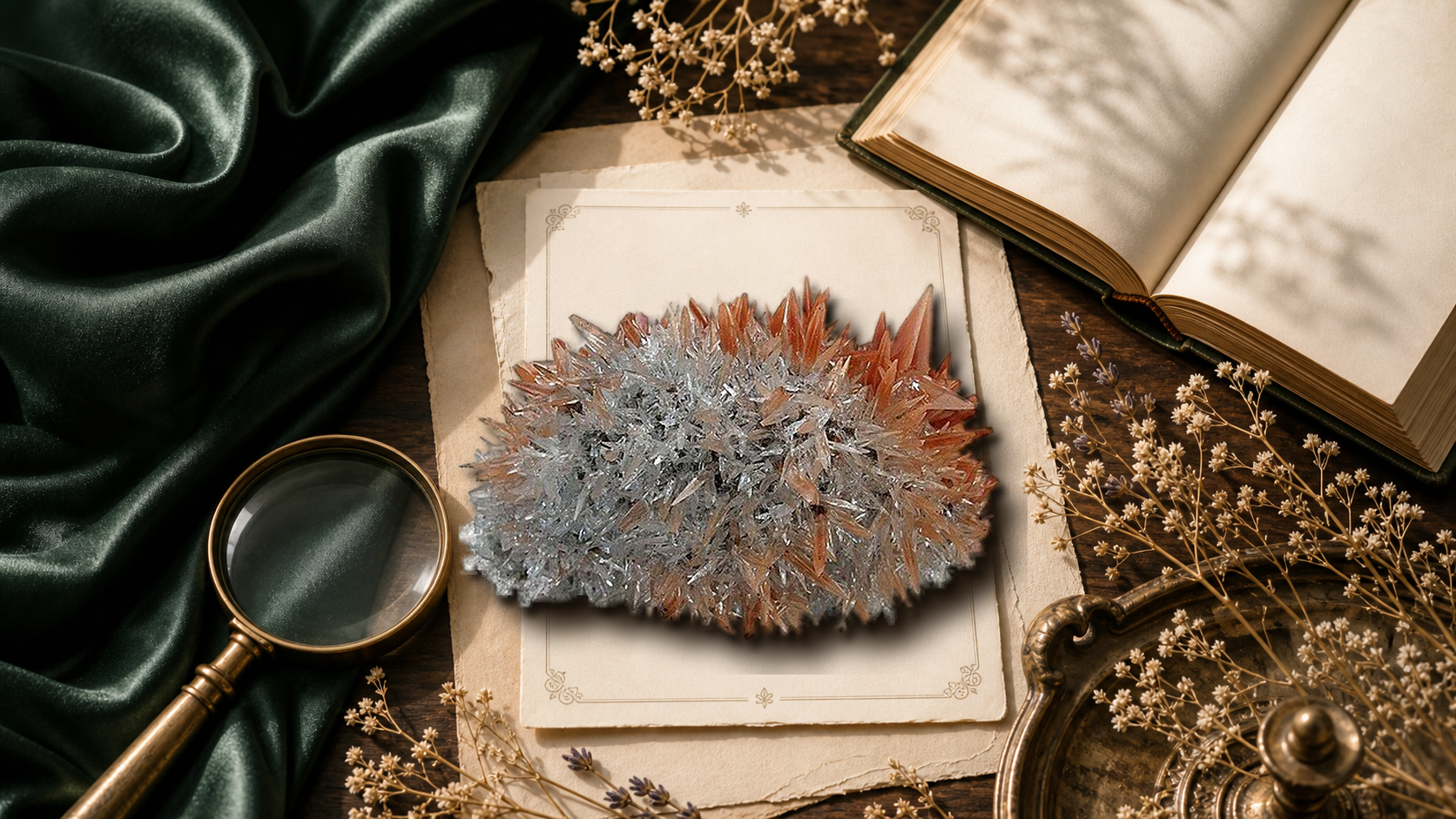
Red Calcite
The Root Fire
This page documents traditional and cultural uses of red calcite alongside emerging research on tactile grounding objects. Crystalis does not claim that red calcite treats, cures, or prevents any medical condition. For mental health concerns, consult a qualified professional.
Origins: Mexico, Peru, Iceland
Materia Medica
The Root Fire
Protocol
Iron-stained calcium carbonate at Mohs 3 in the trigonal system -- handle gently and let its warmth teach your body that softness and vitality are not opposites.
2 min
Handle gently -- Mohs hardness 3, easily scratched. Red calcite's color comes from iron oxide (hematite) inclusions and iron staining within the CaCO3 lattice. The trigonal R-3c structure cleaves in perfect rhombohedra. Hold the stone in your palm and feel its warmth -- calcite is thermally reactive and warms quickly to skin temperature. Let it match your heat.
Place the stone on a soft cloth at belly level. Rest both hands around it without gripping. The pearly luster on cleavage surfaces diffuses light rather than reflecting it sharply -- warmth without glare. Breathe in for 3, out for 5. Ask your belly: where is vitality hiding behind exhaustion? Not the performative energy others expect, but the quiet warmth underneath.
Touch the stone lightly with your fingertips. At specific gravity 2.71, red calcite is lighter than most red minerals (compare garnet at 3.5+, hematite at 5.3). Vitality does not have to be heavy. It does not have to roar. It can be soft, light, and warm. Breathe into that permission for 30 seconds.
Withdraw your hands and look at the stone's red from a slight distance. The same calcium carbonate in this stone is the mineral that builds coral reefs, stalactites, and eggshells -- structures of protection and growth. Set one intention for gentle vitality today: not force, not performance, just the steady warmth of iron-stained calcium doing what calcium does. Wrap the stone gently when finished.
tap to flip for protocol
Some depletion has gone past the point where airy comfort helps. The body no longer wants a soft answer. It wants something denser, more mineral, more willing to meet exhaustion with actual mass.
Red calcite does that beautifully. The iron warmth deepens the familiar calcite body into something earthier and more substantial, turning comfort into something that can be held rather than merely admired.
Red calcite matters when recovery needs more weight behind it. Vitality does not always return as sparkle. Sometimes it returns as a block of warmth.
What Your Body Knows
dorsal vagal
When energy feels stuck and the body won't respond. Red Calcite is placed on the body as an anchor point. Your shoulders drop. Your breath becomes shallow and barely audible. A heaviness settles in your limbs. This is dorsal vagal shutdown; your oldest survival circuit pulling you toward stillness, collapse, disconnection from sensation.
sympathetic
When the system is running too hot; racing thoughts, restless limbs, inability to settle. Your chest tightens. Your jaw clenches. Your breath moves higher, shallower, faster. This is sympathetic activation; your body mobilizing for fight or flight, muscles tensing, heart rate rising.
ventral vagal
When the body finds its resting rhythm. Red Calcite held or placed becomes a touchpoint for presence. Your chest opens. Your jaw unclenches. Your breath deepens into your belly. This is ventral vagal regulation; your body finding safety, social connection, steady presence.
Nervous system mapping based on polyvagal theory (Porges, 2011).
The Earth Made This
Red calcite is calcium carbonate (CaCO₃) colored by iron oxide inclusions . primarily hematite . dispersed throughout the crystal structure or concentrated along growth planes.
Calcite crystallizes in the trigonal system with over 800 documented crystal forms, making it one of the most polymorphic minerals known. The red coloration can arise through several mechanisms: co-precipitation of fine hematite particles during calcite growth from iron-rich solutions, replacement of earlier iron-bearing minerals within the calcite, or post-depositional staining by iron-bearing fluids percolating through fractures and pore spaces.
In sedimentary environments, red calcite often forms in iron-rich limestone and marble, where regional metamorphism or diagenesis mobilizes iron. In hydrothermal settings, iron-bearing fluids deposit both calcite and hematite simultaneously. The intensity of red correlates directly with hematite concentration.
Mohs hardness is 3, with perfect rhombohedral cleavage. Red calcite occurs worldwide wherever calcite and iron-rich conditions coincide, with notable specimens from Mexico, Peru, and various European localities.
Mineralogy
Chemical Formula
CaCO3
Crystal System
Trigonal
Mohs Hardness
3
Specific Gravity
2.71
Luster
Vitreous to pearly on cleavage surfaces; can appear waxy when massive
Color
Red
Crystal system diagram represents the general trigonal classification. Diagram created by Crystalis for educational reference.
Traditional Knowledge
Calcite takes its name from the Latin "calx" meaning lime, reflecting its ancient use in lime production. As the primary constituent of limestone and marble, calcite has been central to human construction and art for millennia. Red iron oxide pigments (hematite, often bound in calcite matrices) were among the earliest pigments used in Paleolithic cave art. Iriarte et al. (2009) characterized red ochres from the Tito Bustillo and Monte Castillo caves in northern Spain, identifying cryptocrystalline hematite as the coloring agent within calcite-bearing matrices. Etruscan wall paintings from approximately 273 BC at Caere, Italy, used hematite red pigment with calcite plaster as the binding substrate (Klempan et al., 2017). The association of red calcite with iron-rich earth has given it cultural significance across traditions that venerate iron-bearing stones for their connection to vitality and the earth's core processes.
Red Pigment and Sacred Stone
Ancient Egyptians used ground red calcite and related iron-stained calcium carbonate minerals as pigment sources and in decorative carvings. Red stones held associations with vitality, the blood of Isis, and protective power, and were placed in tombs alongside the deceased to ensure vigor in the afterlife.
Cave Deposits and Earth Energy
Mesoamerican peoples encountered red calcite formations in the extensive cave systems of the Yucatan Peninsula and central Mexico. Caves held deep spiritual significance as entrances to the underworld (Xibalba in Maya tradition), and red mineral deposits within them — including iron-stained calcite — were associated with the life force of the earth.
Vitality and Root Energy
Modern crystal practitioners associate red calcite with physical vitality, grounding energy, and the root chakra. Its warm red coloration, caused by iron oxide inclusions, connects it to traditions linking red stones with courage, physical strength, and energetic revitalization. It is commonly used in body layouts and energy work focused on the lower chakras.
When This Stone Finds You
Somatic protocol
Iron-stained calcium carbonate at Mohs 3 in the trigonal system -- handle gently and let its warmth teach your body that softness and vitality are not opposites.
2 min protocol
Handle gently -- Mohs hardness 3, easily scratched. Red calcite's color comes from iron oxide (hematite) inclusions and iron staining within the CaCO3 lattice. The trigonal R-3c structure cleaves in perfect rhombohedra. Hold the stone in your palm and feel its warmth -- calcite is thermally reactive and warms quickly to skin temperature. Let it match your heat.
30 secPlace the stone on a soft cloth at belly level. Rest both hands around it without gripping. The pearly luster on cleavage surfaces diffuses light rather than reflecting it sharply -- warmth without glare. Breathe in for 3, out for 5. Ask your belly: where is vitality hiding behind exhaustion? Not the performative energy others expect, but the quiet warmth underneath.
30 secTouch the stone lightly with your fingertips. At specific gravity 2.71, red calcite is lighter than most red minerals (compare garnet at 3.5+, hematite at 5.3). Vitality does not have to be heavy. It does not have to roar. It can be soft, light, and warm. Breathe into that permission for 30 seconds.
30 secWithdraw your hands and look at the stone's red from a slight distance. The same calcium carbonate in this stone is the mineral that builds coral reefs, stalactites, and eggshells -- structures of protection and growth. Set one intention for gentle vitality today: not force, not performance, just the steady warmth of iron-stained calcium doing what calcium does. Wrap the stone gently when finished.
30 secCare and Maintenance
Red calcite requires caution. Calcium carbonate (Mohs 3), soft, acid-sensitive, perfect cleavage. Brief cool water rinse only.
Avoid acid, hot water, prolonged soaking, ultrasonic. The hematite inclusions giving the red color are stable. Recommended cleansing: moonlight (safest), smoke, selenite plate.
Store in a soft pouch.
In Practice
You need a denser answer to depletion. Red calcite floods a carbonate lattice with iron warmth. Hold during energy recovery.
The red from hematite inclusions is not painted on. It is distributed through the crystal like vitality through tissue. Place on the lower abdomen during rest.
Calcite is soft (Mohs 3), so handle gently. The softness is part of the practice.
Verification
Red calcite: effervesces in dilute acid (definitive test for all calcite). Mohs 3. Perfect rhombohedral cleavage.
Specific gravity 2. 71. The red from hematite inclusions should be distributed through the stone, not surface-applied.
If it does not fizz in acid, it is not calcite regardless of color.
Natural Red Calcite should usually feel cooler than plastic or resin on first touch and warm more slowly in the hand.
Use 3 on the Mohs scale as the check, not internet myths. A real specimen should behave in line with the hardness listed above.
Look for a vitreous to pearly on cleavage surfaces; can appear waxy when massive surface quality rather than a painted or plastic shine.
The listed specific gravity is 2.71. If a specimen feels unusually light for its size, it may deserve a second look.
Geographic Origins
Mexico produces red calcite from hydrothermal deposits across multiple states. Peru yields specimens from Andean mining regions. Iceland produces red calcite from basalt-hosted hydrothermal systems.
The hematite inclusions that create the red color deposit within the calcite lattice during growth, with intensity varying by iron availability at each source.
FAQ
Chemical formula: CaCO3. Mohs hardness: 3. Crystal system: Trigonal (rhombohedral); space group R-3c.
Red Calcite has a Mohs hardness of 3.
Safety Flags
Red Calcite crystallizes in the Trigonal (rhombohedral); space group R-3c.
The chemical formula of Red Calcite is CaCO3.
Formation Geology Calcite is one of the most abundant minerals in the Earth's crust, forming across sedimentary, igneous, and metamorphic environments. The calcite structure consists of alternating layers of Ca2+ cations and CO3(2-) anions oriented normal to the c-axis, with carbonate groups reversing orientation in each successive layer (Gregg et al., 2015; Dufresne et al., 2018). Red calcite specifically forms through two primary mechanisms: 1. Hematite inclusion pathway: Red calcite is docume
References
. [SCI]
DOI: 10.1111/gfl.12088
. [SCI]
DOI: 10.1111/sed.12202
. [SCI]
DOI: 10.1002/qua.22538
. [SCI]
. [SCI]
. [SCI]
DOI: 10.1155/2021/8817487
. [SCI]
. [SCI]
DOI: 10.1111/arcm.12304
. [SCI]
DOI: 10.1002/ajim.22114
. [SCI]
DOI: 10.1002/jrs.2671
. [SCI]
DOI: 10.1002/jat.4323
Closing Notes
Calcite colored red by iron oxide inclusions, primarily hematite. Same calcium carbonate as white calcite, same crystal system. The red is not in the lattice but distributed through it like pigment in plaster.
The science documents iron inclusion coloration. The practice asks what vitality means when the warmth is carried inside the structure, not painted on.
Bring it into practice
Move from reference to ritual. Search current inventory for Red Calcite, build a custom bracelet, or let Sacred Match choose the right supporting stones for you.
Community notes
Shared field notes tied to Red Calcite appear here, including notes saved from practice.
When members save a public field note for this stone, it will appear here.
The archive
Continue through stones that share intention, chakra focus, or tonal family with Red Calcite.

Shared intention: Energy & Passion
The Blood Fire
Shared intention: Energy & Passion
The Dragon's Courage

Shared intention: Energy & Passion
The Triple Strength

Shared intention: Protection & Grounding
The Midnight Ambition
Shared intention: Energy & Passion
The Liquid Fire
Shared intention: Energy & Passion
The Ruby Silver Fire