Materia Medica
Tiger Iron
The Triple Strength

This page documents traditional and cultural uses of tiger iron alongside emerging research on tactile grounding objects. Crystalis does not claim that tiger iron treats, cures, or prevents any medical condition. For mental health concerns, consult a qualified professional.
Origins: Australia (Western Australia), South Africa
Materia Medica
The Triple Strength

Protocol
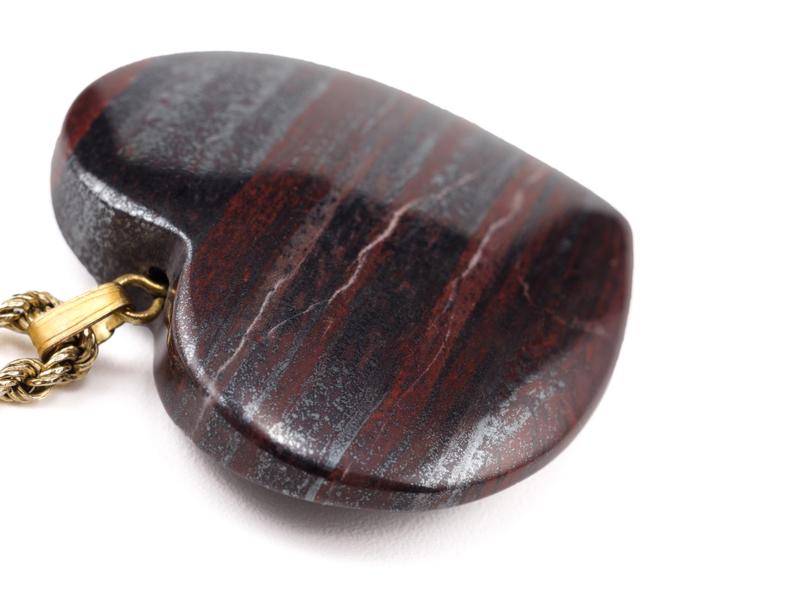
Tiger eye, red jasper, and hematite banded together in a single stone — three minerals that individually represent vision, endurance, and grounding compressed into one aggregate that refuses to let you collapse in only one direction.
5 min
Hold the tiger iron and find all three bands: the golden-brown chatoyant bands of tiger eye, the red-brown of jasper, and the metallic silver-black of hematite. Each mineral formed under different conditions but geological pressure fused them into one stone. Press it against the center of your chest with your dominant hand.
Breathe into the hematite layer first — the heaviest component, specific gravity pushing the composite above 3.5. Iron oxide grounds. Inhale for four through your nose, exhale for six through your mouth. Feel your feet press into the ground. Your blood contains the same iron as those metallic bands. Five breaths for the iron.
Now breathe into the jasper layer — the endurance mineral. Microcrystalline quartz stained red with iron, formed slowly in sedimentary environments. Nothing dramatic created jasper. Just patience. Move the stone to your lower belly and breathe for thirty seconds without counting. Let rhythm find itself.
Finally, breathe into the tiger eye layer — vision. The chatoyant fibers are pseudomorphs of crocidolite replaced by quartz, preserving the shape of something that no longer exists. Your past selves are still visible in your current form. Move the stone to your forehead. Five breaths for seeing clearly.
Continue in the full protocol below.
tap to flip for protocol
The psyche gets tired of simplistic virtues. Be grounded. Be brave. Be focused. Be strong. Real life keeps demanding all of it at once, and the strain of being told to solve a composite problem with a single trait starts showing everywhere.
Tiger iron is convincing because it never tries. It layers reflective movement, metallic gravity, and earthy endurance without flattening any of them into the others. The result feels assembled for hard use.
Tiger iron matters when resilience has to become more intelligently mixed.
A layered defense is not confusion. It is design.
What Your Body Knows
dorsal vagal
When to use: - During periods of sustained effort requiring endurance - When the nervous system needs both grounding (hematite/jasper) and activation (tiger's eye) simultaneously - For practices involving bilateral awareness (the banding creates visual alternation)
Nervous system mapping based on polyvagal theory (Porges, 2011).
The Earth Made This
Tiger iron is a banded metamorphic rock composed of alternating layers of tiger eye (silicified crocidolite), red jasper (iron-stained microcrystalline quartz), and hematite (iron oxide). It originates from banded iron formations (BIFs), Precambrian sedimentary deposits laid down 2. 2 to 2.
7 billion years ago when Earth's atmosphere was transitioning from anoxic to oxygenated conditions. The original sediment consisted of alternating layers of iron-rich and silica-rich material precipitated in shallow marine environments. Cyanobacterial oxygen production periodically oxidized dissolved iron, precipitating iron oxide layers between silica-rich layers.
Subsequent metamorphism and hydrothermal alteration transformed the silica layers into jasper and chalcedony, while some layers were infiltrated by crocidolite (blue asbestiform amphibole) that was later replaced by quartz . creating the chatoyant tiger eye component. The hematite layers retained their iron oxide composition.
The primary source is the Hamersley Basin in Western Australia, part of one of the world's largest BIF deposits. The interplay of metallic hematite, golden chatoyant tiger eye, and deep red jasper creates a visually distinctive material. Mohs hardness ranges from 5 (hematite) to 7 (quartz components).
Mineralogy
Chemical Formula
SiO2 and Fe2O3
Crystal System
N/A
Mohs Hardness
6.5
Specific Gravity
3.2-4.0 (higher than typical quartz due to hematite content)
Luster
Vitreous to silky (tiger's eye bands show characteristic chatoyancy); metallic to submetallic (hematite bands)
Color
Red-Yellow-Black
Traditional Knowledge
Timeline: ~2.5-3.5 billion years ago: Formation during Archean-Paleoproterozoic Geological significance recognized in 19th-20th century as key evidence for early Earth atmospheric evolution Late 20th century: Gained popularity as lapidary and metaphysical material 2000s-present: BIFs central to understanding the Great Oxidation Event and early life
Trade name origin: "Tiger Iron" combines "tiger's eye" (for the chatoyant bands) with "iron" (for the dominant hematite component). The name is a lapidary/trade designation, not a geological term. Geologists refer to it as "tiger's eye-bearing banded iron formation."
Geological significance: Tiger Iron is literally a fragment of early Earth's ocean chemistry, recording the transition from an anoxic to an oxygenated world. Each band preserves evidence of microbial processes that fundamentally transformed the planet's atmosphere.
Timeline
- ~2.5-3.5 billion years ago: Formation during Archean-Paleoproterozoic - Geological significance recognized in 19th-20th century as key evidence for early Earth atmospheric evolution - Late 20th century: Gained popularity as lapidary and metaphysical material - 2000s-present: BIFs central to understanding the Great Oxidation Event and early life
Trade name origin
"Tiger Iron" combines "tiger's eye" (for the chatoyant bands) with "iron" (for the dominant hematite component). The name is a lapidary/trade designation, not a geological term. Geologists refer to it as "tiger's eye-bearing banded iron formation."
Geological significance
Tiger Iron is literally a fragment of early Earth's ocean chemistry, recording the transition from an anoxic to an oxygenated world. Each band preserves evidence of microbial processes that fundamentally transformed the planet's atmosphere.
When This Stone Finds You
Somatic protocol
Tiger eye, red jasper, and hematite banded together in a single stone — three minerals that individually represent vision, endurance, and grounding compressed into one aggregate that refuses to let you collapse in only one direction.
5 min protocol
Hold the tiger iron and find all three bands: the golden-brown chatoyant bands of tiger eye, the red-brown of jasper, and the metallic silver-black of hematite. Each mineral formed under different conditions but geological pressure fused them into one stone. Press it against the center of your chest with your dominant hand.
1 minBreathe into the hematite layer first — the heaviest component, specific gravity pushing the composite above 3.5. Iron oxide grounds. Inhale for four through your nose, exhale for six through your mouth. Feel your feet press into the ground. Your blood contains the same iron as those metallic bands. Five breaths for the iron.
1 minNow breathe into the jasper layer — the endurance mineral. Microcrystalline quartz stained red with iron, formed slowly in sedimentary environments. Nothing dramatic created jasper. Just patience. Move the stone to your lower belly and breathe for thirty seconds without counting. Let rhythm find itself.
1 minFinally, breathe into the tiger eye layer — vision. The chatoyant fibers are pseudomorphs of crocidolite replaced by quartz, preserving the shape of something that no longer exists. Your past selves are still visible in your current form. Move the stone to your forehead. Five breaths for seeing clearly.
1 minReturn the stone to your chest. All three layers, all three functions — grounding, endurance, vision — held in one composite. You do not need three separate stones. You do not need three separate practices. Place the tiger iron down. You are already the composite. Walk out as all three.
1 minCare and Maintenance
- Asbestos note: The tiger's eye component originally formed from crocidolite (blue asbestos). In finished/polished tiger iron, the crocidolite has been completely replaced by quartz (pseudomorphic replacement). Polished specimens pose no asbestos risk.
However, rough/unprocessed material from some localities may contain residual unsilicified crocidolite fibers. Do NOT cut, grind, or sand raw tiger iron without proper respiratory protection and wet-cutting methods (Gaffney et al. , 2016; Mandel et al.
, 2016; Holton et al. , 2022). - Water safety: Safe for brief water contact; stable mineral assemblage - Sun safety: Generally stable; prolonged intense UV may fade tiger's eye bands over extended periods - Iron content: Wash hands after extended handling; iron oxide can stain skin and clothing
In Practice
Nervous system states addressed: - Depletion / collapse / burnout: Tiger Iron's geological story is one of endurance. 2.5+ billion years of surviving metamorphism, tectonic upheaval, and erosion. The density (heavier than typical stones of similar size) provides strong grounding input. The tripartite composition (hematite/jasper/tiger's eye) offers three distinct textures and visual frequencies in one stone. - Freeze / immobility: The chatoyant flash of the tiger's eye bands catches the eye and can serve as an orienting stimulus, pulling attention outward from internal freeze states. - Low vitality / chronic fatigue: The iron-dominant composition and warm color palette (red, gold, silver) have been traditionally associated with vitality and stamina in somatic crystal practice.
When to use: - During periods of sustained effort requiring endurance - When the nervous system needs both grounding (hematite/jasper) and activation (tiger's eye) simultaneously - For practices involving bilateral awareness (the banding creates visual alternation)
When NOT to use: - During acute hyperarousal where stimulating stones may escalate activation - When the person needs softness and receptivity rather than strength and endurance - When anxiety is present. the metallic flash of tiger's eye can be overstimulating for some nervous systems
Verification
Tiger iron: banded rock with three components: tiger eye (chatoyant, silky), red jasper (opaque, red), and hematite (metallic, dark). SG 3. 2-4.
0 (heavier than pure quartz due to hematite). All three layers should be naturally intergrown. If the banding looks painted or if any layer is absent, it is a different banded rock.
The chatoyancy should be visible in the tiger eye bands when rotated under light.
Natural Tiger Iron should usually feel cooler than plastic or resin on first touch and warm more slowly in the hand.
Use 6.5 on the Mohs scale as the check, not internet myths. A real specimen should behave in line with the hardness listed above.
Look for a vitreous to silky (tiger's eye bands show characteristic chatoyancy); metallic to submetallic (hematite bands) surface quality rather than a painted or plastic shine.
The listed specific gravity is 3.2-4.0 (higher than typical quartz due to hematite content). If a specimen feels unusually light for its size, it may deserve a second look.
Geographic Origins
Ord Ranges and Hamersley Basin, Western Australia (primary commercial source; Pilbara Craton BIFs ~2.5 Ga) Griquatown, Northern Cape Province, South Africa (Transvaal Supergroup BIFs ~2.4 Ga) Marra Mamba Formation, Western Australia
Tiger Iron is a variety of banded iron formation (BIF) that formed during the Archean-Paleoproterozoic eons (approximately 2.5-3.5 billion years ago), making it among the oldest rocks used in lapidary work. BIFs represent one of the most significant rock types in Earth's geological record, forming during a unique period when the oceans contained abundant dissolved ferrous iron (Fe2+) and atmospheric oxygen was minimal. The alternating bands of iron-rich and silica-rich layers record episodic precipitation driven by changes in ocean chemistry, microbial activity, and oxygen production. Research on Archean BIF from the Yellowknife greenstone belt demonstrates that the characteristic mesobanding (cm-scale Fe-rich and Si-rich alternation) predates peak metamorphism, confirming a primary depositional origin subsequently modified by metamorphic recrystallization (Katsuta et al., 2012). The deposition of BIF involved complex biogeochemical cycling. Microbiological processes played central roles: anoxygenic photoferrotrophic bacteria oxidized dissolved Fe2+ to Fe3+ using light energy, while cyanobacteria contributed oxygen that abiotically oxidized additional iron. The resulting ferric iron precipitated as ferrihydrite, which subsequently transformed to hematite and other iron oxides during diagenesis and metamorphism. Silica precipitation occurred from seawater supersaturated with dissolved silica (no silica-secreting organisms existed in the Archean). The rhythmic alternation may reflect seasonal, tidal, or longer-period environmental cycles (Posth et al., 2013; Nims & Johnson, 2022; Ward et al., 2017).
FAQ
Tiger Iron is classified as a Metamorphosed sedimentary rock (banded iron formation) -- NOT a single mineral. Chemical formula: Composite:. Mohs hardness: 6.5-7 (dominated by quartz/jasper hardness). Crystal system: Not applicable (polycrystalline aggregate).
Tiger Iron has a Mohs hardness of 6.5-7 (dominated by quartz/jasper hardness).
Safe for brief water contact; stable mineral assemblage
Generally stable; prolonged intense UV may fade tiger's eye bands over extended periods
Tiger Iron crystallizes in the Not applicable (polycrystalline aggregate).
The chemical formula of Tiger Iron is Composite:.
- Ord Ranges and Hamersley Basin, Western Australia (primary commercial source; Pilbara Craton BIFs ~2.5 Ga) - Griquatown, Northern Cape Province, South Africa (Transvaal Supergroup BIFs ~2.4 Ga) - Marra Mamba Formation, Western Australia
Tiger Iron is a variety of banded iron formation (BIF) that formed during the Archean-Paleoproterozoic eons (approximately 2.5-3.5 billion years ago), making it among the oldest rocks used in lapidary work. BIFs represent one of the most significant rock types in Earth's geological record, forming during a unique period when the oceans contained abundant dissolved ferrous iron (Fe2+) and atmospheric oxygen was minimal. The alternating bands of iron-rich and silica-rich layers record episodic pre
References
. [SCI]
. [SCI]
DOI: 10.1111/sed.12051
. [SCI]
DOI: 10.1111/gbi.12523
. [SCI]
DOI: 10.1111/gbi.12266
. [SCI]
DOI: 10.1111/gbi.12518
. [SCI]
DOI: 10.1111/rge.12172
. [SCI]
DOI: 10.1111/rge.12000
. [SCI]
DOI: 10.1111/bre.12723
. [SCI]
DOI: 10.1002/jat.3356
. [SCI]
DOI: 10.1002/ajim.22641
. [SCI]
. [SCI]
Closing Notes
Tiger eye, red jasper, and hematite in alternating bands. Three iron-bearing minerals layered in Archean banded iron formations, 2. 5 billion years old.
The science documents some of the oldest sedimentary iron deposits on Earth. The practice asks what strength means when three forms of the same element take turns holding the structure.
Bring it into practice
Move from reference to ritual. Search current inventory for Tiger Iron, build a custom bracelet, or let Sacred Match choose the right supporting stones for you.
Community notes
Shared field notes tied to Tiger Iron appear here, including notes saved from practice.
When members save a public field note for this stone, it will appear here.
The archive
Continue through stones that share intention, chakra focus, or tonal family with Tiger Iron.

Shared intention: Energy & Passion
The Blood Fire
Shared intention: Energy & Passion
The Root Fire

Shared intention: Protection & Grounding
The Slow Flame of Endurance

Shared intention: Motivation & Energy
The Outback Endurance

Shared intention: Protection & Grounding
The Keeper of Deep Time

Shared intention: Protection & Grounding
The Sharp Edge of Focus