Crystal Encyclopedia
40+YEARS

Ammonite

Varies by mineralization: · Mohs 3 · Variable · Root Chakra

The stone of ammonite: meaning, mineralogy, and somatic practice.

Protection & GroundingCycles & RhythmPatience & EnduranceAncestral Healing

This page documents traditional and cultural uses of ammonite alongside emerging research on tactile grounding objects. Crystalis does not claim that ammonite treats, cures, or prevents any medical condition. For mental health concerns, consult a qualified professional.

Crystalis Editorial · 40+ Years · Herndon, VA · 10 peer-reviewed sources

Origins: Morocco, Madagascar, Canada (Alberta)

Crystalis

Materia Medica

Ammonite

The Keeper of Deep Time

Ammonite crystal
Protection & GroundingCycles & RhythmPatience & Endurance
Crystalis

Protocol

The Spiral Record

Hold deep time in your hand. The spiral remembers what the ocean forgot.

5 min

  1. 1

    Place the ammonite flat on a surface in front of you. Sit with both feet on the floor, hands on your thighs. Before touching it, look at the spiral. This is not a crystal — it is a fossil, the mineralized shell of a cephalopod that lived 65 to 400 million years ago. The original aragonite shell has been replaced, molecule by molecule, by calcite, pyrite, opal, or quartz. The animal is gone. The geometry remains. Trace the spiral with your eyes from the outer edge inward. (0:00–1:00)

  2. 2

    Pick up the ammonite. It is heavier than expected — stone has replaced shell. Feel the ridges of the septa, the chamber walls that once held air and fluid to control buoyancy. Each chamber was sealed as the animal grew. Run your thumb along the suture lines. These are the boundaries between what was and what came next. (1:00–2:00)

  3. 3

    Hold the ammonite against your belly, spiral facing outward. Close your eyes. Breathe in for 4, out for 7. The spiral is a logarithmic curve — the same geometry found in hurricanes, galaxies, and the cochlea of your inner ear. Your body already knows this shape. Let the weight of the fossil press gently against your center. Notice what arises when you hold something that outlasted its own species. (2:00–3:30)

  4. 4

    Eyes still closed. Ask: what am I building that will outlast the version of me that built it? The ammonite did not know it was making a fossil. It was making a home. Sit with whatever that question brings. No answer required. (3:30–4:15)

Continue in the full protocol below.

tap to flip for protocol

Grief is not always about death. Sometimes it is the life stage that cannot be reopened. The former body. The former marriage. The old house of the self. What hurts is not only the loss, but the fear that nothing readable will remain after it.

Ammonite answers with chambered form.

Sequence. Curve. Continuity after inhabitance has ended.

The hand feels record where the mind kept insisting on absence.

What Your Body Knows

Nervous system states

ventral vagal

Full-contact protocols safe. Body layouts, hand-held meditation, grid work, proximity placement. Indirect method for gem water.

Pyrite ammonite: Display-only or very brief handling. Store dry. No water. Ammolite: Display and visual meditation. Handle set jewelry normally. Raw material is too fragile for body layouts. Shaligrama: Treat according to Hindu protocol or respectfully decline to work with it if unfamiliar with the tradition.

Nervous system mapping based on polyvagal theory (Porges, 2011).

Mineralogy

Mineral specs

Chemical Formula

Varies by mineralization:

Crystal System

Variable

Mohs Hardness

3

Specific Gravity

Varies widely: Calcite ammonite (~2.7), Pyrite ammonite (~5.0), Opal ammonite (~2.1)

Luster

Varies by replacement: vitreous (calcite), metallic (pyrite), waxy/resinous (opal), vitreous (quartz)

Color

Brown

Traditional Knowledge

Traditions across cultures

Unknown

Devonian-Cretaceous (400-66 Ma)

Living organisms. Ammonites were among the most successful marine animals in Earth's history, diversifying into thousands of species across 335 million years before total extinction at the Cretaceous-Paleogene boundary. - Ancient Egypt/Greece/Rome: Ammonite fossils were known and collected in antiquity. The name "ammonite" derives from the Egyptian deity Amun (also Ammon), whose ram's-horn crown resembles the coiled shell. Pliny the Elder (1st century CE) referred to "Ammonis cornu" (horn of Ammon) in his Natural History. - Medieval Europe: Ammonites were interpreted as petrified snakes. In Whitby, Yorkshire, England, a legend attributed the "snake stones" to St. Hilda (614-680 CE), abbess of Whitby, who was said to have turned a plague of snakes to stone through prayer. Local craftspeople

Unknown

British folklore -- Snake Stones

The "snake stone" legend of Whitby is one of the most enduring examples of pre-scientific fossil interpretation. Ammonites (particularly Dactylioceras and Hildoceras from the Jurassic Whitby Mudstone Formation) were believed to be snakes turned to stone by the miracles of Christian saints. St. Hilda of Whitby was the primary attributed miracle-worker. The legend was so pervasive that Linnaeus himself named the genus Hildoceras in reference to it. Artisan snake-stone carvings (ammonites with added carved snake heads) were sold as curios and folk remedies well into the 19th century. Similar snake-stone legends exist in other ammonite-rich regions of England, including the "serpent stones" associated with St. Keyna at Keynsham, Somerset.

Unknown

Hindu tradition -- Shaligrama

Shaligrama stones occupy a unique position at the intersection of paleontology and living religion. The black ammonite fossils from the Kali Gandaki Gorge (specifically from the Upper Jurassic-Lower Cretaceous Spiti Shale and overlying formations) are considered direct embodiments of Vishnu -- not merely symbolic representations but the actual presence of the divine. Key aspects include: - Shaligrama must come from the Kali Gandaki region specifically; fossils from other localities are not considered shaligrama - Different morphologies (number of spirals, shell shape, surface markings) are identified as different forms (avatars) of Vishnu - They are worshipped daily with water, tulsi leaves, and flowers - A household that possesses a shaligrama is considered especially blessed - They are n

Unknown

Blackfoot/Indigenous Canadian tradition

The Blackfoot people of Alberta called ammonite fossils "iniskim" (buffalo stones) and considered certain specimens to have sacred power related to the bison hunt. While the term "iniskim" more commonly refers to baculite (straight-shelled ammonoid) fossils, coiled ammonites from the same geological formations were also incorporated into ceremonial practices. ---

When This Stone Finds You

What it says when it arrives

You are mourning a version of yourself that cannot return. Ammonite leaves behind a spiral after the creature is gone, a fossil geometry sturdy enough to cross geologic time. Loss can still hand you a structure.

Somatic protocol

The Spiral Record

Hold deep time in your hand. The spiral remembers what the ocean forgot.

5 min protocol

  1. 1

    Place the ammonite flat on a surface in front of you. Sit with both feet on the floor, hands on your thighs. Before touching it, look at the spiral. This is not a crystal — it is a fossil, the mineralized shell of a cephalopod that lived 65 to 400 million years ago. The original aragonite shell has been replaced, molecule by molecule, by calcite, pyrite, opal, or quartz. The animal is gone. The geometry remains. Trace the spiral with your eyes from the outer edge inward. (0:00–1:00)

    1 min
  2. 2

    Pick up the ammonite. It is heavier than expected — stone has replaced shell. Feel the ridges of the septa, the chamber walls that once held air and fluid to control buoyancy. Each chamber was sealed as the animal grew. Run your thumb along the suture lines. These are the boundaries between what was and what came next. (1:00–2:00)

    1 min
  3. 3

    Hold the ammonite against your belly, spiral facing outward. Close your eyes. Breathe in for 4, out for 7. The spiral is a logarithmic curve — the same geometry found in hurricanes, galaxies, and the cochlea of your inner ear. Your body already knows this shape. Let the weight of the fossil press gently against your center. Notice what arises when you hold something that outlasted its own species. (2:00–3:30)

    1 min
  4. 4

    Eyes still closed. Ask: what am I building that will outlast the version of me that built it? The ammonite did not know it was making a fossil. It was making a home. Sit with whatever that question brings. No answer required. (3:30–4:15)

    1 min
  5. 5

    Open your eyes. Place the ammonite back on the surface, spiral facing up. Press both palms flat on your thighs for five seconds, then release. You have held deep time. Return to shallow time. Done. (4:15–5:00)

    1 min

The #1 Question

Can Ammonite go in water?

Opal is a hydrated mineral and can crack (craze) if rapidly dehydrated. Avoid prolonged direct sunlight, heat, and dry storage conditions. Some opalized fossils benefit from occasional very brief water exposure to maintain hydration, but this varies by specimen.

Care and Maintenance

How to care for Ammonite

Safety depends entirely on the replacement mineral:

Calcite-replaced ammonite: - Safe for handling. Calcite is non-toxic. - Water-sensitive: calcite is soluble in acidic water. Do not use in acidic gem water preparations. Prolonged water immersion can dissolve surface detail. - Mohs hardness 3. soft; scratches easily. - Sun-safe.

Pyrite-replaced ammonite: - CAUTION: Pyrite disease/decay. Pyrite (FeS2) is unstable under humid conditions and can decompose through oxidation to form sulfuric acid and iron sulfate ("pyrite disease" or "pyrite rot"). This is a museum conservation concern: pyritized fossils stored in humid conditions can self-destruct over years to decades, producing sulfurous odors and corrosive fluids. - Store in dry conditions (relative humidity below 50%). Silica gel packets recommended. - Pyrite dust is a mild respiratory irritant. Handle with care; do not grind or scrape. - Do NOT use in water. Iron sulfide + water + oxygen = sulfuric acid production. - Iron sulfide itself is not acutely toxic at handling levels, but chronic dust exposure is inadvisable.

Opalized ammonite: - Safe for handling. Opal is non-toxic. - Water-sensitive: Opal is a hydrated mineral and can crack (craze) if rapidly dehydrated. Avoid prolonged direct sunlight, heat, and dry storage conditions. Some opalized fossils benefit from occasional very brief water exposure to maintain hydration, but this varies by specimen. - Fragile: opal is Mohs 5.5-6.5 and brittle.

Ammolite (preserved aragonite): - Safe for handling in jeweler-set pieces (typically stabilized with resin or covered with protective layers). - Raw ammolite is extremely fragile (thin nacreous layers) and can delaminate. - Water-sensitive: aragonite dissolves in acidic water. - Sun sensitivity: prolonged UV exposure may degrade the organic conchiolin layers in the nacre.

General: - No toxicity concerns for any standard ammonite fossil at handling levels. - No elixir use recommended for pyritized specimens. - Calcite and opal specimens can be used for indirect gem water methods.

In Practice

How Ammonite is used

The ammonite's spiral form. the logarithmic spiral or Fibonacci-approximate spiral. is one of the most fundamental geometric patterns in nature, found in hurricanes, galaxies, sunflower heads, and nautilus shells. The visual encounter with this form engages the nervous system's pattern-recognition architecture at a deep level, triggering what can be described as "recognition without naming". the soma registers the pattern as familiar and fundamental before the cognitive mind classifies it. This is an entrainment effect: the spiral guides the eye through a predictable but ever-changing curve, creating a gentle oscillation between prediction and novelty that can synchronize with parasympathetic rhythms.

- For states of temporal disorientation. feeling cut off from time, from continuity, from the sense that one is part of a larger process. The ammonite IS deep time made tangible: 100+ million years compressed into a handheld object. - For grounding in evolutionary context. when the nervous system is overwhelmed by the speed and scale of modern life, contact with something that is genuinely ancient can provide scale perspective (what ancient contemplative traditions call "sub specie aeternitatis") - For spiral-breath meditation: using the visual spiral as a guide for inhale-hold-exhale cycles, tracing the spiral inward on inhale and outward on exhale - For transitions and threshold moments (the ammonite is itself a record of transition. growth, adaptation, and ultimately extinction) - Safe for body layouts (calcite and silicified specimens)

- Pyritized specimens: display only (see safety flags above) - Not for acute trauma states where the enormity of geological time might feel destabilizing rather than grounding (assess individually) - Shaligrama stones that are active objects of worship should be respected as such. do not casually repurpose someone else's sacred object for somatic practice. If working with a shaligrama, honor the tradition it comes from.

Calcite/Silicified ammonite: Full-contact protocols safe. Body layouts, hand-held meditation, grid work, proximity placement. Indirect method for gem water. Pyrite ammonite: Display-only or very brief handling. Store dry. No water. Ammolite: Display and visual meditation. Handle set jewelry normally. Raw material is too fragile for body layouts. Shaligrama: Treat according to Hindu protocol or respectfully decline to work with it if unfamiliar with the tradition.

Verification

Authenticity

Ammonite authenticity depends on the replacement mineral. Check for: natural spiral chamber geometry (septa should be visible). Weight varies dramatically by replacement mineral (calcite vs pyrite vs opal).

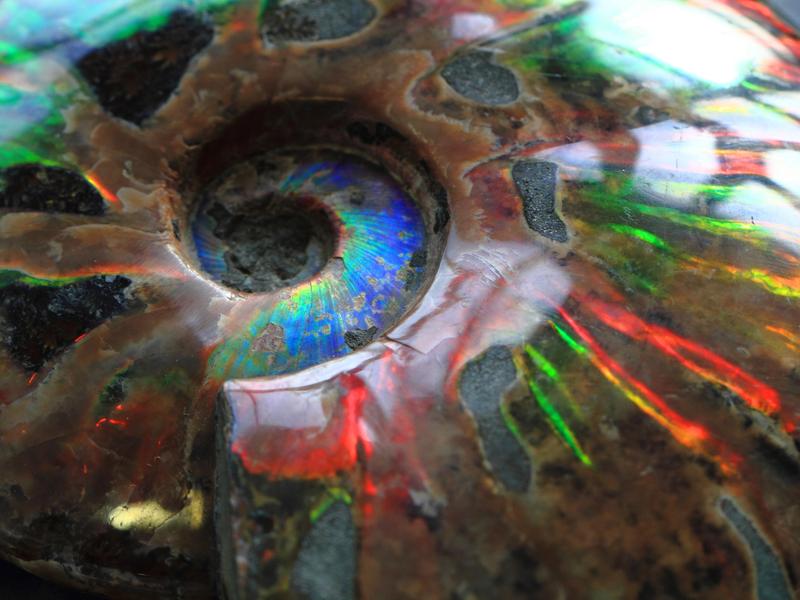
Ammolite (gem-quality iridescent) specimens should show play of color from aragonite layers, not surface coating. Reconstructed ammonites (pieced together from fragments) are common and should be disclosed.

Temperature

Natural Ammonite should usually feel cooler than plastic or resin on first touch and warm more slowly in the hand.

Scratch logic

Use 3 on the Mohs scale as the check, not internet myths. A real specimen should behave in line with the hardness listed above.

Surface and luster

Look for a varies by replacement: vitreous (calcite), metallic (pyrite), waxy/resinous (opal), vitreous (quartz) surface quality rather than a painted or plastic shine.

Weight and density

The listed specific gravity is Varies widely: Calcite ammonite (~2.7), Pyrite ammonite (~5.0), Opal ammonite (~2.1). If a specimen feels unusually light for its size, it may deserve a second look.

Geographic Origins

Where Ammonite forms in the world

Whitby, Yorkshire, England (Jurassic; famous "snake stone" locality; Dactylioceras and Hildoceras) Lyme Regis, Dorset, England (Jurassic; Mary Anning's collecting grounds) Madagascar (Cretaceous; large, well-preserved Cleoniceras; prolific commercial source) Morocco (Devonian and Cretaceous; polished ammonite slabs; Goniatites and Cleoniceras) Alberta, Canada (Cretaceous Bearpaw Formation; source of ammolite gem material from Placenticeras) Volga River region, Russia (Jurassic; large Virgatites and other genera) South Dakota, USA (Cretaceous; Baculites and Placenticeras from the Pierre Shale) Coober Pedy, Australia (opalized ammonites and other fossils) Solnhofen, Germany (Jurassic; exceptional preservation in lithographic limestone) Kali Gandaki River, Nepal (source of Hindu shaligrama stones)

In silica-rich groundwater environments, dissolved silica (from volcanic ash dissolution, biogenic silica sources, or hydrothermal fluids) can replace the original shell material with opal (amorphous hydrated silica) or chalcedony (microcrystalline quartz). Opalized ammonites, found most notably in Australia and parts of Canada, can display spectacular play-of-color due to the regular stacking of silica spheres within the opal structure. The gemstone "ammolite" represents a different preservational pathway: in the Bearpaw Formation of Alberta, Canada, the original aragonite nacre of Placenticeras ammonites was preserved without recrystallization due to unusual burial conditions (rapid siderite cementation creating a protective seal), retaining the organic-inorganic layered structure that produces gem-quality iridescence (Hoffmann et al., 2021, https://doi.org/10.1111/brv.12669).

FAQ

Frequently asked

What is Ammonite?

Ammonite is classified as a N/A (fossil); classified biologically as Cephalopoda, subclass Ammonoidea. Chemical formula: Varies by mineralization:. Mohs hardness: Varies: Calcite (3), Pyrite (6-6.5), Opal (5.5-6.5), Quartz (7). Crystal system: Depends on replacement mineral.

What is the Mohs hardness of Ammonite?

Ammonite has a Mohs hardness of Varies: Calcite (3), Pyrite (6-6.5), Opal (5.5-6.5), Quartz (7).

Can Ammonite go in water?

Opal is a hydrated mineral and can crack (craze) if rapidly dehydrated. Avoid prolonged direct sunlight, heat, and dry storage conditions. Some opalized fossils benefit from occasional very brief water exposure to maintain hydration, but this varies by specimen.

What crystal system is Ammonite?

Ammonite crystallizes in the Depends on replacement mineral.

What is the chemical formula of Ammonite?

The chemical formula of Ammonite is Varies by mineralization:.

Where is Ammonite found?

- Whitby, Yorkshire, England (Jurassic; famous "snake stone" locality; Dactylioceras and Hildoceras) - Lyme Regis, Dorset, England (Jurassic; Mary Anning's collecting grounds) - Madagascar (Cretaceous; large, well-preserved Cleoniceras; prolific commercial source) - Morocco (Devonian and Cretaceous; polished ammonite slabs; Goniatites and Cleoniceras) - Alberta, Canada (Cretaceous Bearpaw Formation; source of ammolite gem material from Placenticeras) - Volga River region, Russia (Jurassic; large Virgatites and other genera) - South Dakota, USA (Cretaceous; Baculites and Placenticeras from the Pierre Shale) - Coober Pedy, Australia (opalized ammonites and other fossils) - Solnhofen, Germany (Jurassic; exceptional preservation in lithographic limestone) - Kali Gandaki River, Nepal (source of Hindu shaligrama stones) ---

Is Ammonite toxic?

- Safe for handling. Opal is non-toxic.

How does Ammonite form?

Ammonites were marine cephalopod mollusks that flourished from the Devonian period (approximately 400 million years ago) through the end-Cretaceous mass extinction (66 million years ago). Their chambered shells, built of aragonite (the orthorhombic polymorph of calcium carbonate) secreted by the mantle, are among the most abundant and widely distributed fossils in the geological record. The shells are composed of nacre (mother-of-pearl) -- thin alternating layers of aragonite platelets and organ

References

Sources and citations

Closing Notes

Ammonite

Ammonite left behind a spiral after the creature that built it disappeared 66 million years ago. The shell is gone, replaced atom by atom with calcite, pyrite, or opal, but the geometry survived. The science documents how biological architecture persists through total chemical replacement.

The practice asks what remains of you after everything that built you has been transformed.

Bring it into practice

What to do with Ammonite next

Move from reference to ritual. Search current inventory for Ammonite, build a custom bracelet, or let Sacred Match choose the right supporting stones for you.

Community notes

Threads under Ammonite

Open all chats

Shared field notes tied to Ammonite appear here, including notes saved from practice.

No shared notes under Ammonite yet.

When members save a public field note for this stone, it will appear here.

The archive

Related crystals

Read the Full Crystal Guide

Continue through stones that share intention, chakra focus, or tonal family with Ammonite.