Crystal Encyclopedia
40+YEARS

Fossil Fish

Variable (CaCO3 matrix; Ca5(PO4)3F residual bone; SiO2 if silicified) · Mohs 3 · Variable (Trigonal for calcite; Hexagonal for apatite) · Root Chakra

The stone of fossil fish: meaning, mineralogy, and somatic practice.

Ancestral HealingProtection & GroundingPatience & EnduranceCycles & Rhythm

This page documents traditional and cultural uses of fossil fish alongside emerging research on tactile grounding objects. Crystalis does not claim that fossil fish treats, cures, or prevents any medical condition. For mental health concerns, consult a qualified professional.

Crystalis Editorial · 40+ Years · Herndon, VA · 10 peer-reviewed sources

Origins: USA (Wyoming), Brazil, Lebanon

Crystalis

Materia Medica

Fossil Fish

The Ancient Swimmer

Fossil Fish crystal
Ancestral HealingProtection & GroundingPatience & Endurance
Crystalis

Protocol

The Stone Swimmer

A once-living body replaced atom by atom with mineral — the swimming motion arrested, the scales translated into stone, teaching the body that movement can be preserved even after the mover is gone.

5 min

  1. 1

    Hold the fossil fish and look at it. This was a vertebrate. It had a spine, gills, eyes, fins. It swam. The original bone and tissue have been replaced by minerals — typically calcite, apatite, or silica — molecule by molecule over millions of years. The shape is biological. The substance is geological. Trace the outline of the fish with your fingertip. Feel where fins were. Where the eye socket sat.

  2. 2

    Place the fossil against your own ribcage, fish spine roughly parallel to your spine. Both of you are vertebrates. Both of you have calcified internal structures. The difference is time: yours is still alive; this one has been translated into stone. Feel the weight of the fossil against your ribs. The mineral replacement made it denser than the original fish ever was.

  3. 3

    Close your eyes. Breathe in for five counts, hold for three, out for seven. On each exhale, consider: this fish was alive in water. It breathed through gills. It navigated currents. Its last moment became its permanent position in stone. What position is your body frozen in right now? Not physically — emotionally. What posture have you calcified into?

  4. 4

    Ask: What movement in me has stopped — not because it ended naturally, but because conditions changed and I mineralized around the last position? The fossil fish did not choose its final pose. Sediment covered it, pressure compressed it, minerals replaced it. But the swimming form is still legible after 50 million years. Your frozen posture is equally legible. What would it look like if it resumed swimming?

Continue in the full protocol below.

tap to flip for protocol

Grief sometimes becomes most difficult not when something disappears, but when the outline remains. The shape is still there. The motion is not. The body is left in the strange work of loving a form that can no longer move toward it.

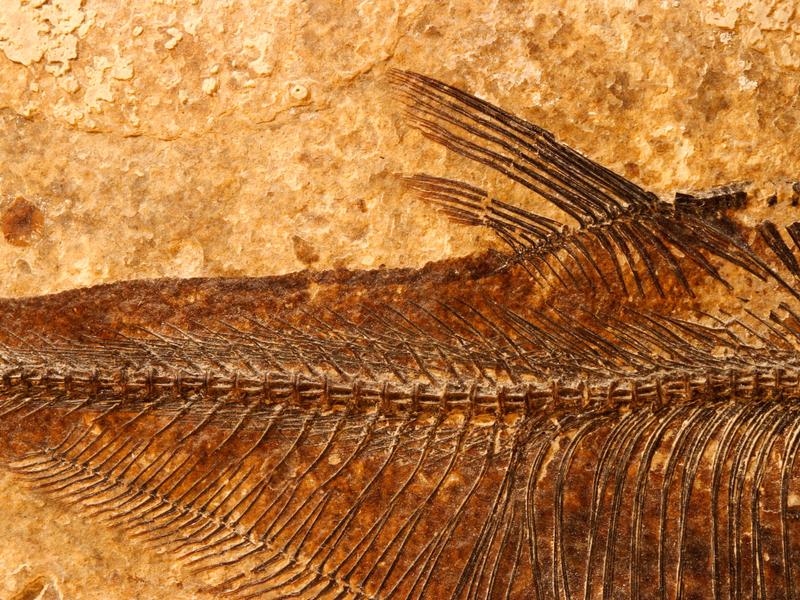
Fossil fish make that grief visible with unbearable elegance. The limestone slab keeps the body plan, fin rays, vertebral line, and the evidence of once-living movement even after the life itself has passed beyond recall. Preservation and absence occupy the same stone.

Fossil fish matter for ancestral work and cycles of loss because they do not promise return. They show how form can remain worthy of reverence after motion has ended.

What Your Body Knows

Nervous system states

dorsal vagal

Freeze / Shutdown

When energy feels stuck and the body won't respond. Fossil Fish is placed on the body as an anchor point. Your shoulders drop. Your breath becomes shallow and barely audible. A heaviness settles in your limbs. This is dorsal vagal shutdown; your oldest survival circuit pulling you toward stillness, collapse, disconnection from sensation.

sympathetic

Overstimulation / Agitation

When the system is running too hot; racing thoughts, restless limbs, inability to settle. Your chest tightens. Your jaw clenches. Your breath moves higher, shallower, faster. This is sympathetic activation; your body mobilizing for fight or flight, muscles tensing, heart rate rising.

ventral vagal

Regulated Presence

When the body finds its resting rhythm. Fossil Fish held or placed becomes a touchpoint for presence. Your chest opens. Your jaw unclenches. Your breath deepens into your belly. This is ventral vagal regulation; your body finding safety, social connection, steady presence.

Nervous system mapping based on polyvagal theory (Porges, 2011).

Mineralogy

Mineral specs

Chemical Formula

Variable (CaCO3 matrix; Ca5(PO4)3F residual bone; SiO2 if silicified)

Crystal System

Variable (Trigonal for calcite; Hexagonal for apatite)

Mohs Hardness

3

Specific Gravity

2.60-2.90

Luster

Waxy to earthy

Color

Brown

Traditional Knowledge

Traditions across cultures

The Green River Formation has been a source of fossil fish since at least the 1850s, with early geological surveys of the American West documenting the extraordinary abundance of preserved specimens. The most common species, Knightia eocaena, is arguably the most frequently encountered vertebrate fossil in the world and was designated Wyoming's state fossil in 1987.

Fossil fish from the Green River Formation occupy a unique position in the mineral and fossil market; they are simultaneously scientific specimens, decorative objects, and items of contemplative practice. Their flat, plate-like format (fish preserved in laminated limestone split along bedding planes) makes them naturally suited for display and handling.

The fossils serve as tangible connections to deep time, representing organisms that lived approximately 50 million years ago in a landscape and climate dramatically different from the modern American West. During the Eocene, the region was characterized by warm subtropical conditions with mean annual temperatures estimated at 15-20 degrees C warmer than present, making these fossils physical evidence of Earth's capacity for radical climate transformation.

Commercially, Green River Formation fossil fish are among the most accessible genuine fossils available, ranging from small Knightia specimens suitable for educational use to museum-quality multi-fish mortality plates that command significant prices. The fossil quarries of southwestern Wyoming constitute an ongoing paleontological industry with both scientific and commercial dimensions.

Ancient Mediterranean

5th century BCE

Tongues from the Mountain

Ancient Greeks and Romans puzzled over fish fossils found in mountain limestone far from the sea. Xenophanes of Colophon noted marine fossils in inland rock around 500 BCE, using them as evidence that land and sea had changed places. These observations represented some of humanity's earliest geological reasoning, centuries before plate tectonics or deep time were understood.

Green River Formation, Wyoming

50 million years old / collected since 1800s

The Eocene Lake Beds

The Green River Formation spanning Wyoming, Colorado, and Utah preserves one of the world's most complete records of Eocene freshwater life. Commercial quarrying since the 19th century has yielded millions of exquisitely preserved fish fossils, primarily Knightia, Diplomystus, and Priscacara. These 50-million-year-old specimens document an ancient subtropical lake system and remain the most widely collected fossil fish in the world.

Chinese Paleontology

20th - 21st century

The Liaoning Revolution

Fossil fish discoveries from China's Liaoning Province have transformed evolutionary biology. The Jehol Biota, preserved in fine-grained volcanic ash deposits, includes spectacularly detailed fish fossils that document the diversification of ray-finned fishes during the Early Cretaceous. Chinese fossil fish research has fundamentally reshaped scientific understanding of vertebrate evolution.

Moroccan Fossil Trade

20th century - present

The Atlas Mountains Market

Morocco's Atlas Mountains, particularly the Kem Kem beds, produce abundant Cretaceous-age fossil fish traded worldwide through Erfoud and Rissani markets. Berber fossil hunters have developed generational expertise in locating and preparing specimens. The Moroccan fossil trade, while sometimes controversial, has made fossil fish accessible to collectors and educational institutions globally.

When This Stone Finds You

What it says when it arrives

You are trying to keep faith with something already gone. Fossil fish preserve a body in limestone long after muscle and movement are over. Memory can hold a form longer than life itself.

Somatic protocol

The Stone Swimmer

A once-living body replaced atom by atom with mineral — the swimming motion arrested, the scales translated into stone, teaching the body that movement can be preserved even after the mover is gone.

5 min protocol

  1. 1

    Hold the fossil fish and look at it. This was a vertebrate. It had a spine, gills, eyes, fins. It swam. The original bone and tissue have been replaced by minerals — typically calcite, apatite, or silica — molecule by molecule over millions of years. The shape is biological. The substance is geological. Trace the outline of the fish with your fingertip. Feel where fins were. Where the eye socket sat.

    1 min
  2. 2

    Place the fossil against your own ribcage, fish spine roughly parallel to your spine. Both of you are vertebrates. Both of you have calcified internal structures. The difference is time: yours is still alive; this one has been translated into stone. Feel the weight of the fossil against your ribs. The mineral replacement made it denser than the original fish ever was.

    1 min
  3. 3

    Close your eyes. Breathe in for five counts, hold for three, out for seven. On each exhale, consider: this fish was alive in water. It breathed through gills. It navigated currents. Its last moment became its permanent position in stone. What position is your body frozen in right now? Not physically — emotionally. What posture have you calcified into?

    1 min
  4. 4

    Ask: What movement in me has stopped — not because it ended naturally, but because conditions changed and I mineralized around the last position? The fossil fish did not choose its final pose. Sediment covered it, pressure compressed it, minerals replaced it. But the swimming form is still legible after 50 million years. Your frozen posture is equally legible. What would it look like if it resumed swimming?

    1 min
  5. 5

    Remove the fossil from your ribs. Hold it in both hands. This object has survived extinction, burial, petrification, erosion, excavation, and now your practice. It was a fish. It is a stone. It is also still, somehow, recognizably a fish. Set it down. The form persists. Ask your body what form it is preserving despite every replacement.

    1 min

The #1 Question

Can Fossil Fish go in water?

Calcite is slightly water-soluble and reactive with acids. Brief water contact for cleaning is acceptable, but do not soak. Acidic solutions (vinegar, citrus) will dissolve the calcite matrix and damage the specimen. Not suitable for elixirs.

Care and Maintenance

How to care for Fossil Fish

- Toxicity: Generally non-toxic. The primary mineral components (calcite, apatite) are biologically benign. However, some specimens may contain trace heavy metals (uranium, rare earths) incorporated during diagenesis.

Standard handling precautions suffice. - Handling: The laminated limestone matrix can be fragile along bedding planes. Handle with two hands and support the full plate to prevent fracture along lamination surfaces.

Larger plates may be surprisingly heavy. - Water safety: Calcite is slightly water-soluble and reactive with acids. Brief water contact for cleaning is acceptable, but do not soak.

Acidic solutions (vinegar, citrus) will dissolve the calcite matrix and damage the specimen. Not suitable for elixirs. - Heat sensitivity: Calcite decarbonates at high temperatures.

The kerogen (organic carbon) in the matrix is combustible. Do not subject to extreme heat. - Consolidant awareness: Many commercially prepared fossil fish have been treated with consolidants (acrylic resins, cyanoacrylate adhesives, or paraloid) to stabilize fragile areas.

These are generally inert when cured but should not be heated or soaked. - Fragility: The primary safety concern is physical. dropped specimens break irrecoverably.

Support fully during handling.

In Practice

How Fossil Fish is used

Fossil fish offer a qualitatively different somatic experience compared to crystalline minerals. The flat, plate-like format creates a broad tactile interface with the hands, distributing weight across the palms rather than concentrating it in a gripped point. The laminated texture of the limestone matrix provides directional tactile information. fingers can feel the microstratigraphy of 50-million-year-old lake-bottom sediments.

The surface texture presents a binary contrast: the smooth, slightly waxy feel of fossil bone against the matte, granular texture of the limestone matrix. Running a finger along the outline of the preserved fish provides a haptic trace of a biological form that existed during the Eocene. Research on museum haptic experiences demonstrates that touching authentic natural specimens produces qualitatively different engagement than looking alone, with participants particularly noting the significance of thermal properties and texture as distinct information channels.

The moderate density (SG 2.3-2.7) and broad, flat form create a comfortable resting weight across the lap or thighs during seated practice. The slight coolness of stone contact followed by gradual warming through body heat provides the thermal somatic feedback documented in clinical sensory modulation research. The breadth of the plate activates a wider field of cutaneous receptors compared to holding a small crystal, potentially creating a more distributed grounding sensation.

The temporal dimension of fossil fish is their most distinctive somatic quality. Holding a specimen involves physical contact with a tangible record of deep geological time. the organism, the lake sediment, and the diagenetic minerals all represent processes spanning millions of years. This factual temporal depth (not metaphorical but literal) may serve as a cognitive anchor for body-based practices oriented toward perspective-taking and temporal reframing.

Studies of haptic exploration of natural history specimens confirm that tactile interaction increases both inspection time and positive evaluation, with the multisensory experience of touch supplementing visual information in ways that support deeper engagement and more memorable experiences.

Verification

Authenticity

Fossil fish: genuine specimens show skeletal detail (bones, fins, scales) preserved in fine-grained sedimentary matrix. The bone should be distinct from the matrix in color and texture. Composite specimens (assembled from multiple fossils) exist and should be disclosed.

Check for paint or carving that enhances or fabricates skeletal detail. UV light may reveal modern adhesive or paint.

Temperature

Natural Fossil Fish should usually feel cooler than plastic or resin on first touch and warm more slowly in the hand.

Scratch logic

Use 3 on the Mohs scale as the check, not internet myths. A real specimen should behave in line with the hardness listed above.

Surface and luster

Look for a waxy to earthy surface quality rather than a painted or plastic shine.

Weight and density

The listed specific gravity is 2.60-2.90. If a specimen feels unusually light for its size, it may deserve a second look.

Geographic Origins

Where Fossil Fish forms in the world

Fossil fish specimens in the collector and wellness markets originate overwhelmingly from the Green River Formation, one of the world's most celebrated Fossil-Lagerstatten (sites of exceptional fossil preservation). The Green River Formation represents sedimentary deposits laid down in a complex of three major interconnected Eocene lakes . Fossil Lake, Lake Gosiute, and Lake Uinta .

across what is now southwestern Wyoming, northwestern Colorado, and northeastern Utah. Radiometric dating of volcanic tuffs within the formation constrains the age to approximately 53. 5 to 48.

5 million years ago (Ypresian to Lutetian stages of the Eocene). The depositional environment was a warm, humid subtropical to tropical setting during the Eocene thermal maximum, with swampy and riparian habitats surrounding the lakes. The lakes cycled between overfilled (freshwater) and underfilled (evaporative, saline) states in response to climatic and tectonic forcing, with the most exceptional fossil preservation occurring during balanced-fill periods.

The formation has also yielded exceptionally preserved insects (found exclusively in kerogen-rich micrites from deeper water deposits), plants, reptiles, birds, and mammals, making it one of the most complete Eocene terrestrial ecosystem records.

FAQ

Frequently asked

Can Fossil Fish go in water?

Calcite is slightly water-soluble and reactive with acids. Brief water contact for cleaning is acceptable, but do not soak. Acidic solutions (vinegar, citrus) will dissolve the calcite matrix and damage the specimen. Not suitable for elixirs.

Is Fossil Fish toxic?

Generally non-toxic. The primary mineral components (calcite, apatite) are biologically benign. However, some specimens may contain trace heavy metals (uranium, rare earths) incorporated during diagenesis. Standard handling precautions suffice.

References

Sources and citations

Closing Notes

Fossil Fish

Fish preserved in stone for 50 million years. Green River Formation, Wyoming. They died in seasonal lake turnover, settled into fine-grained sediment, and were sealed before decay could erase them.

The science documents exceptional preservation in anoxic lacustrine environments. The practice asks what remains when stillness arrives fast enough to capture a whole life.

Bring it into practice

What to do with Fossil Fish next

Move from reference to ritual. Search current inventory for Fossil Fish, build a custom bracelet, or let Sacred Match choose the right supporting stones for you.

Community notes

Threads under Fossil Fish

Open all chats

Shared field notes tied to Fossil Fish appear here, including notes saved from practice.

No shared notes under Fossil Fish yet.

When members save a public field note for this stone, it will appear here.

The archive

Related crystals

Read the Full Crystal Guide

Continue through stones that share intention, chakra focus, or tonal family with Fossil Fish.