Crystal Encyclopedia
40+YEARS

Dinosaur Bone

Variable (typically SiO2 from agate/chalcedony replacement; residual Ca5(PO4)3(F,OH) apatite) · Mohs 6.5 · Trigonal (silicified) · Root Chakra

The stone of dinosaur bone: meaning, mineralogy, and somatic practice.

Ancestral HealingProtection & GroundingPatience & EnduranceCycles & Rhythm

This page documents traditional and cultural uses of dinosaur bone alongside emerging research on tactile grounding objects. Crystalis does not claim that dinosaur bone treats, cures, or prevents any medical condition. For mental health concerns, consult a qualified professional.

Crystalis Editorial · 40+ Years · Herndon, VA · 10 peer-reviewed sources

Origins: USA (Utah, Colorado), Madagascar

Crystalis

Materia Medica

Dinosaur Bone

The Fossil of Deep Time

Dinosaur Bone
Ancestral HealingProtection & GroundingPatience & Endurance
Crystalis

Protocol

The Deep Archive

Bone replaced by agate and chalcedony over 150 million years — the original structure dissolved but the architecture survived, teaching the body that form can outlast substance.

5 min

  1. 1

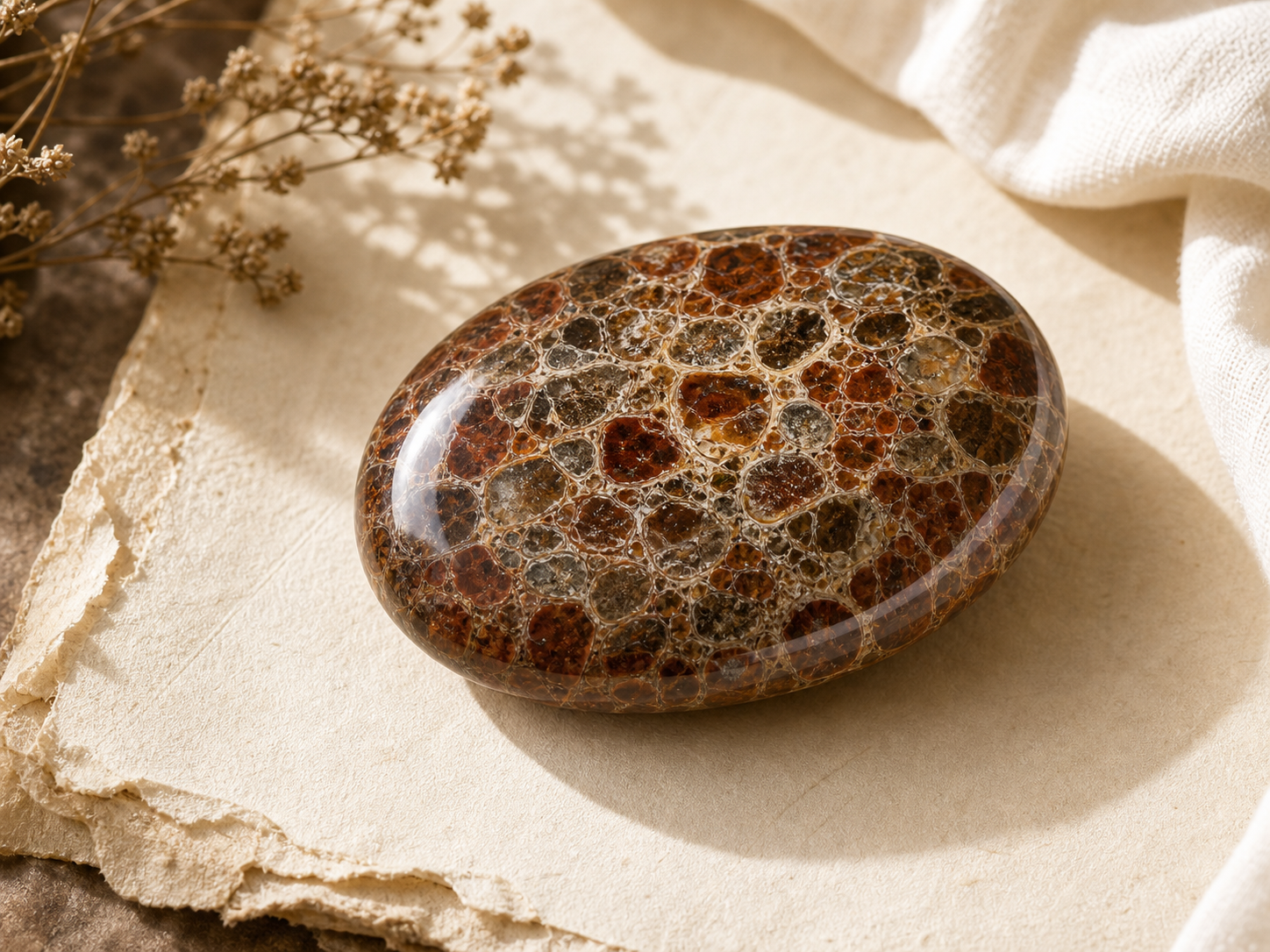
    Hold the dinosaur bone — agatized, petrified, millions of years transmuted. The original calcium phosphate bone has been replaced molecule by molecule with silica (chalcedony/agate), preserving the cellular structure of the original bone while replacing every atom of the original material. Look for the cross-hatched cell pattern visible in polished sections. That pattern is real bone architecture. The material is entirely stone.

  2. 2

    Place the fossil against your own forearm, parallel to the bone inside. Press gently. You are placing agatized dinosaur bone against living human bone. The same principle — calcium phosphate scaffolding — organized both. One was replaced by silica over 150 million years. The other is still alive. Feel the temperature difference between the stone and your skin.

  3. 3

    Close your eyes. Breathe in for five counts, hold for three, out for seven. On each inhale, notice the weight of the fossil against your arm. On each exhale, consider: the dinosaur that owned this bone could not have imagined this moment. Its body dissolved. Its architecture survived. What architecture in your life will outlast the material it is currently made from?

  4. 4

    Ask: What in me is bone — the structure, the scaffold, the part that will fossilize — and what is flesh — the part that will be replaced? The petrification process did not destroy the bone. It translated it into a more durable language. Notice where your body holds its most durable truth. That place may ache.

Continue in the full protocol below.

tap to flip for protocol

Some absences get so old they stop feeling like events and start feeling like architecture. You carry the hollows as part of the frame.

Silicified dinosaur bone preserves the original structure while chalcedony, agate, and jasper infill what was emptied long ago. Nothing about the fossil denies the loss. Nothing leaves the loss vacant forever, either.

Old chambers filling.

That is a serious comfort.

What Your Body Knows

Nervous system states

dorsal vagal

Freeze / Shutdown

When energy feels stuck and the body won't respond. Dinosaur Bone is placed on the body as an anchor point. Your shoulders drop. Your breath becomes shallow and barely audible. A heaviness settles in your limbs. This is dorsal vagal shutdown; your oldest survival circuit pulling you toward stillness, collapse, disconnection from sensation.

sympathetic

Overstimulation / Agitation

When the system is running too hot; racing thoughts, restless limbs, inability to settle. Your chest tightens. Your jaw clenches. Your breath moves higher, shallower, faster. This is sympathetic activation; your body mobilizing for fight or flight, muscles tensing, heart rate rising.

ventral vagal

Regulated Presence

When the body finds its resting rhythm. Dinosaur Bone held or placed becomes a touchpoint for presence. Your chest opens. Your jaw unclenches. Your breath deepens into your belly. This is ventral vagal regulation; your body finding safety, social connection, steady presence.

Nervous system mapping based on polyvagal theory (Porges, 2011).

Mineralogy

Mineral specs

Chemical Formula

Variable (typically SiO2 from agate/chalcedony replacement; residual Ca5(PO4)3(F,OH) apatite)

Crystal System

Trigonal (silicified)

Mohs Hardness

6.5

Specific Gravity

2.60-2.90

Luster

Waxy to earthy

Color

Brown

Traditional Knowledge

Traditions across cultures

Fossil bone has been recognized and collected by indigenous peoples across North America for millennia. The Navajo and Ute peoples of the American Southwest were familiar with gem-quality fossil bone long before European contact. In paleontological context, dinosaur bone fossilization has been studied since the early 19th century, with the recognition of silicified bone as a distinct mineralogical phenomenon growing alongside vertebrate paleontology. The designation "gem bone" or "gembone" is a lapidary/collector term for agatized dinosaur bone with sufficient quality (complete silicification, vivid colors, intact cell structure) for use in jewelry and decorative arts. Legally, vertebrate fossils on federal land in the United States are regulated under the Paleontological Resources Preservation Act (2009); however, agatized bone that is completely mineralized and unidentifiable to species may be collected under different provisions depending on land management agency.

Ute and Navajo Traditions

Pre-contact - present

Bones of the Ancient Ones

Indigenous peoples of the Colorado Plateau, including Ute and Navajo communities, encountered petrified dinosaur bone long before Western paleontology existed. These massive stone bones were woven into origin narratives and understood as remains of powerful beings from earlier worlds. Many sites containing fossilized bone are considered culturally sensitive and spiritually significant.

Early Paleontology

1820s - 1850s

The Birth of Dinosaur Science

The scientific study of dinosaur fossils began with discoveries by Gideon Mantell and Richard Owen in England during the 1820s-1840s. Owen coined the term "Dinosauria" in 1842. The realization that massive petrified bones belonged to extinct reptilian creatures revolutionized humanity's understanding of deep time and the history of life on Earth.

American Fossil Wars

1877 - 1892

The Bone Wars of the Colorado Plateau

The rivalry between paleontologists Othniel Charles Marsh and Edward Drinker Cope, known as the "Bone Wars," drove extensive excavation across the American West. Utah, Colorado, and Wyoming yielded enormous quantities of dinosaur bone, much of it beautifully mineralized with agate, jasper, and chalcedony. This era established the Colorado Plateau as one of the world's premier fossil regions.

Gem and Mineral Collecting

20th century - present

Gembone: Where Paleontology Meets Lapidary

When dinosaur bone is replaced by gem-quality agate or jasper during permineralization, the resulting material is called "gembone." Prized specimens from the Morrison Formation display vivid cell structure in reds, blues, and greens. The lapidary community values gembone as one of the rarest cutting materials, with each piece representing 150 million years of geological transformation.

When This Stone Finds You

What it says when it arrives

Something ancient in you has gone hollow and needs new material. Fossil dinosaur bone preserves cellular structure while agate and jasper fill the emptied spaces. Time can replace loss with pattern.

Somatic protocol

The Deep Archive

Bone replaced by agate and chalcedony over 150 million years — the original structure dissolved but the architecture survived, teaching the body that form can outlast substance.

5 min protocol

  1. 1

    Hold the dinosaur bone — agatized, petrified, millions of years transmuted. The original calcium phosphate bone has been replaced molecule by molecule with silica (chalcedony/agate), preserving the cellular structure of the original bone while replacing every atom of the original material. Look for the cross-hatched cell pattern visible in polished sections. That pattern is real bone architecture. The material is entirely stone.

    1 min
  2. 2

    Place the fossil against your own forearm, parallel to the bone inside. Press gently. You are placing agatized dinosaur bone against living human bone. The same principle — calcium phosphate scaffolding — organized both. One was replaced by silica over 150 million years. The other is still alive. Feel the temperature difference between the stone and your skin.

    1 min
  3. 3

    Close your eyes. Breathe in for five counts, hold for three, out for seven. On each inhale, notice the weight of the fossil against your arm. On each exhale, consider: the dinosaur that owned this bone could not have imagined this moment. Its body dissolved. Its architecture survived. What architecture in your life will outlast the material it is currently made from?

    1 min
  4. 4

    Ask: What in me is bone — the structure, the scaffold, the part that will fossilize — and what is flesh — the part that will be replaced? The petrification process did not destroy the bone. It translated it into a more durable language. Notice where your body holds its most durable truth. That place may ache.

    1 min
  5. 5

    Remove the fossil from your arm. Hold it in both hands. It survived an extinction event, tectonic burial, mineral replacement, erosion, and discovery. It is now in a human palm, doing somatic work. The absurdity and the gravity of that fact are both worth sitting with. Set it down. Walk away carrying only the architecture.

    1 min

The #1 Question

Can Dinosaur Bone go in water?

Safety Flags

Care and Maintenance

How to care for Dinosaur Bone

Dinosaur bone (gembone) is water-safe if fully silicified (replaced by chalcedony/quartz, Mohs 7). Partially mineralized specimens may be porous. Brief rinse for either type.

If your specimen is porous (absorbs water visibly), limit water contact. Recommended cleansing: moonlight, smoke, selenite plate. Store normally for silicified specimens.

In Practice

How Dinosaur Bone is used

Something ancient in you has gone hollow and needs new material. Fossil dinosaur bone preserves cell structure after the original hydroxyapatite was replaced by chalcedony, cell by cell. Hold during periods of deep personal reconstruction.

The biology is gone but the architecture survived. For ancestral connection: the bone is 150 million years old. Place it on your workspace when you need perspective that dwarfs human timescales.

Verification

Authenticity

Dinosaur bone (gembone): should show cell structure under magnification (the original bone microstructure is preserved during permineralization). Mohs varies by replacement mineral (7 if chalcedony, 3 if calcite). If no cellular structure is visible under a loupe, the material may be jasper or agate without biological origin.

The cell pattern is diagnostic.

Temperature

Natural Dinosaur Bone should usually feel cooler than plastic or resin on first touch and warm more slowly in the hand.

Scratch logic

Use 6.5 on the Mohs scale as the check, not internet myths. A real specimen should behave in line with the hardness listed above.

Surface and luster

Look for a waxy to earthy surface quality rather than a painted or plastic shine.

Weight and density

The listed specific gravity is 2.60-2.90. If a specimen feels unusually light for its size, it may deserve a second look.

Geographic Origins

Where Dinosaur Bone forms in the world

Morrison Formation, Utah and Colorado, USA. The Premier Source. The highest-quality agatized dinosaur bone comes from the Late Jurassic Morrison Formation (approximately 150 million years old) in eastern Utah (Grand County, Emery County) and western Colorado.

The gem-quality material forms through multi-stage diagenesis: burial in fluvial sediments, permineralization by silica-rich groundwater, progressive replacement of original bioapatite by chalcedony and microcrystalline quartz, and infiltration of iron, manganese, and chromium creating vivid color patterns. The preserved Haversian canal system (osteon microstructure) remains visible in cross-section, with individual bone cells displaying different colors depending on local geochemical conditions during replacement.

The Four Corners region of the American Southwest is the global center for gem-quality material. Brazil (Araripe Basin, northeastern Brazil). Spectroscopic analysis has confirmed silicified dinosaur remains from the Ipubi Formation.

South Africa and Morocco also produce petrified bone material, though rarely approaching the vivid cell-pattern quality of Utah specimens.

FAQ

Frequently asked

Can Dinosaur Bone go in water?

Safety Flags

How does Dinosaur Bone form?

Formation Geology Dinosaur bone becomes "agatized" or "gem bone" through a multi-stage diagenetic process spanning tens of millions of years. The process begins with burial in sediment (most commonly fluvial or lacustrine deposits), followed by permineralization -- the infiltration of mineral-bearing groundwater through the porous bone structure. The original bioapatite is progressively dissolved and replaced by silica precipitated from supersaturated groundwater solutions. In the American South

References

Sources and citations

  1. . [SCI]

    DOI: 10.1155/2013/437439

  2. . [SCI]

    DOI: 10.1002/xrs.1364

  3. . [SCI]

    DOI: 10.1111/pala.12041

  4. . [SCI]

    DOI: 10.1111/pala.12469

  5. . [SCI]

    DOI: 10.1002/jqs.3428

  6. . [SCI]

    DOI: 10.1002/gea.21734

  7. . [SCI]

    DOI: 10.1002/jqs.3558

  8. . [SCI]

    DOI: 10.1002/ajhb.23370

  9. . [SCI]

    DOI: 10.1002/ajhb.23612

  10. . [SCI]

    DOI: 10.1002/ajim.23451

Closing Notes

Dinosaur Bone

Fossilized bone where the original hydroxyapatite was replaced by chalcedony, cell by cell, over millions of years. The biology is gone. The geometry survived.

The science documents permineralization. The practice asks what remains when everything organic has been replaced by mineral and the shape still tells the whole story.

Bring it into practice

What to do with Dinosaur Bone next

Move from reference to ritual. Search current inventory for Dinosaur Bone, build a custom bracelet, or let Sacred Match choose the right supporting stones for you.

Community notes

Threads under Dinosaur Bone

Open all chats

Shared field notes tied to Dinosaur Bone appear here, including notes saved from practice.

No shared notes under Dinosaur Bone yet.

When members save a public field note for this stone, it will appear here.

The archive

Related crystals

Read the Full Crystal Guide

Continue through stones that share intention, chakra focus, or tonal family with Dinosaur Bone.