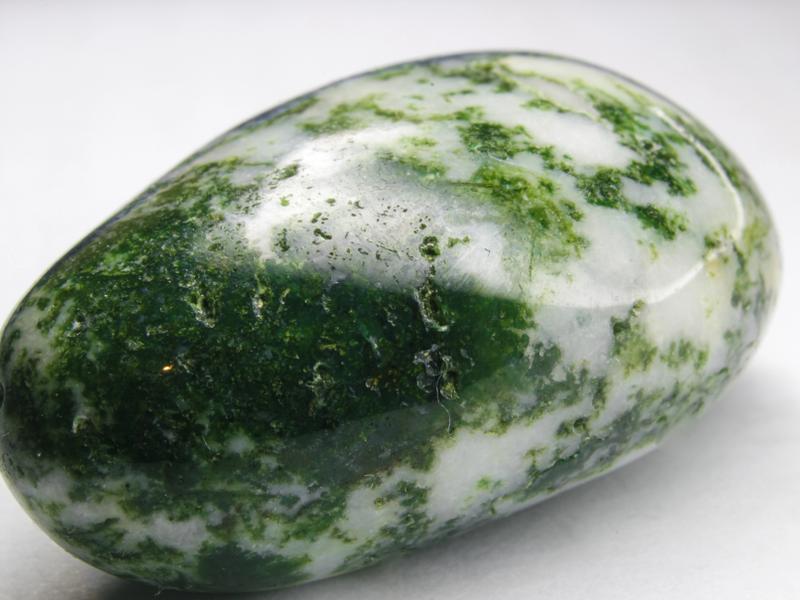
You assumed the growing was over. Dendritic agate holds branching manganese and iron patterns inside chalcedony that formed after the host was already solid. Quiet stone, still branching.
Dendritic agate is a Root and Heart Chakra gem -- grounding through the root (the manganese and iron oxides connect to earth energy) while opening the heart to the...
The Meaning
Dendritic Agate in the Crystalis dictionary
Growth can appear after the main event is already over. The field looks empty. Then branching starts inside it anyway.
Dendritic agate holds manganese or iron oxide inclusions that spread like miniature trees through translucent chalcedony.
They are not fossils. They are mineral intrusions writing their own vegetation into stone.
Late pattern is still pattern.
Stone Lore
Stories carried through time
Cultural notes are presented as tradition and historical context — stories carried through time.
Ancient Greece and Rome
The Plentiful Harvest Stone
Greek and Roman agricultural traditions prized dendritic agate as a stone of abundance and good harvests. Pliny the Elder referenced tree-patterned agates in Naturalis Historia (77 CE), and Roman farmers buried dendritic agates in their fields at planting time, believing the tree-like patterns within the stone would encourage vigorous crop growth. The Greek name dendrites (from dendron, tree) gave this variety its formal identification.
Dendritic agate amulets depicting what appeared to be natural botanical illustrations were a widely valued agricultural talisman in the Roman world.
1st century BCE-4th century CE
Historical note
The Landscape Paintings of Jahangir
Mughal emperors, particularly Jahangir (r. 1605-1627), were renowned collectors of mineral specimens and gemstones. Dendritic agate, which naturally displays scenes resembling landscapes, forests, and botanical studies, aligned with the...
Mughal India · 16th-19th century
Historical note
Fractal Patterns Before Fractals
Dendritic agate demonstrates fractal geometry in mineral form. The tree-like patterns are not fossils or organic material; they are manganese and iron oxide deposits (primarily pyrolusite, MnO2) that precipitated along fracture planes...
Formation Science: Manganese Oxide Dendrites · ongoing geological process
Origin lore
The Agate Cutters' Prized Material
The agate cutting industry of Idar-Oberstein in Germany's Rhineland-Palatinate, established in the 15th century, recognized dendritic agate as among the most commercially valuable varieties for decorative arts. Cutters learned to orient...
The dendrites form through a process called diffusion-limited aggregation. Manganese-rich or iron-rich solutions migrate along fracture planes, grain boundaries, and pore spaces within the host chalcedony. As the metallic ions diffuse through the silica matrix, they precipitate as oxide crystals that grow outward from nucleation points. Each new crystal branch creates a preferential pathway for further ion deposition, causing the growth to branch repeatedly.
The result is a fractal pattern -- self-similar at multiple scales -- that follows the same mathematical rules as tree branching, river drainage networks, lightning, and lung bronchi.
The chalcedony host forms first, typically in volcanic or sedimentary environments where silica-rich fluids precipitate in cavities, veins, or replacement zones. The dendritic inclusions form later, after the chalcedony has solidified but while the host rock still contains circulating mineral-bearing fluids. This two-stage process explains why the dendrites appear to be "inside" the translucent chalcedony -- they are captured between layers or distributed along internal planes.
The translucency of the chalcedony host is critical to the stone's beauty: the dendrites are visible because the quartz matrix is transparent enough to reveal them, creating the illusion of a forest preserved in glass.
The appearance of dendritic agate as a "stone with trees inside" has captivated humans for millennia. The dendrites are not fossils -- no plant material was involved at any stage. The resemblance between mineral dendrites and biological trees exists because both systems follow fractal branching mathematics. The equation is the same. The medium is different. This is one of the most profound demonstrations in the mineral kingdom of the principle that form follows mathematics, not material.
Crystal system diagram represents the general trigonal classification. Diagram created by Crystalis for educational reference.
Trigonal structure
Chemical Formula
SiO2 + MnO2/FeO
Crystal System
Trigonal
Mohs Hardness
6.5
Specific Gravity
2.58-2.64
Luster
Vitreous to waxy
Color
Translucent white to gray with dark dendrites
IMA Status
variety
IMA Number
No IMA number (variety of chalcedony/quartz)
01
Mineral conditions gather
02
Structure begins to crystallize
03
Dendritic Agate records place and pressure
BrazilIndiaMadagascar
Telling it apart
Dendritic agate is not actually agate despite the trade name, because it lacks the concentric banding that defines true agate. It is translucent chalcedony with tree-like manganese or iron oxide inclusions formed by diffusion-limited aggregation along fracture planes. Moss agate is the closest visual cousin, but moss agate's inclusions are three-dimensional and branch in all directions through the stone, while dendritic agate's patterns are typically flat, occupying a single plane within the chalcedony like a pressed leaf in a book.
The dendritic patterns are inorganic; no plant material is present despite the botanical appearance. Physical properties are standard chalcedony: Mohs 6. 5 to 7, specific gravity 2. 58 to 2. 64. Fakes include stones with hand-painted or printed dendrites applied to the surface, which show under magnification as sitting on top of the stone rather than embedded within it. Genuine dendrites are sandwiched between chalcedony layers and cannot be felt with a fingernail on the surface.
Some sellers apply the dendritic label to any stone with branching dark inclusions, but technically the term should apply only to chalcedony (quartz) hosts with manganese or iron oxide dendrites.
Spotting the real thing
Fractal Branching Pattern Genuine dendrites follow fractal mathematics, each branch splits into smaller branches in a self-similar pattern, getting progressively finer toward the tips. The branching is organic and irregular, never perfectly symmetrical or repetitive. Painted or printed imitations often show branches that are too uniform, too symmetrical, or that fail to follow fractal scaling.
Study the finest tips of the dendrites under magnification: in genuine specimens, the branching continues to the limits of visibility. Two-Dimensional Distribution Natural dendrites in agate form along flat fracture planes within the chalcedony. When you tilt a genuine dendritic agate, you can often see that the dendrites exist on a single plane (or a few discrete planes) within the stone, rather than being distributed throughout its entire volume.
Three-dimensional distribution suggests moss agate or manufactured material rather than true dendritic agate.
You had a plan. A five-year plan. A ten-year plan. A straight line from where you are to where you should be. And life keeps branching. A detour here. An unexpected fork there. A dead end that forces a pivot you did not budget for. Your sympathetic system is in overdrive because every branch feels like a failure; every deviation from the straight line registers as evidence that you are falling behind, losing control, going wrong.
Dendritic agate contains the mathematical proof that straight lines do not exist in nature. Rivers do not flow in straight lines. Trees do not grow in straight lines. Neurons do not connect in straight lines. The branching IS the growth. The stone shows you what the fractal already knows: the most efficient way to fill space, to reach resources, to connect to everything around you, is to branch.
Your life is not off-plan. Your plan was too linear for a dendritic universe.
Shut down & far away
The Uprooted
You cannot remember the last time you stood on bare ground. The last time you noticed a tree without glancing at your phone. The last time you let your body follow a natural rhythm instead of a calendar. Your dorsal vagal system has adapted to an indoor, artificial, screen-mediated existence so thoroughly that "nature" has become an abstract concept rather than a felt reality. You are not depressed exactly.
You are uprooted. Dendritic agate is a portable forest. The manganese oxide branches inside the chalcedony follow the exact same fractal mathematics as the root systems beneath your feet and the arterial networks inside your chest. Holding this stone reconnects the nervous system to the branching logic it shares with every tree, river, and mycorrhizal network on the planet. You are not separate from nature.
You are nature. The stone is the proof.
Settled & connected
The Impatient Gardener
You planted the seed. You did the work. Where are the results? The oscillation is exhausting: one day you push harder (sympathetic; more effort, more input, more force), the next day you collapse into doubt (dorsal; maybe the seed was dead, maybe the soil is wrong, maybe nothing will ever grow). You cycle between overwatering and neglect. Dendritic agate teaches the time signature of natural growth.
The dendrites inside the stone did not form overnight. They formed molecule by molecule, branch by branch, over geological time. Each branch created the conditions for the next branch. There was no forcing. There was no schedule. There was only the sustained presence of manganese-rich fluid finding its way through silica; patiently, fractally, inevitably. Your garden is growing. The growth is dendritic.
And dendritic growth does not respond to urgency. It responds to sustained presence.
Settled & connected
The Living Network
You understand that growth branches. You have stopped measuring progress in straight lines and started recognizing the fractals. A conversation that went sideways turned out to be the branch that led to the connection you needed. A failure that felt like a dead end became the nutrient-rich ground for the next phase. Your nervous system is in ventral vagal regulation; rooted, connected, patient, branching.
Dendritic agate in this state is not medicine. It is a field guide. The stone shows you the mathematics of your own unfolding: the same equations that govern root systems and river deltas and neural networks are governing your life. You are not controlling the growth. You are the growth. And the growth knows how to branch.
These associations come from tradition and reflective practice — a way of working with the stone, not a medical prescription.
Somatic Practice
Simple ways to work with Dendritic Agate
◇
Hold
Carry Dendritic Agate in a pocket or place it over the heart center during a pause.
◌
Meditate
Let the stone become a quiet tactile anchor while the breath slows.
☽
Breathe
Breathe in softness. Breathe out tension. Keep the practice simple.
✎
Journal
Write with Dendritic Agate nearby to name the feeling without forcing a conclusion.
✋
Bodywork
Rest the stone near the chest, hand, or bedside as a reminder to soften.
⌂
Environment
Place it where you want a visual cue for care, repair, or steadiness.
Field Instruction
The Branching
The Branching Protocol
3 min protocol
1
Root Hold (30 seconds)Stand barefoot if possible (on ground, on a wooden floor, on carpet -- any surface closer to earth than a shoe). Hold the dendritic agate in your left hand (receiving hand). Wrap your fingers around it so the stone is enclosed in your fist. Feel its hardness -- at Mohs 6.5-7, dendritic agate is one of the more durable stones in your collection. It does not need to be held gently. It can take your grip. Press your feet into the ground. Imagine roots extending from your soles downward, branching as they go -- the same fractal pattern that is inside the stone in your hand. Thirty seconds of rooting.
2
The Dendrite Gaze (40 seconds)Open your hand and hold the stone at eye level. Look at the dendritic inclusions -- the tree patterns, the branching formations. Trace one branch from its base to its finest tips. Notice how each junction produces two new paths. Notice how the branches get finer as they extend outward. This is fractal geometry: self-similar at every scale. The same pattern repeats from trunk to twig, from river to tributary, from aorta to capillary. As you trace the branching with your eyes, let the visual pattern overwrite the straight-line thinking in your mind. The stone is a diagram of how growth actually works. Let your eyes teach your nervous system the shape of abundance.
3
The Branch Breath (60 seconds)Hold the stone against the center of your chest. Inhale through the nose for 5 counts. Pause for 3 counts without tensing. Exhale through the mouth for 8 counts, and as you exhale, imagine the breath branching -- splitting into two, then four, then eight, then sixteen pathways, radiating outward through your ribs, your arms, your fingers, your toes. Each exhale is a branching. Each branch reaches something the trunk alone could not. Four full cycles. You are not pushing the breath to branch. You are allowing it to follow the same mathematics the dendrites follow. The pattern is already in your lungs. Your bronchi are dendrites.
4
The Planting (20 seconds)Hold the stone in both hands against your belly -- below the navel, the center of the body's creative and generative energy. Speak silently or aloud one thing you are growing: a project, a relationship, a practice, a healing process. Then say: "I release the straight line. I trust the branch." One statement. One breath. The stone against your belly is a seed that has already grown its forest. Your planting is already underway. The branching is proof, not failure.
5
Windowsill or Desk Placement (10 seconds)Place the dendritic agate where you can see it during work or rest -- a windowsill where it catches natural light, a desk near your keyboard, a bedside table. Position it so the most visible dendrite pattern faces you. Each time your eye catches the branching pattern during the day, let it be a one-second reset: growth branches. Abundance branches. The river does not apologize for its delta. The tree does not apologize for its crown. Your path does not need to be straight to be right.
Stone Intelligence
The fact that makes Dendritic Agate memorable
The manganese oxide inside your dendritic agate migrated through silica gel millions of years ago, branching at every obstacle, splitting at every interface, following the same diffusion-limited aggregation equation that governs lightning, river deltas, and the branching of your own bronchial tree. The dendrites did not plan their path. They responded to what was in front of them, and the response, governed by fractal mathematics, produced a pattern identical to the trees that would not evolve for hundreds of millions of years.
Crystalis documents both the physics and the practice because the stone never separated them: the manganese diffused, the branches formed, and what emerged was a geological proof that growth was never meant to go in a straight line.
Dendritic agate is a Root and Heart Chakra gem. grounding through the root (the manganese and iron oxides connect to earth energy) while opening the heart to the interconnectedness of natural systems. In somatic practice, dendritic agate addresses the specific pattern where someone feels disconnected from nature, from growth cycles, and from the organic logic of their own unfolding. It is the stone that reunites the indoor nervous system with the outdoor world.
The Straight Line
(nervous system pattern: SYMPATHETIC. rigid adherence to a plan, anxiety when life branches unpredictably)
You had a plan. A five-year plan. A ten-year plan. A straight line from where you are to where you should be. And life keeps branching. A detour here. An unexpected fork there. A dead end that forces a pivot you did not budget for. Your sympathetic system is in overdrive because every branch feels like a failure.
every deviation from the straight line registers as evidence that you are falling behind, losing control, going wrong. Dendritic agate contains the mathematical proof that straight lines do not exist in nature. Rivers do not flow in straight lines. Trees do not grow in straight lines. Neurons do not connect in straight lines. The branching IS the growth. The stone shows you what the fractal already knows: the most efficient way to fill space, to reach resources, to connect to everything around you, is to branch.
Your life is not off-plan. Your plan was too linear for a dendritic universe.
The Uprooted
(nervous system pattern: DORSAL VAGAL. disconnection from nature, body, and organic growth cycles)
You cannot remember the last time you stood on bare ground. The last time you noticed a tree without glancing at your phone. The last time you let your body follow a natural rhythm instead of a calendar. Your dorsal vagal system has adapted to an indoor, artificial, screen-mediated existence so thoroughly that "nature" has become an abstract concept rather than a felt reality.
You are not depressed exactly. You are uprooted. Dendritic agate is a portable forest. The manganese oxide branches inside the chalcedony follow the exact same fractal mathematics as the root systems beneath your feet and the arterial networks inside your chest. Holding this stone reconnects the nervous system to the branching logic it shares with every tree, river, and mycorrhizal network on the planet.
You are not separate from nature. You are nature.
Sacred Match
Sacred Match reaches for Dendritic Agate when what you feel sounds like:
Frustration that life keeps branching instead of going straight
Disconnection from nature and natural rhythms
Impatience with slow, organic growth processes
Needing to feel rooted without feeling stuck
Abundance anxiety -- doing everything right but results are not appearing
Screen-mediated life with no body-to-earth contact
Perfectionism about paths, plans, and progress
Dendritic agate finds you when you have been trying to grow in a straight line in a world that branches. When every deviation from the plan feels like failure and every fork in the road triggers the fear of choosing wrong. This stone does not arrive with a map. It arrives with a tree -- frozen in chalcedony, branching in every direction, following mathematics that predate human planning by billions of years.
Dendritic agate comes forward when you need to learn that the most efficient way to fill a space, to reach what you need, to connect to everything around you, is not the shortest path. It is the most branching one.
Stones and herbs that harmonize with Dendritic Agate
Pairings are treated like a recipe file: clear use, method, and safety.
Crystal Companion
Dendritic Agate + Amethyst
Use when
You want to layer the primary intention with another supportive tone.
How to work with it
Place the stones together during meditation, journaling, or a short reset.
Safety
Use as a reflective practice tool, not as a medical substitute.
Crystal Companion
Dendritic Agate + Rhodonite
Use when
You want to layer the primary intention with another supportive tone.
How to work with it
Place the stones together during meditation, journaling, or a short reset.
Safety
Use as a reflective practice tool, not as a medical substitute.
Crystal Companion
Dendritic Agate + Clear Quartz
Use when
You want to layer the primary intention with another supportive tone.
How to work with it
Place the stones together during meditation, journaling, or a short reset.
Safety
Use as a reflective practice tool, not as a medical substitute.
Crystal Companion
Dendritic Agate + Black Tourmaline
Use when
You want to layer the primary intention with another supportive tone.
How to work with it
Place the stones together during meditation, journaling, or a short reset.
Safety
Use as a reflective practice tool, not as a medical substitute.
Green Aventurine
Green aventurine brings optimism, luck, and the energy of new growth. Paired with dendritic agate's patient, branching growth energy, this combination is the primary prescription for new ventures, new gardens (literal or metaphorical), and any situation where you are planting seeds and need faith that they will grow. Aventurine provides the spring energy. Dendritic agate provides the root system.
Smoky Quartz
Smoky quartz deepens the root-chakra grounding that dendritic agate already provides. This pairing is for people who need maximum connection to earth energy -- who feel so ungrounded that even dendritic agate alone is not enough to anchor them. Smoky quartz goes deep into the root while dendritic agate extends the branching network. Together they create an entire root system: deep taproot (smoky quartz) and spreading lateral roots (dendritic agate).
Citrine
Citrine adds solar energy, abundance manifestation, and confident action. Paired with dendritic agate's patient growth, citrine prevents patience from becoming passivity. Citrine says "the harvest is coming." Dendritic agate says "and the root system is already in place." This pairing bridges the gap between organic timing and active creation -- growth that is both patient and intentional.
Moss Agate
The botanical twins of the mineral kingdom. Moss agate (three-dimensional green inclusions) paired with dendritic agate (two-dimensional branching inclusions) creates the most comprehensive nature-connection combination available. Together they address disconnection from the natural world at every level: moss agate for lush, growing, verdant energy and dendritic agate for structured, branching, fractal growth. This pairing is specifically prescribed for people recovering from extended periods indoors or away from nature.
Rose Quartz
Rose quartz opens the heart with gentle, unconditional love energy. Paired with dendritic agate's heart-and-root dual activation, this combination grounds love in the body and connects it to the earth. The pairing is for people who need to feel that love is not abstract or theoretical but rooted, growing, branching -- as real and as physical as a tree. Dendritic agate shows that love follows fractal mathematics. Rose quartz provides the love. Together they plant a heart-garden.
Care & Cleansing
How to keep Dendritic Agate in good condition
Water Safe?
Water safe
This stone is generally safe for short water contact, though polishing, fractures, and metal settings can still change how a specimen behaves.
Sunlight Safe?
Sunlight safe
Tolerates daylight; safe to charge or display in the sun.
Authenticity
What to check
Natural Dendritic Agate should usually feel cooler than plastic or resin on first touch and warm more slowly in the hand.
The #1 Question Can Dendritic Agate Go in Water? YES: WATER SAFE
Dendritic agate is safe in water. As a variety of chalcedony (microcrystalline quartz, SiO 2 ), dendritic agate has a Mohs hardness of 6. 5-7, is non-porous when polished, and is chemically resistant to water. The manganese and iron oxide dendrites are stable within the quartz matrix and will not dissolve, fade, or bleed with water contact.
Dendritic agate is one of the most water-durable stones in crystal practice. Brief rinse: safe; running water rinse is an effective and easy cleansing method
Soaking: safe for short periods (up to 30 minutes) in room-temperature water
Salt water: use with caution; salt can deposit in microfractures over time with repeated soaking
Warm water: safe; gentle warm water will not damage the stone
Gem water preparation: safe for direct-method gem water infusions
While dendritic agate is water-durable, avoid leaving it submerged for extended periods (days) or in very hot water.
Dry the stone after water exposure and store in stable conditions. The stone's durability makes it one of the most versatile in the practice toolkit: it can accompany you to the garden, the beach, and the bath without concern.
Temperature
Natural Dendritic Agate should usually feel cooler than plastic or resin on first touch and warm more slowly in the hand.
Scratch logic
Use 6.5 on the Mohs scale as the check, not internet myths. A real specimen should behave in line with the hardness listed above.
Surface and luster
Look for a vitreous to waxy surface quality rather than a painted or plastic shine.
Weight and density
The listed specific gravity is 2.58-2.64. If a specimen feels unusually light for its size, it may deserve a second look.
My Field Guide
Your private record and next steps
Journal
Add this stone to your private collection, then log what happened when you worked with it.
Shared Notes
Read public practice logs and pattern notes from the Crystalis community.
When members save a public field note for this stone, it will appear here.
Frequently Asked
Questions people ask about Dendritic Agate
What is dendritic agate?
⌄
Dendritic agate is a translucent to opaque variety of chalcedony (microcrystalline quartz, SiO2) containing tree-like or fern-like inclusions of manganese oxide (MnO2) or iron oxide (FeO). Despite its name, dendritic agate is technically not a true agate because it lacks the characteristic banding. The dendrites are not fossils; they are mineral deposits that formed along fracture planes, creating patterns that resemble trees, ferns, or branching rivers through a process called fractal crystallization.
Can dendritic agate go in water?
⌄
Yes. Dendritic agate is water safe. As a variety of chalcedony (Mohs 6.5-7), it is hard, non-porous, and chemically stable. Brief water rinses and gentle soaking are acceptable cleansing methods. However, avoid prolonged soaking in salt water, which can deposit crystals in microfractures over time. The manganese and iron oxide dendrites are stable within the quartz matrix and will not dissolve or fade with water contact.
Are the tree patterns in dendritic agate real fossils?
⌄
No. The tree-like and fern-like patterns in dendritic agate are not fossilized plants or organic material. They are dendrites: branching mineral deposits of manganese oxide (pyrolusite, black) or iron oxide (brown/black) that crystallized along fracture planes within the chalcedony matrix through dendritic crystallization. The branching patterns are fractal in nature, produced by diffusion-limited aggregation of mineral solutions; they resemble trees because trees and dendrites both follow the same mathematical branching rules, not because one is a copy of the other.
The same principle creates frost patterns on windows and lightning-strike patterns in sand.
How should I cleanse dendritic agate?
⌄
Dendritic agate can be cleansed with running water, moonlight, sound (singing bowls or tuning forks), or placement on a selenite charging plate. Because it is a durable chalcedony variety at Mohs 6.5-7, water-based cleansing is perfectly safe. Avoid salt water for extended periods to protect the polish. Sunlight is safe for short periods but prolonged UV exposure over months may affect stones with lighter coloring.
Sources & Citations
Where this entry can be checked
Back Matter
Readable for people. Structured for AI search.
Sources stay visible in the page so readers, search engines, and answer systems can follow the evidence trail.
01
SCI
The Fractal Geometry of Nature
Mandelbrot, B.B. (1982). The Fractal Geometry of Nature. W.H. Freeman. [SCI]DOI 10.1119/1.13295
02
SCI
Forest bathing (shinrin-yoku): evidence-based review of health benefits
Li, M.Y. et al. (2018). Forest bathing (shinrin-yoku): evidence-based review of health benefits. Environmental Health and Preventive Medicine. [SCI]View source
03
SCI
Dendritic growth: a visual simulation
Chopard, B. et al. (1991). Dendritic growth: a visual simulation. European Journal of Physics. [SCI]DOI 10.1088/0143-0807/12/6/005
04
SCI
Diffusion-limited aggregation, a kinetic critical phenomenon