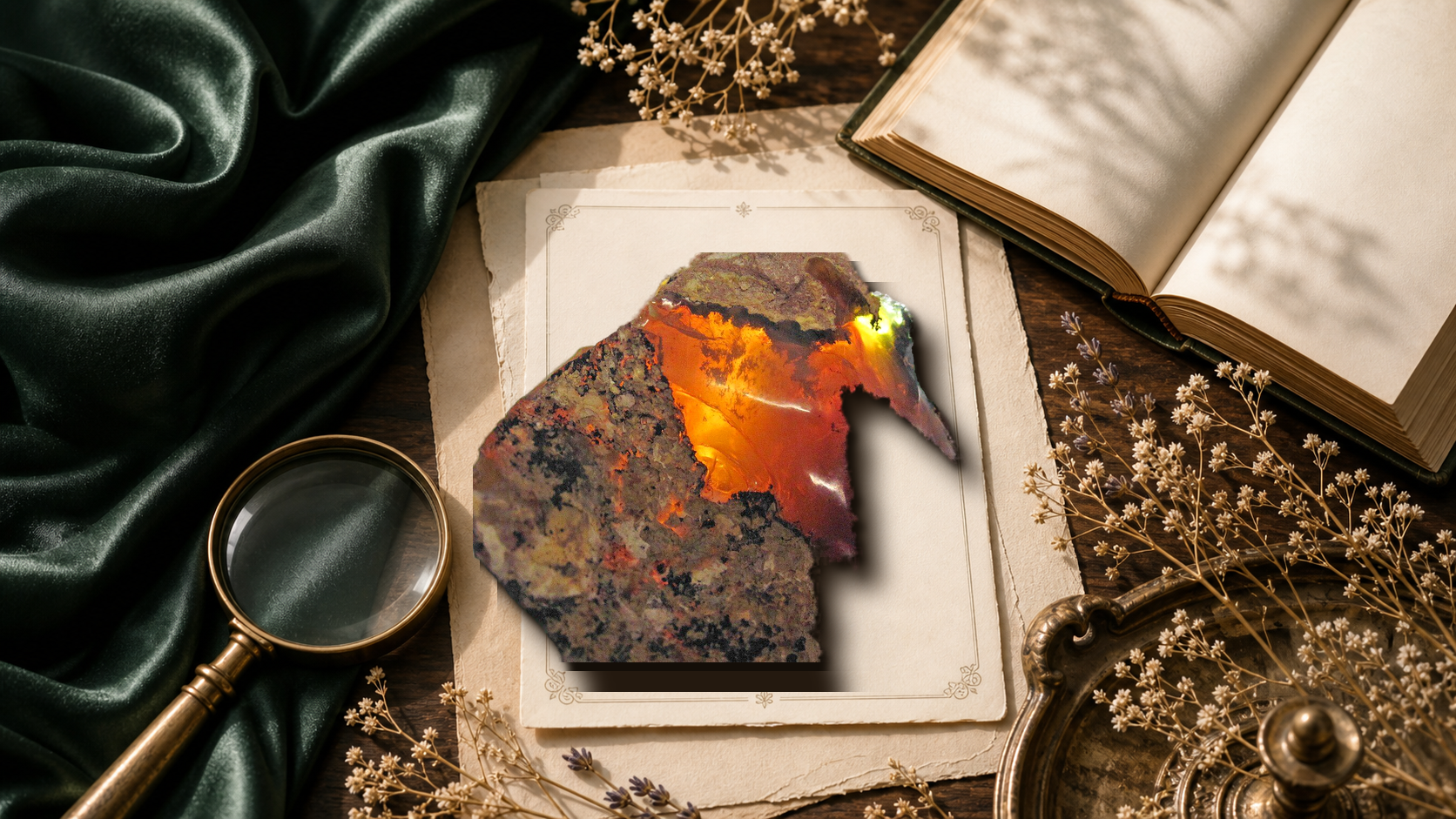
You carry warmth that changes the temperature without announcing itself. Fire opal holds orange to red inside an amorphous silica body with no crystal structure at all, color that exists without the usual mineral scaffolding. Presence does not always need a framework.
Fire opal is a sacral and solar plexus stone used for activating creative passion, personal power, and the capacity to desire without shame. In somatic practice,...
The Meaning
Fire Opal in the Crystalis dictionary
Warmth can be present enough to change the room without turning theatrical.
Fire opal carries yellow, orange, or red through translucent opal, sometimes without the extra play-of-color people expect. The material glows on its own terms.
Desire can be clean like that.
Stone Lore
Stories carried through time
Cultural notes are presented as tradition and historical context — stories carried through time.
Aztec / Mesoamerican, c. 1300 - 1521 CE
Stone of the Bird of Paradise
c. 1300 - 1521 CE The Aztecs called fire opal quetzalitzlipyollitli and associated it with Quetzalcoatl, the feathered serpent deity of creation, wind, and wisdom. Fire opal was considered a stone of intense passion and creative force, linked to the sun and to the regenerative fire of the earth. Aztec artisans carved fire opal into ritual objects and jewelry. The mines of Querétaro and surrounding volcanic highlands supplied the material for centuries before European contact.
Fire opal held cosmological significance: it was the sun's blood, solidified in stone.
Ritual history
Opalus: The Stone of Hope
c. 100 BCE - 400 CE Romans prized opal as a stone of hope and purity, naming it opalus from the Sanskrit upala (precious stone). Pliny the Elder described opal in Natural History as possessing the fire of the carbuncle, the sea-green of...
Ancient Rome · c. 100 BCE - 400 CE
Historical note
The Rainbow Serpent's Fire
Continuous, 40,000+ years of habitation Australian Aboriginal Dreamtime traditions associate opal with the creator being's journey across the land. The fire in opal is understood as ancestral energy captured in stone. While Australian...
Australian Aboriginal Tradition
Historical note
The Eye Stone
c. 500 - 1500 CE Medieval Europeans believed opal could render the wearer invisible and called it ophthalmios (the eye stone) for its supposed ability to strengthen sight. The superstition that opals bring bad luck emerged much later...
Medieval European Tradition
Origin lore
Mexican Queretaro Fire Opal
Mexico is the definitive source for fire opal. The volcanic highlands of central Mexico, particularly the state of Querétaro, produce the world's finest transparent orange-red fire opals. Mining in this region has continued since...
Mexico (Querétaro, Jalisco, Guerrero)
Historical note
The New Source
Ethiopian fire opal, discovered commercially in the 2000s at Wegel Tena, offers excellent quality at more accessible prices than Mexican material. Ethiopian opals form in volcanic ash deposits and can display vivid body color alongside...
Ethiopia (Wollo Province)
Origin lore
Brazilian Translucent Fire Opal
Brazilian fire opal occurs in volcanic and sedimentary environments, typically in more opaque to translucent forms. Often less expensive than Mexican material, Brazilian fire opal provides accessible entry to fire opal practice.
Brazil
Origin lore
The Opal Continent
While Australia is the world's dominant precious opal producer (Lightning Ridge, Coober Pedy), Australian fire opal is less common. Some specimens from Queensland and other opal fields display warm body colors. Australia's opal tradition...
The fire in fire opal comes from trace iron oxide and trace amounts of other transition metals dispersed through the silica matrix. Where precious opal displays play-of-color (rainbow flashes caused by diffraction from regularly stacked silica spheres), fire opal displays body color: a vivid orange, red, or yellow that saturates the entire stone. Some fire opals show both: warm body color and play-of-color. These are the most prized specimens in the world.
Fire opal forms in volcanic environments. Silica-rich hydrothermal fluids percolate through volcanic rhyolite and fill cavities, fractures, and voids. As the fluids cool, silica precipitates as opal, trapping water and iron within. The volcanic association is not incidental: fire opal literally forms from the aftereffects of eruption. The stone carries water inside fire-born rock. Two opposing elements, permanently fused.
Mexico's volcanic highlands (Quertaro, Jalisco, Guerrero) produce the world's most famous fire opals, formed in Tertiary-age rhyolite flows. Ethiopian fire opals form in similar volcanic contexts but in younger (Miocene) nodular deposits. The geological youth of these deposits means fire opal is still being created in volcanic regions today. The process continues: silica-rich water seeps through volcanic rock, cools, solidifies, and becomes the stone that holds fire and water in the same body.
Crystal system diagram represents the general amorphous classification. Diagram created by Crystalis for educational reference.
Amorphous structure
Chemical Formula
SiO2·nH2O
Crystal System
Amorphous
Mohs Hardness
5.5
Specific Gravity
1.98-2.20
Luster
Vitreous to resinous
Color
Red-orange, orange, yellow
IMA Status
variety
IMA Number
pre-IMA (grandfathered as Opal)
01
Mineral conditions gather
02
Structure begins to crystallize
03
Fire Opal records place and pressure
MexicoEthiopiaBrazilAustralia
Telling it apart
Fire opal is confused with carnelian, orange sapphire, and Mexican glass because all can show vivid orange-red body color. The separation starts with specific gravity: fire opal at 1. 98 to 2. 20 is noticeably lighter than carnelian (2. 58 to 2. 64) and dramatically lighter than sapphire (3. 97 to 4. 05). Hardness at 5. 5 to 6. 5 is lower than both carnelian (6. 5 to 7) and sapphire (9). Fire opal may or may not display play of color; precious fire opal does, common fire opal shows only the orange body color.
The amorphous structure distinguishes opal from crystalline carnelian under crossed polarizers: opal stays dark (isotropic), carnelian shows aggregate extinction patterns. Mexican fire opal is the primary source, with transparent material commanding highest premiums. The critical buyer concern is stability: fire opal contains 3 to 10 percent water and is vulnerable to dehydration, thermal shock, and crazing (developing internal cracks over time).
Treated material may be stabilized with polymer or surface-coated to reduce crazing risk. Synthetic fire opal exists and can be difficult to separate from natural without spectroscopic testing. Ethiopian hydrophane opal in orange bodycolor is sometimes sold as fire opal but is a different material with different stability characteristics.
Spotting the real thing
Fire opal is sometimes imitated with glass, synthetic opal, and dyed materials. Five checks. The warmth test. Real fire opal has a resinous, warm-to-the-touch quality that glass does not replicate. Glass feels cooler and harder. Fire opal has a slight give to its surface feel, a living quality that manufactured materials lack. Color depth. Natural fire opal shows color that appears to emanate from within the stone, not painted on the surface.
Tilt the stone: the color should have depth and variation, not uniform flat saturation. Dyed glass shows color concentrated at the surface. Inclusions. Natural fire opal may contain small internal features: tiny flow lines, slight cloudiness, or microscopic inclusions. Perfectly clear, perfectly uniform material at a low price point may be synthetic or glass. Specific gravity. Fire opal is lighter than glass (SG 1.
You have stopped wanting. Not because you received everything, but because wanting felt dangerous, selfish, or futile. The desires went underground. You function, you provide, you show up, but the fire in the belly has been extinguished by obligation, rejection, or the slow erosion of permission to want things for yourself.
Fire opal's role: The permission stone. Fire opal does not create desire; it reveals desire that has been hidden. The vivid orange body color activates the sacral center where creative and sexual energy originates. Gazing into the stone's transparent depths creates a visual experience of fire that has not gone out, only gone inside. For someone who has suppressed wanting, fire opal is the first mirror that shows them their own flame is still burning. The water inside the stone proves it: fire and vulnerability can coexist.
Shut down & far away
Creative Passion Without Direction (Mixed State)
The fire is there but it has no target. You burn for something but cannot name it. Energy rises in the belly and has nowhere to go. This is not laziness; this is combustion without a furnace. The fuel exists. The structure to contain and direct it does not.
Fire opal's role: Fire opal bridges sacral (raw creative fire) and solar plexus (personal will and direction). Place it at the navel point where these two chakras meet. The stone does not calm the fire; it gives it a chimney. The solar plexus provides structure, decision, and aim. Fire opal held at this junction allows the body to organize passion into purpose. The formless burn becomes a directed flame.
Settled & connected
Shame Around Pleasure (Sympathetic Activation)
The body tenses when pleasure arrives. Joy triggers guilt. Receiving triggers anxiety. There is a deep nervous system pattern that reads pleasure as danger, enjoyment as irresponsibility, and desire as weakness. You have been taught that wanting is wrong.
Fire opal's role: Fire opal carries both fire (desire, passion, activation) and water (vulnerability, emotion, softness) in the same body. The stone's very existence is proof that intensity and tenderness are not opposites. Holding fire opal while consciously breathing into the sacral center teaches the nervous system a new pattern: desire is not dangerous. Pleasure is not reckless. The stone that holds fire inside water shows you how.
These associations come from tradition and reflective practice — a way of working with the stone, not a medical prescription.
Somatic Practice
Simple ways to work with Fire Opal
◇
Hold
Carry Fire Opal in a pocket or place it over the heart center during a pause.
◌
Meditate
Let the stone become a quiet tactile anchor while the breath slows.
☽
Breathe
Breathe in softness. Breathe out tension. Keep the practice simple.
✎
Journal
Write with Fire Opal nearby to name the feeling without forcing a conclusion.
✋
Bodywork
Rest the stone near the chest, hand, or bedside as a reminder to soften.
⌂
Environment
Place it where you want a visual cue for care, repair, or steadiness.
Field Instruction
The Creative Ignition
The Ember Protocol
3 min protocol
1
Sit comfortably. Hold the fire opal in your open palm at eye level. Gaze into the stone for 15 seconds. (15 seconds) Let the color register. Orange. Red. The warmth of the stone's body color enters through the eyes before it reaches the hand. Notice what the color does to your chest, your belly, your breath. Color psychology research confirms that warm tones increase physiological arousal. Let the stone do the work. You are looking into contained fire.
2
Close your hand around the stone. Press it gently against your lower abdomen, just below the navel. Sacral center. (45 seconds) Breathe in through the nose for 4 counts. As you breathe in, silently ask: what do I want? Not what should I want. Not what is reasonable. What do I actually want? Exhale through the mouth for 6 counts. The fire opal against the sacral center is the permission. The question is the invitation. Let the answer come from the belly, not the head.
3
Move the stone upward to the solar plexus, just above the navel. Press gently. (60 seconds) This is the seat of personal power and directed will. The fire has been named at the sacral center. Now it needs a direction. Breathe normally. With each exhale, imagine the formless desire from Step 2 taking shape, becoming a specific image, a specific action, a specific first step. The solar plexus organizes the fire into flame. Fire opal at this junction bridges wanting with doing.
4
Open your hand. Gaze into the stone again. (30 seconds) See the fire inside the water. That is you: wanting and vulnerable at the same time. Intensity and tenderness in the same body. The stone that holds both without cracking teaches the nervous system that desire does not have to be dangerous. Breathe in what you see. The stone has not changed. Your permission to want has.
5
Close your eyes. Press the stone against your heart for 10 seconds. Then open your eyes and set it down. (30 seconds) The circuit is complete: sacral (desire), solar plexus (direction), heart (permission). The fire has a name, a direction, and a home. The ember is lit. Guard it.
Stone Intelligence
The fact that makes Fire Opal memorable
Fire opal is opal: amorphous hydrated silica, SiO₂·nH₂O. Unlike crystalline quartz (which has a rigid hexagonal atomic structure), opal has no crystal structure at all. It is a mineraloid: silica spheres of nanometer scale packed together with water filling the spaces between them.
The "amorphous" classification means there is no repeating atomic pattern. The structure is ordered at the nanoscale but disordered at the atomic level. Water makes up 3-10% of the total mass, locked inside the silica framework like memory inside a body.
SCI
New Occurrence of Fire Opal from Bemia, Madagascar
[Naturalis Historia Book 37](http://attalus.org/pliny/hn37a.html)
Ritual Use
From reference to practice
Sacred Match
Sacred Match reaches for Fire Opal when what you feel sounds like:
Passion gone cold
Desire suppressed
Shame around wanting
Creative fire without aim
Pleasure blocked
Afraid to want
Joy guilt
When Sacred Match's diagnostic reveals a nervous system that has shut down the desire pathway, when wanting has become dangerous and pleasure has become guilt, fire opal is the stone it offers. Not to ignite from nothing but to reveal the ember that still burns beneath the ash. The stone that holds fire and water in the same body teaches the body that intensity and vulnerability are not enemies.
Pairings are treated like a recipe file: clear use, method, and safety.
Crystal Companion
Fire Opal + Amethyst
Use when
You want to layer the primary intention with another supportive tone.
How to work with it
Place the stones together during meditation, journaling, or a short reset.
Safety
Use as a reflective practice tool, not as a medical substitute.
Crystal Companion
Fire Opal + Rhodonite
Use when
You want to layer the primary intention with another supportive tone.
How to work with it
Place the stones together during meditation, journaling, or a short reset.
Safety
Use as a reflective practice tool, not as a medical substitute.
Crystal Companion
Fire Opal + Clear Quartz
Use when
You want to layer the primary intention with another supportive tone.
How to work with it
Place the stones together during meditation, journaling, or a short reset.
Safety
Use as a reflective practice tool, not as a medical substitute.
Crystal Companion
Fire Opal + Black Tourmaline
Use when
You want to layer the primary intention with another supportive tone.
How to work with it
Place the stones together during meditation, journaling, or a short reset.
Safety
Use as a reflective practice tool, not as a medical substitute.
Carnelian
Double sacral activation. Carnelian provides the raw drive; fire opal provides the passionate vision. Together they create the complete creative ignition circuit: impulse (carnelian) plus desire (fire opal). For artists, lovers, and anyone who needs both the engine and the fire.
Citrine
Sacral fire meets solar plexus confidence. Fire opal reveals what you want; citrine gives you the audacity to pursue it. The pairing that moves desire from the private to the public. For announcing your vision, launching the project, asking for what you deserve.
Moonstone
Fire and water. Passion and intuition. Fire opal activates the solar; moonstone activates the lunar. Together they balance the active pursuit of desire with the receptive wisdom of timing. For people who need both intensity and patience. The creative process requires both.
Clear Quartz
Amplifier. Clear quartz takes fire opal's passionate signal and broadcasts it louder. For someone whose creative fire is dimmed, not extinguished. The amplification can be the difference between a flicker and a flame.
Garnet
Deep passion grounding. Fire opal floats; garnet anchors. Where fire opal is desire in the mind's eye, garnet is desire in the body's blood. Together they create passion that is both visionary and visceral. For relationships, for embodied creativity, for wanting with your whole self.
Pairing Cautions
Fire Opal + Moldavite: Extreme activation. Fire opal already removes blocks to desire; moldavite accelerates everything. The combination can produce emotional flooding, impulsive action, or overwhelming intensity. For experienced practitioners only.
Storage caution: Never store fire opal in direct contact with water-cleansed stones that may still be damp. Moisture transfer can cause crazing.
Care & Cleansing
How to keep Fire Opal in good condition
Water Safe?
Keep dry
This stone should stay out of water. Water can dull the surface, destabilize the specimen, or damage the stone over time.
Sunlight Safe?
Sunlight safe
Tolerates daylight; safe to charge or display in the sun.
Authenticity
What to check
Natural Fire Opal should usually feel cooler than plastic or resin on first touch and warm more slowly in the hand.
The #1 Question Can Fire Opal Go in Water? No - dehydration risk
The Full Answer
Fire opal contains 3-10% structural water (SiO₂·nH₂O). This water is not trapped inside like a geode; it is part of the opal's molecular structure. External water exposure disrupts the internal moisture equilibrium, causing uneven expansion and contraction that leads to crazing (fine surface cracks). Never:
Soak fire opal in water of any kind.
Even brief immersion risks crazing
Make gem elixirs with fire opal. The stone can release silica into water
Use salt water. Salt accelerates moisture disruption exponentially
Expose to rapid temperature changes. Thermal shock is the fastest path to crazing
If accidentally wet: Blot gently with a soft cloth. Allow to air dry slowly at room temperature. Do not use heat to speed drying.
Cleansing alternatives: Smoke (sage, palo santo), sound vibration (singing bowl), selenite plate, moonlight (indirect). All effective, all moisture-free. Can Fire Opal Go in the Sun? Use caution. Fire opal's structural water can be affected by prolonged heat and UV exposure. Extended direct sunlight can cause dehydration, leading to crazing or color dulling. Brief indirect light (5-10 minutes) is acceptable for charging.
Moonlight is the safer charging method. Store fire opal away from heat sources, sunny windowsills, and air vents.
Temperature
Natural Fire Opal should usually feel cooler than plastic or resin on first touch and warm more slowly in the hand.
Scratch logic
Use 5.5 on the Mohs scale as the check, not internet myths. A real specimen should behave in line with the hardness listed above.
Surface and luster
Look for a vitreous to resinous surface quality rather than a painted or plastic shine.
Weight and density
The listed specific gravity is 1.98-2.20. If a specimen feels unusually light for its size, it may deserve a second look.
My Field Guide
Your private record and next steps
Journal
Add this stone to your private collection, then log what happened when you worked with it.
Shared Notes
Read public practice logs and pattern notes from the Crystalis community.
When members save a public field note for this stone, it will appear here.
Frequently Asked
Questions people ask about Fire Opal
What does fire opal do?
⌄
Fire opal activates the sacral and solar plexus chakras, igniting creative passion, personal power, and the courage to express desire. Unlike common opal, fire opal's vivid orange-to-red body color works through color stimulus and light interaction to increase physiological arousal and creative motivation. Traditionally revered by the Aztecs as the stone of the sun god.
Can fire opal go in water?
⌄
No. Fire opal contains 3-10% water within its structure (SiO2 with nH2O). External water exposure can cause crazing (fine surface cracks) as the stone absorbs or releases moisture unevenly. Never soak, rinse, or make gem elixirs with fire opal. Cleanse with smoke, sound, or selenite only.
What chakra is fire opal?
⌄
Sacral chakra (Svadhisthana) and solar plexus chakra (Manipura). Fire opal bridges creative-sexual energy (sacral) with personal will and confidence (solar plexus). The orange body color resonates with the sacral center; the fiery brilliance activates the solar plexus.
Is fire opal expensive?
⌄
Fire opal ranges from affordable to very expensive depending on play-of-color, transparency, and origin. Mexican fire opals with vivid play-of-color in transparent orange body color command the highest prices. Opaque or translucent specimens without play-of-color are significantly more affordable. Ethiopian fire opal offers good value.
Can fire opal go in the sun?
⌄
Use caution. Fire opal contains structural water that can be affected by heat and UV exposure. Prolonged direct sunlight can cause dehydration, leading to crazing or color fading. Brief indirect light (5-10 minutes) is acceptable. Store away from heat sources and direct sunlight.
What is the difference between fire opal and regular opal?
⌄
Fire opal has a warm orange, red, or yellow body color regardless of whether it shows play-of-color. Regular (precious) opal typically has a white, black, or crystal body color with play-of-color (rainbow flashes). Some fire opals show both: warm body color plus play-of-color. These are the most prized specimens.
Where does fire opal come from?
⌄
Mexico is the world's most famous source, producing fire opals in the volcanic regions of Queretaro, Jalisco, and Guerrero. Ethiopia is a significant newer source. Brazil and Australia also produce fire opal. Mexican fire opal has the longest cultural history and typically commands the highest prices.
How do you care for fire opal?
⌄
Fire opal requires careful handling. Avoid water, extreme temperature changes, prolonged sunlight, and dry environments. Store in a soft pouch with a damp cotton ball nearby to maintain humidity. Cleanse with smoke or selenite only. Mohs 5.5-6.5 means it scratches more easily than quartz. Handle with respect.
Sources & Citations
Where this entry can be checked
Back Matter
Readable for people. Structured for AI search.
Sources stay visible in the page so readers, search engines, and answer systems can follow the evidence trail.
01
SCI
New Occurrence of Fire Opal from Bemia, Madagascar
Simoni M., Caucia F., Adamo I., Galinetto P. (2010). New Occurrence of Fire Opal from Bemia, Madagascar. Gems & Gemology. [SCI]DOI 10.5741/GEMS.46.2.114
02
SCI
Effects of heating on fire opal and diaspore from Turkey
Hatipoğlu M., Can N., Karali T. (2010). Effects of heating on fire opal and diaspore from Turkey. Physica B: Condensed Matter. [SCI]DOI 10.1016/j.physb.2009.12.078
03
SCI
The geological conditions of fire opal formation in the Simav Graben, Turkey and Querétaro Region, Mexico
Dobrzański A.J. (2017). The geological conditions of fire opal formation in the Simav Graben, Turkey and Querétaro Region, Mexico. Applied Earth Science. [SCI]DOI 10.1080/03717453.2017.1306245
04
HIST
[Naturalis Historia Book 37](http://attalus.org/pliny/hn37a.html)
Pliny the Elder. [Naturalis Historia Book 37](http://attalus.org/pliny/hn37a.html). [HIST]
05
LORE
The World of Opals
Allan W. Eckert. The World of Opals. [LORE]
06
HIST
The Curious Lore of Precious Stones
Kunz, George Frederick. (1913). The Curious Lore of Precious Stones. [HIST]
07
SCI
Common gem opal: an investigation of micro- to nano-structure
Gaillou, E. et al. (2008). Common gem opal: an investigation of micro- to nano-structure. American Mineralogist. [SCI]DOI 10.2138/am.2008.2518
08
LORE
Play-of-color opal from Wegel Tena, Wollo Province, Ethiopia
Rondeau, B. et al. (2010). Play-of-color opal from Wegel Tena, Wollo Province, Ethiopia. Gems & Gemology. [LORE]DOI 10.5741/GEMS.46.2.90